Water tray tea party with herbal tea bags, cups and pouring tools for sensory exploration
Sensory Play
Communication and Language
A water tray paired with a child-sized tea set and caffeine-free herbal tea bags offers a gentle sensory invitation. The setup prompts exploration of pouring, scent and colour while introducing early social language around serving and receiving. Practitioners can listen for capacity words and observe how children coordinate wrist movements without directing every step.
Children explore water play through a familiar tea party theme, using cups, saucers and teapots to pour, scoop and serve. Herbal tea bags add gentle scent and colour changes that children may notice as they handle and transfer water. The experience can support sustained attention, early pretend play and shared social routines around offering and receiving. Adults can keep the focus on exploration, noticing children’s ideas and preferences.
Step-by-Step Guidance
1. Prepare the space with a water tray on a stable, wipeable surface and place towels or an absorbent mat underneath.
2. Add a shallow level of water and check it is a comfortable temperature for hands.
3. Arrange cups, saucers and teapots beside the tray so children can see the set clearly and choose what to pick up.
4. Offer a small selection of transfer tools (scoops, ladles, whisks, spoons) in a separate container so children can select and return them.
5. Introduce herbal tea bags as an optional sensory element, keeping them visible and accessible for adult-managed use if needed.
6. Invite children to explore freely, allowing them to pour, scoop, whisk and “serve” in their own way.
7. Model a small amount of language linked to what children are doing, such as naming objects and describing what you notice about the water.
8. Support turn-taking by offering an extra cup or tool, or by suggesting a place to put a tool when finished.
9. If children show interest in scent or colour, pause to notice changes together and offer time to compare water in different containers.
10. Close the activity by providing a clear place for used tea bags and wet tools, and support children to help tidy and dry hands.
Learning Objectives
Children may develop fine motor control as they grasp, tip, scoop and steady containers (Physical Development). Children may build Communication and Language through naming objects, describing sensory changes and taking turns in simple social exchanges. Children may explore early maths ideas such as full/empty, more/less and capacity through repeated filling and pouring (Mathematics).
Adult Role
Stay emotionally attuned by watching children’s cues around sensory comfort, turn-taking and frustration with spills. Use calm, specific language to model vocabulary for objects and actions (pour, scoop, whisk, full, empty) and simple social phrases for offering and receiving. Scaffold only when needed, such as steadying a teapot for a child who is experimenting with tipping, and step back when children are repeating a successful action or deepening pretend play. Observe patterns in tool choice, persistence and social approaches, and use these observations to decide whether to add or remove items. Hold responsibility for safety by supervising closely, managing tea bags for children who mouth objects, and keeping the floor as dry as possible to reduce slipping.
Observation Cues
Reaches for particular tools and adjusts grip to control flow (e.g., switches from ladle to spoon). Uses words, sounds or gestures to request, offer, refuse or negotiate turns with cups and teapots. Notices and responds to sensory changes such as smell, colour tinting or temperature differences in the water. Repeats filling and emptying patterns and begins to compare amounts (e.g., stops at a preferred level). Shows emerging pretend play, such as serving to an adult or arranging cups and saucers in a set. Manages small frustrations (spills, drips) and returns to the task with support.
Time & Space
15–35 minutes, depending on children’s interest and how many are sharing the tray.
Indoor or outdoor area with a stable surface for a water tray and enough room for 2–4 children to stand or sit around it; access to towels and a nearby drying area.
Materials
Safety
Age adaptations
Budding Adventurers
Add a teapot with a wider opening and a small funnel to extend filling attempts, plus a choice of spoon, ladle and whisk for different effects. Offer a small selection of herbal tea bags and allow children to choose which to use, supporting them to place used bags into a designated bowl. Encourage simple comparisons such as which cup feels heavier or looks fuller, without turning it into a test. Support emerging role play by following the child’s lead on serving and setting out cups.
Curious Investigators
Provide a fuller tea set (multiple cups and saucers) and a wider range of tools so children can plan their own “serving” system. Offer two types of herbal tea bags and invite children to notice differences in smell and the way the water changes, using descriptive language like strong/faint or darker/lighter. Support cooperative play by helping children agree on roles (server, washer, pourer) when conflicts arise. Add a simple tidy station with a towel and a bowl for used tea bags so children can manage the end of play with less adult direction.
Confident Discoverers
Offer additional containers of different sizes to invite more complex capacity exploration alongside the tea party theme. Provide a small set of tools that create different flow rates (spoon, ladle, small jug) and allow children to decide what works best for their “serving” idea. Encourage children to describe their plan and reflect on what changed when they swapped tools or tea bags, keeping the tone conversational. Support group agreements about keeping water in the tray and using the floor towel area for drips, stepping in only when safety or fairness needs adult help.
EYFS Links
Communication and Language: Children may use words, gestures and eye contact to request tools, offer “tea” and share attention with an adult, building back-and-forth interaction. Physical Development: Pouring, scooping and whisking can support hand strength, wrist rotation and coordination as children control speed and direction. Mathematics: Repeated filling and emptying can support early understanding of capacity and comparison language such as full/empty and more/less in a meaningful context. Personal, Social and Emotional Development: Shared access to appealing tools can support turn-taking, managing frustration and joining others’ play when adults help children negotiate fairly.
Ethos adaptations
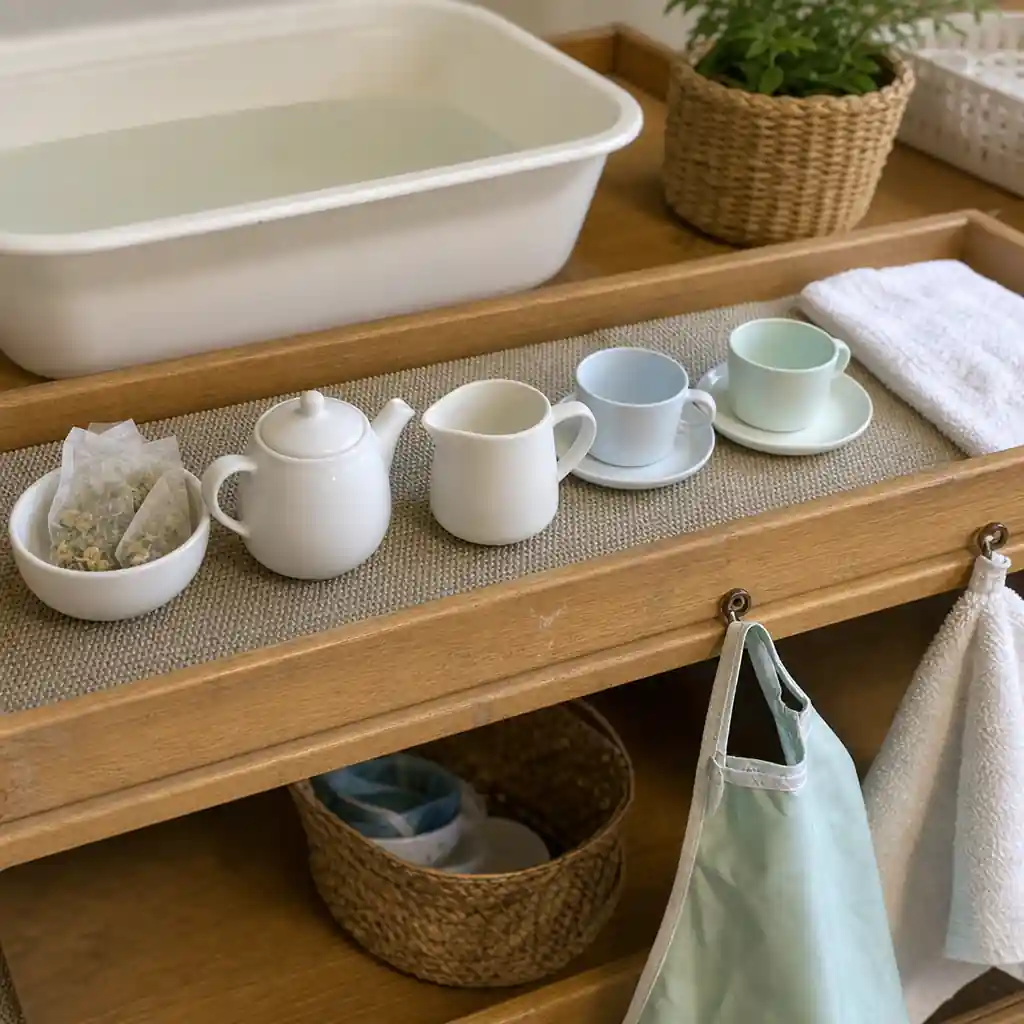
Set one shallow water tray at child height with a tray mat. Offer one small teapot prefilled with hand-warm water, two cups with saucers, one small jug, one spoon, and a small bowl holding a few herbal tea bags; place a bowl for used bags to the side. Arrange left-to-right: tea bags → teapot → jug → cups/saucers → towel. Remove extra tools (whisks, ladles, funnel) to keep the focus on steady pouring and serving. Spills show overfilling; saucers catch overflow for easy self-correction. Keep aprons and a towel within reach.
Give a brief, slow demonstration without commentary: choose one bag, place it into the teapot, watch the colour change, pour from teapot to jug, then from jug to cup, stopping just below the rim, place the bag in the used bowl, and wipe any spill. Then step back and limit language to short safety or turn-taking cues. Observe grip, wrist rotation, two-handed steadying, stopping before overflow, and whether the child repeats a sequence, notices colour/scent, offers and receives “tea,” or uses comparative words.
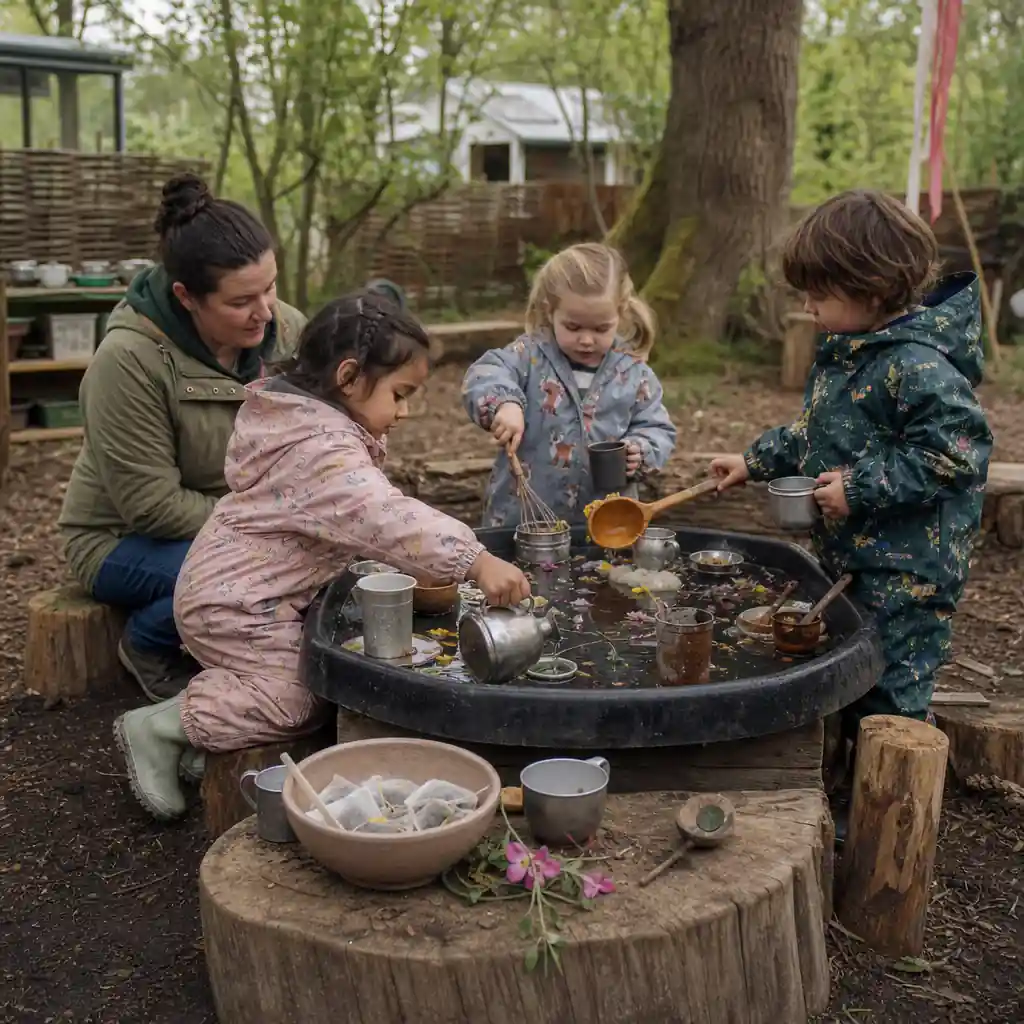
In an outdoor or nature-integrated space such as a sheltered patio, garden corner or grassy clearing, the water tray is placed at low level on a stable surface surrounded by logs or flat stones for seating and extra sensory materials like leaves, petals and pebbles. Materials such as metal teapots, sturdy cups and wooden ladles are mixed with natural scoops (hollowed bark, shells) and herbal tea bags in a bowl; water is hand-warm and bowls for used bags and towels are nearby. Materials are arranged openly so children can choose and reconfigure them.
The adult observes from close enough to manage spills and check safety but does not lead; the adult responds with short prompts, questions or single words and models calm handling only when needed. Children choose roles, share pouring and scooping, test capacity with different vessels, sniff brewed herbs, stir and notice colour changes and pass items between friends. Children may repeat gestures, experiment with angles and flow, and negotiate turns while the adult steps in for risk management or to offer a brief practical prompt.

Arrange the tray area as an accessible self-service station: several low, spaced work spots around a large shallow tub so children move and choose where to work. Offer a varied set of loose parts — different-sized teapots, cups, jugs, ladles, funnels, spoons, natural spoons or shells and several herbal tea bags — laid out openly rather than handed out. Keep towels, a bin for used bags and a drying cloth nearby; water temperature and spill mats are set for safety while children decide how to combine items and scents.
The adult steps back as observer and co-researcher, using commentary not instruction: “I can see the water turning colour,” “You’re trying to steady the teapot,” “What happens if you pour from the jug into the funnel?” The child may initiate pouring sequences, pretend-serving routines, or repeated measuring experiments. The adult notices fine-motor adjustments, turn-taking language, and emerging capacity comparisons as embedded cues for assessment and conversation.

A calm corner is prepared with a shallow stainless-steel basin on a low, stable table, set on a neutral linen cloth to define the space. Only a small number of items are provided: an enamel or stainless-steel teapot, two or three metal or wooden cups with saucers, one small metal jug, and a wooden spoon. Caffeine-free herbal tea is offered in cotton muslin sachets. The water is comfortably hand-warm. A bowl for used sachets, a towel for hands, and a folded cloth for spills sit just at the edge.
The adult demonstrates one slow pour and a quiet offer-and-receive exchange, then steps back, observing closely and keeping language minimal, returning only to support safety or steadiness. The child returns to filling and emptying, noticing scent and gentle colour shifts, offering “tea,” and negotiating turns at their own pace, repeating sequences as wanted. The flow remains predictable: begin, explore, then tidy—tools back on the cloth, sachets into the bowl, and simple wiping of spills together.