Create a group nature rainbow collage using sorted natural materials and colour bowls
Sensory Play
Children work with adults to explore bright natural colours by sorting items into coloured bowls and contributing to a shared rainbow collage. The experience can include scent and texture through herbs, alongside careful noticing of shades and patterns. Adults pay attention to how children choose, match, and negotiate space with others, using simple colour language and calm support.
Children explore colour in nature by selecting and arranging natural items to form a shared rainbow collage. The experience supports noticing shades, matching and sorting, and making choices about placement and shape. Working together can bring in turn-taking, negotiating space, and shared decision-making. Herbs can add scent and texture, especially for green, to widen the sensory experience.
Step-by-Step Guidance
1. Prepare the space with a large base surface placed where several children can reach without crowding.
2. Set out coloured bowls/trays around the base, leaving clear access routes for children carrying items.
3. Place natural materials into the bowls by colour family, keeping a small mixed “unsure” bowl for items that are hard to match.
4. Introduce the invitation: children can choose a colour area to contribute to and help create a shared rainbow shape on the base.
5. Model a simple colour match by selecting one item and placing it onto the base, keeping the demonstration brief.
6. Offer herbs as an option for green, allowing children to explore scent and texture before deciding where to place them.
7. Support children to add materials to their chosen colour band, noticing spacing and overlap without correcting the design.
8. If children compete for the same area, offer choices: share a band, split it into two sections, or swap roles (collector, sorter, placer).
9. Encourage children to compare shades when bowls run low, using the “unsure” bowl to prompt discussion and flexible thinking.
10. Pause to look together at the overall rainbow, inviting children to decide if they want to add more, change placement, or leave it as it is.
11. Document the finished collage and, if appropriate, leave it accessible for continued additions during the session.
Learning Objectives
Children may develop colour recognition and sorting through hands-on selection and grouping of natural materials (Mathematics). Children may explore texture, scent, and visual pattern as they combine items into a shared collage (Expressive Arts and Design). Children may practise sharing space, taking turns, and contributing ideas within a group task (Personal, Social and Emotional Development).
Adult Role
Stay emotionally attuned by noticing frustration around turn-taking or scarce colours and naming feelings calmly. Model simple, specific language such as colour names, shade words (light/dark), and action words (sort, match, place, curve) without over-directing. Scaffold when children are stuck by offering two clear choices or a small prompt, and step back when children are collaborating or deeply focused. Observe how children approach sorting, how they negotiate shared space, and which sensory materials they return to. Hold responsibility for safety by checking plants, removing hazards, and supervising any cutting or handling of twiggy materials.
Observation Cues
Looks for and selects items that match a chosen colour, including lighter and darker shades. Sorts items into bowls with increasing accuracy, or re-sorts after noticing a mismatch. Uses words or gestures to claim a colour area, offer materials, or request a turn. Adjusts placement to follow a curved rainbow shape, or chooses to create blocks, lines, or clusters. Explores herbs by rubbing, sniffing, or comparing scents, and returns to preferred textures. Persists with a colour section even when materials are scarce, by adapting choices or asking for alternatives.
Time & Space
20–45 minutes, with the option to leave it available for ongoing additions.
A clear floor area indoors or a flat outdoor space where a large base can be reached from at least two sides. Space for bowls to sit around the base without creating trip hazards.
Materials
Safety
Age adaptations
Budding Adventurers
Use full rainbow bowls and add simple colour cards beside each bowl for matching. Encourage children to choose a band to work on and to sort a small handful of mixed items into the correct bowls before placing. Offer tongs for transferring small petals if children show interest in tool use. Support collaboration by naming roles children can adopt (sorter, collector, arranger) and by helping them agree on where the curve begins and ends without fixing the design.
Curious Investigators
Invite children to notice shades and decide together what counts as each colour, including “in-between” items. Add a mixed bowl and encourage children to justify choices using simple reasoning (for example, comparing to the colour card). Offer herbs for green and invite children to compare scents and textures, choosing how to represent green (leafy, grassy, herby). Support group planning by helping children agree on spacing so each band is visible, and observe how children negotiate changes when someone wants to redesign a section.
Confident Discoverers
Offer a wider range of natural materials and invite children to create patterns within each colour band (lines, clusters, repeating textures). Encourage children to take responsibility for sorting accuracy and for managing the shared workspace, including deciding where extra materials are stored. Introduce vocabulary such as shade, gradient, and curve, and invite children to compare natural greens using herbs and leaves. Support children to reflect on teamwork by noticing how decisions were made and how they solved disagreements about placement.
EYFS Links
Mathematics: Children may sort and match by colour, compare shades, and notice patterns as they group and arrange materials. Expressive Arts and Design: Children may explore combining natural media, making choices about placement, shape, and overall composition in a shared artwork. Personal, Social and Emotional Development: The group format can support turn-taking, negotiating shared space, and managing feelings when ideas differ. Communication and Language: Adults can model and extend vocabulary for colours, textures, scents, and simple reasoning as children explain choices.
Ethos adaptations

Set out the large base on the floor with faint rainbow arcs drawn or taped, left to right. Place six colour bowls in the same order just above the base, with only a small, safe selection of natural items visible in each; keep the rest out of sight and top up later. Remove scissors unless trimming is essential, and keep herbs only within the green bowl. Invite children to carry and place one item at a time so the key task is colour sorting and careful placement.
Give one slow, quiet demonstration: choose a red item, check its shade beside the red bowl, place it in the bowl, then transfer it onto the red arc and press it flat. Step back and limit words to brief safety notes or naming when asked; avoid questions and re-arranging. Observe shade checking, self-correction when a piece looks out of place, ordering light-to-dark, careful hand control when pressing, repetition and sustained focus, awareness of others’ space, and turn-taking or simple negotiation at a band.
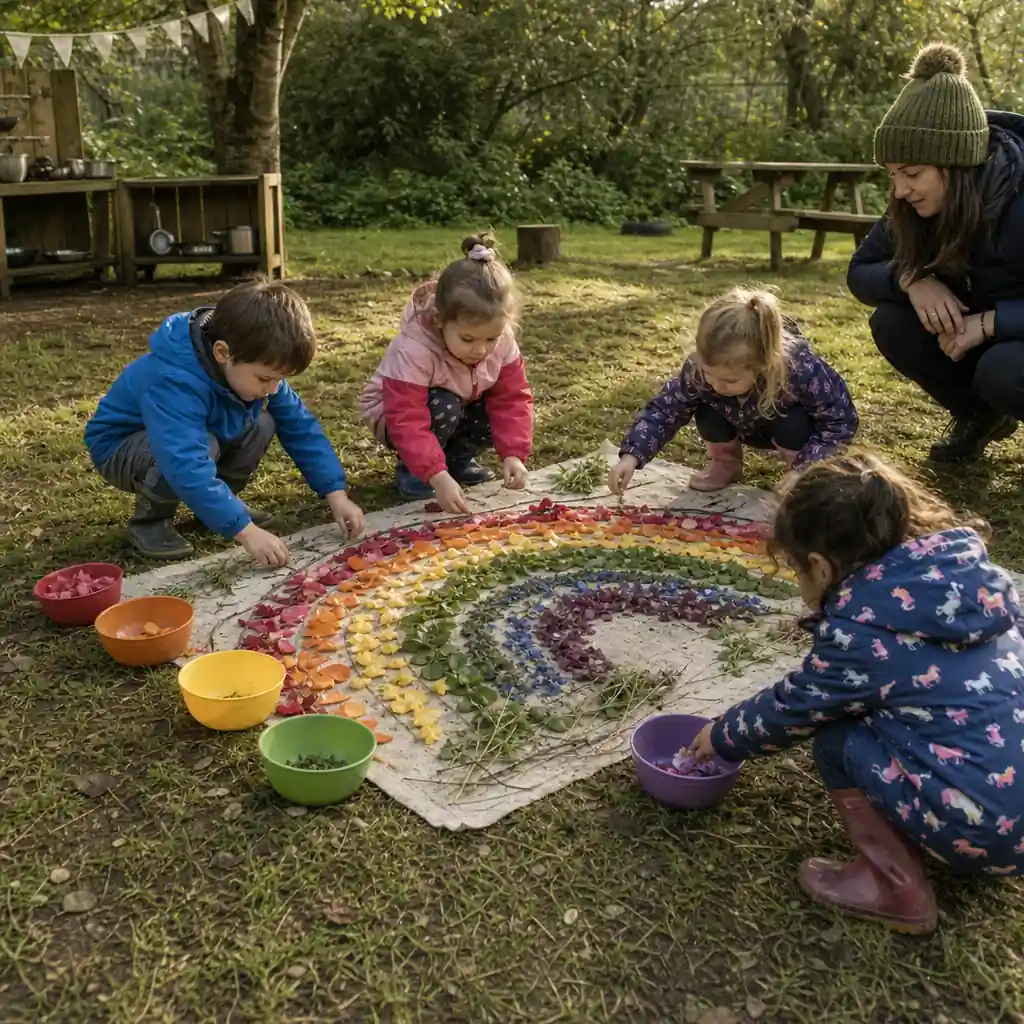
In an outdoor or nature-integrated space, set the base on a cleared patch of grass, a low picnic table or a groundsheet under a tree so children work among natural surfaces and gentle slopes. Materials such as petals, leaves, grasses, twigs, seed heads and small herb bundles are provided in open-ended piles rather than pre-sorted trays; a few coloured bowls remain for loose grouping but items are mostly mixed so children notice shades and textures as they collect and place them.
The adult observes from close by, names simple colour or sensory words when asked and offers one-word prompts or short questions rather than directing choices; the adult checks herbs and models safe handling, manages child-safe scissors only when necessary, and intervenes for safety. Children choose where to collect, take turns adding to the shared rainbow, negotiate placement and balance, and may rework areas repeatedly while the adult responds with concise observations.
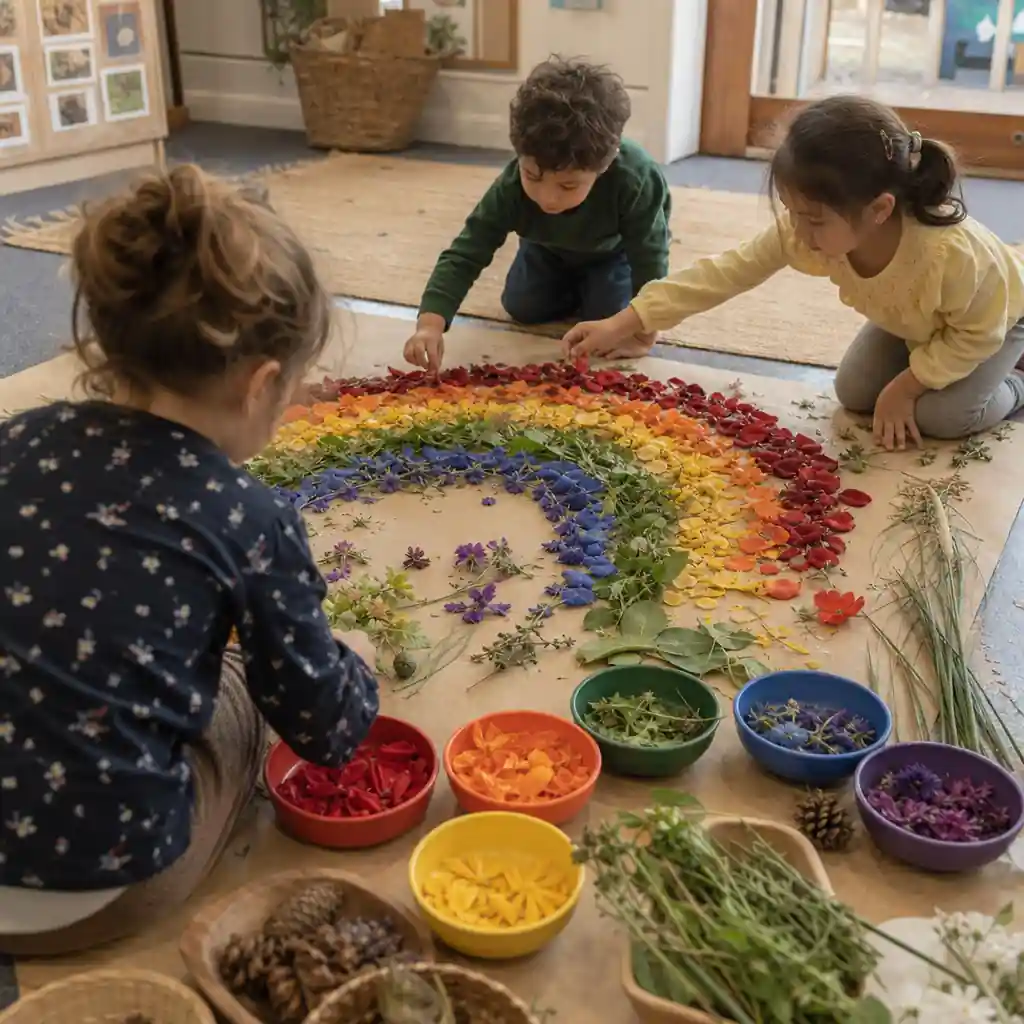
Arrange the space as a shared studio area: a low central base (card, fabric or groundsheet) with coloured bowls and loose natural materials placed in reachable clusters so children choose where to work and return freely. Swap any single-use kits for varied loose parts—petals, seed heads, twigs, grasses, herb bunches—laid out by colour but not prescribed for one stripe. Leave gaps in the collage area to invite reinterpretation, overlapping and re-sorting so multiple outcomes remain possible while preserving EYFS learning aims.
The adult steps back as observer and co-researcher, using commentary instead of direction: "I can see different greens being tested," "You’re trying to make that curve meet the blue," or "What happens if you move those leaves together?" The child may take responsibility for placement, negotiate space, trim stems safely if needed, and revisit arrangements. Observation cues are embedded—note repeated sorting strategies, scent choices for greens, turn-taking moments, collaborative problem-solving and shifts in pattern-making.
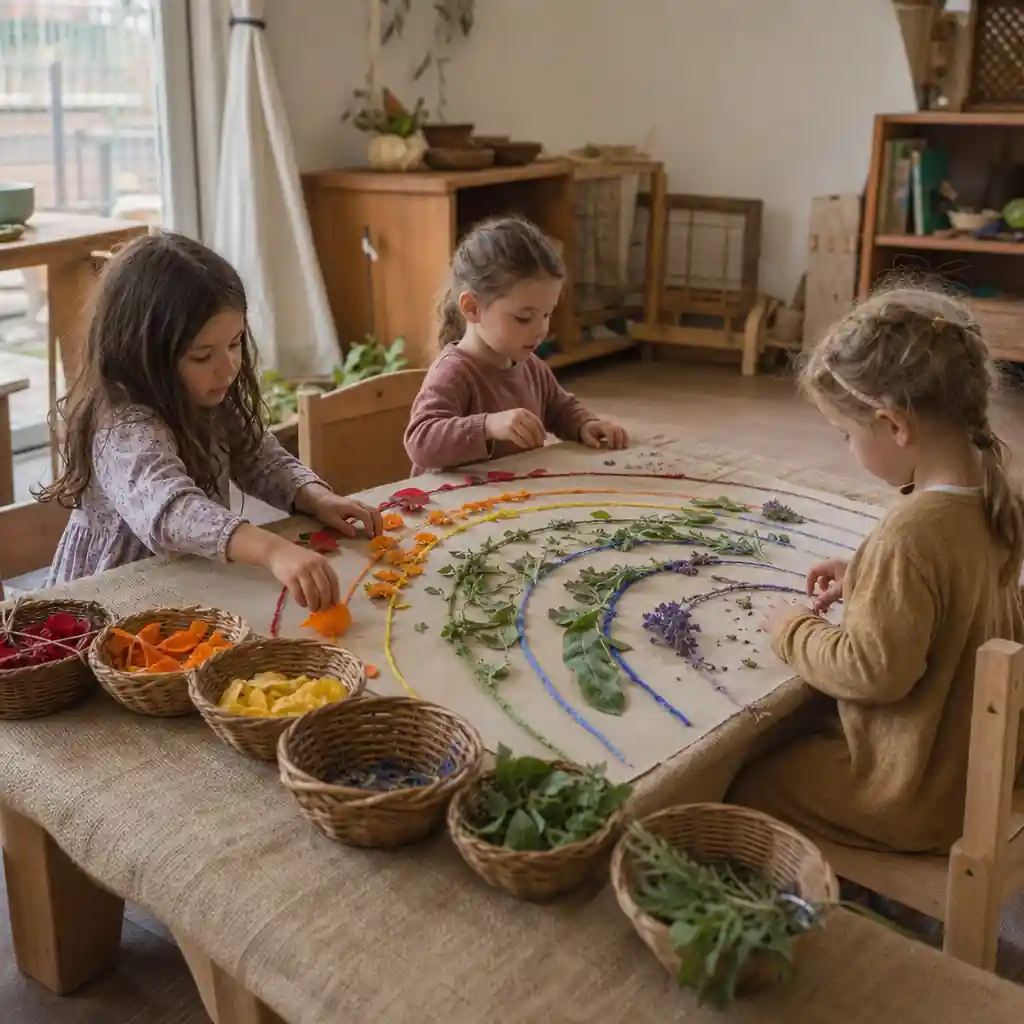
A quiet, clearly defined workspace is created with a neutral hessian or cotton cloth as the base. Only a small number of natural items are set out at once in wicker or wooden baskets: petals, leaves, grasses, twigs, seed heads, and small herb bunches. Instead of coloured plastic bowls, soft arcs are marked with plant-dyed wool threads or a few plain wooden dishes lined with undyed cloth to contain sorted hues. Child-safe scissors are kept at the edge for adult use only to trim stems when needed.
The adult demonstrates once by calmly placing a single item along an appropriate arc, naming a colour or scent only if helpful for clarity, then steps back to observe. Children lead the pace, returning to collect, compare shades, and place or rearrange pieces together, negotiating space with gestures and brief exchanges. The adult remains nearby for safety and to steady the flow, allowing repetition. The session ends with a simple, unhurried tidy, returning items to baskets.