Mixing coloured water with pipettes and an ice cube tray alongside Mouse Paint
Literacy
Colours
Sensory Play
Children explore colour mixing with small amounts of coloured water, using a compartment tray and droppers with Mouse Paint available as a shared reference. The experience can support careful hand control and close noticing as colours change in different sections. Adults may pay attention to how children choose combinations, persist with tricky squeezing, and use colour words or story links to explain what they see.
Children explore colour mixing using small amounts of coloured water and a tray with separate sections, with Mouse Paint as a shared reference point. The experience supports careful hand control and close noticing as colours change and combine. Children may choose to follow the story’s colour moments or test their own combinations. Adults can keep the pace calm and allow time for repeated experimenting.
Step-by-Step Guidance
1. Prepare the space on a wipe-clean surface, placing a spill tray or mat underneath where the tray will sit. Set out aprons and cloths within adult reach.
2. Pre-mix coloured water in clear, unbreakable jugs or bottles using a small amount of food colouring. Use only a few colours to start, keeping the liquid level low to reduce spill risk.
3. Place the empty ice cube tray in the centre. Put pipettes beside it, and position the coloured water slightly to the side so the adult can control access if needed.
4. Share Mouse Paint briefly, pausing on pages where colours are shown clearly. Keep the reading short so children can move into exploring without waiting.
5. Invite children to choose a colour to add to one section of the tray. Model how to draw up liquid and release it slowly into a single compartment, using calm, minimal demonstration.
6. Offer the book nearby so children can refer back to it. Some children may match the story colours; others may choose their own combinations.
7. As children add a second colour to a compartment, allow time for them to watch the change. Support them to keep some compartments as “single colours” for comparison if they choose.
8. If children want to change a colour again, offer a way to rinse the pipette or provide a second pipette, depending on what you have available. Keep the focus on noticing rather than producing a perfect result.
9. Use simple language to name what is happening (for example, colour names, lighter/darker, more/less). Avoid over-directing; follow children’s experiments.
10. Close the activity by helping children decide what to do with the tray (leave it to observe, tip away with adult support, or photograph the tray for later discussion). Wipe the surface together where appropriate.
Learning Objectives
Children may develop fine motor control as they squeeze and release a pipette with intention (Physical Development). Children may build early understanding of cause and effect and simple changes in materials as colours combine (Understanding the World). Children may extend colour vocabulary and talk about what they notice, linking ideas to a familiar story (Communication and Language; Literacy).
Adult Role
Stay emotionally attuned by keeping the pace unhurried and noticing when a child is frustrated by squeezing or waiting. Model language that matches what children can see, naming colours and simple changes, and reflecting children’s ideas back to them. Scaffold only as much as needed: demonstrate pipette control once, offer hand-over-hand support only with permission, and step back when a child is repeating an experiment independently. Observe closely for patterns in how children plan, persist, and compare results, and use those observations to decide whether to add complexity (more colours, fewer prompts) or simplify (fewer choices, larger droppers). Hold responsibility for safe handling of liquids, preventing mouthing, managing spills promptly, and keeping materials within safe reach.
Observation Cues
Selects a droplet size deliberately, watching until it falls before releasing more liquid. Pauses to compare two tray sections side by side, using gesture rather than words. Moves the tray closer or further to catch the light when checking a new shade. Links a colour mix back to a page in Mouse Paint without an adult prompt. Waits for a peer to finish before reaching for a jug, showing awareness of turn-taking.
Time & Space
15–35 minutes, depending on interest and how many children are sharing materials.
A wipe-clean table or low tray on the floor with enough room for the book, the compartment tray, and a controlled area for coloured water. Access to a sink nearby is helpful.
Materials
Safety
Age adaptations
Budding Adventurers
Offer three colours and a clear routine for where each colour sits on the table to reduce tipping. Provide one pipette per child and a rinse cup to support independence. Keep the book accessible and invite children to choose whether to “make story colours” or “make new colours,” supporting short phrases like colour names and “more/less” as they compare compartments.
Curious Investigators
Add a simple recording option such as small colour swatches on paper beside the tray for children to match what they see, without turning it into a worksheet. Offer two pipettes per child or a clear rinse system so children can plan combinations more deliberately. Encourage children to predict what might happen using everyday language, and support them to keep one compartment as a comparison sample if they choose.
Confident Discoverers
Introduce shade control by offering clear water as an additional option so children can explore lighter and darker versions. Provide a larger compartment tray or two trays so children can organise their own “palette,” and invite them to create a set of colours linked to the book or their own plan. Support children to explain their process and to notice patterns, such as which mixes consistently make similar results, without pushing for correct answers.
EYFS Links
Communication and Language: Children may use and hear precise vocabulary for colours, changes, and quantities as adults model simple descriptive language and respond to children’s comments. Physical Development: Using pipettes supports hand strength, grip adjustment, and hand–eye coordination through repeated squeezing and aiming. Understanding the World: Children can explore cause and effect and simple material changes by combining colours and noticing differences across compartments. Literacy: Sharing Mouse Paint supports enjoyment of books and helps children connect images and ideas from a story to their own exploration.
Ethos adaptations
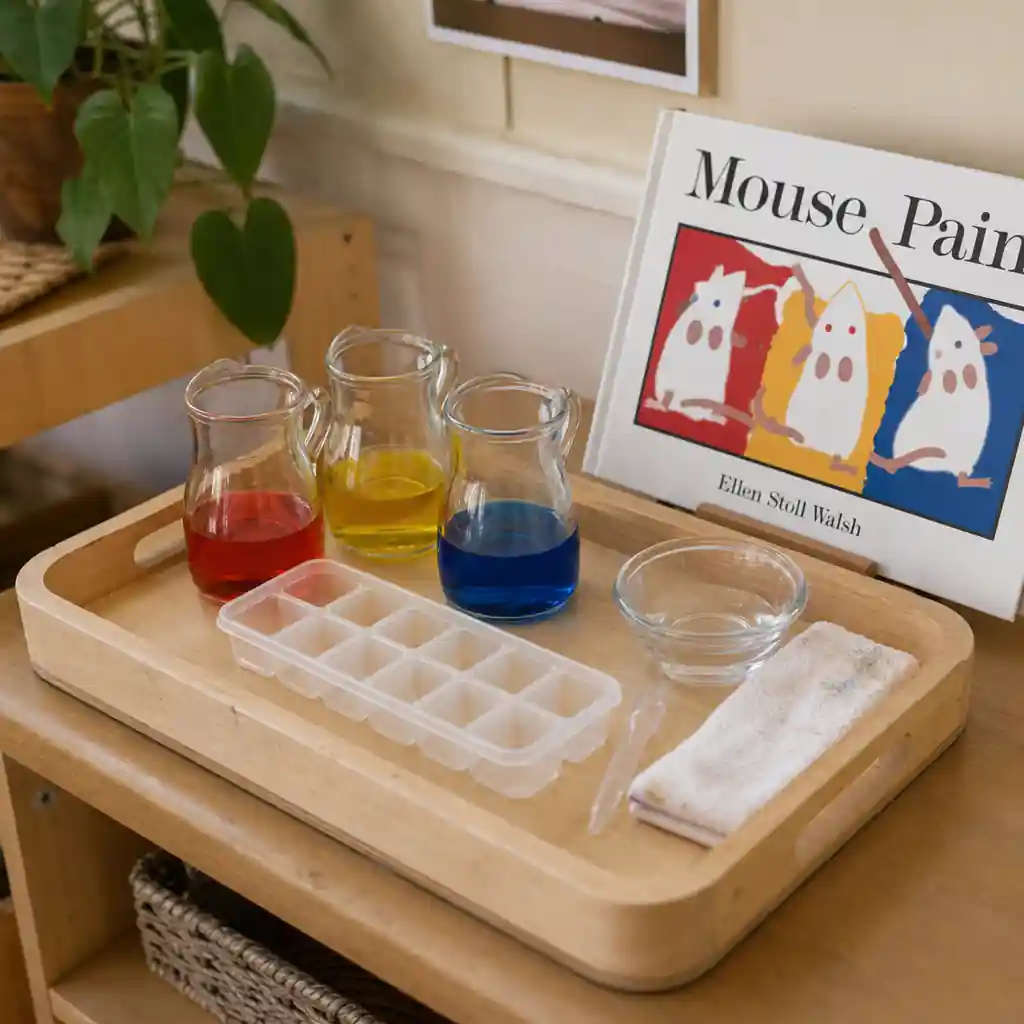
Place one ice cube tray, one pipette, and three small clear jugs of primary coloured water on a single shallow tray per child, arranged left to right: red, yellow, blue. Fill jugs only halfway and set everything on a low shelf so children can collect and return independently. Put Mouse Paint on a stand nearby for self-chosen reference, not on the work tray. Add a small rinse bowl and cloth on the same tray. The clear wells act as control of error: colour change is visible and overfilling shows immediately.
Give a slow, quiet demonstration once: take one drop of a colour into the first well, rinse and empty the pipette, take a second colour into the same well, pause to look, then return everything to its place. Step back and limit language to brief naming if the child initiates. Watch for steady squeeze-and-release, consistent hand placement, careful aiming, self-correction after spills, repetition across wells, and whether the child chooses story pairings or their own tests.
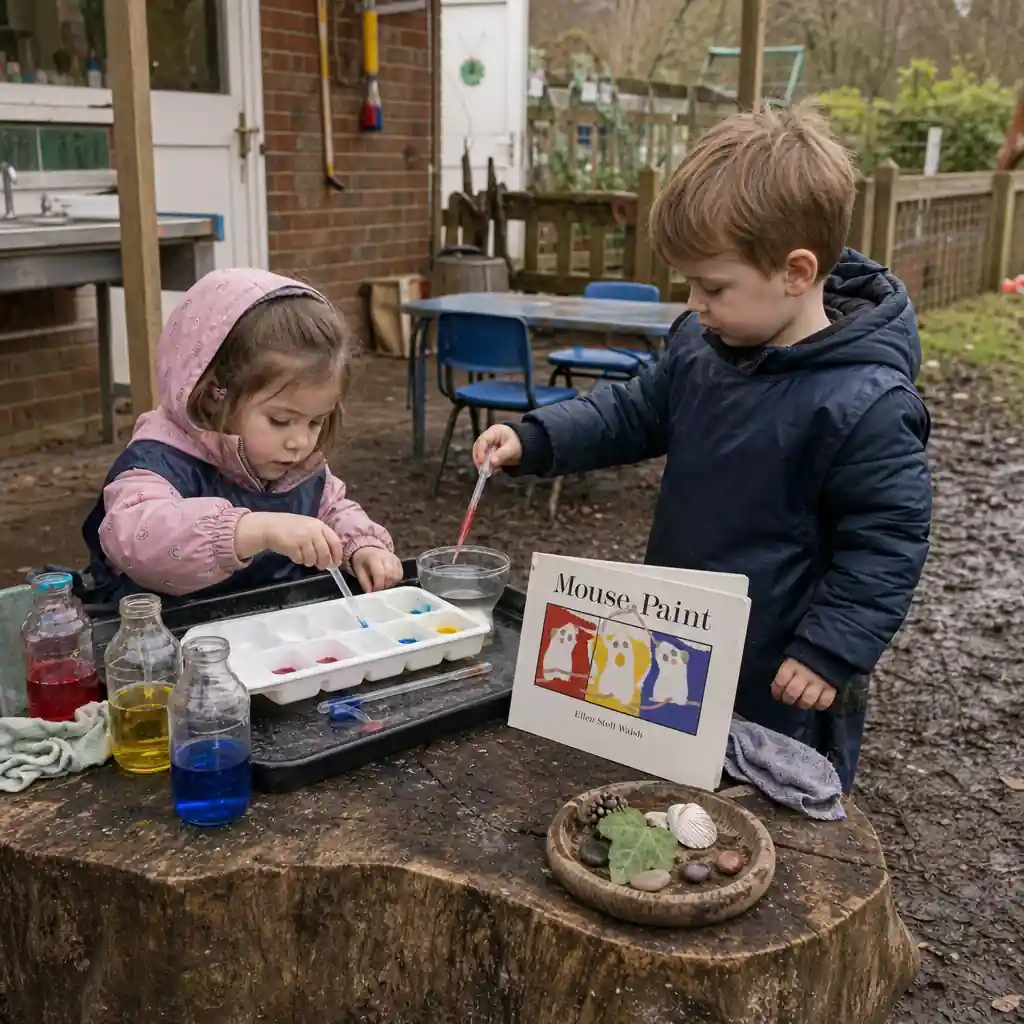
In an outdoor or nature-integrated space such as a sheltered patio, grass clearing or garden table, the activity is moved outside with uneven surfaces and natural light to notice colour changes. Materials are arranged on a low log or tray: clear, unbreakable jugs of coloured water, ice-cube compartments or shallow bark dishes, child-safe pipettes, and natural markers (leaves, pebbles, shells) to move between wells. A wipe-clean mat and aprons remain for spills and water bowls for rinsing; containers sit at child height to encourage independent access.
The adult observes from a short distance, checking safety, tightening lids and modelling one short word or question when needed, then stepping back to watch. Children choose colours, test droplet size and aim, move natural markers between wells, repeat mixtures and return to story moments from Mouse Paint as they like. Materials are left open-ended so children may pace themselves, experiment with cause and effect and talk about what they notice while the adult offers brief, responsive language.
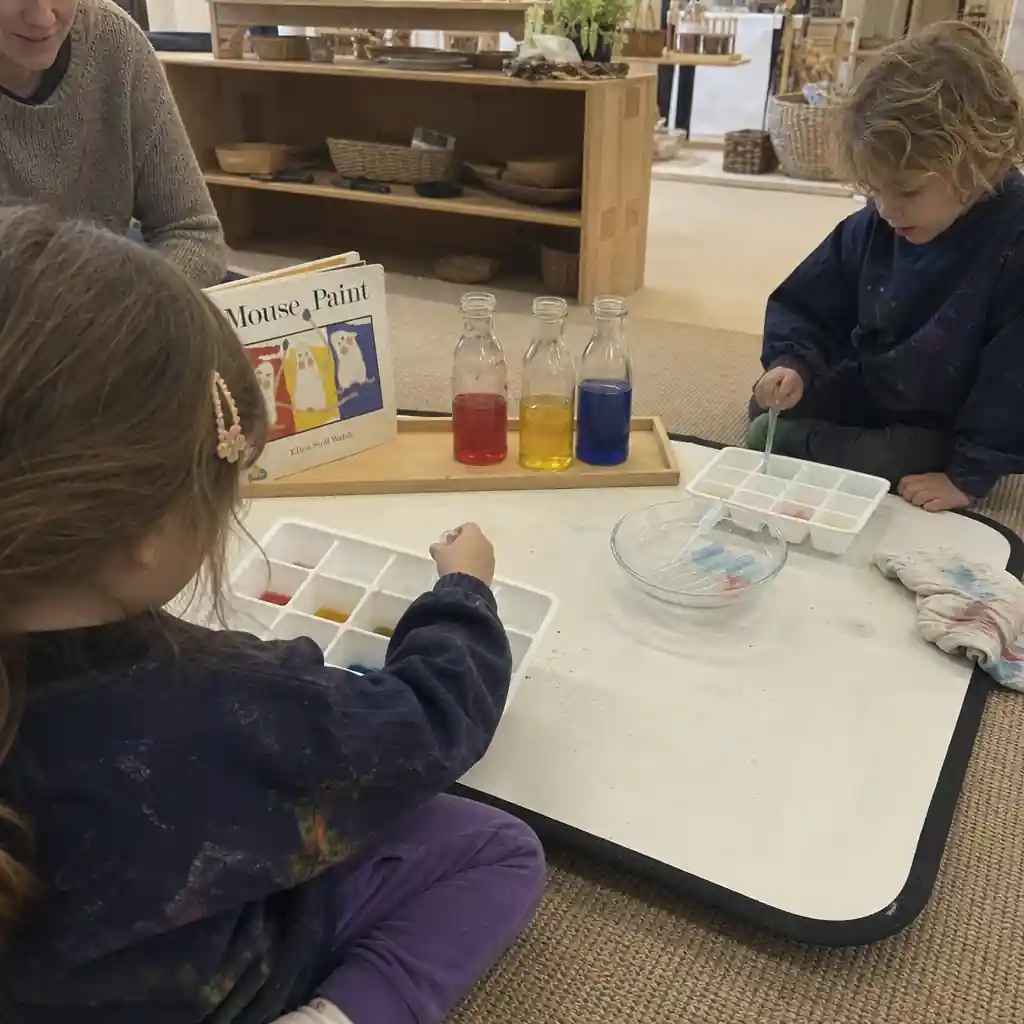
Set up low tables or floor trays so each child can reach their own ice-cube compartment tray while the coloured-water jugs sit openly within the group on a central low shelf. Place one jug per primary colour, pipettes laid loose in a shallow bowl, aprons and cloths nearby, and the Mouse Paint book where children can access it. Space trays so children can move between stations; materials stay available for mixing, pausing, abandoning and returning rather than being handed out in sequence.
The adult stays beside the play as observer and co-researcher, using commentary: "I can see red moving into this well," or "You’re testing how much the pipette holds." The child may choose to copy a story moment, layer drops, or invent new blends; the adult follows those choices and offers reflective language rather than instructions. Observation cues are embedded in the flow: the adult notices grip changes, repeated combinations, verbal labels, and moments of surprise or problem-solving for later documentation.

A small table by natural light is cleared and covered with a plain cotton cloth; a low wooden tray defines the workspace. Mouse Paint is set open on a simple book stand nearby. Only three small glass jars hold red, yellow, and blue water tinted with plant infusions (e.g., beetroot, turmeric, blueberry). A ceramic compartment tray or metal muffin tin replaces plastic sections. Thick glass droppers with natural rubber bulbs are set on a folded cotton cloth, with a small ceramic bowl of clean water for rinsing and cotton smocks available.
The adult demonstrates one slow squeeze-and-release to move a drop into a compartment, then steps back, staying close and quiet. The child chooses colours, returns to filling sections, and watches changes as drops meet, pausing or repeating at their own pace; Mouse Paint remains a calm visual prompt if they look back to it. The adult names a colour or simple change only in response to the child’s noticing, supports safe handling and steady rhythm, and models unhurried tidy-away.