Posting and pulling coloured scarves through a decorated tissue box for babies and toddlers
Sensory Play
Communication and Language
Children explore a posting-and-pulling game using a tissue box and a small set of coloured scarves, focusing on the feel of fabric and the surprise of it reappearing. Adults support with calm proximity, simple colour naming, and careful timing so children keep ownership of the repetition. Practitioners can watch for changes in grip, persistence, and how children use gaze or gesture to share attention around the box.
Children explore a simple posting-and-pulling game using a tissue box filled with soft coloured scarves. The repeated action of pushing fabric in and drawing it back out can feel satisfying and invites long periods of concentration. Adults can add gentle language by naming colours and noticing children’s choices without taking over the play.
Step-by-Step Guidance
1. Prepare the space on the floor with a clear area and a non-slip mat if needed. Sit close enough to support without crowding.
2. Check the tissue box: remove any inner plastic, reinforce the opening with tape, and ensure no sharp edges or loose tape ends.
3. Loosely cover the box in wrapping paper or plain paper if desired, keeping the opening clear and unobstructed.
4. Place several scarves into the box so that at least one corner or edge is easy to grasp from the opening.
5. Present the box and pause. Allow children to approach, touch, and explore the opening and the fabric at their own pace.
6. When a child posts a scarf, name what you notice in simple language, such as the colour and the action (for example: “red scarf in”, “pull out”). Keep your voice calm and slow.
7. If a child struggles to retrieve a scarf, offer minimal help: steady the box, hold the edge of the opening, or expose a small corner of fabric. Step back again as soon as the child can continue.
8. Follow the child’s lead on repetition. Some children will pull everything out; others will post and retrieve one item many times.
9. Reset only when needed: invite the child to help push scarves back in, or quietly re-load the box when interest remains but materials are scattered.
10. End by gathering scarves together with the child, naming one or two colours as you tidy, and storing the box out of reach until next time.
Learning Objectives
This activity supports Physical Development by offering repeated opportunities for grasping, releasing, pulling and two-handed coordination. It also supports Communication and Language as adults model simple words for colours and actions in the moment. Children may begin to show early problem-solving as they work out how to retrieve fabric that has disappeared into the box.
Adult Role
Stay emotionally attuned by watching for signs of frustration, excitement, or sensory overload, and adjust your proximity and pace. Model simple, accurate language for colours and actions, keeping phrases short and timed to what the child is doing. Scaffold lightly by stabilising the box or revealing a small fabric edge when needed, and step back as soon as the child re-engages independently. Observe grip changes, persistence, and how the child uses gaze or gesture to share attention, and use these observations to decide whether to add fewer scarves, more contrast, or a slower rhythm. Maintain safety by supervising closely, checking the box for wear, and removing any torn paper or loose tape immediately.
Observation Cues
Reaches with one hand or both hands and adjusts grip to pull fabric through the opening.
Shows persistence when a scarf catches, including changing angle, swapping hands, or seeking adult help.
Tracks the scarf visually as it disappears and reappears, including looking into the opening.
Chooses particular colours repeatedly or reacts differently to different colours.
Uses sounds, gestures, or single words to request “more”, indicate a turn, or share attention with an adult.
Experiments with posting one scarf versus several, or stuffing versus carefully pushing.
Time & Space
5–20 minutes, depending on age and interest; can be revisited across the day.
A clear floor space indoors with room for children to sit or kneel around the box; ideally on a mat to prevent slipping.
Materials
Safety
Age adaptations
Budding Adventurers
Add a small basket beside the box for “out” scarves so the child can organise the space independently. Invite the child to find a named colour among two or three options, keeping it playful and optional rather than a test. Support early sorting by placing two coloured scarves together and noticing patterns the child makes (for example, alternating colours). Reduce adult help by encouraging problem-solving through gestures, such as pointing to the opening or tapping the box to show where fabric is caught.
Curious Investigators
Offer two boxes with different openings (one wider, one narrower) and a set of scarves with varied textures (silky, cotton, mesh) to compare how they move. Encourage the child to decide their own rule, such as posting by colour group or texture, and describe their plan back to them using their words. Extend language by adding positional words linked to action (in, out, under, through) and by noticing sequences the child creates without directing them. Observe whether the child changes strategy depending on the opening size and respond by adjusting challenge rather than correcting.
Confident Discoverers
Introduce a simple recording element: a small set of colour cards that the child can place beside the box to show which colours they have used, if they choose. Provide longer scarves or fabric strips to increase planning and control, and allow the child to set up the box independently with minimal adult input. Use richer descriptive language (shade, smooth, slippery, bunched) and invite the child to explain their method. Watch for leadership and collaboration if peers join, supporting turn-taking agreements the children suggest.
EYFS Links
Physical Development: Children practise fine motor control through grasping, pulling, posting, and coordinating both hands, with repeated opportunities to adjust grip and force. Communication and Language: Adults model simple vocabulary for colours and actions in context, supporting attention to words linked to what the child is doing. Personal, Social and Emotional Development: The predictable, repeatable nature of the game can support self-regulation, with adults helping children manage frustration and take turns when others join. Understanding the World: Children explore cause and effect and early object permanence as fabric disappears into the box and returns.
Ethos adaptations
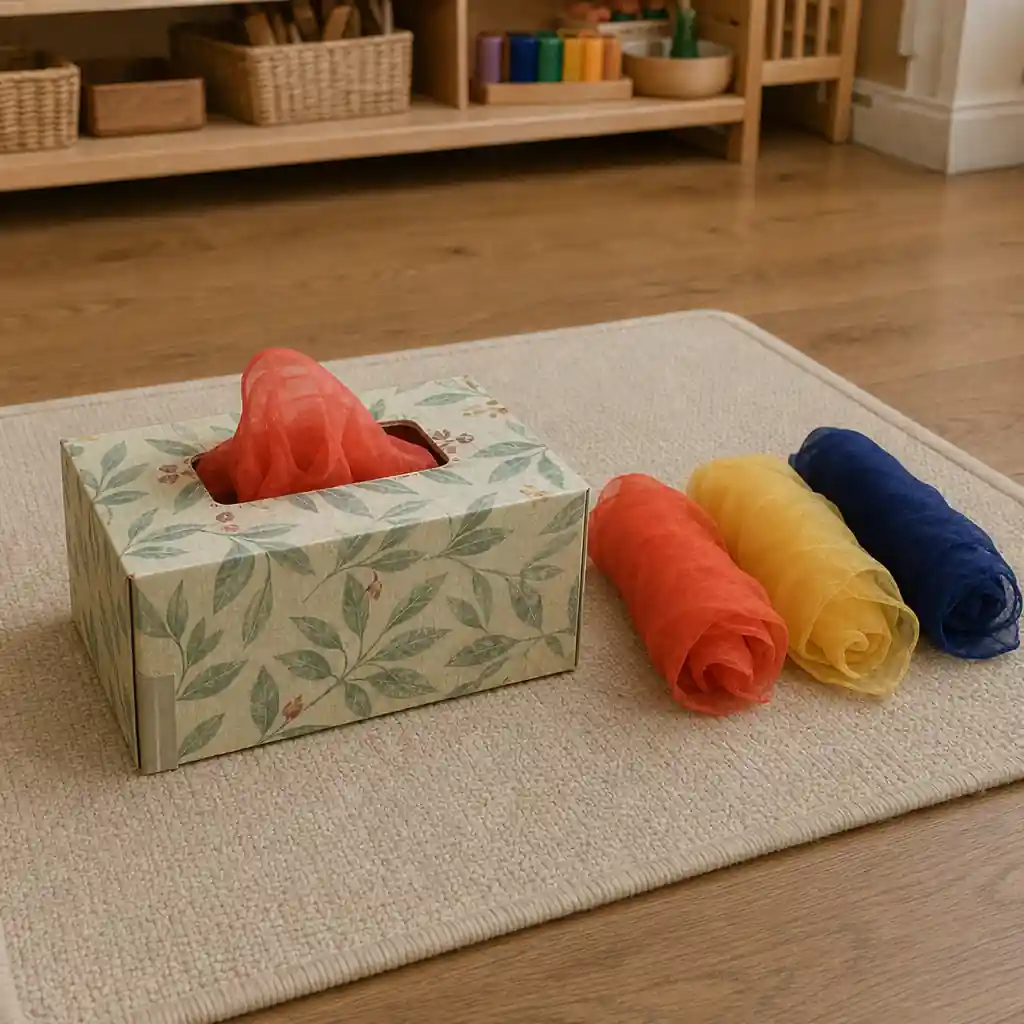
Place a single reinforced tissue box with the slot facing the child on a non-slip mat. Offer three or four large, lightweight scarves only; roll them loosely and set them to the child’s right, arranged left-to-right by colour. Keep extra scarves out of sight. Start with one scarf partly threaded through the slot to make the sequence clear (post until it disappears, then retrieve). The clear slot and visible or hidden fabric act as the control of error. Remove other toys and visual clutter nearby.
Give one slow demonstration: without speaking, post the part-threaded scarf fully, pause, then pull it out, placing the scarf back to the right. Say one short word once (e.g., “red” or “pull”), then step back. Keep language minimal and avoid questions; wait for the child’s initiative. Observe grip changes, two-hand coordination, posting to disappearance, problem-solving when only a corner is visible, and signs of sustained focus or frustration. If needed, stabilise the box silently or re-roll scarves between turns without directing.

In an outdoor or nature-integrated space, place the activity on a low log, wooden crate or non-slip mat in a sheltered garden corner so surface texture and gentle unevenness are part of play. Materials such as a reinforced cardboard or shallow wooden box with a single slot, soft fabric squares or scarves in distinct colours, and a small selection of natural items (leaves, smooth stones to weight the box) are provided in an open-ended way rather than pre-arranged. Children may bring found items to tuck beside or under the box.
The adult observes from close proximity, naming colours or single actions only when the child looks for language, and adjusts supervision rather than directing steps. Materials are arranged for choice and repetition; the adult checks edges and models calm handling but then steps back. Children choose how to post and pull, may experiment with different grasps or hiding scarves with leaves, and the adult responds with brief, responsive prompts or single-word observations while managing safety.
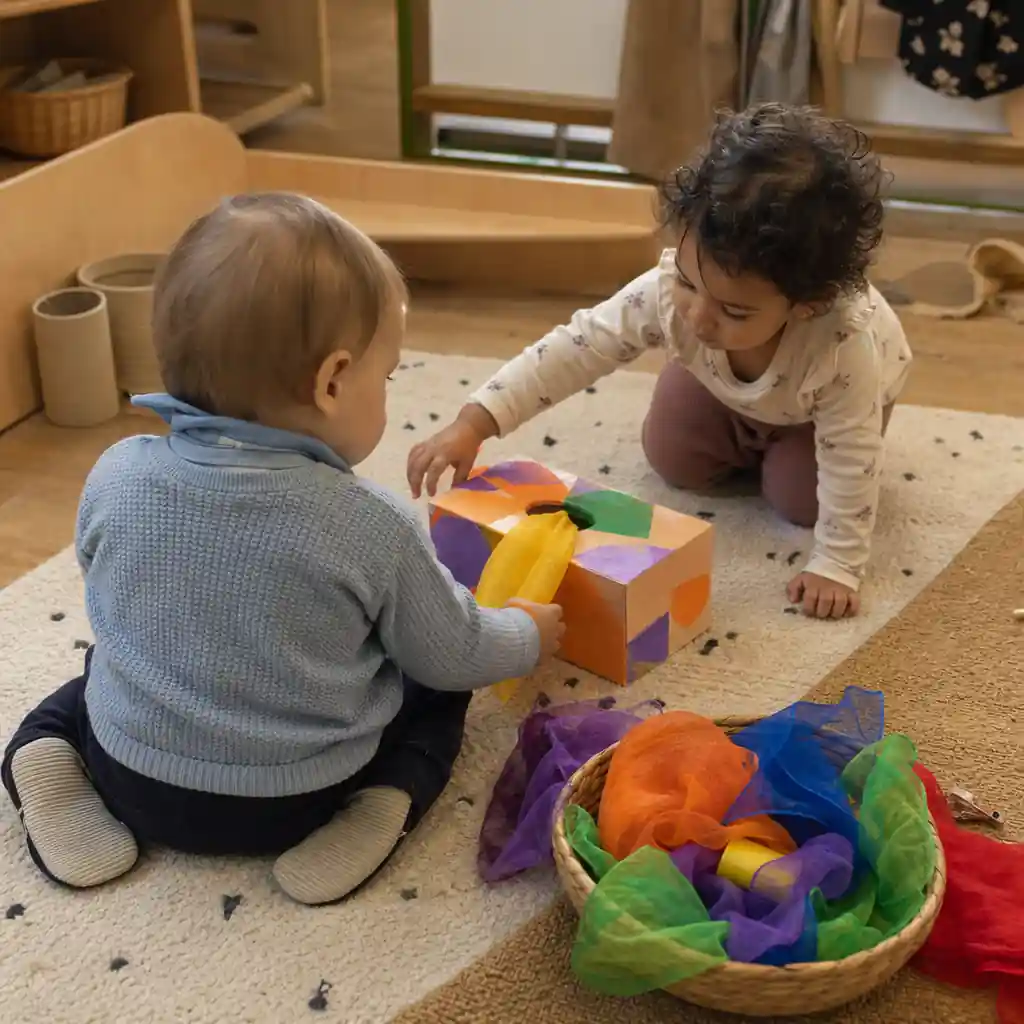
Ethos adaptation: Arrange the space so the box sits within easy reach on a low tray or mat with scarves sorted into visible piles rather than handed out. Provide a few alternative receptacles (cardboard tubes, baskets) and loose items (ribbons, fabric scraps) so the posting action can be varied; remove any one-way expectation by leaving openings of different sizes and textures. Keep materials washable, safe, and large enough to avoid choking, letting children choose which textile and opening to use.
The adult steps back as an observer and co-researcher, offering short, open commentary such as “I can see the blue scarf moving” or “You’re trying the small hole now,” and asking exploratory prompts like “What happens if you pull slowly?” The child may invent uses (dragging, hiding, threading) or combine receptacles; the setup reveals moments to note fine-motor adjustments, sustained attention, turn-taking attempts, and problem-solving strategies without directing outcomes.

A quiet corner is defined with a neutral wool cloth on the floor or a low table, free from other toys. The materials are arranged simply: a smooth wooden box with a single oval opening, or a plain, sturdy cardboard box reinforced with brown paper tape; alongside sit 4–6 soft cotton or silk squares in muted tones, large enough to be safe. A small woven basket holds spare cloths. The box rests on the cloth for steadiness, keeping the workspace contained and uncluttered.
The adult demonstrates once, slowly posting and then drawing a cloth back out, then settles nearby with minimal language. Simple words for colours and actions are offered sparingly in the moment. The child returns to grasping, releasing, and two-handed pulling at their own pace, repeating as long as interest holds. The adult observes for safety and steadiness, modelling a gentle pinch only if fabric is stuck, and supports turn-taking and a calm tidy by placing cloths back in the basket.