Water sensory tray with cups, spoons and sponges for early pouring and squeezing play
Sensory Play
Communication and Language
Children explore a small amount of water in a shallow tray using cups, measuring spoons and sponges, noticing how water moves, drips and soaks. Adults keep the experience contained and calm, offering simple words linked to actions and sensations. Practitioners may watch for repeated schemas such as pouring and squeezing, and for how children adjust their grip and attention over time.
Children explore a small amount of water in a shallow tray using simple tools such as cups, spoons and sponges. The experience supports curiosity about cause and effect, early problem-solving, and the feel and movement of water. It can be offered on the floor or at a high chair to suit different stages of sitting and reaching. Adults can keep the experience calm and contained, with plenty of time for repetition.
Step-by-Step Guidance
1. Prepare the space: place an absorbent towel or mat on the floor, or position the tray securely on a high chair tray. Keep the area clear of slipping hazards.
2. Add a minimal amount of water to the shallow tray so the base is covered but the depth stays low.
3. Place a small selection of tools beside or in the tray: a couple of cups, a few measuring spoons, and one or two large sponges.
4. Present the tray calmly and allow children to choose where to start. Keep your hands back at first so children can explore the materials in their own way.
5. Model one simple action only if needed, such as dipping a sponge or scooping with a spoon, and return the tool to the tray for the child to take over.
6. Use short, consistent language linked to what the child is doing, such as wet, drip, squeeze, full, empty, more, and stop.
7. Support turn-taking if more than one child is present by offering a duplicate tool or by naming what you notice and waiting for children to negotiate.
8. Maintain the water level as needed by adding very small amounts, or pause the activity if the tray becomes too splashed for the space.
9. Close the activity with a clear ending: help children tip remaining water into a suitable container or remove the tray, then offer towels for hands and the floor area.
Learning Objectives
Physical Development: children may practise grasping, releasing, squeezing and controlled arm movements as they handle cups, spoons and sponges. Communication and Language: children may build understanding through simple words linked to actions and sensations, such as full, empty, wet and drip. Understanding the World: children may notice simple cause and effect as water moves, soaks, and changes what objects feel like.
Adult Role
Stay emotionally attuned by noticing signs of uncertainty (startle at splashes, pulling hands back) and offering reassurance through a calm voice and slower pacing. Model simple, accurate language that matches the child’s actions and sensations, and repeat key words without over-questioning. Scaffold only when a child is stuck or frustrated, for example by steadying the tray edge or offering a tool closer, and step back when the child is repeating and refining an action. Observe grip strength, attention, and preferred schemas (pouring, transporting, enveloping) to decide whether to add or remove a tool. Hold responsibility for safety by keeping water minimal, supervising continuously, and managing the environment to prevent slipping and mouthing hazards.
Observation Cues
Reaches for a preferred tool repeatedly and uses it in a consistent way (e.g. scooping, pouring, squeezing). Notices changes in the sponge and adjusts grip pressure to make water drip faster or slower. Watches water movement closely and pauses to repeat an action that creates a clear effect. Uses gestures, sounds, or single words to request more water, a turn, or a specific item. Shifts between tools and compares what each one does (e.g. spoon versus cup).
Time & Space
10–25 minutes, depending on attention and tolerance for wet hands.
A wipeable floor area with room for a towel or mat under the tray, or a stable high chair setup with clear space around it.
Materials
Safety
Age adaptations
Budding Adventurers
Provide a slightly wider tray area and include a small set of measuring spoons plus two cups and two sponges so children can compare tools. Keep the water level low but allow children to transport water within the tray using different tools, watching for repeated patterns such as filling, emptying, and squeezing. Adults can introduce simple problem-solving language (stuck, try, again) and support children to pause and notice what changes when they switch tools.
Curious Investigators
Offer the tray on the floor with a clear boundary (towel/mat) and a small, consistent set of tools: cups, measuring spoons, and sponges. Encourage children to make comparisons using everyday words (heavier, lighter, faster, slower) without turning it into a test. Adults can support longer attention by reflecting what is noticed (the sponge holds water; the spoon drips) and by helping children reset the space when splashing increases.
Confident Discoverers
Provide the tray with a deliberate selection of tools: a couple of cups, a small range of measuring spoons, and sponges of two sizes. Keep water minimal and invite children to manage their own containment within the tray area, including wiping small spills with a towel. Adults can extend language around capacity and control (full, half, empty; gentle squeeze, strong squeeze) and observe how children plan, persist, and negotiate shared use of tools.
EYFS Links
Physical Development: handling cups, spoons and sponges can support hand strength, grasp control, and coordinated movements, especially through repeated squeezing and controlled pouring. Communication and Language: adults modelling simple words linked to actions and sensations can support understanding and early expressive attempts in a meaningful context. Understanding the World: water play offers a concrete way for children to notice cause and effect, changes in materials (soaking, dripping), and differences between tools through direct exploration.
Ethos adaptations

Place a shallow tray on a low mat with only a single small cup with a visible fill line, one sponge and one spoon neatly spaced left-to-right; remove extra cups and toys so the sequence (pick cup → pour to line → return) is clear. Keep water volume small so over-pouring is obvious on the tray for self-correction. Arrange materials on a small tray the child can pull close and return to a marked place to support independent use and a single dominant skill: controlled pouring and wrist movement.
Show the full sequence once with a slow, silent demonstration: lift cup, pour to the line, squeeze sponge to mop a spill, then step back. Use minimal language—one-word labels or safety reminders—and limit questions. Observe how many repeats the child attempts, steadiness of the pour, wrist control and whether they notice spills or correct themselves, intervening only for safety or to reset materials.

In an outdoor or nature-integrated space, set the tray on a low stump, bench or waterproof mat on grass so surfaces vary and children can move around. Materials are arranged using real items: shallow tray with a small water supply, wooden or metal cups, shells or bark scoops, natural sponges or folded cotton cloths, and a stone or wooden scoop for pouring. Materials are arranged openly in a tray or on a bark platform rather than laid out in a fixed sequence so children can select, combine and repeat actions at their own pace.
The adult observes from close by, checking anchors, water levels and hands-on safety, and steps in only for brief, practical support such as tightening a lid or mopping a large spill. Children choose how to explore pouring, squeezing and scooping, take turns, experiment with filling and emptying, and may use single-word prompts from the adult (for example “full,” “drip”) or short questions to notice cause and effect while the adult offers concise responsive observation.
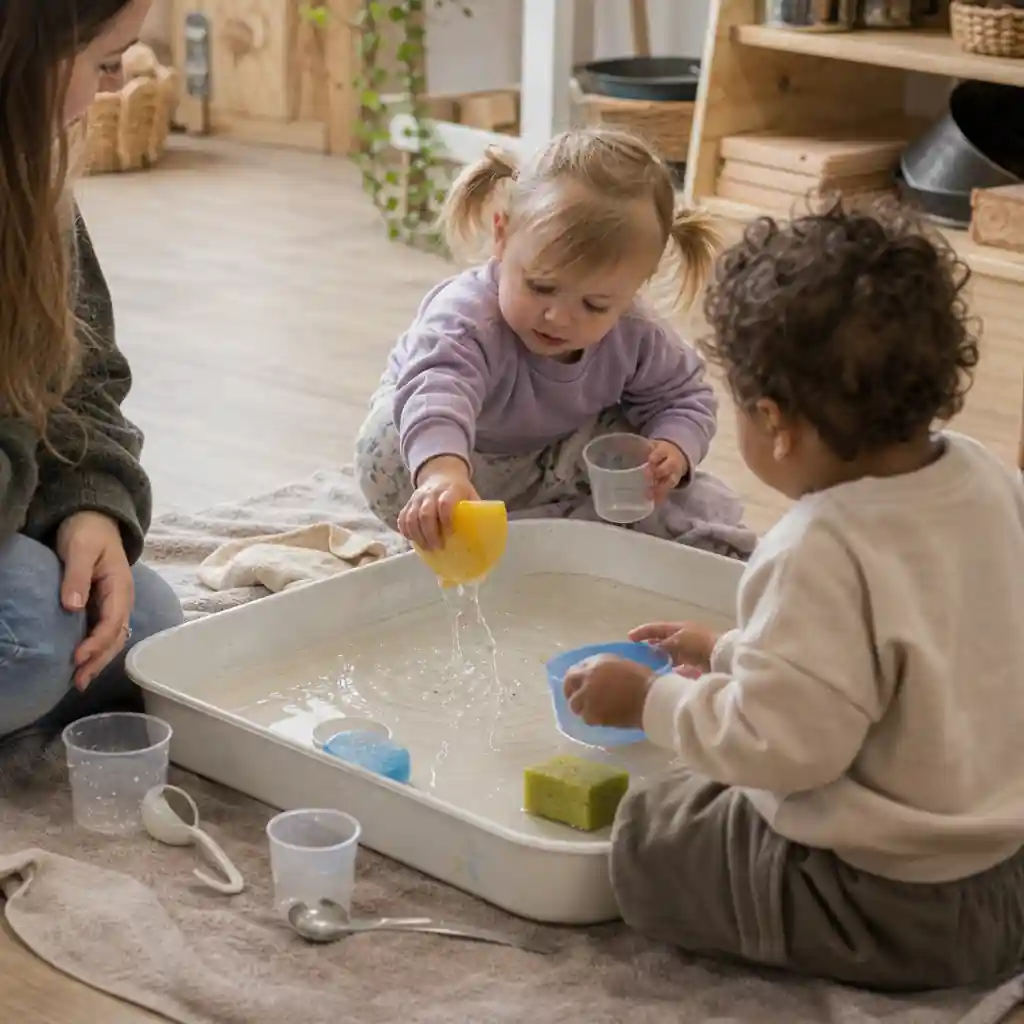
Place the tray where children can approach from different angles — low on the floor for leaning and at a higher surface for supported sitting — and spread the cups, spoons and sponges openly around it so choices are visible and reachable. Leave gaps in presentation (no preset stations or step order) so the child may combine tools, move the tray, or use towels as part of the play; the small water amount and stable base keep EYFS safety intact while inviting repeated, self-directed exploration.
The adult stays nearby as observer and co-learner, using brief commentary such as "I can see the sponge soaking" or "You’re trying to pour into the small cup" and asking open prompts like "What happens if…?" rather than giving instructions. The child may choose to pour, squeeze, stack, or abandon and return; the adult notices patterns (hand strength in repeated squeezes, new words like wet/drip, problem-solving when linking cups) and records these behaviours within the flow of play.
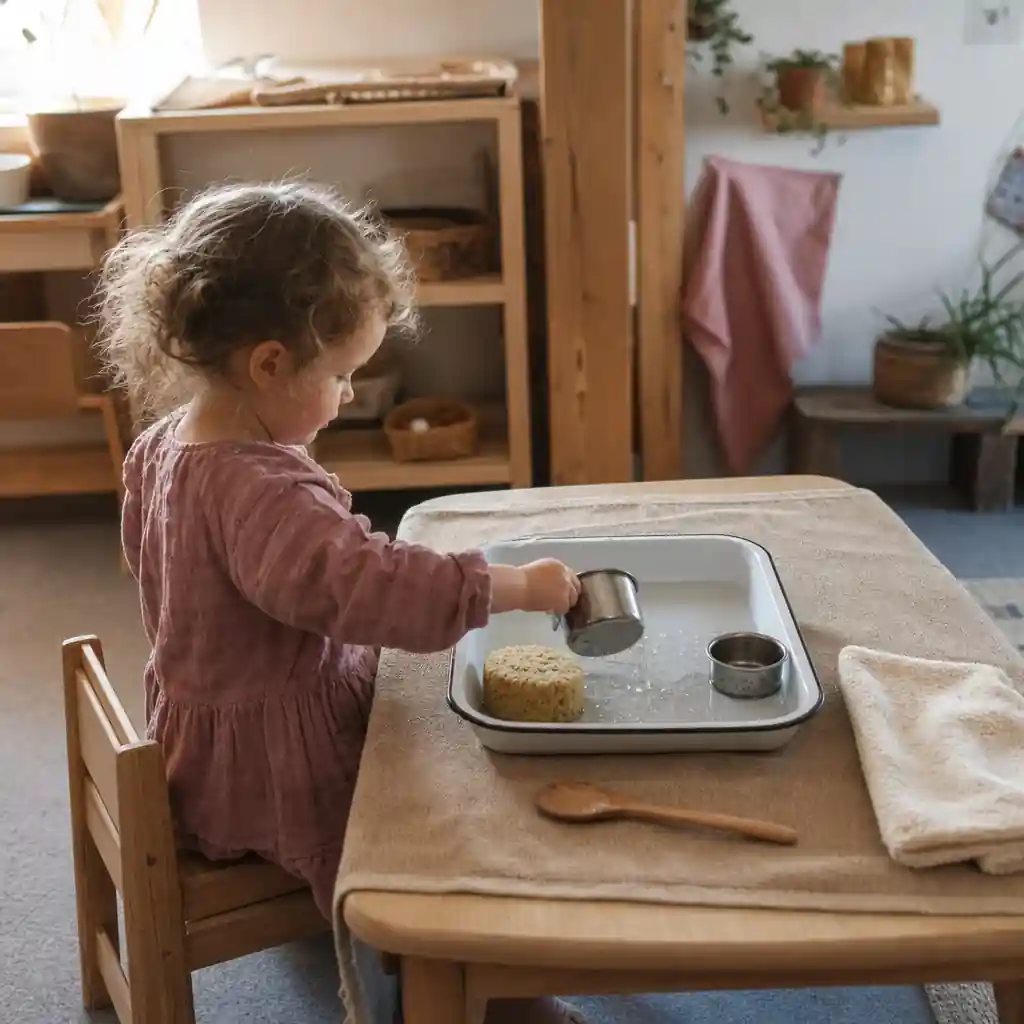
A calm corner is prepared with soft natural light, a wool felt mat, and a shallow stainless steel or enamel tray set firmly on the floor or clipped to a stable high-chair tray. Only a small amount of clean water is poured in. The materials are arranged with space between them: two small metal cups, one wooden spoon with rounded edges, and a large natural sponge or tightly woven cotton cloth. A cotton towel is folded at the edge for drying, with another towel beneath the tray to contain any overflow.
The adult demonstrates one slow pour and a single gentle squeeze over the tray, using spare, concrete words such as “wet,” “drip,” “full,” and “empty,” then steps back and watches. The child returns to filling, tipping, scooping, and squeezing at their own pace, observing the movement and sound of water without pressure for a set outcome. The adult remains nearby for safety, quietly replenishes a little water if needed, and models an unhurried tidy by pressing the towel to small puddles.