Washing toy and ride-on vehicles with water and bubbles outdoors on a hot day
Sensory Play
A flexible outdoor car-wash provocation invites children to test real cleaning tools with water, bubbles and a mix of vehicle sizes. The experience highlights shifting textures, changing surfaces and cooperative problem-solving, while adults track safe movement, shared resources and emerging descriptive language.
Children explore washing vehicles using water and bubbles in an outdoor space. The experience can be set up for small-world vehicles or larger ride-on items, depending on the group and environment. Children may notice changes as surfaces get wet, slippery, clean, or covered in foam, and may choose to repeat actions that feel satisfying. Adults support safe water play, shared use of resources, and language for what children are noticing.
Step-by-Step Guidance
1. Choose the scale: decide whether the focus is small-world vehicles on a low table/tray or larger ride-on vehicles in a marked outdoor area.
2. Prepare the environment: set a clear boundary for the wet zone, place tubs/buckets on stable ground, and position towels and spare cloths within easy reach.
3. Prepare the liquids: an adult pre-dilutes a small amount of bubble solution/soap in one container and keeps a separate container of clean water for rinsing.
4. Present materials simply: lay out a small number of tools at first (for example, sponge, cloth, brush, pouring jug) so children can see choices without overload.
5. Invite exploration: offer a brief, calm introduction to the idea of washing vehicles and allow children to choose a vehicle and a tool.
6. Support early technique without taking over: demonstrate one slow action if needed (a single scrub or rinse) and return the tool to the child.
7. Keep the flow going: replenish water as needed, rotate cloths, and add or remove tools based on children’s interest and the level of waiting.
8. Build in language naturally: name what children are doing and noticing (foam, drip, splash, rinse, dry) and reflect effort (you’re pressing hard; you’re wiping in long lines).
9. Support shared use: help children create informal roles if they choose (washer, rinser, dryer) and step in to mediate when tools become a sticking point.
10. Transition to finishing: offer a drying cloth or a “parking” area for finished vehicles and support children to decide when they are done.
11. Close the activity: guide children to tip out water safely (adult-led), place tools in a collection tub, and wash hands.
Learning Objectives
Children may develop Physical Development through squeezing, pouring, scrubbing, pushing, and reaching in a purposeful context. Children may build Communication and Language as adults model words for wet/dry, bubbly/clear, clean/dirty, and for actions such as rinse, scrub, and squeeze. Children may also draw on Personal, Social and Emotional Development as they negotiate turn-taking, shared space, and caring for shared equipment.
Adult Role
Stay emotionally attuned by noticing when children are excited by splashing, frustrated by waiting, or unsure how to start, and respond with calm, steady support. Model language that matches what children can see and feel, including action words (scrub, rinse, squeeze), describing words (wet, slippery, bubbly), and simple comparisons (more/less foam, heavy/light when full/empty). Scaffold only when it helps a child re-enter play or stay safe, such as offering one tool choice, showing one slow movement, or suggesting a shared plan; step back when children are repeating, experimenting, or negotiating successfully. Observe in the moment for grip strength, coordination, persistence, and social strategies, and adjust the environment (more cloths, fewer tools, clearer boundary) rather than directing children’s play. Hold responsibility for safety by managing water depth, supervising any ride-on movement, and keeping the wet area predictable and uncluttered.
Observation Cues
Chooses tools with intent (cloth, sponge, brush) and changes grip or pressure to get a different effect.
Repeats a preferred action (pouring, scrubbing, rinsing) and sustains attention for longer over time.
Uses or responds to descriptive language (wet, slippery, foamy, heavy, empty) and action words (wash, rinse, scrub).
Notices cause and effect (more water makes more foam; rinsing changes what can be seen on the surface).
Manages social moments (offers a tool, waits, protests, problem-solves) and seeks adult support when needed.
Shows awareness of body and space (steps around puddles, adjusts stance, carries a container carefully).
Time & Space
20–45 minutes, depending on scale and how long children sustain interest.
Outdoor space with a defined wet zone on stable ground (patio, tarmac, or grass). Access to water for refilling and a nearby handwashing point is helpful.
Materials
Safety
Age adaptations
Budding Adventurers
Include a wider choice of vehicles (toy cars plus a scooter or ride-on if available) and add a clear “parking” space for washed items. Introduce a spray bottle only if children can manage it safely and direct it away from faces. Offer a simple choice of roles that children can opt into, without insisting on a sequence. The adult supports problem-solving around resources (one brush, two children) and adds vocabulary for parts of vehicles (wheel, seat, handlebar) as children notice them.
Curious Investigators
Add a simple visual prompt for wash/rinse/dry and provide separate cloths for different purposes (wiping, drying, polishing) to encourage comparison. Offer measuring jugs or marked containers so children can notice how much water they are using, without turning it into a task. Include opportunities for children to care for larger items (bikes, ride-ons) with adult supervision for moving equipment. The adult listens for children’s theories about foam and dirt and responds with open questions that keep play moving (What do you notice when you add more water?).
Confident Discoverers
Offer a larger-scale setup with more responsibility for organising tools, such as a labelled tub for cloths and a clear place for refilling water under adult supervision. Provide a choice of brushes (soft/harder) and invite children to decide which works best on different parts, noticing scratch risk and being gentle. Children can collaborate on a shared plan for managing turns and keeping the area safe, with adult support to keep it fair and realistic. The adult encourages children to review their process (What helped you get the foam off?) and to care for equipment at the end.
EYFS Links
Physical Development: Children practise hand and arm strength through squeezing sponges, scrubbing, lifting small containers, and controlling water flow. They also practise whole-body balance and coordination as they move around a wet area and position themselves to reach different parts of a vehicle.
Communication and Language: Adults can model clear vocabulary linked to actions and sensory changes, and children may use words, gestures, or signs to request tools, describe what they notice, and explain their ideas.
Personal, Social and Emotional Development: The shared nature of water and tools supports turn-taking, managing frustration, and cooperating on a shared task that feels meaningful.
Understanding the World: Children may notice cause and effect (water changes surfaces; bubbles appear and disappear) and begin to connect the idea of caring for objects with everyday routines.
Ethos adaptations

Set out one shallow tub per child or one tub per small group on low trays at child height, with a single watering can or jug, one sponge and one soft brush each. Reduce the number of vehicles to two or three ride-on items or a small tray of toy cars so the task focuses on pouring and scrubbing. Arrange tools in order of use (tray → sponge → brush → rinse → cloth) and mark a clear wet-work boundary so children can reach and return materials independently.
Introduce the activity with a single, slow demonstration showing reach, pour to a visible line, scrub and rinse, then step back and limit language to short safety reminders. Avoid questions and ongoing prompts; instead quietly monitor each child’s control of pouring and scrub pressure, waiting for repeated attempts, steady hand movements or signs of frustration. Note turn-taking, persistence and changes in surface (wet/clean) as observational evidence to inform brief future setups.
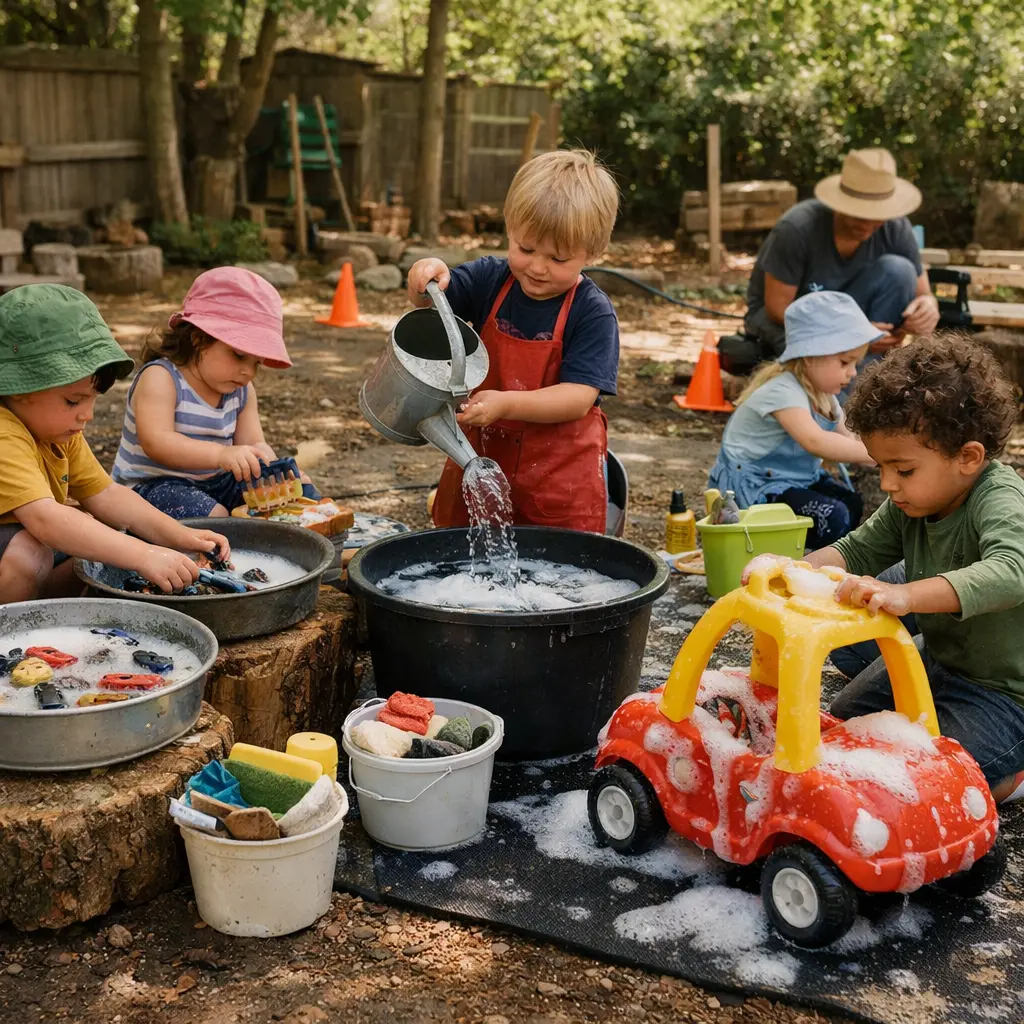
In an outdoor or nature-integrated space such as a paved courtyard, garden or grassy clearing, set tubs and stable basins on low logs or stones so surfaces are uneven and tactile. Materials such as real water from a watering can or hose (gentle flow), sponges, soft brushes, microfibre cloths, and buckets are provided alongside natural add-ins — leaves, twigs and small stones — for wiping and rinsing rather than single-use plastic props. Children may move between washing small toy cars and larger ride-ons, noticing wet, slippery and foamy surfaces at their own pace.
The adult observes from close by, checking anchors, water depth and safe footing, and uses minimal, responsive language — short prompts, single words or questions — to support turn-taking and name actions like rinse, scrub or squeeze. Children choose tools, experiment with pouring and scrubbing, take roles in caregiving or vehicle-cleaning, and repeat actions that interest them while the adult steps in only to manage risk, re-supply materials or model gentle handling when necessary.

Ethos adaptation — Environment shift and materials: Set up a low, open wash-station along the boundary of the outdoor play area so tubs, jugs, sponges, brushes and a tray of bubble solution are permanently visible and reachable rather than handed out. Include a variety of loose parts (scrap fabric, old brushes, funnels, sieves, foam pieces) so children choose tools, sizes of vehicles and surface textures. Mark the wet zone with cones or chalk but leave multiple entry points so play can begin anywhere.
Adult role, child direction and observation cues: The adult steps back as co-researcher, offering commentary such as "I can see the foam moving across the wheel" or "What happens if you tilt the car?" rather than instructions. The child may invent washing sequences, use sponges for pouring or riding parts as ramps, or abandon and return to tasks; adults follow those shifts and mirror vocabulary (wet/dry, bubbly, rinse) in situ. Notice moments of problem-solving, negotiation over tools, repeated actions and sensory delight as embedded observation opportunities.
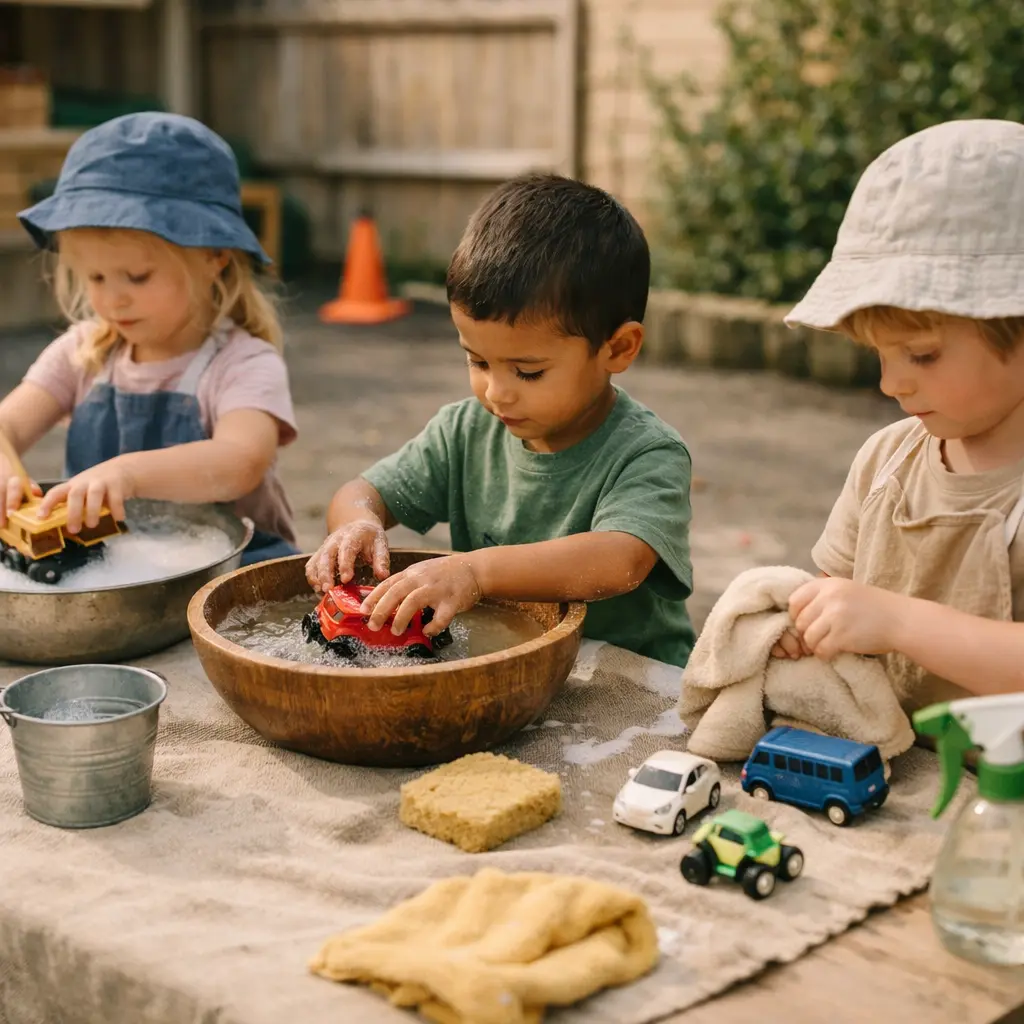
Create a calm, rhythmic washing experience with warm water if appropriate, natural cloths, and simple wooden or metal bowls, keeping the setup uncluttered. Choose a small number of sturdy vehicles and include a gentle drying cloth so the sequence feels complete without becoming task-driven. Use consistent routines for beginning and ending, such as laying out cloths in the same place and returning items together.
Use warm, simple language and a steady pace, focusing on imitation rather than instruction. Allow children to settle into repetitive scrubbing and rinsing, stepping in quietly to support sharing or to reset the space. Observe children’s regulation, persistence, and care for objects, and respond by simplifying the environment if play becomes overstimulating or by offering a quieter role such as drying and parking vehicles.