Vehicle sensory bin car wash and muddy construction site with tractors and small world vehicles
Sensory Play
Small world play
Children explore a contained vehicle play space where washing and muddy textures can be investigated through pushing, scrubbing, and pouring. Adults provide a small set of tools and vehicles and keep the focus on what children notice about change, texture, and effort. The experience often supports sustained repetition and emerging storylines linked to farm and construction play. Adults pay attention to turn-taking, sensory preferences, and how children adapt their movements.
Children explore a contained sensory bin where small world vehicles can be cleaned, pushed, parked, and moved through different textures. The experience invites noticing changes such as wet and dry, clean and muddy, and smooth and gritty. Children often bring their own storylines, including farm and construction themes, as they repeat actions and test ideas. Adults can keep the play open-ended and language-rich without taking over the narrative.
Step-by-Step Guidance
1. Prepare the space with a wipeable mat and a towel nearby, and place the tray on a stable surface at child height.
2. Decide on one main sensory focus for the session (car wash with water/foam, or construction/farm mud with dry materials) and set out only the matching tools to reduce clutter.
3. Add a small amount of water to one section of the tray or a shallow bowl, and create a small amount of foam with a drop of washing-up liquid. Keep extra water in a jug for adult-controlled top-ups.
4. For a dry option, add sand or soil to a separate section or a second tray. If using cocoa powder, keep it dry at first so children can choose how it changes when combined.
5. Present the vehicles and tools in a simple layout: vehicles grouped together, brushes and cloths within reach, and a clear place to put “clean” vehicles.
6. Invite children to choose a vehicle and explore. Allow time for repeating actions such as dipping, scrubbing, rolling, and pushing through textures.
7. Model a small amount of language that matches what children are doing, such as naming tools, describing textures, and noticing changes, without directing the storyline.
8. If children want a farm theme, offer tractors first and keep the language grounded in what is visible (tracks, loads, pushing, tipping). If children want construction, offer diggers and scoops and notice filling, dumping, and making marks.
9. Scaffold only when needed: offer a cloth when a child looks stuck, steady the tray if it shifts, or show how to squeeze a sponge once and hand it back.
10. Support transitions by offering a clear end point, such as parking vehicles in a “finished” area, and involve children in simple tidy-up like placing tools in a bowl and wiping the mat.
Learning Objectives
Children may develop fine motor control and hand strength as they grasp, scrub, pour, and manoeuvre vehicles (Physical Development). Children may build early vocabulary for textures, changes, and simple cause and effect as they notice what happens to vehicles in water, foam, sand, or powder (Communication and Language). Children may extend imaginative play by using vehicles to represent familiar routines such as washing, building, and farm work (Expressive Arts and Design).
Adult Role
Stay emotionally attuned by watching for signs of uncertainty around wet textures, splashes, or messy hands, and offer choices such as a cloth, a dry tool, or a smaller bowl. Model calm, specific language that follows the child’s focus, naming what is happening (foam, rinse, muddy, gritty, slippery) and reflecting effort (pressing hard, gentle scrubbing) without praising outcomes. Step in to scaffold when a child is stuck with a tool, when frustration rises, or when turn-taking breaks down; step back when children are repeating, experimenting, or building their own storyline. Observe in action by noting which textures children seek or avoid, how they coordinate two hands, and whether they plan sequences like lining up vehicles or separating clean and dirty. Hold safety responsibility by controlling soap quantity, supervising water play closely, and keeping small items and powders managed and out of reach when not in use.
Observation Cues
Returns to the same action (scrubbing, rolling, pushing) and varies pressure, speed, or direction. Uses words or gestures to show noticing of change, such as clean/dirty, wet/dry, heavy/light. Chooses particular vehicles for particular areas and shows a plan, such as lining up, parking, or sorting. Manages turn-taking around popular tools or spaces, or seeks adult support to do so. Adjusts grip and wrist movement when using brushes, cloths, or scoops.
Time & Space
20–45 minutes, plus 5–10 minutes for set-up and tidy-up.
Tabletop or floor space with a wipeable mat; access to water for filling and cleaning; enough room for 2–4 children to stand or sit around the tray without crowding.
Materials
Safety
Age adaptations
Budding Adventurers
Introduce two zones (wet wash and dry mud/construction) with clear boundaries using separate bowls or trays. Add a small jug for child-led pouring with adult-controlled refills, and include a “clean parking” area to support sorting without requiring it. Adult notices emerging storylines (farm loads, building piles) and offers vocabulary for actions (scoop, tip, rinse, scrub) while keeping expectations flexible.
Curious Investigators
Offer a wider tool choice (two brush types, cloths, scoops) and include cocoa powder as an optional mud material so children can explore how it changes. Add simple prompts through materials, such as a small container for “mud” and a separate container for “rinse,” without directing a fixed sequence. Adult supports collaborative play by helping children negotiate roles (washer, builder, farmer) and by reflecting plans children describe.
Confident Discoverers
Add opportunities for planning and representation, such as a simple drawn parking bay sheet under a clear mat, or labelled bowls for clean/dirty, wet/dry. Offer measuring cups or marked containers so children can compare amounts when making foam or mud, keeping soap minimal and adult-managed. Adult encourages children to explain their choices and notice patterns (which tools clean best, which surfaces make tracks) while stepping back to allow sustained group play.
EYFS Links
Communication and Language: Adults can model and respond to vocabulary linked to what children can see and feel, such as texture words and action words, supporting children to express ideas and needs during shared play. Physical Development: Scrubbing, squeezing, pouring, and manoeuvring vehicles can support hand strength, coordination, and control, especially when children choose tools and repeat actions. Expressive Arts and Design: Small world vehicle play can support imaginative representation of familiar routines (washing, building, farm work) and encourage children to combine materials to create effects. Personal, Social and Emotional Development: Shared access to popular tools and spaces can support turn-taking, negotiating, and managing feelings with adult co-regulation when needed.
Ethos adaptations

Put the bin on a low tray with two clearly divided shallow bowls marked wet and dry; place only three vehicles, one brush, one sponge and one small jug on a tray so the sequence (park → clean → rinse → dry) is obvious. Remove extra powders and toys so the child uses the same tools each time; provide a towel and apron at arm’s reach and arrange tools left-to-right in the order they will be used to make self-directed choice easy and visible.
Show the full sequence once as a slow, silent demonstration: park a vehicle, scrub with the brush, pour from the jug to rinse, then pat dry with the sponge, then step back. Use very brief language for safety only and avoid prompting; watch for steady repetition, controlled scrubbing and pouring, signs of concentration or frustration, and whether the child returns to correct order without help.
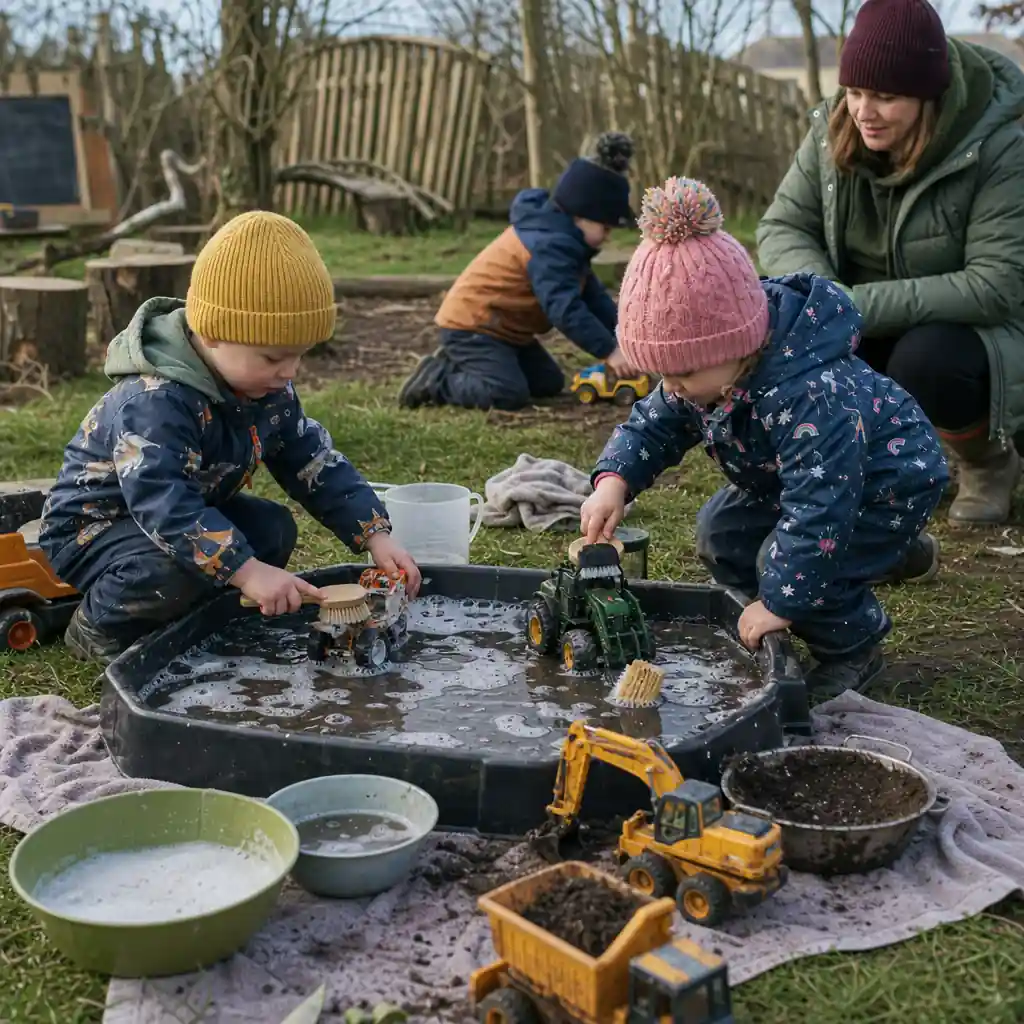
In an outdoor or nature-integrated space, move the sensory tray onto grass, a sheltered patio or a gravel clearing with nearby logs for seats and uneven surfaces to explore. Materials are arranged using real items: metal or wooden brushes, cloths, scoops, watering cans, real soil or garden mud, sand and shallow bowls for wet and dry zones, plus trays on towels to manage spills. Children may transport water in small jugs or shells and mix textures freely rather than following a set recipe.
The adult observes from close proximity, checking anchors, water levels and footing, and offers minimal, responsive prompts such as single words or short questions when needed. Children choose tools, roles and pacing, scrubbing, pouring and manoeuvring vehicles, revisiting actions and making up scenarios. Materials are replenished or adapted by the adult only on request, and the adult steps in to manage clear safety moments while otherwise supporting independent exploration.
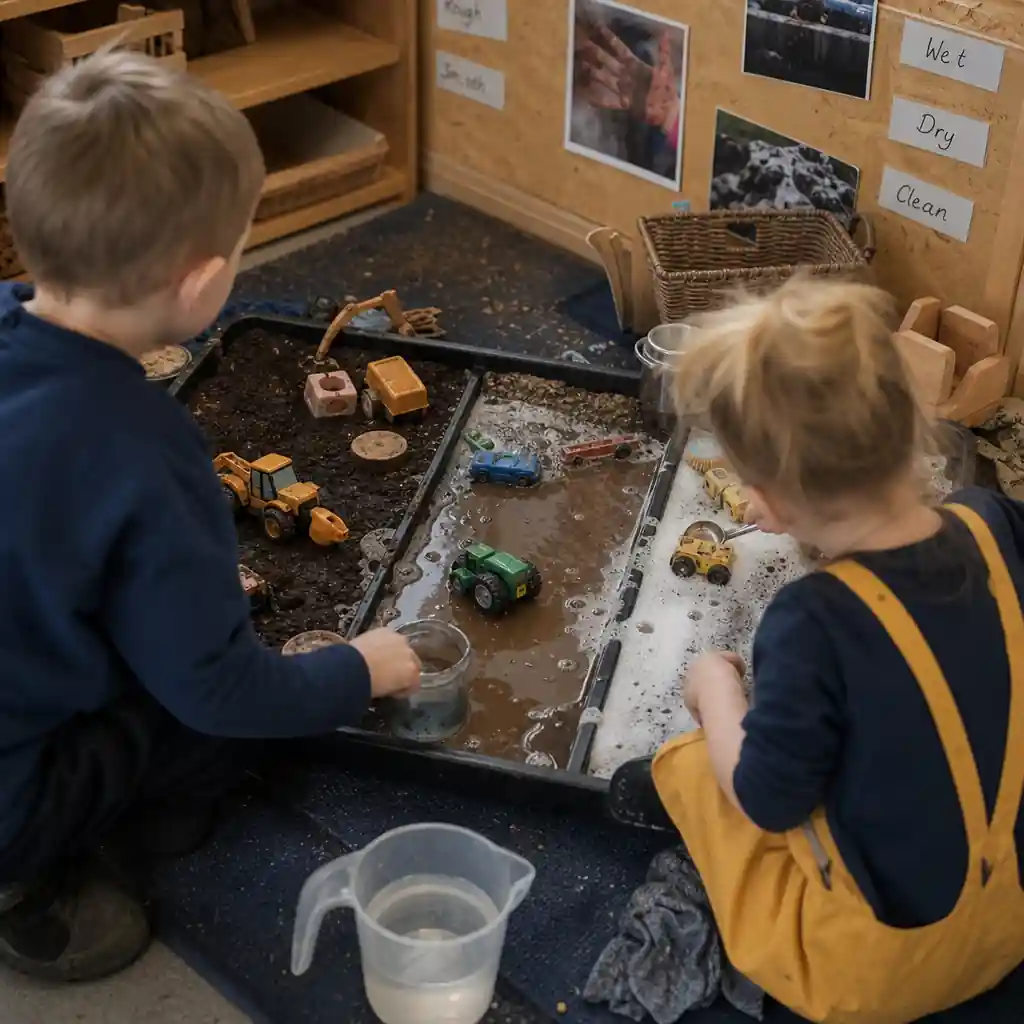
Ethos adaptation: arrange the tray area as a low, invite-only workbench with three visible zones (wet foam, shallow water, dry grit/mud) set side-by-side so children can move vehicles between textures independently. Replace single-use props with varied loose parts—scraps of fabric, pebbles, wooden blocks, funnels, extra cups and spoons—placed where little hands can reach. Keep brushes and cloths available but not presented as the only way to “wash”; the child may choose tools, pathways and parking spaces while physical play and vocabulary goals remain intact.
The adult steps back as observer and co-researcher, using reflective commentary such as “I can see the tractor is heavier when it’s muddy,” “You’re trying different brushes,” or “What happens if you pour from here?” rather than giving directions. The child may shift roles, repeat actions, mix textures or invent routines; these choices reveal fine motor persistence, new words for texture and change, negotiation around shared tools and problem-solving strategies—embedded moments the adult records through brief notes or photos without interrupting play.

A low wooden tray is set with two calm zones: a shallow enamel bowl of warm water for washing and a small area of clean sand or sifted soil for “work.” Only a few sturdy wooden or metal vehicles are offered. Natural-bristle brushes, cotton cloths, a wooden scoop, and two terracotta or enamel dishes separate wet and dry. A neutral cotton mat contains spills, and a plain cotton apron is available. Colours are soft and materials feel authentic—cool metal, smooth wood, warm water, fine grain.
The adult demonstrates once: slowly dipping a vehicle, brushing, rinsing, then parking it to dry on a folded cloth, using minimal words such as “wet,” “dry,” and “mud.” They step back to observe, staying close for safety and to maintain a simple rhythm of begin, explore, and tidy. The child returns to washing, pushing, and parking, moving freely between water and earth, repeating actions, adding quiet storylines, and noticing changes in weight, texture, and tracks at their own pace.