Tummy time with a non-breakable floor mirror and textured sound toys for early reaching
Communication and Language
An adult sits at floor level beside children on a firm mat, keeping a shatterproof mirror within view and a small basket of textured and sound toys nearby. Children spend short periods noticing reflections, shifting their weight, and exploring objects with hands and mouth. Adults keep their hands ready to steady materials, use simple action words, and watch for signs that children need a pause or a change in challenge.
This is a floor-based tummy time experience where babies explore their reflection in a non-breakable mirror and notice nearby toys with different textures and sounds. The mirror can offer a steady visual focus, and the toys can invite small shifts in weight, reaching, and turning. Adults can use the setup to tune into babies’ cues about comfort, effort, and interest, adjusting the level of challenge in the moment.
Step-by-Step Guidance
1. Prepare the space on the floor with a firm mat in a clear area where an adult can sit close at baby level.
2. Check the mirror for smooth edges and a stable base. Wipe it clean and place it flat on the floor where it will not slide.
3. Position the baby for tummy time on the mat so the mirror is within comfortable viewing distance. Keep the baby’s arms forward rather than tucked under the chest.
4. Offer one toy at a time near the baby’s hands, choosing a texture or sound that matches the baby’s alertness. Keep the toy close enough to invite a small reach rather than a full stretch.
5. Pause often. Allow the baby time to look between the mirror and the toy, and to organise their body before you change anything.
6. If the baby begins to tire, reduce the challenge by bringing the toy closer, lowering sound intensity, or adding a small rolled towel under the chest to support lifting.
7. If the baby is comfortable and seeking more, place the toy slightly to one side to invite a gentle head turn and a weight shift, keeping movements small and slow.
8. End when the baby shows clear signs of fatigue or distress. Transition to a cuddle, side-lying play, or back play, and clean the mirror and toys after use.
Learning Objectives
In Physical Development, babies may practise lifting the head, shifting weight through the shoulders, and reaching with increasing control during short periods on the tummy. In Communication and Language, babies may attend to sounds and adult voice, and show early turn-taking through looks, pauses, and vocalisations. In Personal, Social and Emotional Development, babies may build a sense of security as an adult responds to signs of effort, frustration, or enjoyment.
Adult Role
Stay close at floor level and watch for early cues of comfort, effort, and overload. Use a calm voice and simple language to label what you notice, such as looking, reaching, resting, and trying again, without pressuring the baby to continue. Scaffold by adjusting distance, toy choice, and support under the chest, and step back when the baby is calmly exploring or repeating a movement pattern. Observe in action by noting what captures attention (reflection, texture, sound), how the baby shifts weight, and how long they tolerate tummy time today. Hold responsibility for safety by keeping the mirror stable, supervising continuously, and removing any toy that becomes a mouthing or choking risk for the baby’s stage.
Observation Cues
Looks towards the mirror image and holds gaze, or turns away when it feels too intense.
Lifts head briefly, rests, and repeats; notices changes in endurance across attempts.
Shifts weight to one side to free an arm for reaching, or uses a forearm prop.
Reaches towards a toy, touches with fingertips, grasps, or mouths when close enough.
Responds to sound by stilling, turning head, vocalising, or kicking.
Shows cues of discomfort (fussing, face-down collapse, arching) and cues of readiness (calm breathing, open hands, alert eyes).
Time & Space
3–10 minutes, repeated in short bursts depending on the baby’s cues.
A clear floor area large enough for an adult to sit close beside the baby, with space to place a mirror flat and keep toys within arm’s reach.
Materials
Safety
Age adaptations
Budding Adventurers
Offer a low, stable mirror and a small selection of sensory toys for the child to explore facial expressions and movement. Adults can invite the child to notice loud/quiet sounds and rough/smooth textures, keeping language simple and following the child’s choices. Avoid making it a performance; keep it exploratory and brief.
Curious Investigators
Provide a floor-level mirror and a tray of textured and sound-making objects. Adults can support descriptive language (smooth, bumpy, loud, soft) and encourage the child to compare what they see and feel, without directing a set outcome. Keep the focus on noticing and describing rather than copying actions.
Confident Discoverers
Set up a low mirror with a small collection of sensory objects and invite the child to sort by texture or sound level using their own categories. Adults can support more precise vocabulary and sustained attention by asking open prompts about differences the child notices. Keep materials limited to reduce distraction and support deeper comparison.
EYFS Links
Physical Development: Tummy time can support strength and control through the neck, shoulders, and trunk as babies lift, turn, and shift weight to reach. Communication and Language: Babies may practise attention and listening as they orient to sound toys and adult voice, and may respond with looks, pauses, and vocalisations. Personal, Social and Emotional Development: A responsive adult can support emotional security by noticing cues, offering comfort, and pacing the experience so the baby can rest and re-engage when ready.
Ethos adaptations

Place the firm mat directly in front of a secured, baby‑safe floor mirror at eye level. Offer only two toys: one textured and one sound toy, cleaned and placed 10–20 cm from the baby—one to each side—with one just beyond easy reach to invite a small shift. Keep the rest of the area clear. Have a small rolled towel ready but out of sight unless needed, so the focus stays on lifting the head, shifting weight through the shoulders, and reaching.
Lay the baby prone facing the mirror. Give one slow, quiet demonstration: shake the sound toy once, set it down, then stillness with a brief “I’m here.” Move to a safe side position and limit words. Observe sustained gaze to the mirror, head lifts and controlled turns, shoulder weight‑shifts, hand opening, repeated reaches, and turn‑taking cues (looks, pauses, vocalisations). Notice strain or disengagement (grimace, face turn‑away, arching). Adjust only challenge—nudge a toy’s distance or add brief towel support—then step back and end on first tired signs.

In an outdoor or nature-integrated space, the tummy mat and firm support are placed on grass, a sheltered patio or under a low tree to introduce gentle unevenness and sensory interest. Materials are arranged with the non‑breakable mirror secured at baby height and surrounded by open-ended, real textures: soft fabric scraps, a wooden rattle or natural fibre crinkle toy, smooth pebbles kept out of reach, and leaves or pinecones for visual touch. Cleaning supplies remain on hand for hygiene.
The adult observes from close proximity, checking anchor points and stepping in only for safety or to offer brief, responsive prompts such as a single word, gesture or pause. Children may choose which toy to reach for, lift heads, shift weight and turn toward sound or reflection at their own pace, using a rolled towel for support if needed, while the adult notices cues of effort or comfort and adjusts the challenge silently and safely.
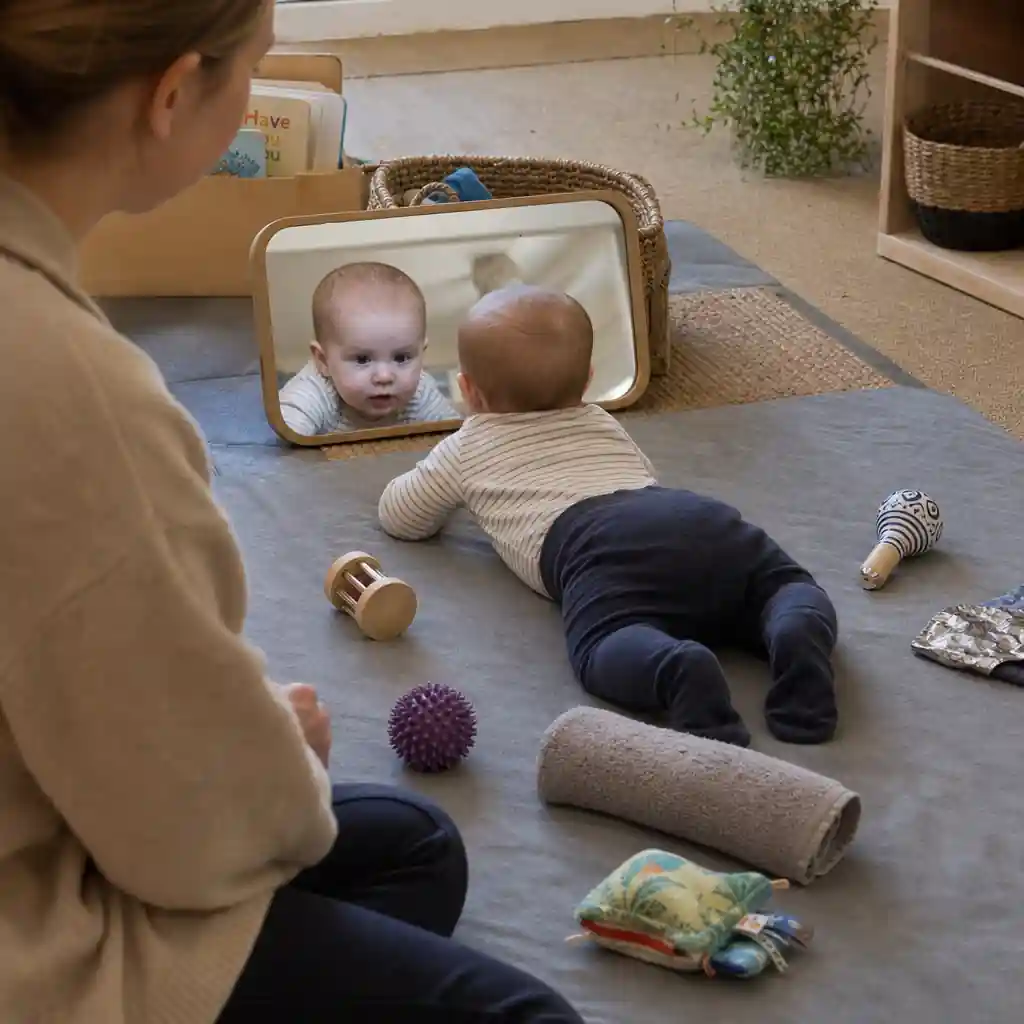
Ethos adaptation: set the mat as an open play surface with the mirror propped low and stable so faces are visible from multiple angles; place textured and sound toys in small clusters at varied distances and heights (near, just-out-of-reach, lateral) to invite turning, weight-shift and choice. Keep the towel/wedge nearby for optional support. Materials stay loose and reusable with no prescribed order—scarves of movement or a soft object may be added by the child—so the space itself suggests exploration and different entry points while still supporting tummy-time head and shoulder practice.
The adult steps back as observer and co-researcher, using commentary such as "I can see you looking here," "You're trying to reach that sound," or "What happens if you roll toward the toy?" The child may lead pacing—brief lifts, rests, repeated reaches, or new strategies for contacting the mirror—while the adult notices gaze shifts, shoulder weight-bearing, vocal turns and signs of effort or calm. Observation notes emerge naturally from these moments to inform responsive, safe adjustments without directing outcomes.

A quiet, warm corner is cleared, with soft natural light and a firm surface under a neutral cotton or wool blanket to define the space. A non-breakable polished metal floor mirror with a smooth wooden frame is placed flat so the baby can see their face without strain. Only two or three items are set within easy reach: a wooden rattle filled for a gentle sound, a small knitted wool ball, and a folded cotton cloth with stitched ridges. A rolled cotton towel is on hand for chest support if needed.
The adult settles at floor level beside the baby, offering a steady presence and few words, humming softly or matching the baby’s breathing rhythm. The adult observes looks, pauses, and vocalisations, adjusting the mirror’s distance, bringing a single toy slightly nearer, or easing the rolled towel to change the effort level. Short periods are repeated with unhurried rests; the baby returns to the mirror or a toy at their own pace, with the adult intervening only for safety and comfort.