Apple variety tasting with washing, safe cutting and sensory comparison at snack time
Communication and Language
Children compare the look, feel and taste of several apple varieties within a calm snack-time routine. Adults focus on safe food handling and language that supports sensory description, allowing each child to decide how much to prepare and explore.
Children explore different apple varieties as part of snack time, noticing how they look, smell, feel and taste. The experience supports children to compare and describe what they notice, and to make simple choices about what to try. With adult support, children can take part in practical snack routines such as washing, preparing and serving their own portion.
Step-by-Step Guidance
1. Prepare the snack area with a clear work surface, handwashing access, and a defined place for waste/compost. Place apples whole in a bowl so children can see differences in colour and size.
2. Decide what needs adult pre-prep for your group. For younger children, pre-slice some apples into safe sizes and keep whole apples available for smelling and handling.
3. Invite small groups to wash hands. Keep the pace calm so children can notice the routine and wait for a turn.
4. Present the apples and name the varieties you have chosen. Offer a simple focus such as noticing colour, smell, or how the skin feels, without turning it into a test.
5. Support children to wash apples. Model a steady hold and slow rubbing motion, and offer a cloth for drying.
6. Set out boards and safe tools. Demonstrate how to carry and place tools, where hands go, and where cut pieces are placed. Keep the demonstration brief and repeat as needed.
7. Offer children a choice: prepare their own portion with support, or choose from pre-cut pieces. Keep both options available so children can join without pressure.
8. Encourage tasting at each child’s pace. Offer water and allow children to spit out a piece discreetly if they dislike it.
9. Prompt simple comparisons as children eat, such as crunchy/soft or sweet/tart, and support children to notice differences without ranking as better/worse.
10. Close the routine with clearing away: children scrape cores/peel into the caddy, wipe their place, and wash hands. Store remaining apples safely and clean tools and surfaces.
Learning Objectives
Children may build confidence with self-care routines linked to snack preparation, supporting Physical Development. Children may extend Communication and Language as they name, describe and compare what they notice using simple sensory words. Children may also practise turn-taking and shared routines within Personal, Social and Emotional Development.
Adult Role
Stay emotionally attuned by noticing children’s comfort with new tastes and respecting refusals without persuasion. Model calm language for sensory noticing, such as naming colours, textures and taste words, and repeat children’s attempts back clearly. Scaffold only where needed: steady a board, guide hand placement, or offer pre-cut pieces, and step back when a child shows control and focus. Observe closely during tool use and eating, watching grip, pacing, and signs of fatigue or overwhelm. Hold responsibility for hygiene and safety, including handwashing, safe cutting choices, and appropriate portion sizes for the child’s age.
Observation Cues
Reaches for a preferred apple variety and shows clear choice-making (pointing, naming, selecting). Uses sensory language such as sweet, sour, crunchy, soft, juicy, smooth, shiny, red/green. Watches closely and adjusts grip when washing, holding or cutting with a safe tool. Tries a new variety after watching peers or after adult reassurance. Notices differences and makes comparisons, such as bigger/smaller, darker/lighter, more/less crunchy. Manages snack routines with increasing independence, such as collecting a plate, disposing of peel/core, wiping hands.
Time & Space
15–30 minutes, depending on group size and how much children choose to prepare themselves.
Snack table or food prep area with access to handwashing. A clear, stable surface for boards and tools, with space for a small group to work without crowding.
Materials
Safety
Age adaptations
Budding Adventurers
Introduce a stable board and a toddler-appropriate safe cutter for children who can follow a short safety routine. Offer a clear choice between cutting one piece themselves or selecting from pre-cut pieces. Add a simple sorting option: children can group slices by colour of skin or by variety label. Support language by offering two-word frames such as more crunchy, very sweet, little sour, and accept non-verbal responses as valid communication.
Curious Investigators
Offer 3–4 varieties and invite children to notice differences in skin colour, smell and texture before tasting. Provide a simple tasting record using symbols (smiley/neutral) or coloured stickers so children can mark preferences without needing to write. Children can take more responsibility for washing, drying and cutting with a safe tool, with the adult checking hand placement and pace. Extend talk with comparison words such as juicier, firmer, sharper, and encourage children to explain choices.
Confident Discoverers
Add a small investigation element: children can weigh apples on balance scales or compare circumference with a string, alongside tasting. Offer a wider vocabulary set (tart, mild, crisp, mealy) and encourage children to match words to what they notice. Children can take on roles such as washer, slicer (with safe tool), server and cleaner, rotating if they choose. Invite children to think about where food waste goes by using a compost caddy and noticing what can and cannot be composted in your setting.
EYFS Links
Physical Development: Children practise handwashing routines, controlled hand movements for washing and safe cutting, and coordinated hand-to-mouth actions during eating. Communication and Language: Children hear and use words for sensory qualities, make choices, and take part in back-and-forth talk about what they notice. Personal, Social and Emotional Development: Children manage snack-time routines, wait for turns with shared materials, and build confidence to try or refuse foods respectfully. Understanding the World: Children notice that apples can vary by type and appearance, and may begin to talk about where food comes from and how it is prepared.
Ethos adaptations
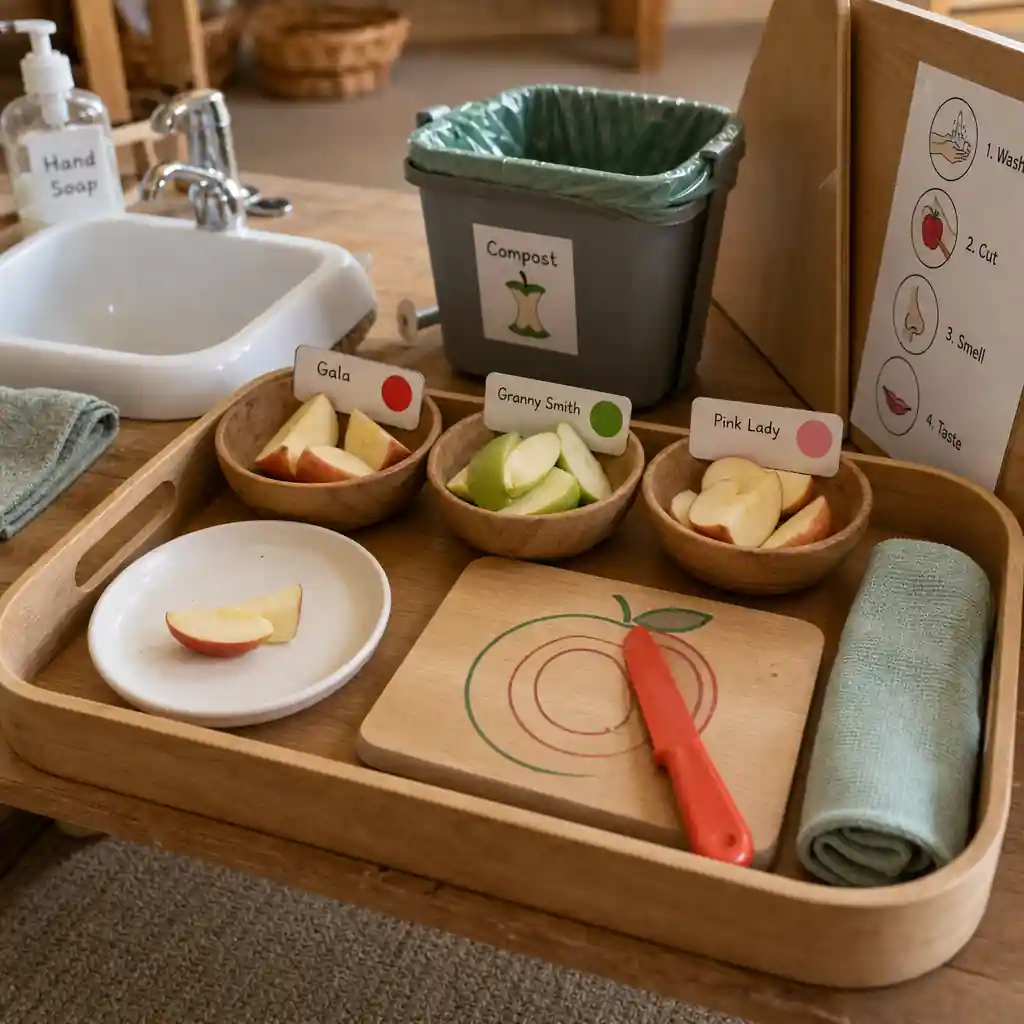
Set up a low tray or shallow tray per two children with only two or three apple varieties, each in its own labelled bowl with a colour dot. Include one reachable handwashing station, one child-safe cutter per child on a small chopping board with a simple visual cutting guide, a single tasting plate and a visible compost caddy for cores. Remove extra cups, cards or utensils so the sequence—wash, prepare, smell, taste—is clear and materials are within easy reach for independent use.
Give one slow, quiet demonstration of the whole sequence: wash hands, place an apple on the guide, cut once to make a tasting piece, smell and taste, then return tools. After that, step back and limit language to brief safety reminders only. Watch for signs of steady concentration, correct hand placement and controlled cutting (self-correction when pieces don’t match the guide), children’s choice to taste or decline, and turn-taking at the tray rather than prompting each action.
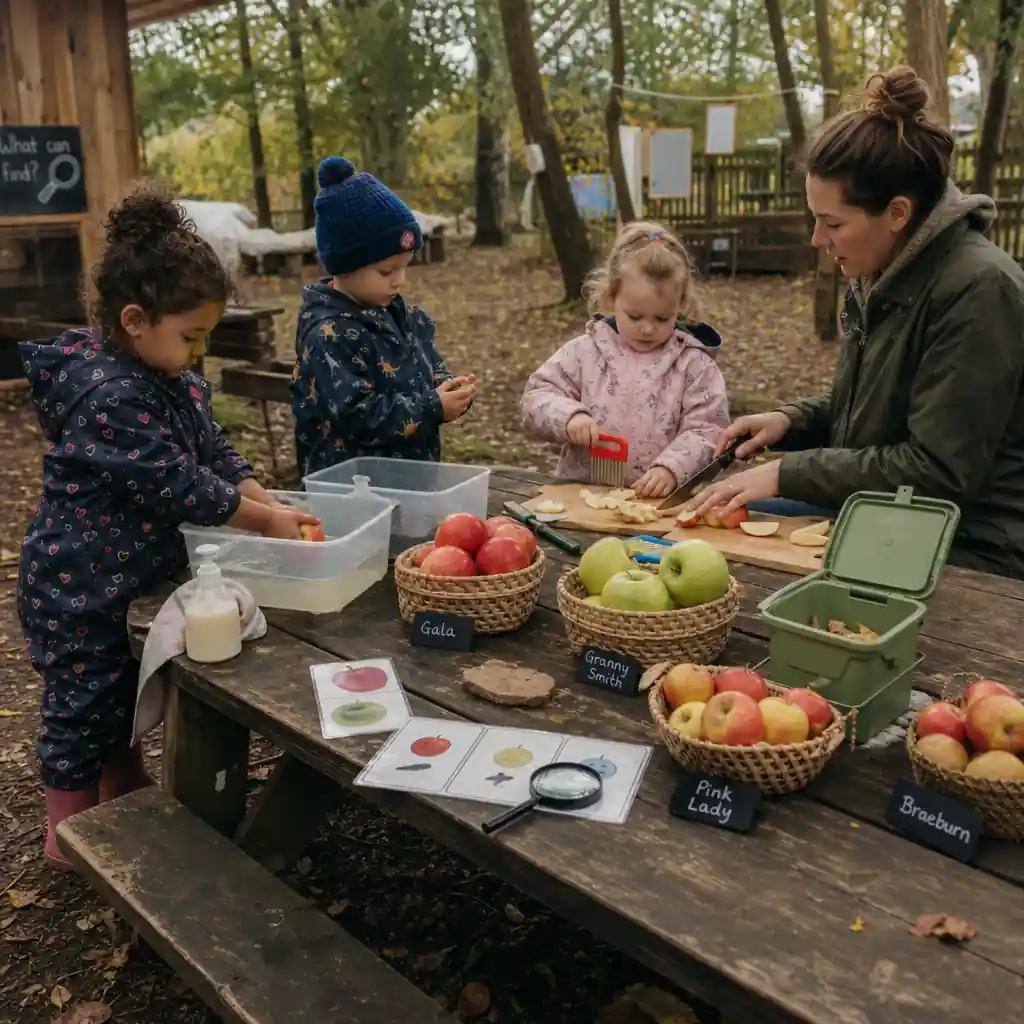
In an outdoor or nature-integrated space, set up on a picnic bench, log seats or a low tarp with nearby grass and leaves to handle spillages. Materials are arranged openly: 2–4 apple varieties in baskets, a shallow handwashing basin with soap and towels, stable chopping boards, age-appropriate child-safe cutters and an adult knife kept for supervised use, a compost caddy for cores, magnifying glasses and simple labelled plates or natural leaf/stone markers. Allow imperfect fruit and mixed surfaces rather than a clinical table setup.
The adult observes from close enough to intervene, checks knife readiness and models one clear washing or cutting action, then steps back to offer brief, responsive prompts or single-word questions. Children may choose which apple to wash, cut or taste, take turns using cutters or watching an adult slice, and use picture symbols or a simple smiley chart to indicate preferences. The adult stays attentive to safety, briefly supports hand hygiene and celebrates choices with concise language.

Ethos adaptation: The snack area is arranged as a low table of loose stations rather than a single served tray — whole apples are placed in visible baskets, labelled plates and bowls are reachable, a handwashing tray is nearby, and sensory tools (magnifying glass, cloths, neutral containers) sit out for choice. Child-safe cutters remain accessible but are not prescriptive; children may select whole fruit, slice, scrub, or simply explore texture and scent. Materials invite repeated return and multiple uses rather than a single finished product.
The adult steps back as observer and co-researcher, using commentary such as "I can see the skin is shiny," "You’re trying to slice through," or "What happens if you smell this next to that?" The child may decide order of washing, cutting or tasting, trade roles, or create comparing routines with peers. Observation cues are embedded: note sustained attention, emerging hand control during washing/cutting, new sensory vocabulary, negotiation over turns, and choices to try or refuse tastes.

A calm snack corner is prepared with a neutral cotton cloth marking the space; only 2–4 apple varieties rest in a wooden bowl beside a metal compost pail. The materials are arranged simply: small wooden boards, child-sized metal knives with wooden handles, ceramic bowls for slices, and a glass jug and ceramic basin with warm water, a plain bar of soap, and clean cotton cloths for drying. Handwritten variety cards on plain card sit by each apple. Each child has a defined place mat of wool felt.
The adult demonstrates quiet handwashing, washing an apple, and a steady, safe cutting motion, then steps back, remaining nearby and observant. Words are limited to naming a tool or a single sensory word when helpful; guidance is given only for safety or to steady a hand. The child returns to washing, slicing, and serving a small portion, noticing colour, scent, texture and taste, and placing cores into the pail. Children set their own pace, wait for shared tools, repeat with another variety, and help tidy in the same simple order.