Supported tummy time with sealed sensory bags for looking, pressing and reaching
Sensory Play
Communication and Language
Understanding the World
Tummy Time
Adults provide a supported tummy time invitation using sealed sensory bags that look and feel different under hands and forearms. Children may explore moving colour, floating items, and gentle resistance through pressing, patting, and brief reaching. Adults watch for comfort, fatigue, and what holds attention, and they model simple words for texture, movement, and body position. Materials are chosen to stay calm, clear, and easy to clean.
This activity offers a calm, supported tummy time experience using sealed sensory bags that change how the surface looks and feels. Children may notice colour movement, floating objects, and gentle resistance under their hands and forearms. The bags can invite longer looking, small shifts of weight, and early reaching without adding lots of noise or equipment. Adults can use the setup to tune into comfort, fatigue, and what captures attention.
Step-by-Step Guidance
1. Prepare the floor space with a wipeable mat and place a soft tummy time mat or folded blanket on top for comfort.
2. Make 2–4 sensory bags so there is choice without crowding: fill each bag with one main combination (for example water with a drop of colour; water with oil; water with a small amount of glitter; water with large pom poms; water with peas). Remove excess air so the bag lies flat.
3. Seal each bag, double-bag it, and tape over the zip and along the edges. Check for leaks by pressing firmly over a sink or towel.
4. Place one bag at a time in front of the child’s chest and hands, close enough to notice without forcing a reach. Keep other bags out of reach until needed.
5. Support the child into tummy time in a way that matches their current tolerance (for example, a small rolled towel under the chest if used in your setting). Watch breathing and head position.
6. Allow time for looking. If the child shows interest, let them press, pat, or rake fingers across the bag. Keep the bag stable so it does not slide away.
7. Model simple language linked to what is happening (colour moving, items floating, cold peas, slippery oil) and pause to let the child respond with gaze, movement, or sound.
8. If the child tires, offer a short rest by changing position (side-lying or cuddle) and return only if cues suggest they are ready.
9. Rotate to a different bag if attention drops, or keep the same bag if the child is still exploring. End with a calm transition and clean the area.
10. Dispose of any damaged bags immediately and wipe the mat and the child’s hands.
Learning Objectives
Children may build strength and control through short periods of tummy time, linking to EYFS Physical Development. Children may practise focusing their gaze, tracking movement, and coordinating reach and grasp, supporting early cognition and sensory processing. Adults can support Communication and Language by naming what children notice and by responding to cues for comfort and rest.
Adult Role
Stay emotionally attuned by watching for comfort and stress cues and adjusting position, distance, and duration. Use calm, descriptive language that matches what the child is doing, such as naming colours, textures, and movements, and leaving space for the child to respond with gaze, sound, or reach. Scaffold lightly by stabilising the bag, offering a brief chest support if appropriate in your setting, or moving the bag slightly to invite a small shift, and step back when the child is absorbed. Observe in action by noting what materials hold attention, how long the child tolerates tummy time, and what movements appear (head lift, forearm push, hand opening). Hold safety responsibility by checking seals, supervising continuously, and ending the activity promptly if the child becomes distressed or fatigued.
Observation Cues
Turns head to one side or lifts chin briefly to look at the bag surface
Tracks moving colour or floating items with eyes
Opens and closes hands, pats, presses, or scratches at the bag
Shifts weight through forearms, pushes up, or repositions knees/hips
Shows comfort cues (steady breathing, relaxed hands) or stress cues (fussing, face-down collapse, arching)
Pauses to rest, then re-engages with looking or reaching
Time & Space
5–15 minutes, with flexible rests and re-joins based on the child’s cues.
A clean floor area large enough for a mat and an adult to sit alongside (about 2 m x 2 m). A nearby sink or cleaning station is helpful.
Materials
Safety
Age adaptations
Budding Adventurers
Provide a small selection of bags and add a simple matching element nearby, such as a colour card that relates to one bag, without turning it into a task. Place bags to encourage crawling up to them, leaning on one forearm, and using the other hand to press or trace. Adult supports self-regulation by offering clear boundaries (bags stay on the mat; hands press, not bite) and by noticing when the child needs a movement break. Use language for action words (press, squash, slide, float) and body words (elbow, palm, fingers).
EYFS Links
Physical Development: tummy time and prone play can support core, shoulder and neck strength through brief head lifts, forearm weight-bearing, and reaching. Communication and Language: adults can model simple, accurate words for what children see and feel, and respond to sounds, gaze and gestures as communication. Understanding the World: children may notice changes in materials (separation of oil and water, movement of floating items, temperature differences) and begin to compare what happens when they press or release.
Ethos adaptations
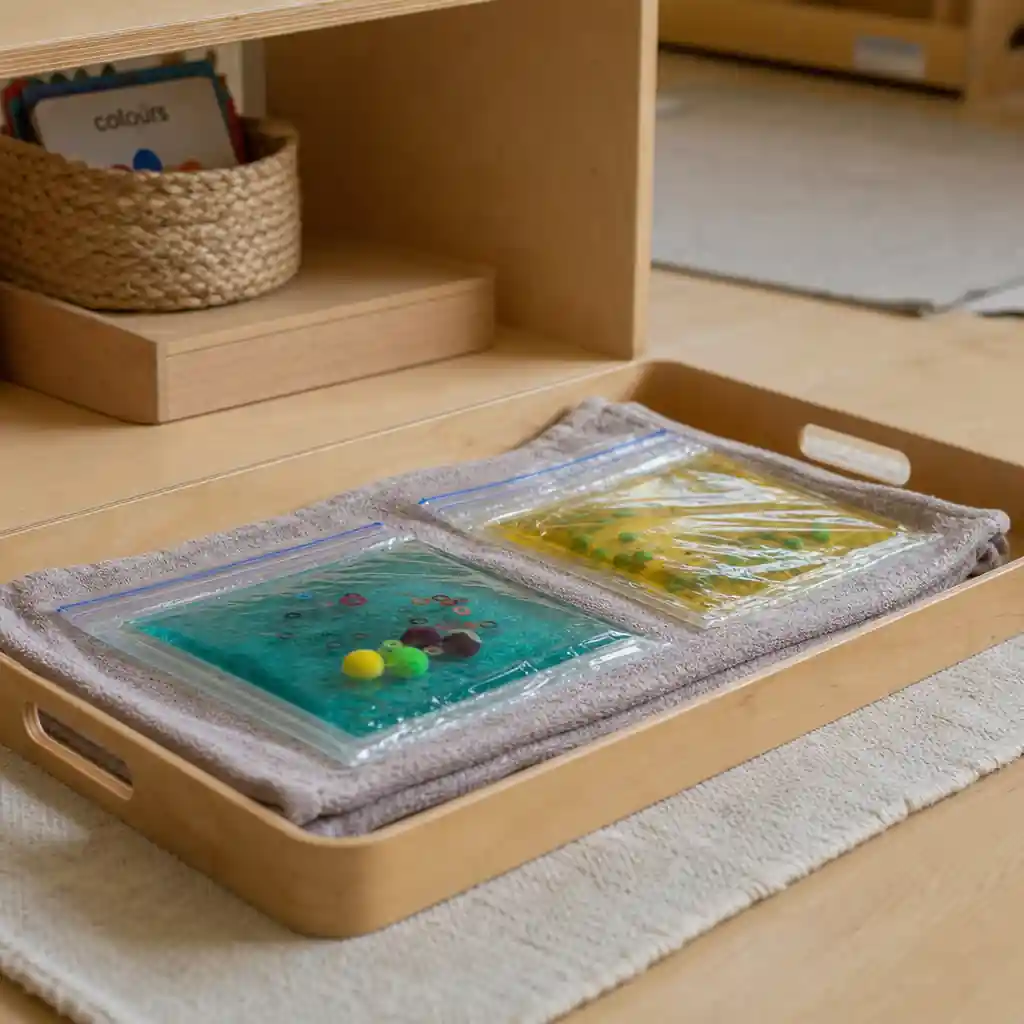
Set out one or two pre-sealed sensory bags only, placed on a low, wipeable mat or shallow tray so the child can reach the bag without the adult lifting them. Remove extra props and keep colours muted; double-bag and tape edges beforehand and place a single towel under the bag to control slippage. Position the bag so its centre aligns with the child’s midline to isolate head lift, visual tracking and a small forward reach as the primary skills to practise.
Show the child once with a slow, silent demonstration: place the child briefly on their tummy, press the bag to make a small visible ripple and then step back. Keep comments to brief labels for what you see and a calm safety reminder, then limit prompts and avoid questions. Observe instead for signs of controlled head lift, steady eye tracking, midline hand placement, repetition or fatigue, and whether the child returns to the activity without adult coaxing.
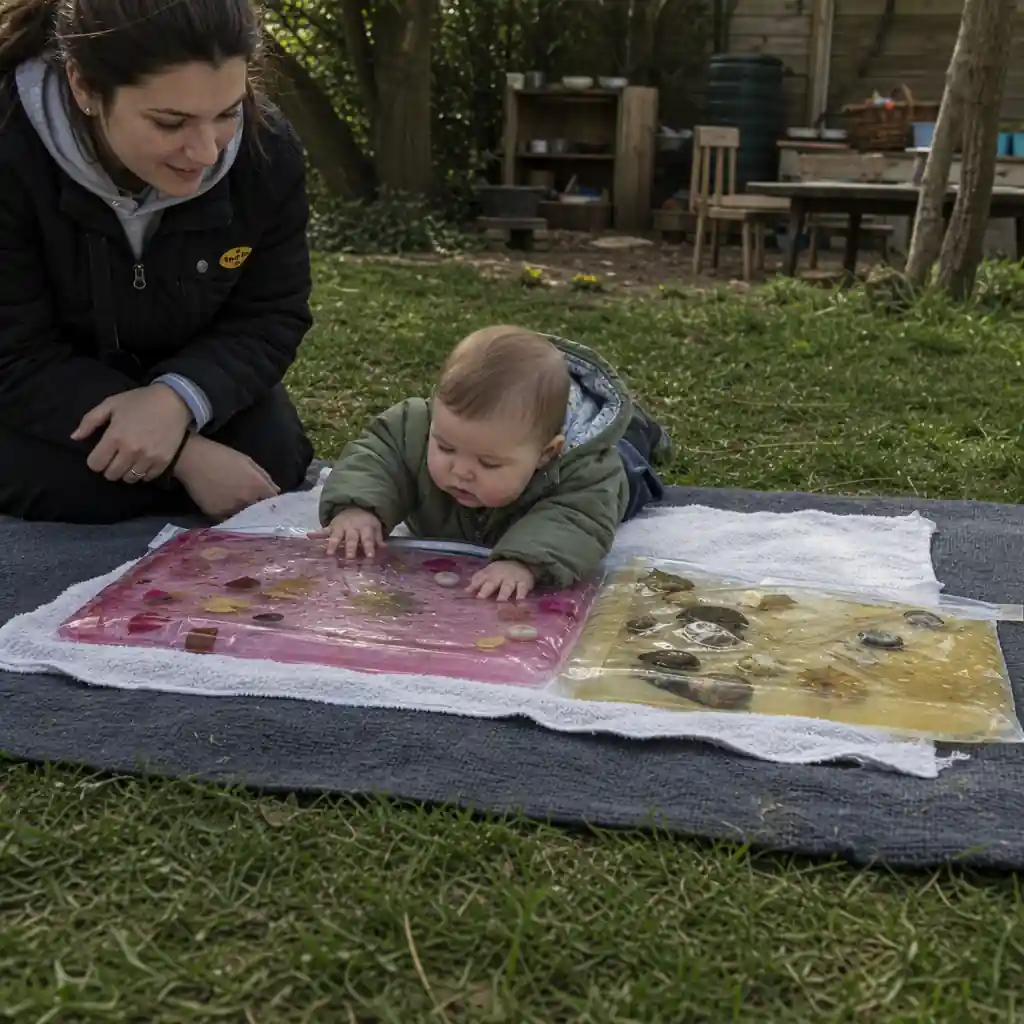
In an outdoor or nature-integrated space, set the mat on grass, a sheltered patio or beneath a low branch so natural light and gentle breeze vary sensory input. Materials are arranged using the sealed bags but filled with simple natural items — water tinted with a little beetroot or chamomile infusion, a few large petals, smooth pebbles or broad seed pods and a separate bag with cooled, fully sealed stones instead of frozen peas — all double-bagged and taped. An absorbent towel sits under the bags on the mat.
The adult observes from close by, kneeling or seated at child level to check seals and offer one-word labels or brief descriptions only when children look for interaction. Children choose their own tummy time rhythm, may press, track moving petals or stones, shift weight and reach as they wish, and may return to the same bag or move between bags. The adult monitors safety, swaps any compromised bags quickly, and uses minimal prompts to support comfort and interest.
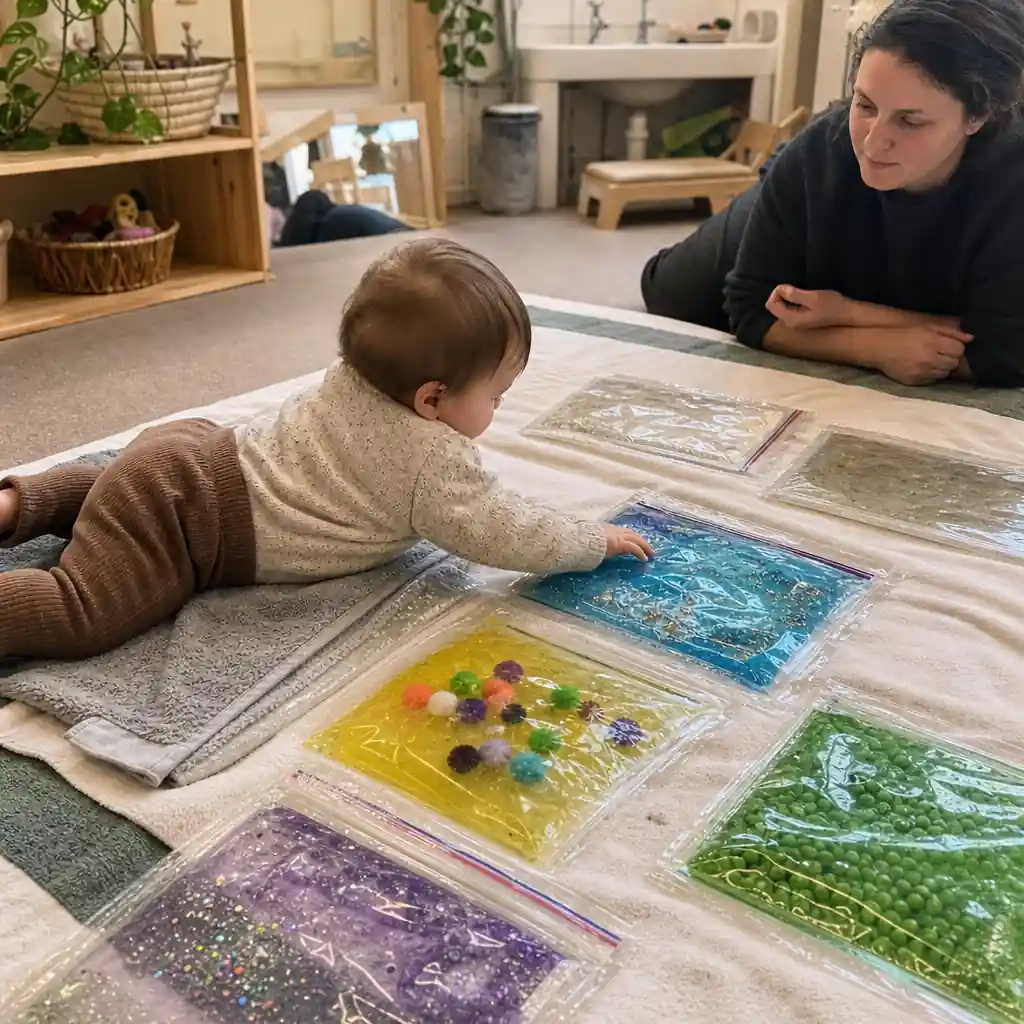
Arrange the play surface so several sealed sensory bags sit openly on a low, non-slip mat within easy forearm range rather than being handed to the child. Vary contents (clear water, oil layer, pom-poms, frozen peas) and temperatures across bags and space them so the child can choose where to look or press; replace rigid single-outcome kits with these loose, reconfigurable options. Keep spare reinforced bags visible and reachable to change the scene during the same session while maintaining safety and comfort.
The adult positions slightly back, at eye level, observing and offering reflective language such as "I can see the colour move" or "You’re trying to reach that floating pom-pom" and occasionally asking "What happens if you press here?" The child may shift weight, pause, repeat a reach or abandon and return; the adult notices gaze length, shoulder lift, handedness and signs of fatigue and records these moments as embedded observation rather than adding instructions.

A quiet corner is prepared with soft natural light, a folded wool blanket for tummy support, and a neutral cotton cloth marking a small working area. The materials are arranged simply: two or three tightly sewn linen or silk pouches (double-stitched) filled separately with fine dry sand, millet, or a few smooth flat wooden discs, set on a stable wooden board to give gentle resistance. A rolled wool cloth is available to support the chest if needed, and a cotton towel sits at the edge; seams are checked before use and after each turn.
The adult settles the child calmly, demonstrates one slow forearm press into a pouch, then remains close and quiet, watching breathing, head lifts, and signs of comfort or fatigue. Words are sparse and accurate, offered in response to the child’s attention, such as naming “sand,” “press,” or “rest.” The child returns to small shifts of weight, pausing and repeating presses, reaching toward a chosen pouch, and tracking the subtle movement under the fabric; pacing stays child-led with unhurried repeats.