Tummy time sensory ball play with textured silicone balls in a shallow water tray for babies
Sensory Play
Communication and Language
Tummy Time
Children explore textured silicone balls during tummy time with a shallow water tray placed within comfortable reach, supported by an adult staying close. The experience may invite looking, reaching, grasping, and noticing wet and dry sensations without turning it into a task. Adults pay attention to head control, weight shifts, and signs of fatigue, adjusting positioning and language to match the child’s cues.
This tummy time experience offers babies a calm, motivating reason to lift their head, shift their weight, and reach forward. Textured silicone balls in a shallow water tray provide gentle movement, sound, and visual interest. Babies may explore through looking, touching, mouthing, and grasping, with the adult staying close and responsive.
Step-by-Step Guidance
1. Prepare the floor space with a non-slip mat and place the shallow tray on top so it cannot slide.
2. Add a small amount of lukewarm water to the tray base. Keep the water level very low so the balls can move but the tray remains shallow.
3. Place 2–4 textured silicone balls into the tray, spaced so they are easy to see and reach.
4. Position the baby for tummy time on the floor with the tray in front, close enough that the baby can reach with an extended arm. Stay at arm’s reach of the baby.
5. Allow the baby time to look and orient. Notice where their gaze goes and adjust the tray position slightly if needed so the balls sit within their visual field.
6. Support early reaching by gently rolling one ball a short distance within the tray, keeping movement slow and predictable. Pause to let the baby initiate.
7. If the baby touches the water or a ball, give time for repeated exploration. Name what you notice using simple words (wet, splash, bumpy, roll).
8. If the baby shows fatigue, offer a brief rest by changing position (for example, a short pause on their side or in arms) and return only if the baby settles and shows interest.
9. End by drying the baby’s hands and forearms, emptying the tray, and wiping the area to prevent slipping.
Learning Objectives
This activity supports Physical Development by offering opportunities for head control, shoulder stability, and reaching during tummy time. It also supports Communication and Language as adults model simple words for actions and sensations. Babies may begin to show preferences, anticipate movement, and sustain attention for short periods.
Adult Role
Stay emotionally attuned by watching for signs of effort, overstimulation, or discomfort, and respond quickly with a pause, repositioning, or a cuddle. Model simple, sensory language linked to what the baby is doing and noticing, such as wet, smooth, bumpy, roll, stop, and splash. Scaffold lightly by adjusting distance, slowing movement, or offering a ball closer, and step back when the baby is focused and initiating their own reaches. Observe how the baby uses eyes, head, and arms together, and use those observations to decide when to continue, when to simplify, and when to stop. Maintain safety by keeping constant supervision, keeping water very shallow, and ensuring all items are clean, stable, and too large to be a choking hazard.
Observation Cues
Tracks a ball with eyes across the tray or between two balls.
Shifts weight onto one forearm to free the other hand to reach.
Opens and closes fingers around a textured ball, or pats the water surface.
Shows signs of effort or fatigue (face down, fussing, pushing back) and recovers with a pause.
Responds to adult voice by turning head, pausing, or re-orienting gaze.
Mouths the ball or brings hands to mouth after touching water.
Time & Space
5–15 minutes, depending on the baby’s tolerance for tummy time and interest.
A clear floor area for tummy time with room for an adult to sit close, plus a wipeable surface or mat under the tray.
Materials
Safety
Age adaptations
Budding Adventurers
Use a stable tray on the floor or a low table with 4–6 textured balls. Invite the child to help with simple setup choices, such as selecting which balls to use and placing them into the tray. Support language for describing textures and actions (bumpy, squishy, slippery, roll, push) and notice early problem-solving, such as trying different pushes to change how a ball moves. Keep expectations simple and sensory-led rather than task-led, and maintain close supervision around water and mouthing.
Curious Investigators
Use a wider tray and include a small range of silicone balls with distinct textures and sizes (still too large to be a choking risk). Offer a clear boundary for water play and provide a towel within reach so children can manage wet hands independently. Adults can introduce descriptive vocabulary (smooth, ridged, heavy, light) and invite children to notice patterns in movement without turning it into a test. Observe how children negotiate space, wait, and share materials, and step in to support calm turn-taking if needed.
Confident Discoverers
Use a large, stable tray and a curated set of textured balls that vary in firmness and surface pattern. Provide a simple way for children to manage the environment, such as a designated drying spot and a clear routine for returning balls to the tray. Adults can support richer language for describing sensations and movement and encourage children to explain what they notice in their own words. Observe sustained attention, self-regulation around water, and how children adapt their touch and force to achieve different effects.
EYFS Links
Physical Development: Tummy time with reachable objects can support head lifting, shoulder strength, and coordinated reaching, with adults adjusting distance and duration to match the baby’s cues. Communication and Language: Adults naming sensations and actions in the moment can support attention to words and early understanding, especially when language is repeated and linked to what the baby is looking at or touching. Personal, Social and Emotional Development: A calm, responsive adult presence can support the baby’s sense of safety during effortful movement and help them regulate when they need a pause.
Ethos adaptations
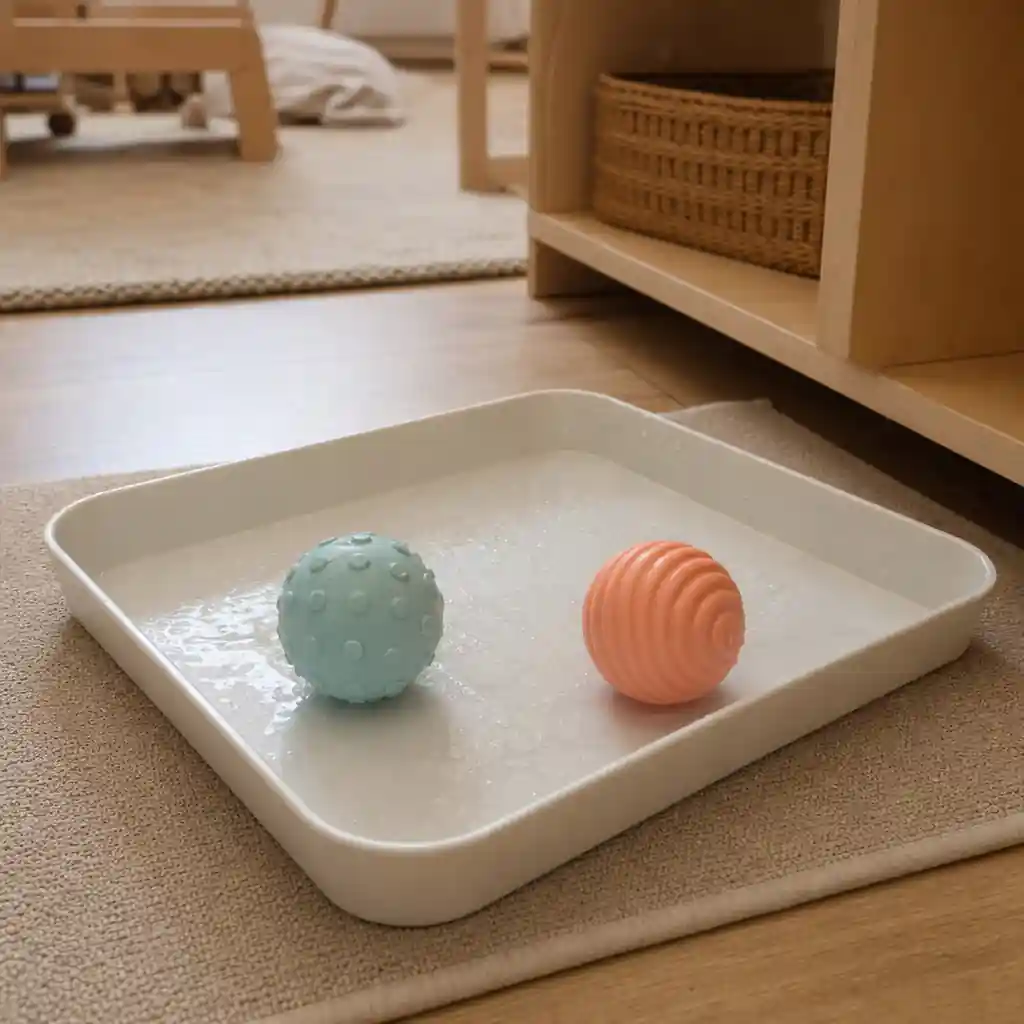
Place only two large silicone balls in the wide, low-sided tray with a very thin layer of lukewarm water, set on a non‑slip mat. Clear the area of other items and put the clean towel within easy reach but out of the baby’s sightline. During tummy time, position the tray directly in front of the baby so the rim is level with the chest. Set one ball just within comfortable reach and the other slightly farther to invite a simple reach. The tray edge and ripples act as clear feedback.
Give one slow, quiet demonstration: roll a ball once to show the movement, then pause. Stay within arm’s reach but keep hands still and language minimal—name a single action or sensation only when the baby looks or touches, then return to silence. Avoid moving the balls for the baby. Observe head lifts and how long they’re held, weight shifting to one forearm then the other, hand opening to grasp, visual tracking, repetition, signs of fatigue, and any clear preference for one ball.
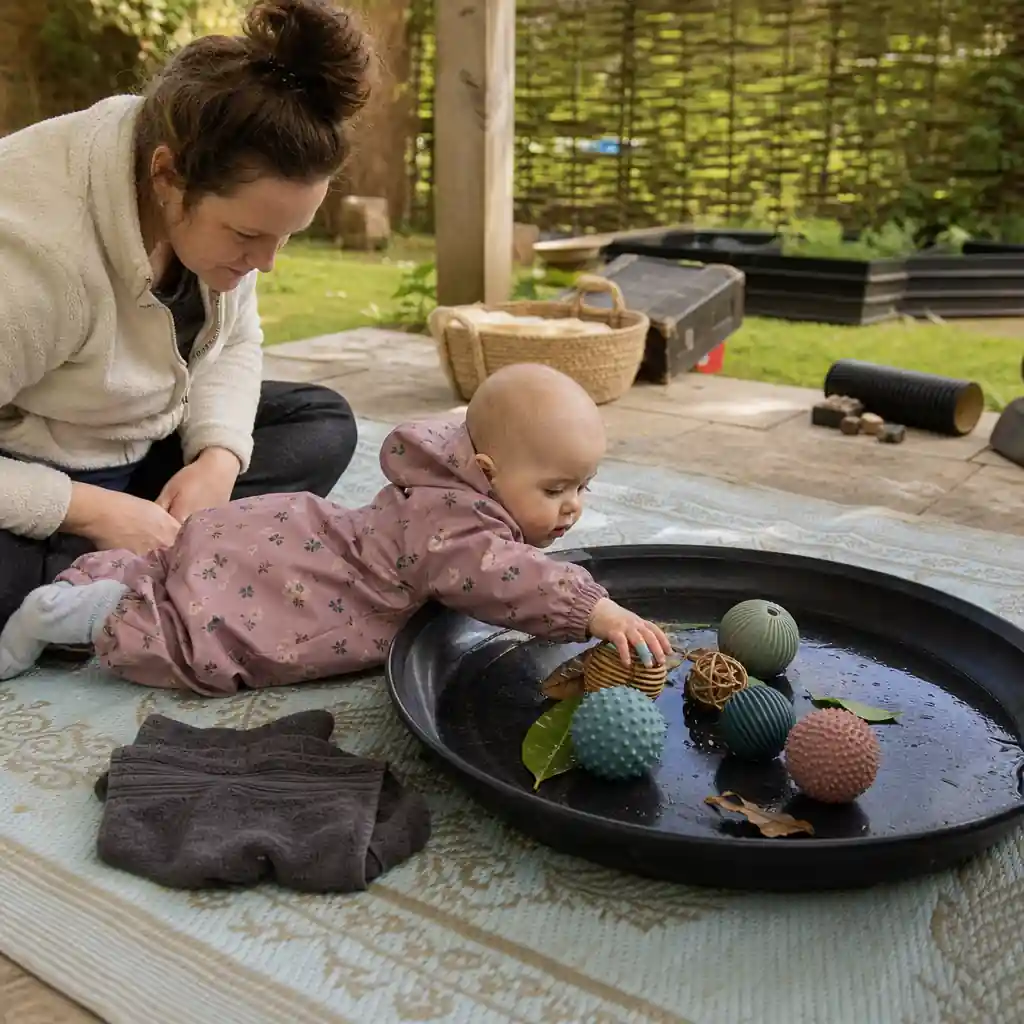
In an outdoor or nature-integrated space, set the shallow tray on a waterproof mat in a sheltered spot on a patio or lawn so the baby is on a non-slip surface with natural light and gentle airflow. Materials such as a few large woven rattan or smooth wooden sensory balls, broad floating leaves or dried seed pods, and slightly damp natural fabric are provided in an open-ended way rather than pre-arranged; the tray holds just enough lukewarm water to wet the base and allow gentle movement of items.
The adult observes from close by at baby level, remaining nearby to manage safety and temperature while using minimal, responsive language like single words or short phrases. Children choose how long to reach, mouth, or push objects and may repeat actions; the adult checks materials for safety, adjusts object distance or position on request, and steps in briefly to support settling or change posture while otherwise watching and responding.

Set the tray on a non-slip mat at floor level beside a clear tummy-time space, with soft light and minimal noise. Place 2–4 textured silicone balls where babies can see them: some resting in the shallow, lukewarm water and one or two dry on the tray edge or towel. Leave gaps so hands can reach without crowding; keep the clean towel and optional waterproof mat visible and reachable. The open layout invites rolling, patting, splashing, mouthing, or ignoring water in favour of dry textures.
The adult stays close for safety and warmth, checking the water remains shallow and comfortable, and positioning at the baby’s eye level as observer and co-learner. Offer simple, descriptive language tied to the baby’s focus: “I can see ripples,” “You’re reaching forward,” “Smooth… bumpy,” then pause. Follow the baby’s shifts—bring a ball nearer only if signalled. The child may watch, splash, bat, or mouth a ball, setting the pace. Notice head lifts, weight shifts, grasp shape, eye-tracking, preferences, and cues for rest.

A quiet floor space is defined with a neutral wool or cotton mat, with a stainless-steel or enamel shallow tray set firmly on a folded towel to prevent movement. The tray holds a thin layer of lukewarm water. Only two to three large, smooth spheres are offered: sealed hardwood and cork balls, each too large to fit fully in the mouth. Colours remain natural and muted, with a dry cotton cloth nearby for hands and tray. The area is uncluttered so the sound and movement of water remain the dominant sensory focus.
The adult settles near the baby at floor level, demonstrates a slow roll of a ball through the water, then waits. Language is spare and linked to action, such as “wet,” “roll,” “stop,” repeated gently in the moment. The adult stays close for safety, adjusting distance by nudging a ball slightly nearer or farther to meet the baby’s reach, and pausing when the baby looks away. The child explores, returns to preferred balls, and the session ends with a calm, unhurried dry-down.