Transportation spotting hunt with a picture checklist on a clipboard for outdoor walks
Communication and Language
Understanding the World
Children use a simple picture checklist on a clipboard to notice transport and transport-related features in the local area. Adults support children to match what they see to images, record sightings in a way that suits them, and stay with any strong interests that emerge. The experience often brings out early categorising, shared attention, and descriptive language, and adults can watch for how children scan, point, and persist.
Children use a simple picture checklist to notice and identify different types of transport and related features in the local area. The focus stays on looking closely, matching what they see to images, and sharing observations in their own way. The activity can sit naturally within a short walk around the setting or neighbourhood and can be repeated to notice changes over time.
Step-by-Step Guidance
1. Prepare the route and stopping points. Choose a short loop with safe places to pause where sightlines are clear and the group can stand together.
2. Prepare the checklist. Use a sheet with 6–12 clear pictures that reflect what children are likely to see locally (for example cars, buses, bikes, delivery vans, planes if relevant, and a few transport-related signs).
3. Introduce the purpose briefly. Show the sheet and name a few pictures, keeping language simple and allowing children to point rather than repeat words.
4. Agree how children will record. Offer a choice of ticking, circling, dotting, or adding a sticker. Model one mark on the sheet without turning it into a worksheet task.
5. Begin the walk with a slow pace. Pause at the first stopping point and give quiet time for scanning. Hold the clipboard so children can see and reach it, or offer individual clipboards if available.
6. Support noticing and matching. When a child indicates something, help them compare it to the pictures and decide whether it matches. Accept close matches and children’s own categories.
7. Keep the flow child-led. If children become interested in one item (for example a bus stop or a loud vehicle), stay with that interest and reduce the pressure to complete the sheet.
8. Use repeated pauses. Move between a few planned stopping points, allowing time for children to look, listen, and record in short bursts.
9. Close the activity calmly. Back at the setting, place the completed sheet somewhere visible. Offer a brief recap using the sheet as a prompt, and note any items children want to look for on another day.
Learning Objectives
Children may build Communication and Language as they name what they notice, listen to others’ ideas, and use simple descriptive words. Children may develop Understanding the World by noticing features of their local environment and how transport is used within it. Children may also practise aspects of Physical Development through walking, stopping safely, and handling a clipboard and mark-making tool.
Adult Role
Stay emotionally attuned by keeping the pace manageable, noticing when children need a break, and offering reassurance around loud noises or busy areas. Model simple, accurate language for what children notice, adding one extra word at a time (for example, blue car, long bus, loud motorbike) and repeating children’s own words back to them. Scaffold by offering a clear choice of how to mark the sheet and by helping children compare what they see to the pictures; step back when children are confidently spotting and recording. Observe in action by watching how children scan, point, categorise, and persist, and by noting which items prompt the most talk or curiosity. Hold responsibility for safety by choosing safe stopping points, maintaining group supervision, and positioning yourself between children and traffic where needed.
Observation Cues
Looks back and forth between the environment and the sheet to match an item
Points, gestures, or vocalises to direct an adult’s attention to a vehicle or sign
Uses category words such as car, van, bus, bike, plane, or makes their own labels
Notices differences such as fast/slow, loud/quiet, big/small, near/far
Waits at a stopping point and checks for adult cues before moving on
Shows persistence by continuing to scan even when nothing is immediately visible
Time & Space
15–35 minutes depending on route length, group size, and children’s interest.
Outdoor route around the setting grounds or local streets with at least two safe stopping points and enough space for the group to stand together away from traffic flow.
Materials
Safety
Age adaptations
Budding Adventurers
Use 6–8 pictures including one or two transport-related features (for example traffic light, crossing). Offer a choice between ticking and circling, and let children carry the clipboard for short stretches with adult support. Add simple comparison prompts such as big/small or fast/slow linked to what they can see and hear. Build in a return-to-base moment where children can show the sheet to an adult and name one item they found.
Curious Investigators
Use 8–12 pictures and include a few that may not appear every time (for example ambulance, plane) to support prediction and revisiting. Encourage children to add their own mark or quick drawing for something not on the sheet. Invite children to notice patterns such as where vehicles stop, where people cross, or which direction vehicles travel, without turning it into a test. Offer small-group roles such as sheet holder, marker, and spotter, rotating if children want to.
Confident Discoverers
Use a checklist that includes categories (wheels, wings, emergency, delivery) alongside pictures, and leave space for children to add one new item. Encourage children to justify matches using observable features (for example has two wheels, has flashing lights) and to notice environmental cues like road markings or signs. Offer a simple tally option for repeated sightings (for example counting how many buses) if children choose it. Support children to take more responsibility for the clipboard and recording, with clear boundaries about stopping points and staying with the group.
EYFS Links
Communication and Language: Children may use words, gestures, and attention to share what they notice, and adults can extend vocabulary linked to real objects in the environment.
Understanding the World: Children may notice features of their local area and begin to connect transport to places, people, and routines they recognise.
Physical Development: Children may practise walking safely as part of a group, stopping and starting with control, and using a tool to make marks.
Personal, Social and Emotional Development: Children may take turns with the clipboard, manage waiting at stopping points, and feel more confident in familiar local spaces with adult support.
Ethos adaptations
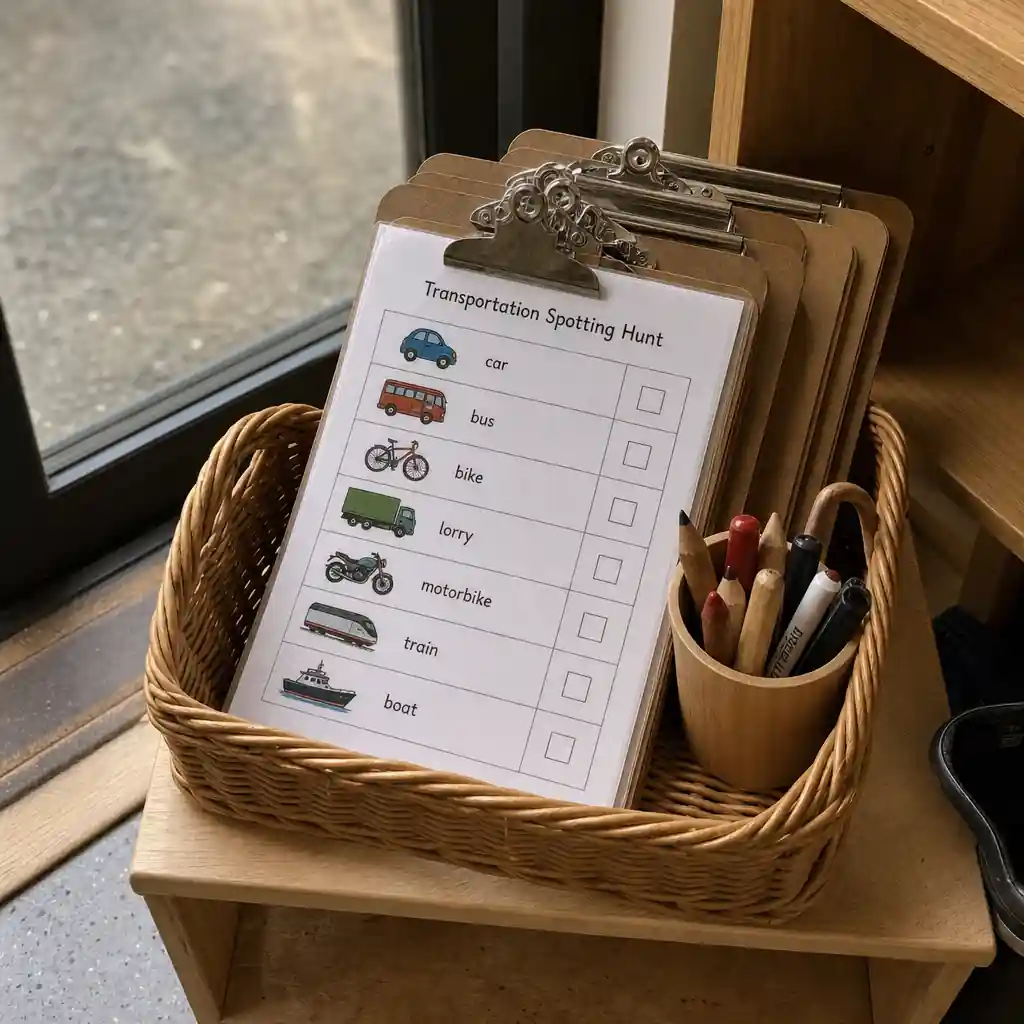
Prepare the walk as a clear, reduced set-up: place one laminated A4 spotting sheet on each lightweight clipboard with a single chunky pencil or dry-wipe marker, and store extras out of view. Arrange clipboards in a low basket at the door so children take one independently; remove stickers or extra tools unless a child needs them, keeping the task to matching picture to sight. Limit the checklist to 6–8 common transport images so the key skill is focused on noticing and matching during short stops.
Show the sequence once with a slow, silent demonstration: take a clipboard, point to an image, look up, and make a single mark. Then step back and use minimal language, only brief safety reminders. Observe rather than prompt—note each child’s ability to match image to object, signs of sustained concentration, control of marking, and how they wait or share the clipboard—using those observations to decide when to offer a brief, specific prompt.

In an outdoor or nature-integrated space, the route includes a mix of pavement, grass and a sheltered green corner so children encounter different surfaces and nearby transport features. Materials are arranged on small wooden clipboards or waterproof paper tied to lanyards: picture sheets, a chunky pencil or crayon, and a small pot of natural tokens (pebbles, leaves) for marking finds instead of relying on stickers. Children may collect a token and place it on the matching picture or on a tray to record what they notice.
The adult observes from a safe distance, briefly modelling road-side safety and checking anchors or lanyards, then steps back to listen and respond with short prompts. Children choose when and where to stop, point, talk or place a token, taking turns with the clipboard as needed; the adult responds with concise questions or single-word labels, supports crossings and manages risk without directing how children complete their sheets.
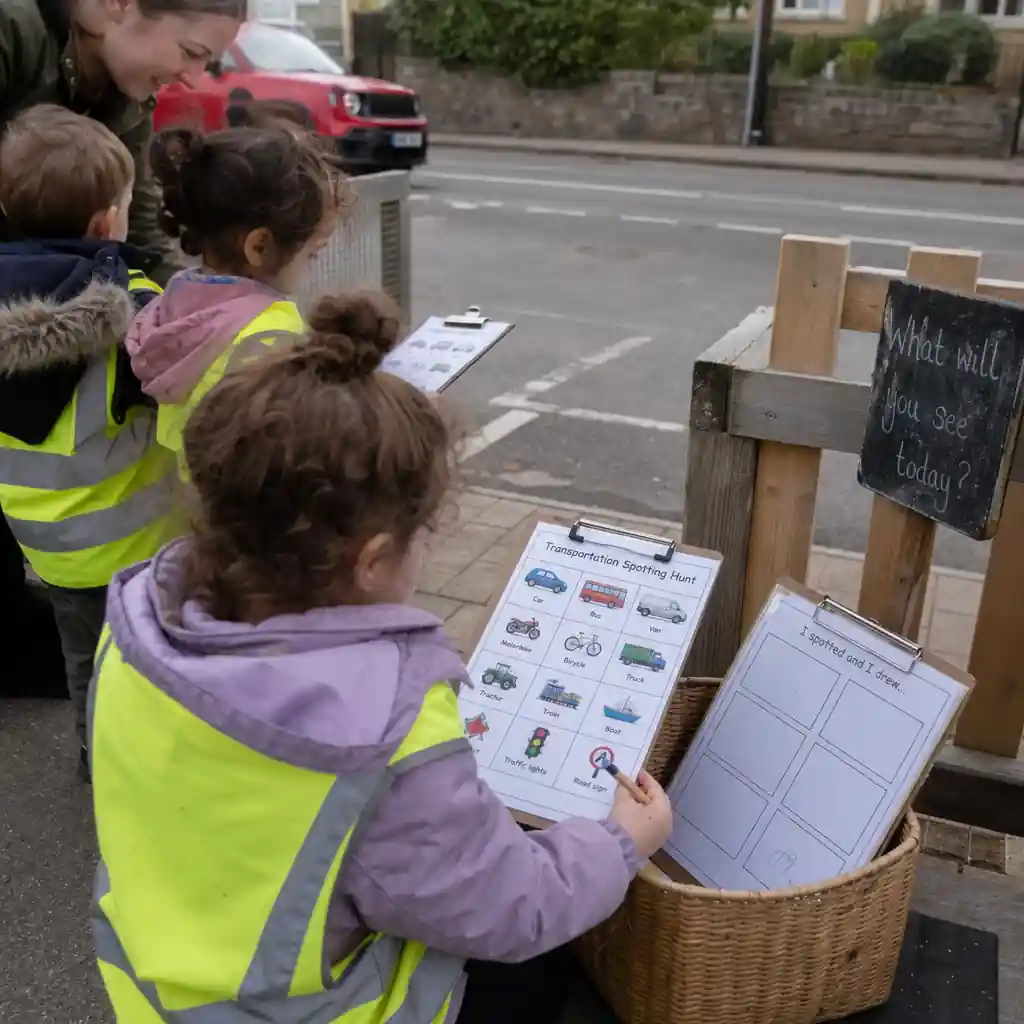
Arrange the outdoor route as a self-service exploration so materials invite choice: several clipboards resting in a low basket near the gate, a mix of A4 vehicle-spotting sheets including one with blank boxes for child-drawn signs, laminated and ready with chunky pencils, crayons or dry-wipe markers and optional sticker dots. Place stopping points where transport is visible and keep the clipboard accessible throughout the walk so the child may pick when and how to record, return, or abandon activity without a fixed sequence.
The adult steps back as observer and co-researcher, using commentary rather than instruction: “I can see a red bus—what happens if you draw it here?” or “You’re trying to decide which picture matches that sound.” The child may choose routes, which sheet to use, and whether to tick, draw or talk; the adult notices naming, pointing, negotiation, physical handling of the clipboard and marks, and records moments of comparing or repeating discoveries as embedded observation cues.

A short, familiar route is chosen with two or three calm pause points marked by a small natural-fibre cloth placed on the ground or bench. Materials are kept to essentials in a simple cotton pouch: a smooth wooden board, a vehicle-spotting sheet printed on unlaminated recycled card with clear line pictures, and a single soft graphite pencil or beeswax crayon. Optional synthetic items required by setting policy (such as safety clothing) are available at the edge and used when needed without adding visual clutter.
The adult demonstrates a quiet rhythm of walk–pause–look by softly stopping at a cloth marker, scanning the scene, and making one small dot or line on the card without commentary, adding words only for safety or to name a real object briefly. The child leads the spotting, choosing where to look and when to mark, and may place a small wool loop beside a picture they notice. The walk can be repeated on different days so the child returns to the same route, noticing changes over time.