Transferring water between different sized containers in a shallow paddling pool
Sensory Play
Children explore shallow water in a paddling pool using containers of noticeably different sizes, often returning to filling and emptying in their own patterns. Adults support by keeping the space safe and calm, offering a small set of well-chosen vessels and modelling simple words linked to what children notice. Practitioners may pay attention to how children adjust their grip, manage heavier containers, and negotiate shared access to favourite items.
Children explore shallow water in a paddling pool using containers of different sizes. The focus is on transferring, filling, emptying and noticing how water behaves in each container. The experience can feel calming and repetitive for some children and energetic for others, depending on how they choose to use the resources.
Step-by-Step Guidance
1. Choose a flat outdoor surface and place non-slip matting or towels around where the paddling pool will sit.
2. Set up the paddling pool with shallow water only, keeping the water level low enough for safe supervised play.
3. Place a small selection of different sized containers beside the pool, spaced so children can see each option clearly.
4. Invite children to approach in their own time. Allow them to choose containers and begin filling, emptying or carrying water in ways that make sense to them.
5. Stay close and watch for how children manage weight and balance as containers fill. Offer a second container or reduce the number of items if the space becomes crowded.
6. Model a small amount of language linked to what children are doing, such as fill, empty, full, more, heavy, light, pour, drip, splash.
7. If a child is unsure, demonstrate one simple transfer and return the container to the child, keeping the play child-led.
8. Support turn-taking if needed by naming what you notice and offering a clear way to wait, such as placing chosen containers in a nearby tray.
9. End by helping children place containers into a collection tray and offering towels for drying hands and feet. Check the area for slipping hazards and remove excess water from the ground.
Learning Objectives
Children may develop Physical Development through hand and arm control as they lift, tip and steady containers. They may explore early mathematical thinking in Understanding the World by noticing capacity, volume and cause-and-effect in water movement. Communication and Language can be supported as adults model simple words for actions and quantities during play.
Adult Role
Stay emotionally attuned by noticing children’s comfort with water, proximity, and sensory preferences, and respond calmly to signs of uncertainty or over-excitement. Model simple, accurate language for actions and quantities, keeping phrases short and linked to what the child is doing. Scaffold only when needed, such as steadying a container briefly, offering a smaller option, or reducing the number of containers, and step back when the child is managing independently. Observe patterns in repeated actions, problem-solving attempts, and how children negotiate space and resources. Maintain active supervision at all times around water, manage the environment to reduce slipping, and intervene promptly if play becomes unsafe or too rough for the space.
Observation Cues
Chooses a container for a purpose (to fill quickly, to pour carefully, to carry). Repeats the same transfer action many times and adjusts grip or speed. Notices differences in how long filling takes with small versus large containers. Uses two hands to steady a container or switches hands when tired. Watches the water stream and changes angle to reduce splashing. Seeks adult attention to show a full container or a successful pour.
Time & Space
15–40 minutes, depending on weather, group size and children’s interest.
Outdoors on a flat surface with room for the paddling pool and a dry perimeter for standing and walking. Access to towels and a place to put wet items.
Materials
Safety
Age adaptations
Budding Adventurers
Add a wider variety of container shapes, including a narrow jug and a wide tub, so children can compare how pouring feels and looks. Encourage children to choose their own “job” (filling, carrying, emptying) without assigning roles, and support them to notice when a container is too heavy to lift safely. Model language for comparison such as bigger, smaller, more, less, heavy, light, and pause to let children test their own ideas. Provide a nearby collection tray so children can reset the space independently when they want to change tools.
Curious Investigators
Include containers that invite more controlled pouring, such as a small jug with a spout alongside open tubs, so children can explore different water streams. Support children to make simple predictions about which container will fill faster or hold more, without turning it into a quiz. Encourage cooperative play by offering enough space and a clear place to return containers, and step in only if conflicts persist. Notice and name strategies children use to reduce spills, such as slowing down, using two hands, or changing the pouring angle.
Confident Discoverers
Offer a broader set of containers with clear capacity contrasts, including one large container that requires careful handling when filled. Invite children to organise the containers by size or create their own self-chosen challenges, such as transferring without splashing, while keeping expectations flexible. Extend language with capacity-focused words such as nearly full, half, empty, and compare, and encourage children to explain their thinking in their own words. Observe leadership, negotiation and self-regulation as children manage shared resources and adapt their approach.
EYFS Links
Physical Development: Children practise coordination and strength as they lift, tip, carry and steady containers, adjusting their movements as the water level changes. Communication and Language: Adults can support vocabulary for actions and simple concepts by naming what children are doing and responding to their attempts to communicate needs or ideas. Understanding the World: Children explore cause-and-effect as water flows, splashes, drips and changes level, and they may begin to notice differences in capacity between containers. Personal, Social and Emotional Development: Shared water play can support turn-taking, managing frustration after spills, and negotiating space when adults model calm boundaries and fair access to resources.
Ethos adaptations

Remove extra vessels and present three containers (small, medium, large) on a low tray placed at the pool edge so each sits in a fixed spot and is easy to reach. Keep the paddling pool water level low and place one measuring mark or taped line on the jugs to isolate filling to a single visible target; provide one shallow return bucket for used containers and a single towel. This reduces choices and makes the core skills—lifting, steady tipping and judging volume—clear and repeatable.
Give a single, slow demonstration: show lifting a filled container, pour to the marked line once, then place the container back on its tray and step back. Limit language to brief safety reminders and one-word labels if needed; avoid prompts or questions. Observe whether the child repeats the action, shows steady control and corrections (slower pouring, realigns container), how they manage spills, and signs of sustained concentration or withdrawal rather than directing the play.
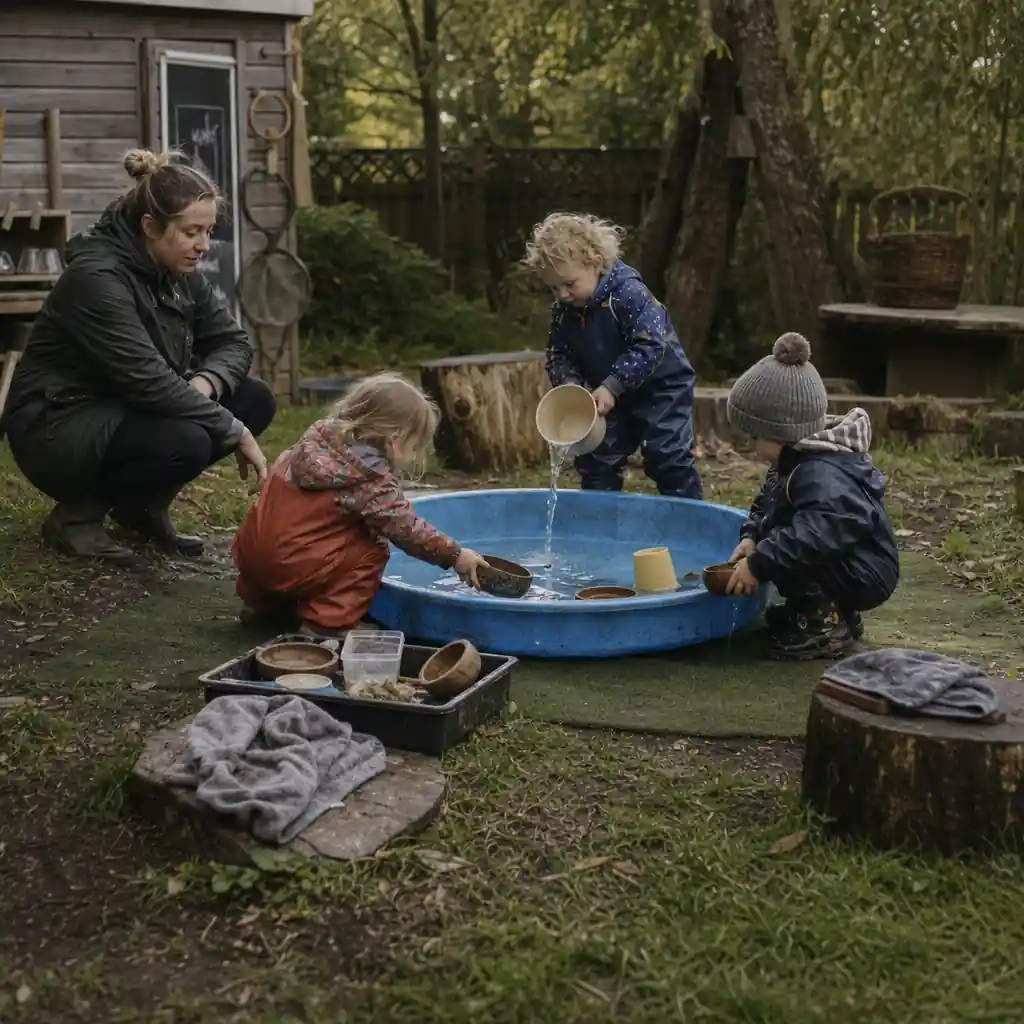
In an outdoor or nature-integrated space, move the shallow paddling pool to grass or a sheltered patio with nearby logs and stones for seating; allow gentle slopes and uneven ground under supervision. Materials are arranged to favour real, open-ended items such as wooden ladles, hollowed gourds or smooth stone bowls alongside a few plastic tubs for comparison, plus towels and non-slip mats. Children may also use leaves, shells or pebbles to explore displacement and splash patterns rather than following a fixed sequence.
The adult observes from close by, checking water depth and footing and offering single-word prompts or brief questions only when needed, rather than step-by-step direction. Children choose containers, roles and rhythms, repeating filling, tipping and carrying at their own pace and testing capacity with found materials; the adult intervenes to manage risk (drying, changing clothes, steadying a child) and mirrors simple vocabulary or labels in response to children’s actions.

Set the paddling pool in a low table arrangement or on the floor with clear, reachable gaps so several children can approach from different sides; group containers by size and leave the shallow tray and spare bucket visible rather than handed out. Replace any single-use framing with open-ended prompts: containers remain available for reuse, emptied and combined in different ways, and the pool edge becomes a working surface for balancing, pouring, or resting tools. Non-slip mats and towels are placed nearby to support safe, independent movement without adult direction.
The adult adopts an observing and co-researcher stance, keeping hands off while using short commentary such as "I can see the water rise," "You’re trying to tip that slowly," or "What happens if you pour from the small cup into the large tub?" The child may repeat preferred actions, shift from filling to balancing, or create patterns of pouring and collecting; the adult notices hand strength, bilateral coordination, turn-taking and emerging capacity concepts within those patterns and records interactions as natural documentation.

Steady, contained area: a shallow wooden or galvanized basin sits on a low neutral cloth inside a shallow tray so water is visible but contained; only a small depth of clean water is used and natural-fibre mats sit around the edge. The materials are reduced to a few smooth wooden cups, stainless-steel ladles, small unglazed ceramic bowls and a cotton sponge; spare towels and a change of clothes remain on the periphery for safety. Bright plastics and extraneous toys are removed to keep the space calm.
The adult demonstrates a single, calm pour and steady handling of a wooden cup, remaining close but quiet and observant, using minimal language and modelling one or two simple words for actions or quantities. The child returns to transferring, filling and tipping at their own pace, repeating preferred motions; the adult intervenes only for safety or to quietly model steadiness, allowing the child-led rhythm and repeated trials to unfold without task-focused outcomes.