Throwing snowballs into hoops at different distances with optional number matching
Winter
Physical education
Outdoor exploration
Mathematics
Children throw soft “snowballs” towards hoops or tyres placed at different distances, exploring how aim and force change what happens. Adults may notice children adjusting their stance, choosing their own level of challenge, and repeating attempts to test an idea. The same materials can also be used for small-group counting and matching, using snowballs as a concrete quantity to handle and compare.
Children explore throwing “snowballs” into hoops or tyres placed at different distances. The experience invites children to notice how force, aim, and distance affect where an object lands. The same materials can also support simple counting and matching, using the snowballs as a concrete quantity to handle and compare.
Step-by-Step Guidance
1. Choose a clear throwing area with a safe backstop (a fence, wall, or open space) and enough room for children to stand behind a line.
2. Place 2–4 hoops/tyres on the ground at different distances. Keep the closest target large and easy to reach.
3. Prepare a container of “snowballs” and place it beside the throwing line so children can collect one at a time.
4. Introduce the invitation in simple terms: children can throw snowballs into the hoops and notice what helps them land inside.
5. Model one throw without coaching technique. Name what you notice in plain language (distance, strength, where it landed).
6. Support turn-taking by keeping the throwing line clear. Allow children to choose which hoop to aim for and whether to repeat or change target.
7. Adjust the challenge by moving a hoop slightly, changing the throwing line, or offering a larger/smaller target. Keep changes visible so children can link cause and effect.
8. Optional maths extension: place numeral cards near buckets/trays. Invite children to make a set of snowballs that matches a chosen numeral, or to count how many landed in each hoop.
9. Optional addition extension: offer two small trays and invite children to combine two small sets of snowballs and count the total, keeping numbers small and concrete.
10. Close by gathering snowballs together and inviting children to help return hoops/tyres, noticing which distances felt easiest or hardest.
Learning Objectives
Children may develop gross motor control and coordination through throwing, linking to Physical Development. Children may explore early maths through counting, comparing quantities, and matching numerals to amounts, linking to Mathematics. Children may practise attention and self-regulation as they repeat attempts and adjust their approach, linking to Personal, Social and Emotional Development.
Adult Role
Stay emotionally attuned, noticing effort and frustration and offering calm support without taking over. Model simple language for what children can see and feel, such as “near/far”, “hard/soft”, “miss/in”, and “more/less”. Scaffold only when it helps a child re-enter play, for example by reducing distance, offering a larger target, or suggesting one small adjustment; step back when children are repeating, experimenting, or negotiating turns. Observe patterns in how children choose targets, how they count, and how they respond to misses, and use these observations to decide whether to simplify or extend. Hold responsibility for safety by managing spacing, ensuring throws happen in one direction, and checking materials remain appropriate for the age group.
Observation Cues
Adjusts throwing force when the hoop is moved further away. Changes body position (stance, arm swing, release point) to improve aim. Counts snowballs with one-to-one correspondence, touching each item once. Matches a numeral card to a set of snowballs, or notices when a set has “too many/too few”. Persists after misses, or seeks adult support to manage frustration. Waits for space to throw and watches where others are throwing.
Time & Space
10–25 minutes
A clear indoor hall or outdoor area with a defined throwing direction and a safe backstop. Enough space for a waiting area behind the throwing line and a separate area for collecting snowballs.
Materials
Safety
Age adaptations
Budding Adventurers
Offer 2–3 hoops at clearly different distances and a visible marker for where to stand. Provide a limited number of snowballs (for example 5) to support counting and reduce scattering. Add simple numeral cards 1–3 with matching trays so children can make small sets. The adult supports one-to-one counting by slowing the pace and pointing to each snowball as it is counted, stepping back when the child maintains the count independently.
Curious Investigators
Offer 3–4 targets with one “challenge” distance and a choice of hoop sizes if available. Introduce a simple tally option: the adult marks a line for each successful throw into a chosen hoop, and children compare which hoop has more marks. Add numeral cards 0–10 for matching sets, keeping the focus on accurate counting rather than speed. The adult notices strategy talk and supports vocabulary like “further”, “stronger”, and “aim”.
Confident Discoverers
Offer varied targets (different sizes and distances) and invite children to set their own throwing line within a safe boundary. Add addition with two small sets (for example 2 and 3) using snowballs as counters, and invite children to check totals by recounting. Introduce simple recording choices such as writing numerals beside each hoop or drawing dots to represent successful throws. The adult supports children to agree rules fairly, notices accuracy in counting, and prompts children to explain how they know a total is correct.
EYFS Links
Physical Development: Children practise gross motor movements through throwing, adjusting force and aim, and coordinating eyes and hands. Mathematics: Snowballs act as concrete objects for counting, comparing quantities, matching numerals to amounts, and combining small sets for early addition. Personal, Social and Emotional Development: Turn-taking, coping with misses, and persisting with a self-chosen challenge can support self-regulation and confidence in trying again. Communication and Language: Adults can model and extend vocabulary linked to position, quantity, and simple reasoning as children describe what they notice.
Ethos adaptations

Set 3 hoops in a straight lane from near to far, each with a chalk dot in the centre. Mark one throwing line. Place one low basket with five snowballs beside the line; remove extras. Keep numeral cards 1–5 on a simple left‑to‑right strip at child height with one small empty tray beneath. Children can choose a card, count that many balls into the tray, or ignore it and just throw. Retrieval path is clear so balls are returned to the basket before the next turn.
Give one brief, slow demonstration with minimal words: stand at the line, look at the centre dot, underhand throw, collect all, return, then show choosing one card and counting that many into the tray. Say you’ll watch from the side, then step back and limit input to quiet safety prompts only—no scoring, praise, or hints. Observe distance choices, hand use, body alignment, and adjustments after misses. Notice repetition, steady aim, one‑to‑one counting, matching card to quantity, and signs of deep focus or fatigue.

In an outdoor or nature-integrated space, hoops or tyres are set on grass, bare earth or compacted paths at varied distances and slight slopes to introduce managed challenge. Materials are arranged openly: natural snowballs if available, large scrunched compostable paper balls, pine cones or large stones as alternatives, and sticks, stones or cones mark throwing lines. Numeral cards and small trays sit loose for choice rather than being fixed to a station, allowing the layout to change and be revisited.
The adult observes from nearby, checking safety and ball size, offering single-word prompts or brief questions only when children ask for help. Children choose where to throw, which material to use and whether to match numerals, collect their own sets, take turns and repeat experiments at their own pace. The adult responds with concise observations and steps in for risk management, otherwise supporting concentration and self-directed adjustment.
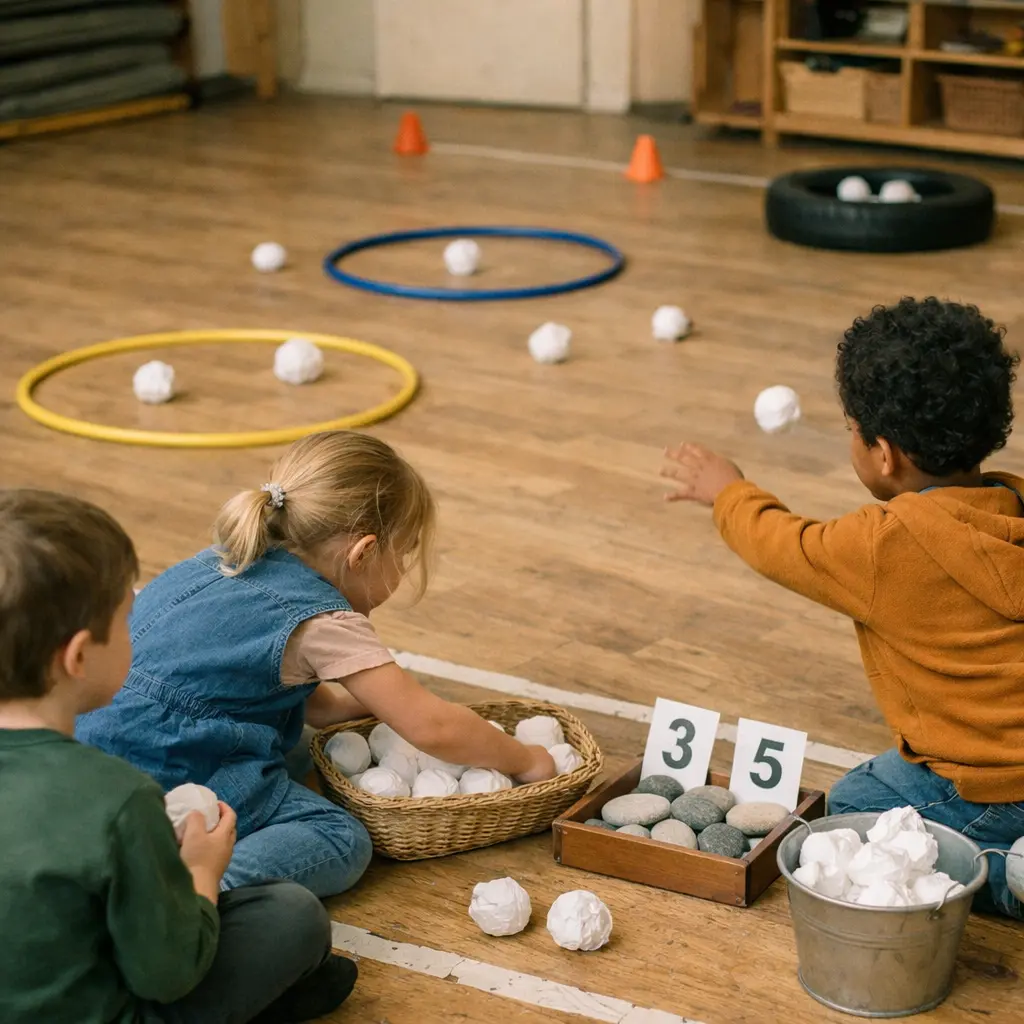
Ethos adaptation: Arrange the play area so hoops/tyres, throwing lines and containers are always visible and reachable; space them to create overlapping zones so children choose where and how far to throw. Replace single-use props with loose parts: a mix of soft white balls, fabric scrunches, shells or stones in trays, removable numeral cards and small buckets for collecting. Labels or fixed targets are avoided so the child may invent goals, combine materials, or repurpose lines as start points or score zones.
The adult steps back as observer and co-researcher, using commentary such as "I can see you’re testing that distance" or "What happens if you throw softer?" rather than giving instructions. The child may decide to focus on force, counting, matching numerals, or creating games with peers; turn-taking and persistence can emerge naturally. The adult notices repetition, adjustment of aim, and language around quantity and position as embedded observation cues to inform next steps.
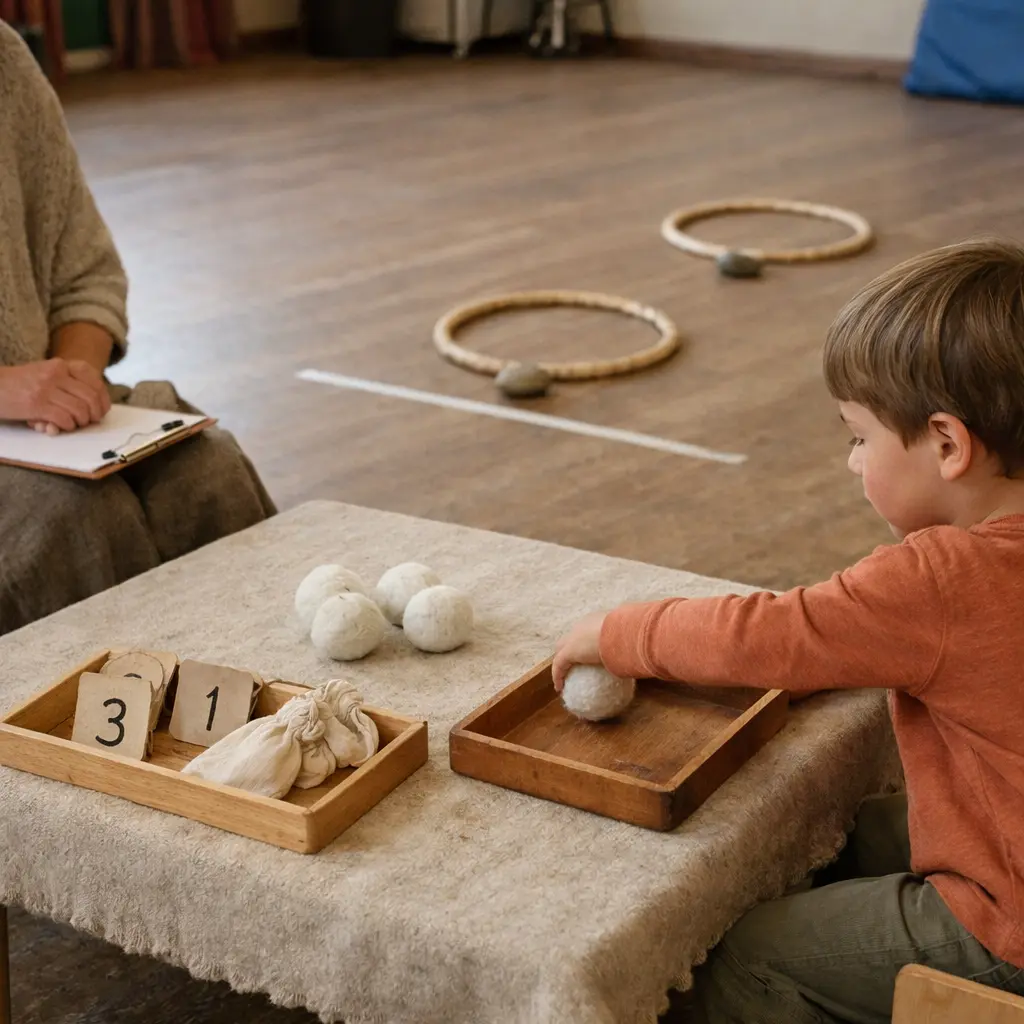
Steiner (Waldorf) Adaptation The materials are arranged on a neutral wool cloth to create a contained throwing area: only three hand‑rolled wool "snowballs," two wooden hoops or rope‑woven rings, and two smooth stones as distance markers are provided. A single shallow wooden tray holds numeral cards printed on recycled paper and small cotton pouches for sets; bright plastics, noisy markers and extra items are removed. The layout is simplified to one throwing line and one target area so repetition is clear and uncluttered.
The adult demonstrates a calm, single throw quietly and then steps back to observe, using minimal language and intervening only for safety. The adult models steady posture, retrieval and gentle handling, remaining close but unobtrusive. The child returns to repeated, self‑paced throws and may choose to count, match numerals to sets, or repeat attempts; the adult supports engagement by modelling and quiet presence rather than giving step‑by‑step instructions.