Collecting and comparing rainfall using outdoor containers and trays for early maths in wet weather
Mathematics
Children use outdoor containers and trays to collect rainwater and compare how much has gathered in different shapes and sizes. The experience supports early ideas of capacity and quantity through noticing water levels, fullness and simple ordering. Adults pay attention to the strategies children choose for comparing and how they use words like more, less and same. Materials stay robust and easy to handle in wet weather.
Children explore rainfall by placing different containers outdoors and noticing how much water collects in each one. The experience invites comparison of quantity, capacity and simple measurement in a real, changeable context. Children may return to the containers over time to see what has changed and to talk about what they notice. The focus stays on noticing, comparing and representing amounts in ways that make sense to the children.
Step-by-Step Guidance
1. Choose a safe outdoor area where rain can fall directly into containers and where children can move without crowding.
2. Select 4–8 containers with clearly different shapes (tall/narrow, wide/shallow, medium/deep). Include at least one clear container.
3. Place containers around the garden with some spacing. Keep placement simple and visible, avoiding slopes where containers may tip.
4. Introduce the idea that rain can be “collected” and invite children to decide where to put a few containers. Keep adult-placed containers as a steady comparison point.
5. Agree a simple check-in routine with children (e.g. look, point, compare) either during rainfall in waterproofs or by returning later.
6. Support children to compare without rushing to measure. Encourage noticing water height, fullness, and which container looks like it has more.
7. Offer a measuring jug only when children show interest in finding out “how much”. Demonstrate pouring slowly into the jug over a tray area, then hand back control.
8. Help children record comparisons in a simple way that fits the moment: ordering containers, using “most/least”, or making a quick group decision.
9. Close the activity by emptying containers safely with children if appropriate, or by choosing to leave them for a later revisit if the weather continues.
10. Reset the area to reduce slipping risks and store containers where they can dry.
Learning Objectives
Children may develop early mathematical thinking through comparing quantities and exploring capacity in a real-life context (EYFS area: Mathematics). Children may also build language for describing what they notice about water levels, more/less, full/empty, and changes over time (EYFS area: Communication and Language). The activity can support persistence and curiosity as children revisit observations and refine their comparisons (EYFS area: Characteristics of Effective Learning).
Adult Role
Stay emotionally attuned by checking children’s comfort with wet clothing, cold hands, and sensory preferences, and offer choices about observing from under shelter or going out in waterproofs. Model simple, accurate language for comparison and measurement, such as fuller, emptier, higher level, lower level, more, less, and about the same, without turning it into a test. Scaffold when children want to compare but are stuck, for example by suggesting two containers to compare side-by-side, and step back when children are confidently ordering or revisiting containers independently. Observe closely for children’s strategies (looking at water lines, lifting, tipping, ordering) and respond by naming the strategy and offering one small extension. Hold responsibility for safety by managing slippery areas, supervising any pouring, and keeping containers stable and away from walkways.
Observation Cues
Chooses containers for a reason (e.g. wide, tall, shallow) and can indicate a preference.
Uses comparative language such as more, less, same, fuller, emptier, higher, lower.
Notices that different shapes collect different amounts and points to water lines or depth.
Attempts to represent quantity by lining containers up, grouping, or ordering by “most to least”.
Shows care in handling water and adjusts actions to avoid spilling when trying to compare.
Returns to check changes and remembers what was seen earlier.
Time & Space
10–25 minutes, with optional revisits across the day depending on rainfall.
Outdoor area where rain can fall into containers, with a clear walkway and a nearby sheltered spot for observing or regrouping.
Materials
Safety
Age adaptations
Budding Adventurers
Provide 4–6 containers with obvious differences (very tall vs very shallow). Encourage children to place one or two containers themselves and to line them up for “most to least” using visual water height. Introduce a simple measuring jug as an optional tool for children who ask, with adult support for slow pouring and turn-taking. Keep recording informal, such as choosing a “most rain” container and checking again later.
Curious Investigators
Offer a wider range of containers including two that look similar but differ in width, to prompt deeper comparison. Support children to make predictions about which might collect more and to revisit to check, without requiring correct answers. Introduce simple units in context, such as counting jugfuls into a clear container, and encourage children to explain their reasoning using because. Invite children to create a simple ordering line and adjust it after a later check.
Confident Discoverers
Add a consistent “reference container” (same container used each time) so children can compare rainfall across different days. Encourage children to choose a fair way to compare, such as placing containers in similar open spots and checking at the same time. Offer measuring with a marked jug and support children to read approximate levels, using language like nearly, about, and just over. Invite children to represent findings with simple marks or tallies on a clipboard, focusing on their chosen method rather than accuracy.
EYFS Links
Mathematics: Children compare quantities and explore capacity by noticing different water levels and fullness in containers, and by ordering or measuring in simple ways. Communication and Language: Children build vocabulary for describing what they see and for explaining comparisons, supported by adult modelling of precise words. Understanding the World: Children notice weather effects and changes over time by revisiting containers and linking rainfall to what they observe outdoors. Characteristics of Effective Learning: Children may show curiosity by checking and re-checking, testing ideas about which container collects more, and adapting their approach when comparisons feel tricky.
Ethos adaptations
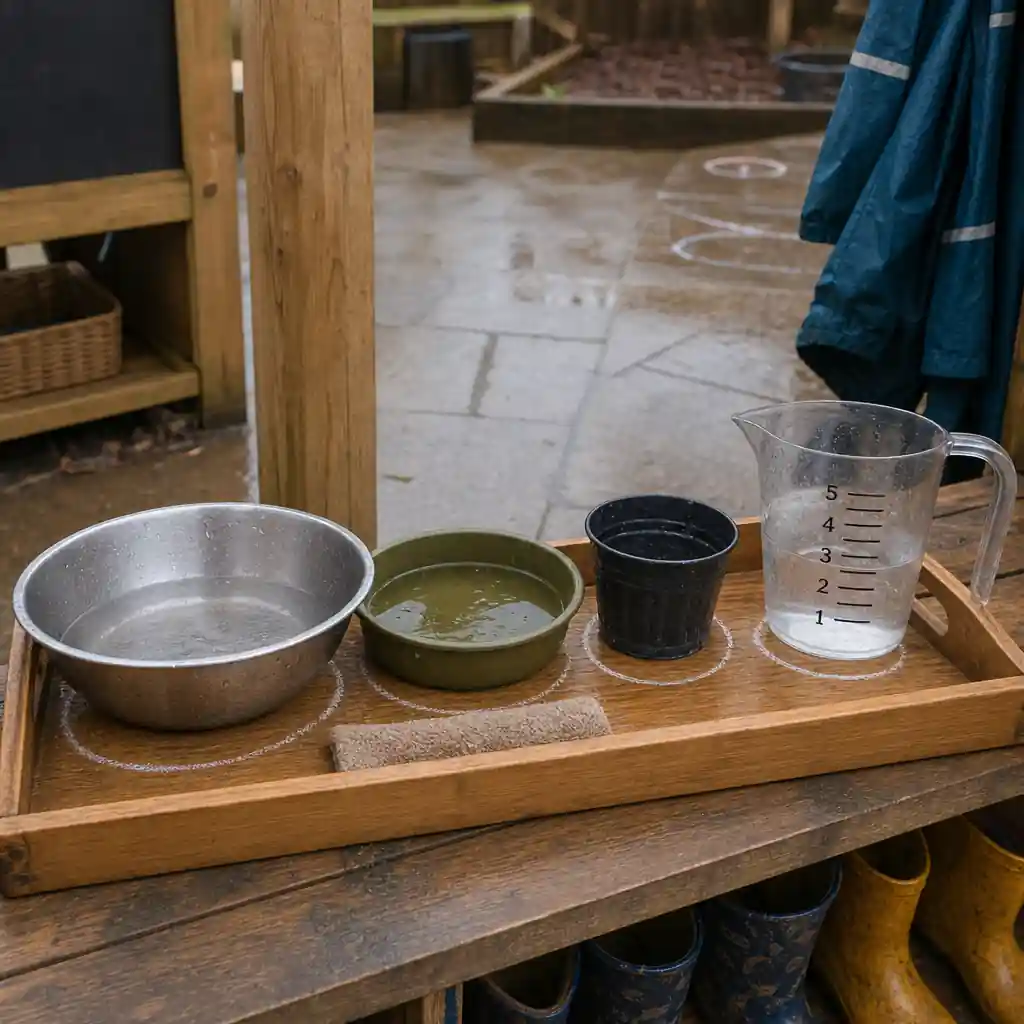
Set out three containers (bucket, bowl, tray) on a low, flat area, each on a chalked circle, arranged left-to-right from widest to narrowest. Add one clear jug with bold markings and place all items on or beside a single shallow tray for defined workspace. Remove spare containers and cups. Position so children can reach without stepping into beds; keep cloth nearby for spills. The key focus is comparing visible water levels; the jug acts as a common reference to the first big line for simple, self-checking pours.
Give a brief, quiet demonstration: point to the sky, look at the levels at eye height, then slowly pour from one container into the jug up to the first large marking, pause, and return both. Name just a few words—more, less, full, empty—then step back. Avoid questions and commentary. Observe who returns after rain, who orders containers by level, who pours steadily to the line (or notices overshoot), and signs of concentration or disengagement to decide whether to keep the setup available or simplify further.
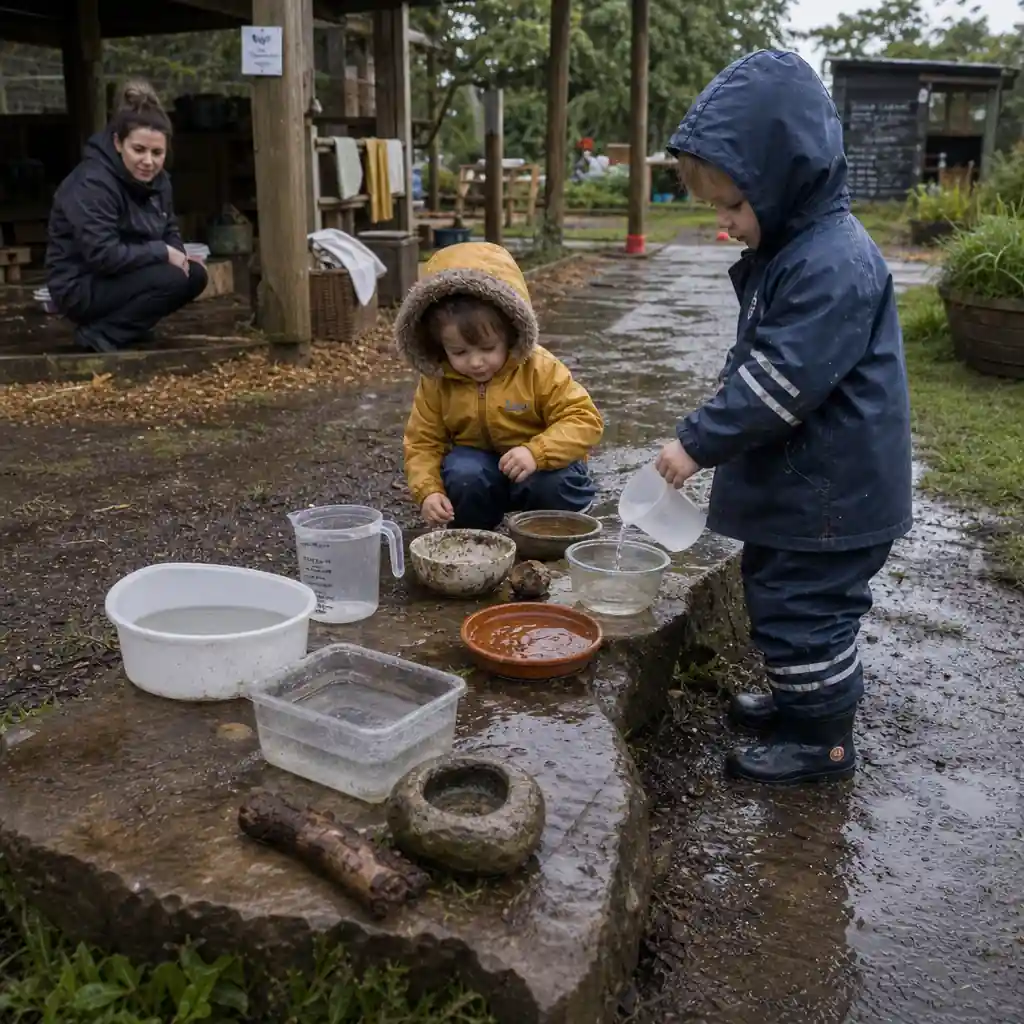
In an outdoor or nature-integrated space, move the trays and containers onto a sheltered patch of grass, a paved courtyard with puddles, or beneath a canopy so children can access them during wet weather; add natural receptacles such as half coconut shells, bark cups, stone hollows and plant saucers alongside the original containers. Materials are arranged on level stones or a low log to create varied collection points and to allow uneven surfaces to influence filling; clear containers remain for level visibility.
The adult observes from a short distance, checking anchors and safety, naming simple phenomena if asked and offering single-word prompts or short questions rather than instructions. Children choose containers, rearrange them, test placement on slopes or hollows, and may mark starting positions; they return to compare levels, tip, pour or lift under supervision and represent amounts in sand, leaves or chalk marks, with the adult responding only to manage risk and extend language briefly.
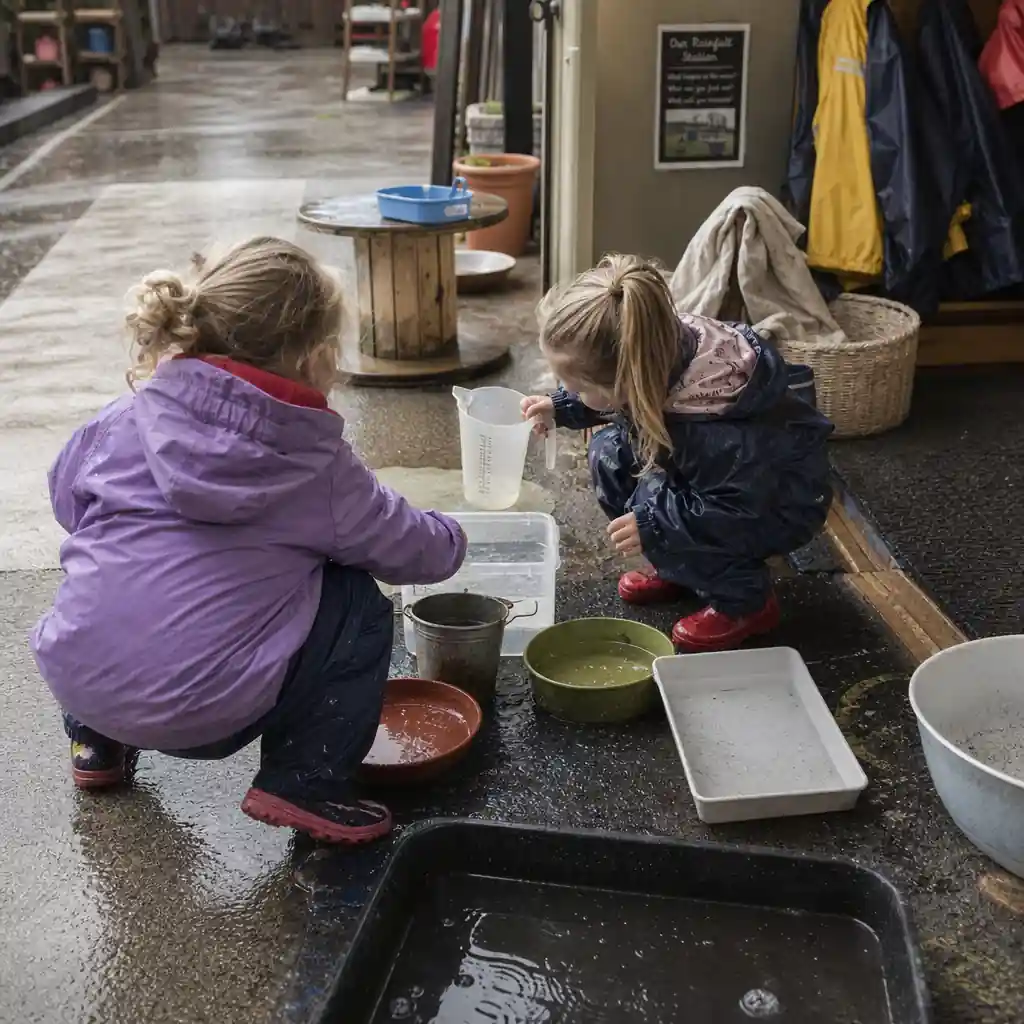
Ethos adaptation: Reconfigure the outdoor area into several low-level stations where the variety of provided containers and trays are openly accessible on stable surfaces rather than handed out one at a time. Place clear jugs and tubs beside opaque containers so children can choose and combine them, and leave waterproof clothing and cloths nearby for independent use. Materials remain loose and reusable; the layout invites children to place, move or group containers, to leave some out to collect rain, and to return without a prescribed sequence.
The adult steps back as observer and co-researcher, using brief commentary such as "I can see water collecting here" or "You’re trying to see which one holds more" and asking open invitations like "What happens if you move this one under the drain?" The child may decide where to position containers, how long to wait, and how to represent comparisons (ordering, drawing, or verbal labels). Observation cues are embedded: the adult notes repetition, shifting strategies, language development about more/less, and choices to combine or abandon containers.
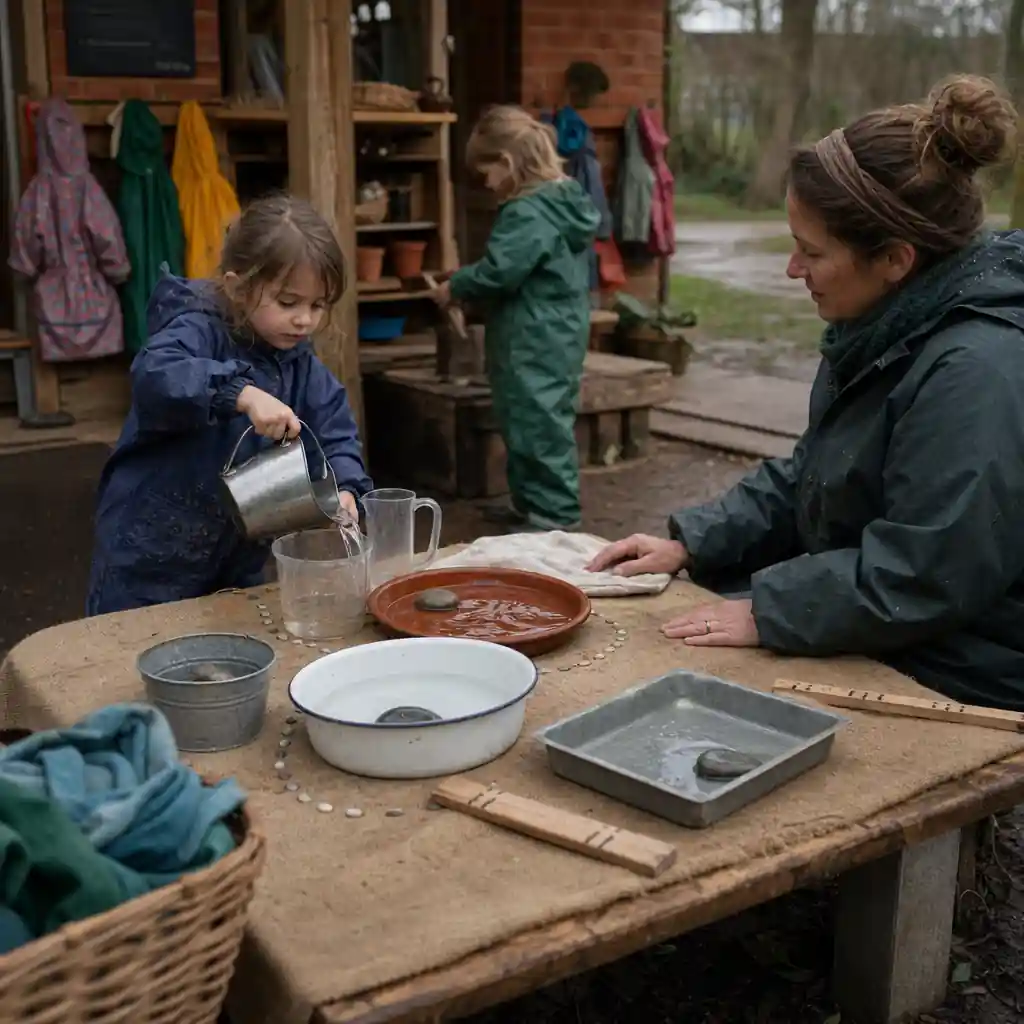
A calm corner outdoors is defined with a neutral ground cloth or a low wooden board, away from main walkways. The materials are arranged simply: a small galvanised metal pail, an enamel basin, a terracotta plant saucer, and a shallow metal tray, each weighted with a river stone and set on marked spots using a single chalk line or small pebbles. A couple of smooth wooden “depth sticks” with simple burn marks rest nearby. Waterproofs and absorbent cloths sit at the edge for safety and care.
The adult places the vessels before rain and later returns quietly, demonstrating steady checking without instruction: setting a depth stick upright, pausing to notice the wet mark, and making brief observational phrases such as “cool metal,” “more,” or “empty.” The child returns over time to look, touch, and compare by eye or with the same stick, and may pour between vessels using a plain metal jug. The adult remains close, observing and stepping in only for safety, allowing repeated, unhurried comparisons.