Spring counting garden with numbered pots, loose parts base and reusable flowers for ages 2–4
Mathematics
Understanding the World
A spring-themed collection of numbered pots, loose flowers and matching numerals offers an open counting invitation. The arrangement encourages noticing symbols, comparing quantities and playing with colour without fixing a set order. Adults may watch where mathematical curiosity meets aesthetic choice and choose subtle language prompts to deepen thinking.
Children explore a spring-themed counting area where numbers, quantities and colour sit alongside open-ended flower play. The experience invites children to notice numerals, compare amounts and make choices about how to arrange materials. It also offers a calm context for practising simple self-help routines such as selecting, carrying and returning resources.
Step-by-Step Guidance
1. Prepare the space indoors or outdoors with a stable surface and clear boundaries for where materials belong.
2. Add the chosen base material to the tuff tray/container to create a “garden” surface that can hold pots steady.
3. Place numbered pots around the tray edge or within the base so children can reach them without leaning across.
4. Put the number cards in a small basket within reach, with only the range of numbers you want available that day.
5. Offer the reusable flowers either scattered in the tray for immediate access or in a tall container to support selecting and carrying.
6. Invite children to explore freely, noticing whether they choose to match cards to pots, count flowers into pots, or focus on arranging by colour and pattern.
7. As children play, model one clear mathematical idea at a time (e.g. matching a numeral, counting into a pot, comparing two pots) and pause to allow children to take over.
8. If a child is ready, add a gentle challenge by changing the number range, offering fewer cards than pots, or encouraging them to check quantities by recounting.
9. Support a simple tidy routine by returning flowers to the container and cards to the basket, keeping it manageable and shared.
Learning Objectives
Children may develop confidence with number recognition and counting in the Mathematics area, linking numerals to quantities in a meaningful context. Children may also build vocabulary for comparing amounts and describing what they notice. The activity can support Personal, Social and Emotional Development through turn-taking, sharing space and persisting with a chosen challenge.
Adult Role
Stay emotionally attuned by noticing frustration, pride, or hesitation, and offering calm reassurance without taking over. Model simple, accurate language for number and quantity (for example: numeral names, count words, more/less/same) and keep sentences short so children can hold the idea. Scaffold when children show they want help (pointing, pausing, looking to you), and step back when they are repeating a strategy or testing their own solution. Observe how children choose to use the resources—whether they prioritise arranging, matching, counting, or social play—and use that to decide whether to extend, simplify, or leave the play uninterrupted. Maintain safety by checking small parts, supervising any base material that could be mouthed, and positioning resources to reduce tipping and reaching across others.
Observation Cues
Notices and names numerals on pots or cards, or avoids them and focuses on arranging flowers.
Counts objects with one-to-one pointing, or counts without tracking.
Uses quantity language such as more, less, lots, same, bigger, smaller.
Sustains attention with one idea (filling, matching, arranging) or moves quickly between resources.
Seeks help, checks with an adult, or self-corrects when quantities do not match.
Engages alongside others by sharing materials, copying ideas, or negotiating turns.
Time & Space
Set-up: 10–15 minutes. Play: open-ended with children choosing how long to stay.
Indoor or outdoor floor/table space for a tuff tray or shallow container, with enough room for 2–4 children to stand or sit around without crowding.
Materials
Safety
Age adaptations
Budding Adventurers
Use a small number range (for example 1–3) with large, clear numerals on pots and matching cards. Offer fewer flowers and larger base items to reduce scattering and support success with one-to-one counting. Adult support focuses on naming numbers as children touch them, counting slowly together, and accepting non-matching play such as filling and emptying as part of exploring quantity.
Curious Investigators
Offer a wider number range (for example 1–5 or 1–10 depending on the group) and include both numbered pots and separate number cards for matching. Encourage children to check their own counting by touching each flower as it goes into a pot, and to compare two pots using more/less/same. Adult support can include light problem-solving prompts such as noticing a mismatch and inviting a recount, without correcting immediately.
Confident Discoverers
Include a fuller set of number cards and pots, and allow children to decide their own system (matching first, counting first, or arranging by colour and then counting). Add a self-help element such as a simple “return station” for cards and flowers, and invite children to organise the space for others. Adult support can extend mathematical language by encouraging children to explain how they know a pot has the right amount and to notice patterns across numbers (for example, which pots fill quickly).
EYFS Links
Mathematics: Children can practise recognising numerals, counting with one-to-one correspondence, and linking a number symbol to a quantity using concrete objects. The open-ended format also supports comparing amounts and using everyday mathematical language such as more, less and same.
Understanding the World: A spring garden theme can prompt children to talk about seasonal change and flowers they notice in their environment, linking play materials to real-world experiences.
Personal, Social and Emotional Development: Shared access to attractive resources can support turn-taking, negotiating space, and persisting with a self-chosen challenge, with adult support for confidence and regulation.
Expressive Arts and Design: Children may explore colour, pattern and arrangement when creating flower displays, using materials in their own ways alongside the number focus.
Ethos adaptations
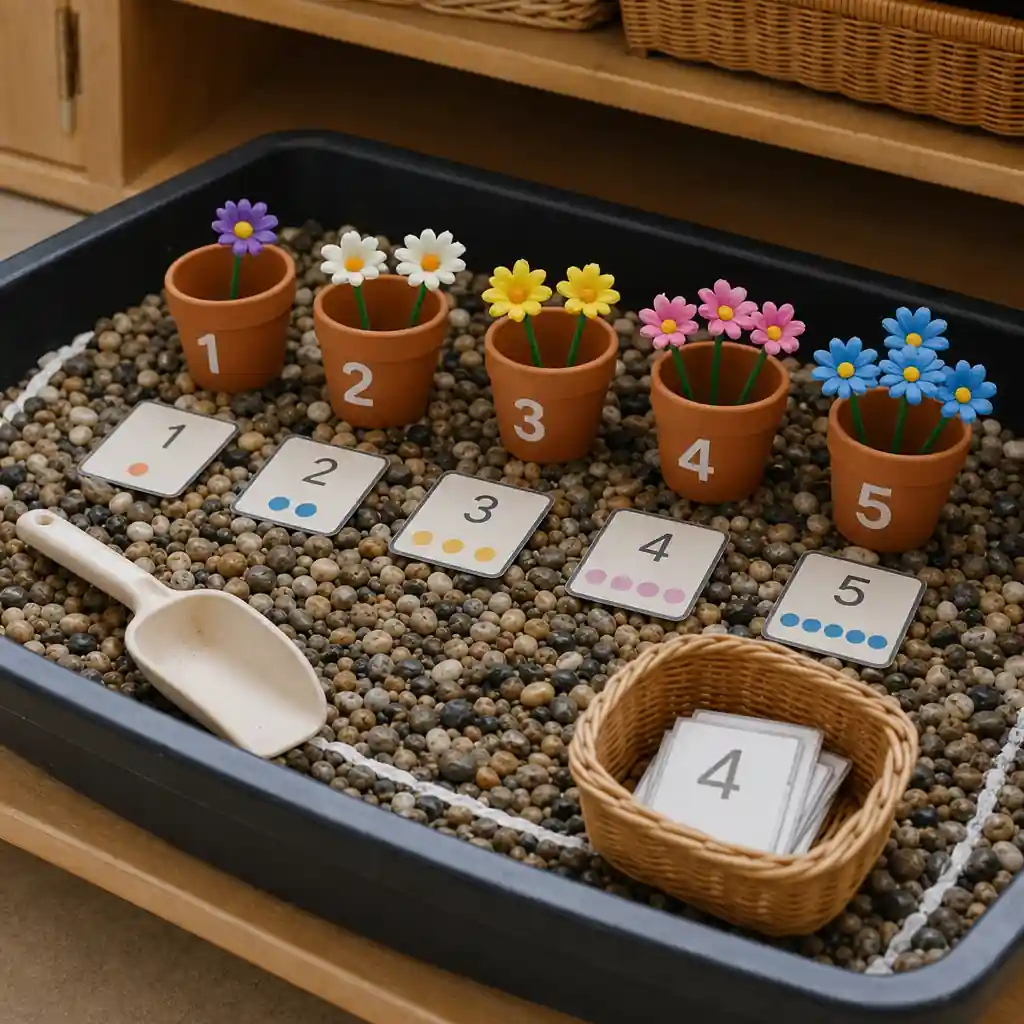
Set up a low tray with numbered pots arranged left-to-right and only the matching quantity of reusable flowers per pot range (for example 1–5). Place number cards in a small basket beside the tray and remove extra loose pieces and ornaments so the sequence is clear. Use one scoop and one brush for the area and mark a small work boundary on the tray so each child has a defined space; this reduces choice overload and makes the counting task the visible focus.
Show the sequence once: pick a card, place it by the pot, count out flowers and return them to the basket, using a slow, silent demonstration. Then step back, use brief safety reminders only, and avoid questioning or prompting. Watch for steady one-to-one counting, visual self-correction when quantities don’t match numerals, repetition or concentration on the task, and whether the child carries and returns materials independently.
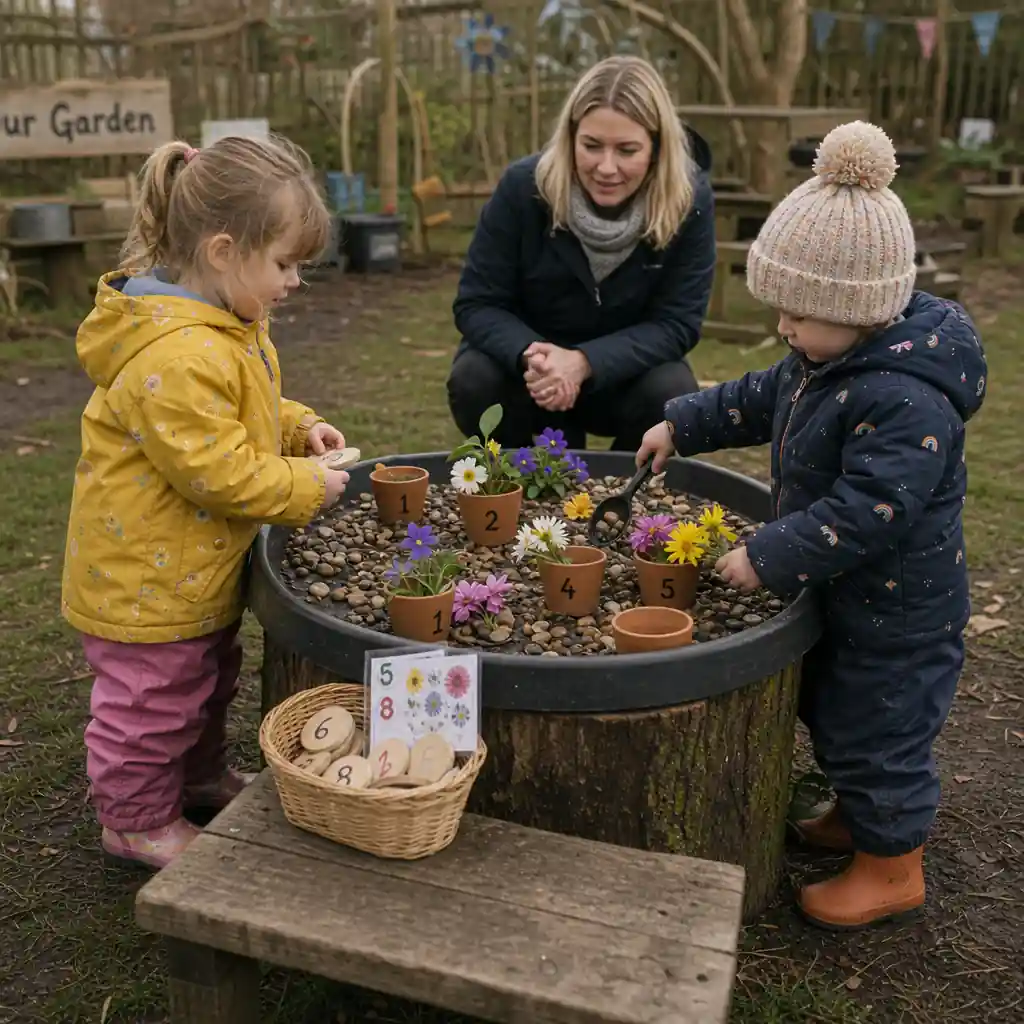
In an outdoor or nature-integrated space, set the tray on a low tree stump, bench or on grass so children work at natural height with varied footing. Materials such as pebbles or mud are used as the base and numbered pots are terracotta or wooden cups rather than plastic; number cards are on wooden discs or laminated and kept in a small basket. Flowers are real picked blooms, petals, leaves and safe seedheads or simple fabric flowers to allow repeated use and sensory variation.
The adult observes from close by, checks anchors and tidies when needed, and responds with minimal, timely prompts such as a word or question rather than step-by-step instruction. Children choose pots, carry and arrange quantities, match number discs to piles and experiment with more/less at their own pace; they may swap roles, practise returning materials to the basket and use a scoop or brush with adult supervision to manage small risks.

Arrange the tray area as a low, inviting “garden” with several mini-stations so materials are visible and reachable; group numbered pots across the surface with gaps for children to move between them, and place number cards loosely in a small basket rather than pre-matching. Use open-ended loose parts — pebbles or mud base, varied reusable flowers, fabrics and small wooden pieces — so the child may choose quantity, colour and arrangement; this preserves the counting and numeral-linking intent while allowing multiple, non-prescriptive outcomes.
The adult steps back as observer and co-researcher, replacing directives with short commentaries such as “The adult notices…”, “I can see…”, or “What happens if…”, following the child’s focus and language. The child may select pots, create patterns, match quantities or invent new uses; this can lead to visible moments for observation: attempts at one-to-one counting, use of comparative language (more/less/same), persistence with a chosen layout, and social negotiation during shared access.

A calm space is defined with a small rug and a low wooden tray lined with neutral cotton. Only a few items are set out: unglazed terracotta pots marked with clear numerals matched to the group’s stage, a small wicker basket of wooden or thick card number discs, and a modest quantity of large smooth pebbles or a shallow layer of damp earth. Flower play is offered through fresh, thorn-free garden cuttings or simple wool-felt blossoms on wooden stems. A wooden scoop and natural-bristle brush with metal pan sit to one side for tidy-up.
The adult demonstrates quietly: selecting a pot, matching a number disc, and placing a steady count of pebbles or flowers, then returning items and pausing. The child chooses pots, returns to arranging and counting at their own pace, compares fuller and emptier pots, and may shift between matching numerals and open display-making, repeating as desired. The adult observes gently, offers a single word or numeral only when needed, supports turn-taking with calm presence, and intervenes solely for safety.