Supermarket clue hunt using simple item riddles during a real shopping trip
Communication and Language
Mathematics
Children and adults use short spoken clues to locate everyday items in a real shop, with the shopping list giving the experience a clear purpose. Children may explore categories such as fruit and notice features like colour as they search. Adults pay attention to how children hold information in mind, use describing words, and manage the busy environment. Materials stay simple and portable so the routine can fit into an ordinary trip.
Children take part in a clue hunt during a real shopping trip, using short descriptions to work out which item is being talked about and where it might be found. The experience sits inside everyday routines and can be repeated in small moments across the shop. Children may notice categories, colours, and familiar signs as they search. Adults can keep it playful and flexible, following children’s interests and energy levels.
Step-by-Step Guidance
1. Choose a calm time to shop where stopping briefly is possible, and plan a short section of the trip for the clue hunt.
2. Decide on a small set of familiar items that are likely to be in stock and easy to identify, such as a common fruit that can be red or green.
3. Set expectations at the entrance: explain that the adult will give a short clue and children can point, name, or lead the adult towards the item.
4. Start with one clear clue that includes a category and one or two features (for example, fruit plus colour). Pause to give thinking time.
5. Support children to scan the environment by gesturing broadly to an area rather than pointing directly at the item. Repeat the clue once if needed.
6. When children identify an item, acknowledge their reasoning and link it to the shopping task by placing it in the basket or trolley.
7. Offer a choice: the adult gives another clue, or the child suggests a clue for an item already on the list.
8. Keep the pace responsive. If children become tired or overstimulated, reduce the number of clues and return to straightforward shopping.
9. End the clue hunt with a clear finish point, such as completing a small part of the list, and transition back to the routine of shopping and paying.
Learning Objectives
Children may practise listening and understanding as they hold a short clue in mind and connect it to a real object (Communication and Language). Children may use early maths thinking as they sort items into groups such as fruit, vegetables, or drinks, and compare features like colour or size (Mathematics). Children may build confidence in everyday community experiences by taking an active role in shopping routines (Personal, Social and Emotional Development).
Adult Role
Stay emotionally attuned to the demands of a busy shop, noticing signs of overwhelm and offering closeness, a calmer voice, or a pause. Model simple, precise language by using short clues and repeating key words without adding extra information too quickly. Scaffold when children are stuck by narrowing the category or offering two options, and step back when children are confidently searching or generating their own clues. Observe how children use memory, describing words, and environmental cues such as signs, and adjust the challenge to keep it achievable. Hold responsibility for safety by keeping children close, managing trolley and aisle space, and choosing stopping points that do not block others.
Observation Cues
Looks towards the right area of the shop when given a category clue (for example, fruit or bread). Uses describing words such as red, green, big, small, smooth, or bumpy when searching. Asks for a clue to be repeated or repeats key words to self. Changes strategy after an incorrect guess, such as scanning shelves more carefully. Notices print or symbols, such as aisle signs or familiar brand colours, and uses them to navigate. Shows turn-taking by waiting to give or answer a clue.
Time & Space
5–15 minutes within a longer shopping trip, adjusted to children’s stamina and the shop environment.
A real shop with enough aisle space to pause briefly without blocking others; best in one or two sections of the store rather than the whole trip.
Materials
Safety
Age adaptations
Budding Adventurers
Use two-part clues that combine category and one feature, and invite children to carry a light item to the trolley when appropriate. Encourage children to use describing words back to the adult, even if approximate. Keep the search area small, such as one section of produce, to reduce frustration.
Curious Investigators
Add location language such as top shelf, bottom shelf, near the fruit, or by the bread, and invite children to explain their guess. Offer chances for children to create clues for items already chosen, supporting turn-taking. Increase challenge by including two possible answers and asking children to check features to decide.
Confident Discoverers
Invite children to help plan a short set of clues from the shopping list, including category and two features. Encourage children to use shop signs or aisle labels as part of their search, and to justify choices using evidence they can see. Offer responsibility such as checking off items on the list with the adult, keeping the focus on safe movement and awareness of others.
EYFS Links
Communication and Language: Children listen to short clues, hold key words in mind, and connect spoken descriptions to real objects in the environment. Adults can extend vocabulary by naming categories (fruit, vegetables) and describing features (red/green, smooth/bumpy) without overloading children.
Mathematics: Children sort and classify items by category and attribute, and compare visible features such as colour and size. Adults can support early reasoning by asking what makes an item a good match for the clue.
Personal, Social and Emotional Development: Children take turns, cope with small uncertainties when guessing, and experience themselves as capable participants in a community routine. Adults can support regulation by keeping the game brief and predictable within the shopping trip.
Understanding the World: Children notice how shops are organised into sections and begin to use environmental cues like signs and familiar packaging to navigate.
Ethos adaptations
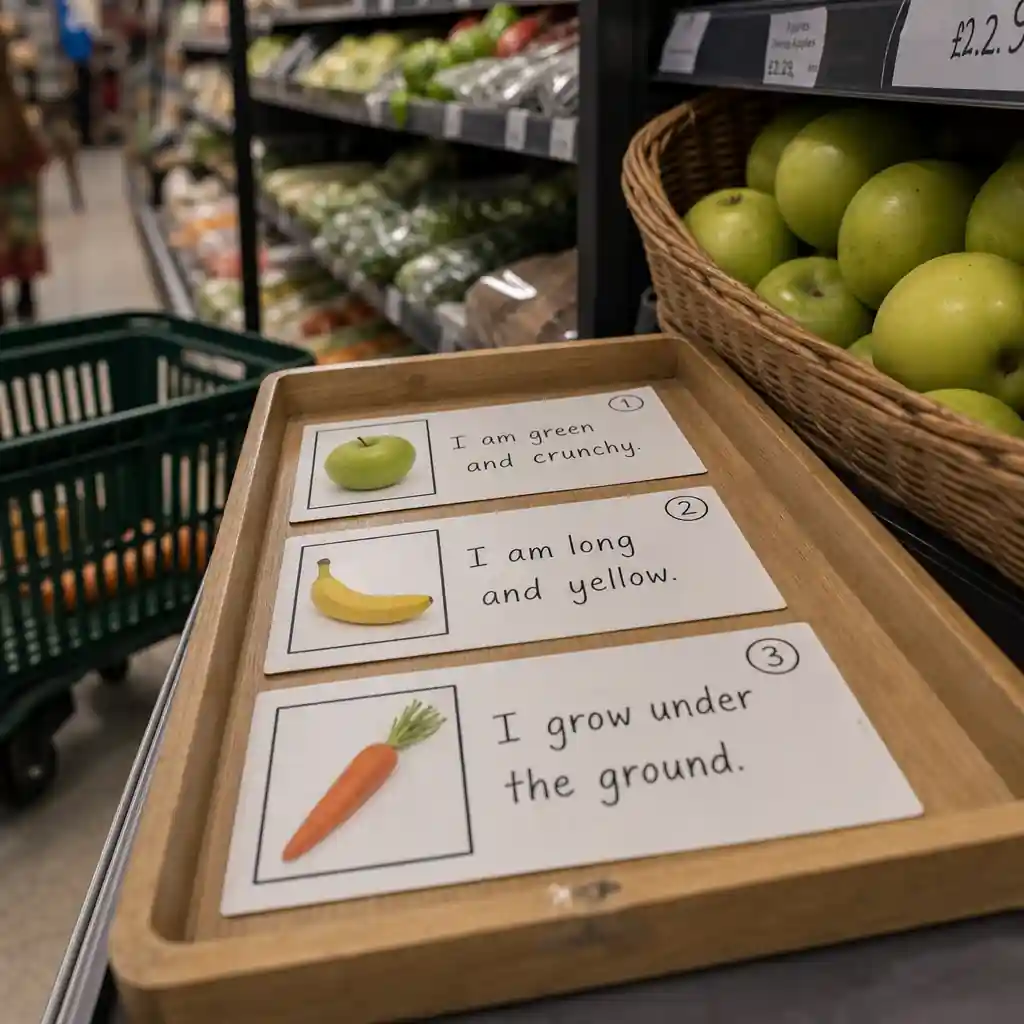
Limit the materials to a small clipboard or tray with 3 clear clue cards arranged in order, a photo or single-word label for each clue if helpful, and one reachable basket or small trolley for the child. Move the hunt to one clearly defined section of the shop at a time (eg fruit and veg), remove extra toys or competing tasks, and keep the list visible so the child can hold one clue in mind and focus on matching description to real items.
Show the child the routine once with a slow demonstration: read one card, point to the relevant shelf or area and place the item in the basket, then step back. Use minimal language after the demo and brief safety reminders only; do not prompt guesses. Watch for independent searching, accurate matches and self-correction (returning wrong picks), repetition of category words, waiting turns, and signs of concentration or frustration.

In an outdoor or nature-integrated space, move the clue hunt to a weekly street market, outdoor food stalls or a nearby row of shopfronts and pavements so children navigate varied surfaces and real community cues. Materials such as leaf or pebble tokens tied to simple written or spoken clues are provided in an open-ended way rather than pre-arranged; baskets or small fabric bags replace trolleys. Children may use signs, colours and smells from stalls and displays as part of their searching.
The adult observes from close by, offering minimal, responsive prompts—single words, brief questions or a rephrasing of a clue—rather than step-by-step direction, and checks safety on uneven ground or road edges. Materials are arranged so children choose tokens and lead the sequence, take turns reading or listening, and sort found items into casual groups at their own pace while the adult notes language and counting opportunities and steps in only to manage risk.
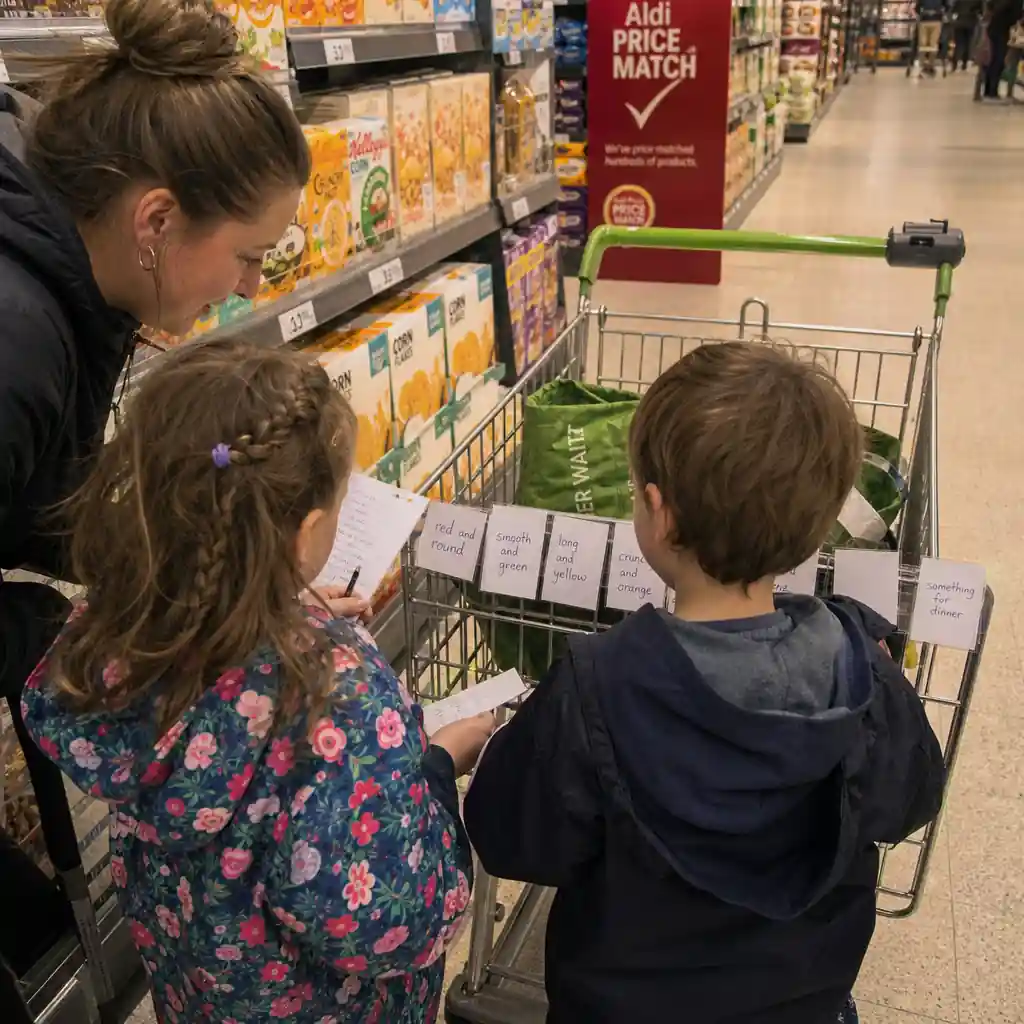
At the trolley, create a low, reachable “clue rail” by laying the small clue cards along the basket edge, mixing in blank cards and card backs for child-made clues. Keep the paper/phone shopping list and the pencil visible for children’s own marks, tallies, arrows, or sketches. Begin from any aisle or endcap; park the trolley at safe pause points. Treat the real shop—stock, packaging, colours, and section signs—as open materials that children can combine, sort, re-group, or ignore while choosing routes and return points.
The adult walks alongside as co-shopper, using noticing language: “I can see you’re holding ‘smooth and green’ in mind,” “You’re trying a new path,” “What happens if we follow that red sign?” Children may lead by picking which card to try next, swapping order, inventing new clues, or redefining groups (big/small, crunchy/soft). The adult notices sustained listening, how children scan signage, compare features, manage turns, and regulate pace within agreed safety boundaries.

A quieter aisle and a short route are chosen, with a calm pause point near produce or bakery. The materials are arranged simply: a small stack of unbleached card clues in a cotton pouch, a soft graphite pencil, and a plain cloth shopping bag; any phone is kept away during the hunt. Clues are written or sketched in plain hand, using few words. Only a few clues are used at once, and the child handles real items with authentic textures and weights, avoiding bright synthetics or noisy add-ons.
The adult demonstrates taking one card and speaking the clue once in a quiet tone, then walks steadily without directing, pointing briefly to a sign only if needed for safety or orientation. The child leads the search, handling one item at a time to compare colour or size, deciding when a match feels right. The simple rhythm repeats: hear, look, place gently in the cloth bag, return to the pause point. The adult observes, notes ideas discreetly, and allows pauses or endings in line with the trip’s flow.