Threading spring flowers through a colander for fine motor posting and arranging
Sensory Play
Spring
Children explore posting and threading flower stems through a colander to build an arrangement they can change and revisit. Adults offer a small, curated selection of artificial and/or real spring flowers so children can notice differences in thickness, texture, and scent. The experience often brings careful two-handed coordination, persistence with tricky angles, and personal choices about colour and placement. Adults watch for grip changes, problem-solving strategies, and how children care for the materials.
Children explore threading and posting flower stems through the holes of a colander to create a simple spring arrangement. The activity offers repeated opportunities to grasp, orient, push, pull, and reposition materials in a purposeful way. Using artificial flowers supports repetition and revisiting, and using real flowers can add scent, texture, and natural variation. The arrangement can stay available for children to return to and adjust over time.
Step-by-Step Guidance
1. Prepare the space: Place a wipeable mat on a low table or on the floor. Set a tray or shallow tub on top to catch dropped flowers and keep the area defined.
2. Choose and check materials: Select a colander with holes that match the stems you are offering. If using real flowers, trim stems adult-only so they are long enough to post and not sharp or split.
3. Present the invitation: Place the colander upside down or upright on the tray (choose the most stable position for your group). Arrange a small selection of flowers beside it, mixing easier and trickier stems.
4. Model briefly: Show one slow posting action, naming what you are doing (hold, line up, push through, pull back). Keep the demonstration short and return the materials to the child.
5. Support child-led exploration: Allow children to choose holes and flowers. Notice their strategies and only intervene when they are stuck or frustrated.
6. Offer light scaffolds: If needed, steady the colander with two fingers, suggest turning the stem, or offer a wider hole without taking over. Reduce support again once the child re-engages.
7. Extend for interest: Add a second colander or a smaller set of holes for children seeking challenge, or introduce real flowers for scent and texture if appropriate.
8. Close and reset: Leave the arrangement available for revisiting. At tidy-up, invite children to remove and sort flowers back into the tray, checking for any damaged stems.
Learning Objectives
Children may strengthen fine motor control through grasping, rotating, and posting stems with increasing accuracy. The activity can support Physical Development (fine motor) as children coordinate both hands and adjust pressure. It can also support Expressive Arts and Design as children explore colour, placement, and simple design choices. Communication and Language may be supported as adults model words for parts of flowers, actions, and simple comparisons.
Adult Role
Stay emotionally attuned by watching for signs of effort, frustration, or pride, and respond with calm, specific encouragement that focuses on the process. Model simple, accurate language for actions and parts (stem, petals, hole, push, twist, through) and add comparison words (thick/thin, long/short, smooth/bumpy) without turning it into a test. Scaffold only when needed by stabilising the colander, offering a different hole, or slowing the pace with a single demonstration, and step back as soon as the child has a workable strategy. Observe hand preference, grip changes, persistence, and how children plan their arrangement, and use these observations to adjust stem thickness, hole size, and the amount of choice offered. Maintain safety by supervising closely, checking stems for sharp ends, and managing real flowers and water to prevent slips and mouthing risks.
Observation Cues
Uses one hand to hold the colander steady and the other to guide a stem through a hole.
Changes grip (whole hand to pincer) to manage thinner stems.
Rotates a flower to find an angle that fits, rather than switching holes immediately.
Persists with a tricky hole, pauses, and tries a different approach.
Sorts or groups by colour/type, or comments on differences in texture or smell.
Repositions flowers to change the look of the arrangement and checks the effect.
Time & Space
10–25 minutes, with the option to leave available for revisiting across the session.
A low table or clear floor space with a wipeable mat and a defined tray area; suitable for 1–4 children at a time.
Materials
Safety
Age adaptations
Budding Adventurers
Introduce a wider variety of stem thicknesses and a second colander with different hole sizes to allow self-chosen challenge. Offer a small selection of real flowers for sensory interest, with clear boundaries about gentle handling and adult support for water. Adults can prompt problem-solving with simple options (try a different hole, turn the stem) and notice persistence. Add an invitation to group by colour or type without requiring it.
Curious Investigators
Include both artificial and real flowers and add a simple container of water nearby for adult-managed refreshing of real stems. Offer a photo of a simple spring arrangement as optional inspiration, not a target. Adults can introduce vocabulary such as arrange, balance, symmetrical, and compare how different stems behave in different holes. Encourage children to plan where a flower might go and to adjust placement to change the overall look.
Confident Discoverers
Offer a larger range of flowers, including thinner stems that require more precise alignment, and provide two colanders to support collaborative arranging. Invite children to create patterns (alternating colours, tall/short) or to design for a purpose (table centre, welcome display) while keeping it child-led. Adults can support children to evaluate stability and make revisions, and to care for real flowers by checking water and removing damaged stems with adult-only tools. Encourage children to describe their design choices and notice how small changes affect the arrangement.
EYFS Links
Physical Development: Fine motor control is supported as children grasp stems, coordinate both hands, and adjust pressure and angle to post through holes. Communication and Language: Adults can model action words and descriptive vocabulary linked to what children are doing and noticing, supporting understanding and expressive language in context. Expressive Arts and Design: Children can explore colour, placement, and simple composition as they arrange and rearrange flowers, making choices about how the display looks. Understanding the World: Using real flowers can support noticing natural features such as scent, texture, and variation, and linking the experience to seasonal change.
Ethos adaptations

Place one colander in a shallow tray at child height with the holes facing up. Offer a small set of 10 stems only, pre-trimmed to two consistent lengths and sorted into two neat piles from left (thinner) to right (thicker). Keep optional real flowers dry to simplify the task; store the jug away. Position a folded cloth on the tray edge and remove snips from reach. The setup creates visible control of error: stems that are too thick won’t pass, bent angles won’t thread, and overly short stems won’t stand.
Give a slow, single demonstration without narration: take one thin stem from the left pile, feel for a hole, rotate gently, push until it stands, then step back. Use only brief safety language if needed and avoid questions or suggestions. Watch for hand use, grasp changes, wrist rotation, and matching stem thickness to holes. Notice repetition, sustained focus, and self-correction when a stem buckles or wobbles. Observe choices in spacing and colour without directing placement.

In an outdoor or nature-integrated space such as a sheltered garden patch, low bench or grassy clearing, the colander is placed on a stump, tray or wobble-safe surface so children work at standing or knee height on varied ground. Materials are arranged as open-ended natural mixes: flexible real stems, daffodil or tulip stems, grass, seedheads, small twigs and a few artificial stems of different thicknesses, with a jug of water and a wipeable mat nearby for real flowers.
The adult observes from close by, offers a brief model of one posting action and stem-trimming when required, then steps back to watch and respond with short, responsive prompts or single words rather than instructions, maintaining supervision for any child-safe snips. Children choose how to post, rotate and rearrange stems, experiment with hole sizes and angles, take turns, repeat attempts and talk about what they notice while the adult quietly notices and records key moments.
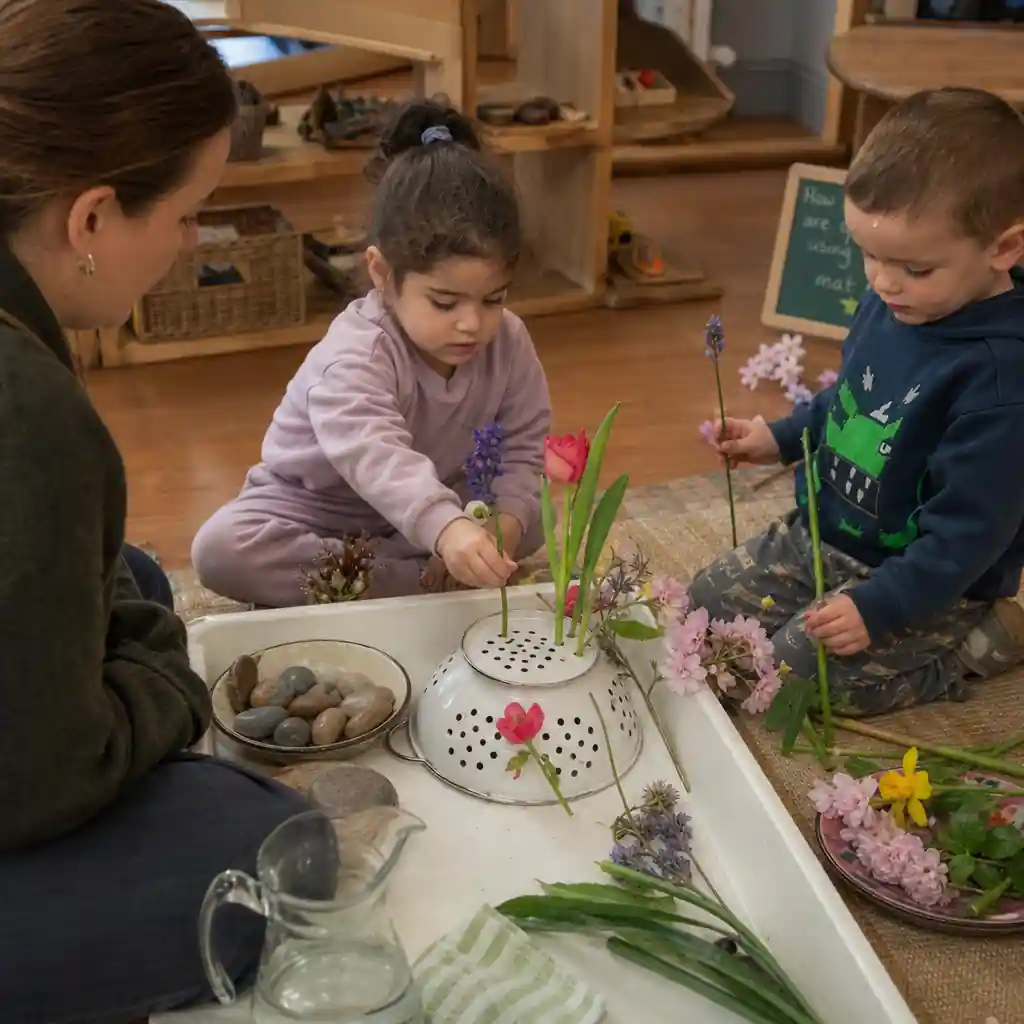
Set the colander and tray on a low, stable table with holes facing up and space for several working places so materials invite independent choice. Offer a variety of stems and loose parts—artificial flowers of mixed thicknesses, a few real stems, lengths of ribbon, small pebbles—placed in shallow dishes within reach rather than handed out. The child may select, combine, trim (by adult) and reuse pieces; the layout supports repeated return and different compositional experiments without a fixed end-product.
The adult moves to the side as observer and co-researcher, using commentary such as "I can see you trying to thread that stem" or "What happens if you use a thicker stem here?" rather than giving instructions. The child may change direction—posting, layering, or leaving gaps—and may alternate between precise posting and exploratory play. The adult notices patterns in grip, hand coordination, problem-solving and language use; these behaviours are recorded through short notes or photos taken unobtrusively during the flow of play.

Steiner (Waldorf) Adaptation
The materials are arranged on a small neutral cloth-covered tray to create a calm, contained workspace: a single metal colander, a small jug of water, a cloth for wiping, and only a few real spring flowers with natural stems (no artificial blooms or bright plastics). Only a small number of stems of varying thickness are provided so the child can repeat posting without clutter; child-safe snips remain accessible for adult trimming and are kept off the tray until needed for safety.
The adult demonstrates quietly how to hold a stem and gently post it through a hole, using no step-by-step verbal prompts, then steps back to observe. The adult remains close, modelling calm handling and intervening only for safety or to trim a stem; the child returns to posting and repositioning at their own pace, repeating actions and pausing as they choose while the adult uses minimal language to name a single action or part when it naturally occurs.