Spring sensory soup in a water tray with herbs, flowers and citrus for 2–4 years
Sensory Play
A spring-scented water tray holds herbs, flowers and citrus, creating layered colours, textures and aromas. The setup encourages sensory language, capacity talk and collaborative role play, while adults notice how smells, tools and social exchanges shape the play.
Children explore a spring-themed water tray where natural materials invite pretend cooking and potion-style play. The mix of herbs, flowers and citrus offers strong smells, colours and textures that can prompt rich language and imaginative intentions. Children often return to filling, emptying and mixing as they test ideas about capacity and change. Shared access to tools and ingredients can support early social negotiation in a calm, open-ended space.
Step-by-Step Guidance
1. Choose an indoor or outdoor spot with clear walking space around the tray and a surface that can cope with splashes.
2. Clean the water tray and place it on a stable base. Add non-slip matting underneath if you are indoors.
3. Prepare the citrus fruit away from children and slice into pieces that are easy to handle. Check for allergies and swap items if needed.
4. Gather the tools (ladles, pots/bowls) and place a small, manageable number into the tray so children can see each item clearly.
5. Add fresh warm water to a shallow level that supports scooping and pouring without encouraging large splashes.
6. Add spring materials (herbs, flowers/petals, citrus, sticks) in small clusters so children can choose and combine without everything mixing immediately.
7. Invite children to approach in small numbers. Offer a simple framing such as “soup”, “tea”, or “mixing”, and let children decide what it becomes.
8. Stay close at the start to model safe handling of tools and to support early turn taking. Step back when children are settled and absorbed.
9. Add language as you notice children’s focus, for example naming materials, describing smells, and using capacity words like full/empty.
10. If conflict arises over tools, offer a clear choice (wait, swap, or find an alternative tool) and support children to agree a plan.
11. Refresh materials if they become overly broken down, and remove any items that start to pose a safety risk.
12. Close the activity with a clear tidy routine: children can help return tools to a basket and place used natural materials into a compost/waste container as appropriate. Clean and dry the tray.
Learning Objectives
Children may develop imaginative intentions through Expressive Arts and Design as they use materials to represent ideas in role play. Children may extend Communication and Language by naming materials, describing sensory experiences and using simple comparative words. Children may practise Physical Development through controlled pouring, scooping, filling and emptying. Children may draw on Personal, Social and Emotional Development as they share space, wait, and respond to others’ ideas.
Adult Role
Stay emotionally attuned by noticing children’s cues around sharing, waiting, and frustration, and naming feelings in a calm, matter-of-fact way. Model language that fits children’s play intentions, including sensory words (smell, soft, sharp, juicy), spring vocabulary (herb, petal, peel), and maths language (full, empty, more, less, big, small). Scaffold only when needed: demonstrate a slower pour, offer a steadier container, or reduce the number of tools if the space becomes crowded; step back when children are collaborating or deeply focused. Observe in action by tracking what holds attention, how children combine materials, and how they manage turn taking, and use those observations to decide whether to add, remove, or rotate materials. Hold responsibility for safety by supervising water play closely, managing slip risks, and ensuring materials remain age-appropriate and non-choking.
Observation Cues
Sustained attention: which materials or tools children return to, and what changes when new items are added or removed. Sensory awareness: whether children notice and name smell, touch, sight and taste-related language (without tasting), and whether they can name senses. Physical control: how children manage ladles and pots, and whether they adjust grip, speed and aim when pouring or transferring. Early maths language: use of full/empty, more/less, heavy/light, and comparisons between containers. Communication: naming herbs/flowers/citrus, using descriptive words, and whether children bring in counting or familiar sounds/letters during play. Social negotiation: how children manage turn taking, sharing tools, and coping with waiting or changes to their play plan.
Time & Space
Preparation: 30–40 minutes (including cleaning tray, slicing citrus, and set-up). Play time: 15–30 minutes, depending on children’s interest.
Indoor or outdoor area with room for 2–4 children to stand around a water tray and clear walkways to reduce slips. Access to a nearby surface for spare materials and towels.
Materials
Safety
Age adaptations
Budding Adventurers
Use fewer items at once: one pot, one ladle, a small handful of herbs, and a few large petals or citrus slices. Keep water very shallow and offer a wider, stable container that is easy to hold with two hands. Adult stays close to support turn taking with simple choices and models single words and short phrases such as “pour”, “full”, “empty”, “smell”, and names of items.
Curious Investigators
Offer two or three different container sizes to invite comparisons of capacity, and add a second ladle to reduce waiting. Include a small basket or bowl beside the tray for children to “collect” ingredients and return them, supporting early sorting and organisation. Adult models descriptive language and invites children to explain their plan for the soup, noticing when they begin to negotiate roles or rules with peers.
Confident Discoverers
Add a wider range of herbs and citrus types to extend vocabulary and sensory discrimination, and include a simple visual prompt such as pictures of herbs/flowers near the tray. Offer a small number of tools that vary in function (ladle plus a scoop) so children can choose based on intention. Adult supports longer collaborative play by helping children agree shared rules for tool use, and by extending maths talk about more/less and how many scoops fill a pot.
EYFS Links
Expressive Arts and Design: children can use open-ended natural materials to represent ideas, develop pretend play intentions, and explore combining materials in different ways. Communication and Language: adults can model and extend vocabulary linked to spring items, sensory description, and role play, supporting children to explain what they are making. Physical Development: scooping, pouring, filling and emptying support hand and arm control and coordination, with opportunities to adjust grip and force. Personal, Social and Emotional Development: shared tools and space create real reasons to practise turn taking, waiting, negotiating, and managing feelings when plans change. Mathematics: containers and water naturally invite capacity language such as full/empty and more/less, and children may bring in counting as they repeat scoops or compare amounts.
Ethos adaptations
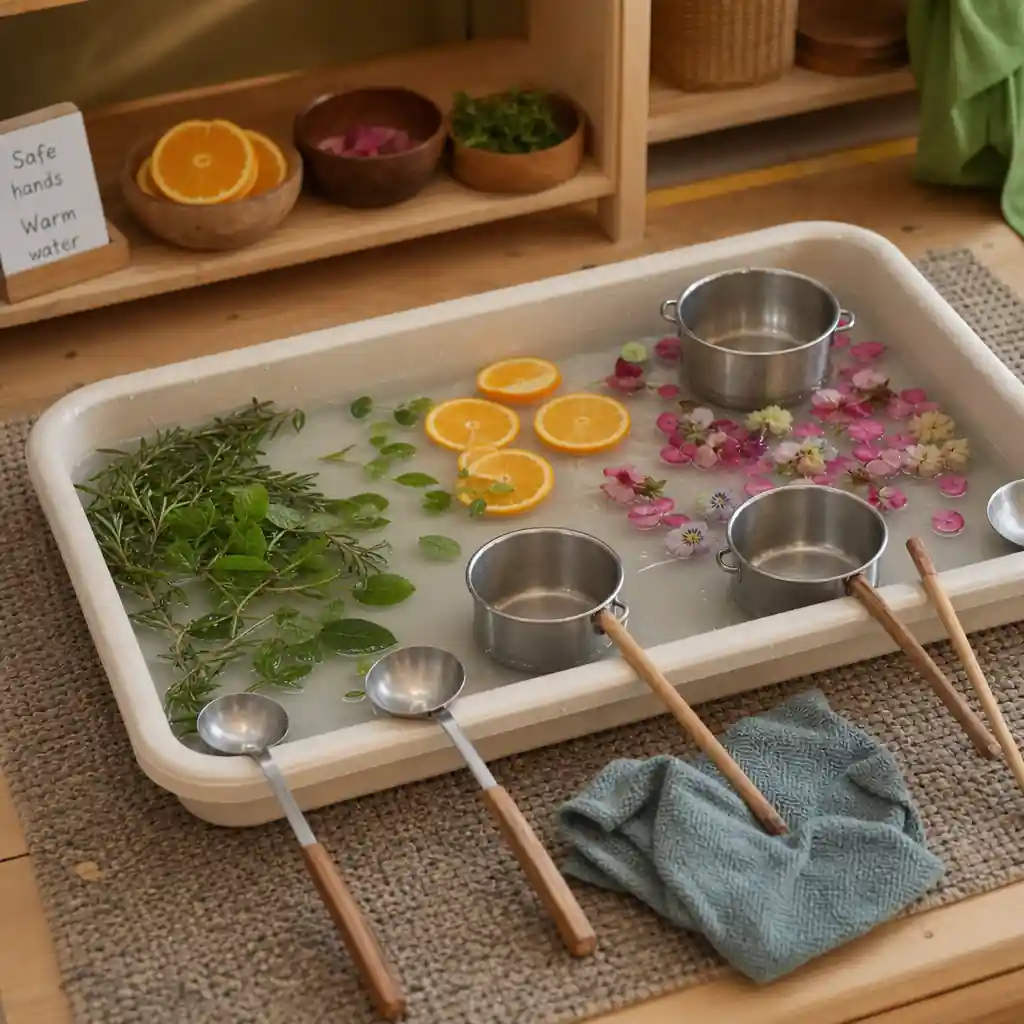
Set the water tray on non-slip matting at child height. Offer a small selection: a few sprigs of one herb, a small handful of petals, and a few citrus slices. Keep water warm and shallow. Place one ladle and one stick per child on the tray edge, and two identical small pots per child inside the tray space. Arrange materials in clear zones (herbs left, citrus middle, flowers right) so the sequence scoop → add → pour → stir is obvious. Keep cloths beside the tray for children to manage spills.
Give a slow, brief demonstration without commentary: scoop water, add one item, pour to just below the rim, stir once, return tools, wipe a drip with a cloth, then step back. Use few words only for names or safety and avoid questions. Observe controlled scooping and pouring, visible self-correction when pots overflow or spills appear, repetition of a chosen sequence, simple comparative words used spontaneously, and how children negotiate turns. Notice sustained concentration, changing grip or force, and signs of frustration or disengagement before choosing to pause or reset.

In an outdoor or nature-integrated space, the water tray sits on a low tree stump or on non-slip matting on grass beside a patch of plants so children can bring in leaves, petals and soil. Materials such as fresh edible herbs, loose flowers, pre-sliced citrus (prepared by an adult), wooden ladles, small wooden or metal bowls and sturdy sticks are provided in an open-ended way rather than pre-arranged, with spare cloths and a shallow mud area nearby for added texture and sensory choice.
The adult observes from close proximity, checks anchors and hygiene, slices citrus beforehand and offers brief, responsive language or single-word prompts rather than step-by-step direction. Children choose roles, pour, scoop, crush herbs, mix petals and water, name smells, compare more/less, and negotiate turns; the adult intervenes only to manage safety, offer a short question or model handling, and then steps back to let exploration continue.

Ethos adaptation: set the water tray within a low, open area where several small clusters of materials sit visibly and within reach — a bowl of loose flower petals, a dish of torn herbs, slices of citrus in shallow plates, sticks and child ladles, plus empty pots of different sizes. Arrange space so children can approach from any side and move items between small sub-trays; leave gaps in setup so no single arrangement feels like the “right” way to play. Materials stay loose and reusable, inviting mixing, stirring, layering and collecting rather than a fixed recipe.
The adult steps back as observer and co-researcher, using short reflective phrases such as “I can see the lemon fizzing” or “You’re trying to make it smell different” and occasional open prompts like “What happens if you add more petals?” The child may choose to create pretend recipes, test capacity by pouring between pots, or negotiate roles with others; these choices guide the adult’s responses. Observation cues are embedded: note repeated pouring sequences, new comparative language, changing grips, and moments of joint planning or conflict as natural data for next steps.
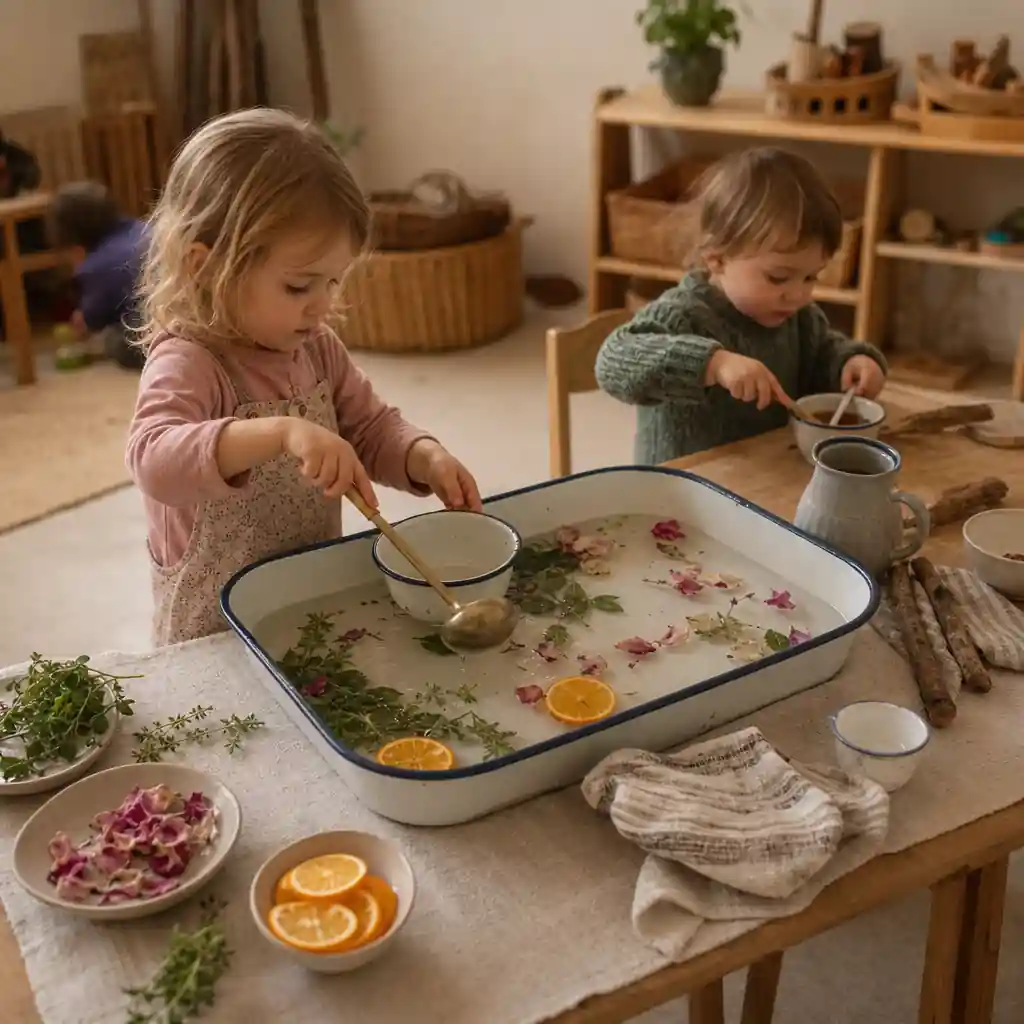
A calm corner is defined with a neutral cotton cloth and a wool mat beneath a low wooden trough or large enamel basin. Fresh warm water is poured in, with only a few natural items set out in small groups: two edible herbs, a handful of soft petals, several adult-sliced citrus rounds, smooth sticks, and a few wooden scoops with enamel or ceramic bowls. Colours are soft and limited. Cotton cloths for spills sit at the edge, keeping the workspace uncluttered and steady.
The adult demonstrates a slow scoop and pour into a bowl, briefly naming an item or a simple comparison, then steps back to observe. The child returns to filling, emptying, and combining at their own pace, testing heavier and lighter bowls and sharing tools in the open space. The adult stays close for safety, modelling calm waiting and gentle tool exchange when needed, and quietly supports a simple rhythm of exploration and a short, unhurried tidy back into the basin.