Spring planting mud tuff tray with scoops, pots and watering cans for transferring and early planting play
Spring
Sensory Play
Children explore a mud tuff tray with pots, scoops and watering cans, choosing how to fill, tip and carry materials in their own way. Adults support with simple vocabulary about actions and changes in texture and quantity, and notice how children solve practical problems like stability and control. The set-up can include optional spring planting elements so children can connect soil and water to early ideas about growth.
Children explore a mud-filled tuff tray set up with planting tools and containers. The experience centres on transferring, filling, emptying and making simple “planting” choices using pots and watering cans. It offers a rich context for practical vocabulary linked to spring, soil and growth, alongside repeated hand and arm movements that children often choose to practise for long periods.
Step-by-Step Guidance
1. Prepare the space outdoors or on a wipe-clean floor with a non-slip mat under the tuff tray. Place a handwashing point within sight.
2. Add soil/mud to one side of the tray so children can choose between heaping and flattening. Keep a small area clearer for pots to stand.
3. Arrange tools in a simple layout: scoops and spades together, pots nested by size, watering cans empty and upright. Place natural loose parts in a shallow bowl.
4. Introduce the tray with a short, neutral invitation that names what is available (mud, pots, scoops, watering cans) and one or two words to listen for (full/empty, wet/dry).
5. Allow children to choose their own starting point. Some will begin by digging, others by lining up pots or carrying tools.
6. Offer water in a controlled way. Keep the refill container with the adult or on a stable surface, and support children to carry a manageable amount to the tray.
7. Follow children’s focus and add language that matches what they are doing: label actions (scoop, tip, pour), properties (sticky, runny, crumbly), and quantities (more, less, nearly full).
8. When a child meets a challenge (spilling, heavy can, pot collapsing), pause and scaffold with one small adjustment: suggest a smaller container, show a slower pour, or steady the pot base. Step back again once the child re-engages.
9. Extend for children who want “planting” by offering a small set of seeds or pretend seeds (e.g. large beans) in a dish and a simple idea such as covering and watering. Keep this optional and child-led.
10. Support a clear ending: give a time cue, invite children to tip remaining mud back into the tray, stack pots, and place tools in a return tub. Finish with handwashing and a brief recap of a few words children used or heard.
Learning Objectives
Children may build Physical Development through scooping, pouring, carrying and controlling tools with increasing accuracy. Children may develop Communication and Language by hearing and using words linked to soil, wet/dry, full/empty, more/less, and plant parts. Children may also explore Understanding the World by noticing changes in mud consistency and making early links between planting, watering and growth.
Adult Role
Stay emotionally attuned by noticing children’s pace and tolerance for mess, and offer reassurance without taking over. Model language that fits the child’s current action, using short phrases and repeating key words (scoop, pour, full, empty, wet, dry, heavy) so children can join in when ready. Scaffold only at the point of difficulty by reducing load, stabilising a container, or offering a choice of tool; step back when the child has a workable strategy. Observe patterns in how children transfer, whether they persist, and what vocabulary or gestures they use to communicate needs. Hold responsibility for safe water access, tool condition, and supervision around lifting, slipping and mouthing of small items.
Observation Cues
Repeats filling and emptying with a clear purpose (e.g. keeps returning to the same pot size or scoop). Uses comparative language or gestures (full/empty, heavy/light, wet/dry) during play. Adjusts grip or two-handed coordination to manage a heavier watering can. Chooses to sort or match pots, lids, scoops or natural items by size or type. Shows awareness of cause and effect by changing how fast or where water is poured. Seeks adult attention to label items or to share a plan (e.g. points to pot, soil, water in a sequence).
Time & Space
20–45 minutes, with the option to leave the tray available for longer child-led returns.
Best outdoors with access to water and a clear, washable area around the tuff tray. Indoors is possible on a wipe-clean floor with a protective mat and a nearby handwashing point.
Materials
Safety
Age adaptations
Budding Adventurers
Add a wider range of containers (seed trays, small buckets, nested pots) and one funnel for experimenting with flow. Introduce a small dish of large seeds or “pretend seeds” (large beans) for children who want to add a planting storyline, without requiring everyone to do so. Adults can model two-step sequences in language (fill pot, cover soil; pour water, stop) and notice early measuring behaviours (choosing the same scoop each time).
Curious Investigators
Include simple labels or picture cards for seed, root, stem, leaf and flower, and a small set of sticks to use as plant markers. Offer two mud textures (drier soil and wetter mud) so children can compare and choose what works for filling and shaping. Adults can support children to describe plans, make predictions about what will happen when water is added, and negotiate shared space when several children want the same tools.
Confident Discoverers
Add a small measuring jug or marked container and invite optional challenges such as making two pots “the same amount” or keeping a tray area “dry” for sorting. Provide a simple real planting option (a few hardy seeds in pots to take to a growing area) for children who want a longer project link. Adults can extend vocabulary (soak, drip, sprinkle, absorb) and support children to reflect on strategies (slower pour, wider base, firmer soil) without turning play into a lesson.
EYFS Links
Communication and Language: Children hear and practise vocabulary that matches real actions and materials, and adults can model short, meaningful phrases that children may copy or adapt. Physical Development: Scooping, pouring, carrying and stabilising containers supports hand strength, bilateral coordination and control of movement in a purposeful context. Understanding the World: Children can explore natural materials, notice changes when water is added, and make early links between soil, planting and growth in spring. Personal, Social and Emotional Development: Shared access to popular tools supports turn-taking, managing frustration when spills happen, and seeking help appropriately.
Ethos adaptations

Prepare the tuff tray with one soil area and remove loose parts, funnels and picture cards so the focus is scooping, filling and watering. Place 4 identical pots in a left‑to‑right row with one scoop beside the soil. Set a single watering spot at the far side with one small and one medium can and the shallow refill container nearby (adult‑managed). Show a clear control of error: children can see the pot’s inner ridge/rim to level soil, and any over‑watering pools in the pot or spills safely into the tray.
Give one slow, quiet demonstration: scoop soil, fill one pot to the inner ridge, carry with two hands to the watering spot, pour from one can until the soil surface darkens, then return tools. Step back and keep language minimal, offering brief safety words only; name vocabulary if the child initiates. Watch for repetition, steady wrist and two‑hand carry, choosing an appropriate can, stopping without overflow, noticing changes in soil, and how children manage turns at the watering spot.
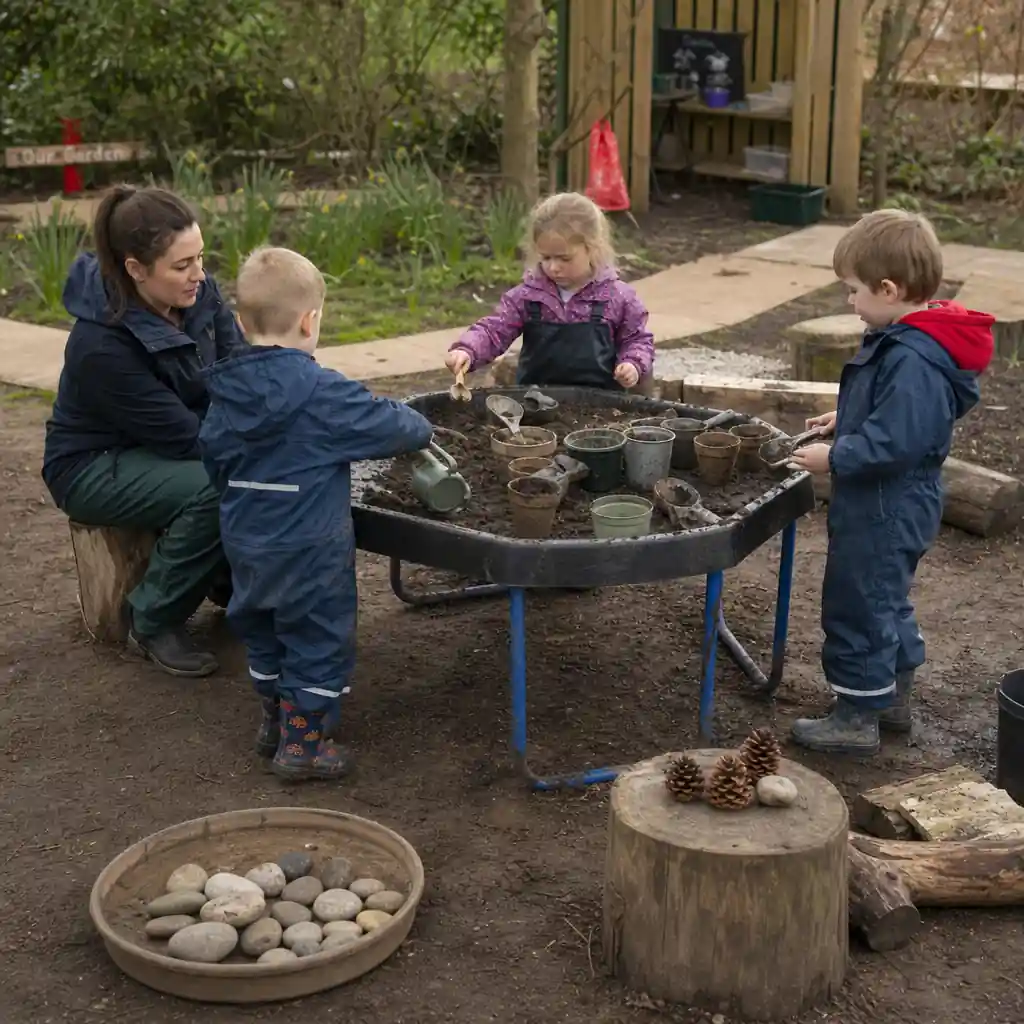
In an outdoor or nature-integrated space, place the tuff tray on level ground in a garden or paved courtyard near grass and a patch of soil; include nearby logs or a low stump for seating and a shallow tray of stones for sorting so surfaces vary gently. Materials such as real garden soil or mud, child-sized metal or wooden scoops and small spades, biodegradable pots, buckets, funnels and a selection of natural loose parts (twigs, smooth stones, bark) are provided in an open-ended way rather than pre-arranged.
The adult observes from close proximity, checking anchors, supervising water refill and modelling calm handling of tools, then steps back to offer concise, responsive language and single-word prompts as needed. Children choose roles and pace, transferring, pouring and experimenting with mud and water, noticing wet/dry and full/empty through repetition; the adult intervenes only for safety, brief demonstration or to pose a short question to extend vocabulary while keeping control with minimal direction.
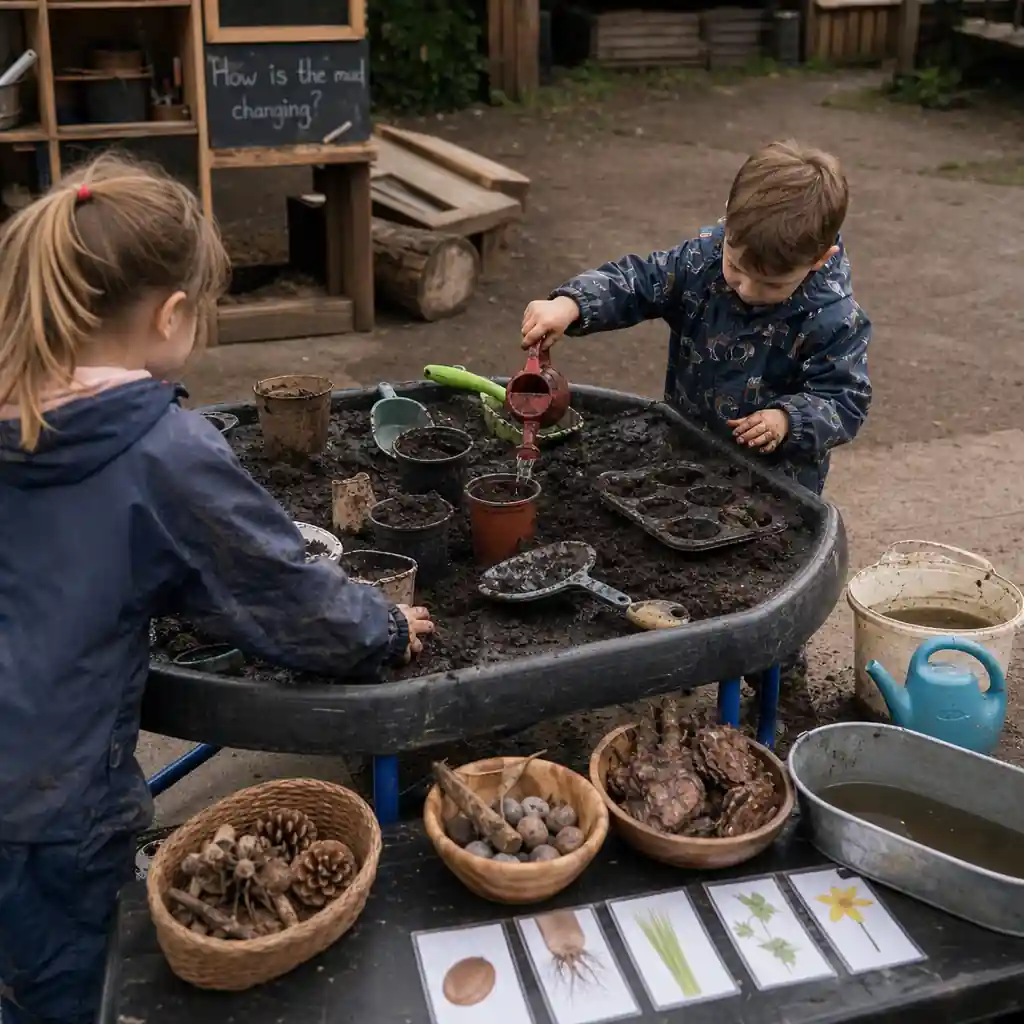
Shift the tuff-tray layout so materials are uncapped and reachable: place scoops, pots, funnels and a variety of loose natural parts grouped by texture and size around the tray rather than handed out, with open buckets and spare containers nearby for combining. Keep the shallow refill container supervised but visible so the child may choose when to add water within safe boundaries. This arrangement supports the same physical, language and world-learning aims while leaving multiple pathways for filling, mixing and planting.
The adult steps back as observer and co-researcher, using commentary such as “I can see the soil is getting wetter,” “You’re trying to move that pot,” or “What happens if you pour from the small can?” rather than directing steps. The child may select tools, repeat pouring patterns, invent planting rituals or shift to sensory sorting; the adult notices bilateral control, vocabulary use (wet/dry, full/empty), persistence or turn-taking and records moments of change in mud consistency and emerging planting ideas.
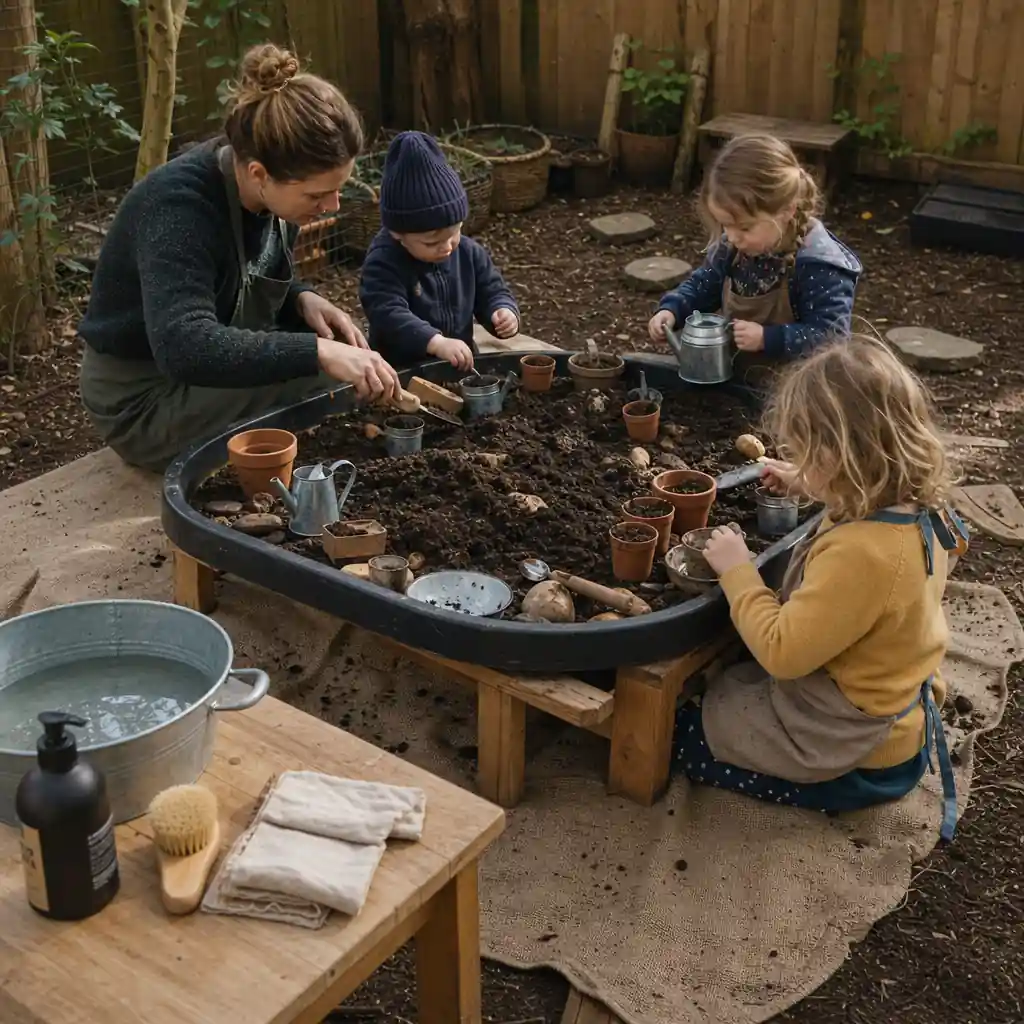
A calm outdoor nook is defined with a neutral hessian cloth and a low wooden border; clean garden soil is heaped at the centre with clear space around the edges for movement. Only a few items are set out at once: small terracotta pots and fibre pots, a tiny and a medium metal watering can, wooden scoops and a child-sized hand trowel with a wooden handle, enamel bowls for collecting, a metal funnel, and natural loose parts (smooth stones, bark, small sticks). Cotton aprons and a nearby handwashing bowl are ready, with the water refill placed at the edge.
The adult quietly models one slow scoop, a steady pour, and pressing soil into a pot, then steps back, staying close and observant. Words are brief and situational, naming qualities as they arise: wet, dry, heavy, light, full, empty. Children set the pace, repeating filling, carrying and emptying, choosing if and how to “plant” with soil and natural items, and refilling cans from the adult-managed water bowl. The rhythm is simple: begin, linger in repetition, then return tools to the cloth.