Spring nature scavenger hunt with sticky collection card on a local walk
Communication and Language
Literacy
Understanding the World
Children explore an outdoor area to look for spring signs such as petals, new leaves, moss, smooth stones and feathers, using a simple checklist and a sticky collection card. Adults support seasonal vocabulary and purposeful mark-making, and keep the focus on noticing rather than rushing to complete a list. Children may choose to work alone or with others, and adults can watch how children classify, name and care for found natural materials.
Children explore a local outdoor area and look for signs of spring such as blossom petals, new leaves, moss, smooth stones and feathers. They use a simple checklist and a sticky collection card to notice, compare and decide what counts as a match. The experience supports seasonal vocabulary and gives children time to follow their own interests within a shared purpose. Adults focus on safety, language, and helping children manage their own tools and choices.
Step-by-Step Guidance
1. Prepare the checklists in advance, choosing either printed sheets or an iPad image list to reduce printing.
2. Make one coloured card per child (or per pair). Keep the top section clear for the checklist and cover the lower section with strips of double-sided tape so items can be lightly attached.
3. Set out clipboards and pencils where children can collect them independently. Check pencils are sharpened and clipboards are easy to hold.
4. Briefly introduce the purpose of the walk: looking for signs of spring. Show the checklist items and name them using simple, clear words.
5. Agree boundaries and walk expectations for the outing. Keep the language short and consistent, and check children understand where they can explore.
6. Invite children to choose how they will record findings: ticking/marking the checklist, collecting small items onto the sticky card, or doing a mix.
7. During the walk, pause in suitable spots and allow time for searching. Offer the sticky card when children want to keep a small, safe item, and support children to decide whether it matches the checklist.
8. Use the checklist to refocus children who want a shared goal, and allow children to follow interests when they are noticing spring features not on the list.
9. Gather the group at agreed points to check in, count what has been found, and notice what is still being looked for.
10. Return to the setting or meeting point and offer a simple way to finish: children can keep their card as a record, or place it in a shared area for later use (for example, collage or a spring display).
Learning Objectives
Children may build Communication and language by naming spring items, describing what they notice, and extending simple phrases into short sentences. Children may develop Understanding the world by noticing seasonal change and exploring natural materials in the local environment. Children may use Literacy through purposeful mark-making on a checklist and by recognising that marks can stand for meaning during a real task.
Adult Role
Stay emotionally attuned by noticing children’s confidence outdoors, offering calm reassurance when a child is unsure, and keeping expectations predictable. Model language by naming spring items, adding one extra describing word, and repeating children’s words back with a small extension (for example, “leaf” to “new green leaf”). Scaffold independence by showing how to hold a clipboard, where to place a mark, and how to carry the card, then step back so children can choose their own approach. Observe in action by watching what children recognise, what they avoid, and how they manage social cues when searching near others. Hold responsibility for safety throughout the outing, including ratios, boundaries, road awareness, and stopping children from picking up unsafe items.
Observation Cues
Notices and names items confidently, or pauses and seeks reassurance when unsure about an item. Uses descriptive words linked to spring (for example, new, green, soft, smooth, feather) and begins to compare items. Chooses to use the checklist, the sticky card, or both, and explains their choice through actions or words. Responds to walk expectations such as staying with the group, stopping at boundaries, and noticing road safety cues. Works alone or alongside others, showing turn-taking, sharing tools, or preferring independent searching. Uses imagination in how items are arranged on the card and whether the child wants to create a picture, a pattern, or a simple collection.
Time & Space
Set-up: 10–15 minutes. Preparing for outing: 10–15 minutes. Activity time outdoors: flexible; often 15–45 minutes depending on route and children’s interest.
Outdoors in a local natural area such as a garden, park, or safe walking route with clear boundaries and stopping points.
Materials
Safety
Age adaptations
Budding Adventurers
Use a picture checklist with 3–5 items and a sturdy clipboard. Provide one sticky card per child and pre-tear tape backing if needed so the collection area is ready. The adult supports turn-taking around popular finds, models two-word descriptions (for example, “smooth stone”), and helps children decide what counts as a match without correcting every attempt.
Curious Investigators
Use a fuller checklist and invite children to add their own “spring find” at the bottom using a drawing or mark. Encourage children to choose solo or partner searching and to compare similar items (two leaves, two stones) using simple describing words. The adult prompts children to explain their choices and supports longer sentences by adding one idea at a time.
Confident Discoverers
Invite children to help agree the checklist items and to suggest where they might find them. Add a simple recording option such as tally marks for repeated finds (for example, how many petals) alongside the sticky card. The adult supports children to negotiate roles in teams (finder, recorder, carrier), and encourages careful classification by texture or colour when children show interest.
EYFS Links
Communication and language: Children may practise naming, describing and extending vocabulary linked to spring as they point, compare and talk about what they notice. Adults can support by modelling clear words and short sentences that match the child’s level.
Literacy: Children may use mark-making for a real purpose by ticking, circling, or drawing on the checklist, and by seeing that marks can record what they have found. Adults can value all marks as meaningful and offer simple prompts about what the mark stands for.
Understanding the world: Children may notice seasonal change through direct experience of natural materials and spring signs in the local environment. Adults can support by drawing attention to what is new or changing and by helping children connect items to the season without overloading with facts.
Ethos adaptations
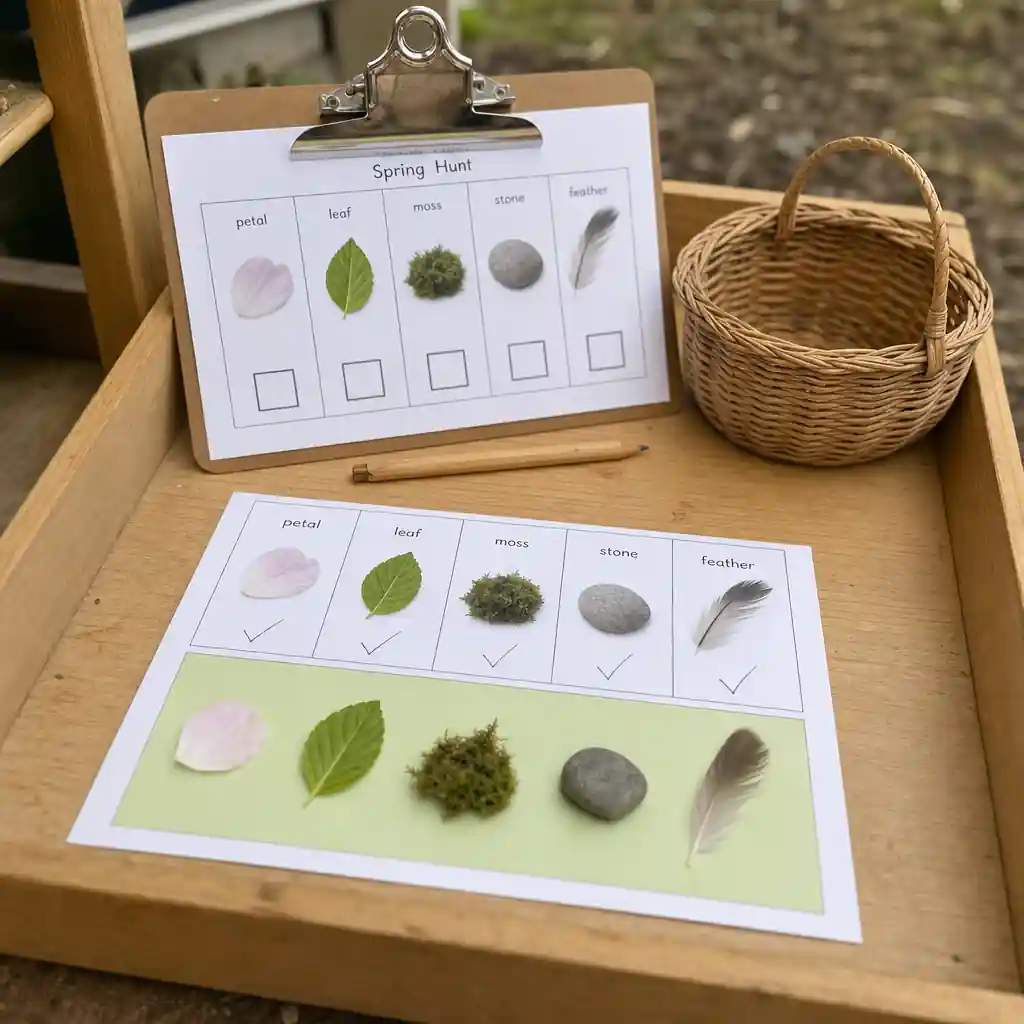
Prepare one simple paper checklist with five pictured targets arranged left-to-right and a matching sticky collection card split into checklist and collection zones; pre-apply the double-sided tape only in the collection area and place one clipboard, pencil and a small low basket on a shallow tray for each child. Remove extra materials and limit options so children focus on finding, choosing and sticking one item at a time, making the sequence (spot → decide → stick → mark) visible and reachable independently.
Introduce the activity with a single, slow demonstration showing the order: show an item, place it on the card, make one mark, then step back. Use only brief safety reminders and one-word labels during the walk; avoid questions or repeated prompts. Observe children for steady attention, correct placement that shows self-correction, emerging vocabulary during naming, and purposeful mark-making rather than directing their choices; intervene only for safety or tool handling.

In an outdoor or nature-integrated space, the local walk uses grassy verges, leaf litter, gentle slopes and a sheltered stop so children can crouch, compare and spread finds. Materials are arranged as open-ended natural substitutes: simple paper checklists or an image tablet in a weatherproof sleeve, coloured card with a fold or small pocket for placing items, trays or cloths for moss, petals, feathers and smooth stones, and small reusable putty or string ties for attaching lightweight finds rather than pre-glued strips.
The adult observes from nearby, checking safety and offering brief, responsive prompts or single words rather than step-by-step instruction, and helps with fastening bags or handling tools only when asked. Children choose where to look, decide whether an item matches the list, and record by marking, placing or pocketing finds at their own pace; the adult models careful handling once, steps back to allow repetition, and manages controlled risks (uneven ground, water margins) while supporting language through short descriptive prompts.
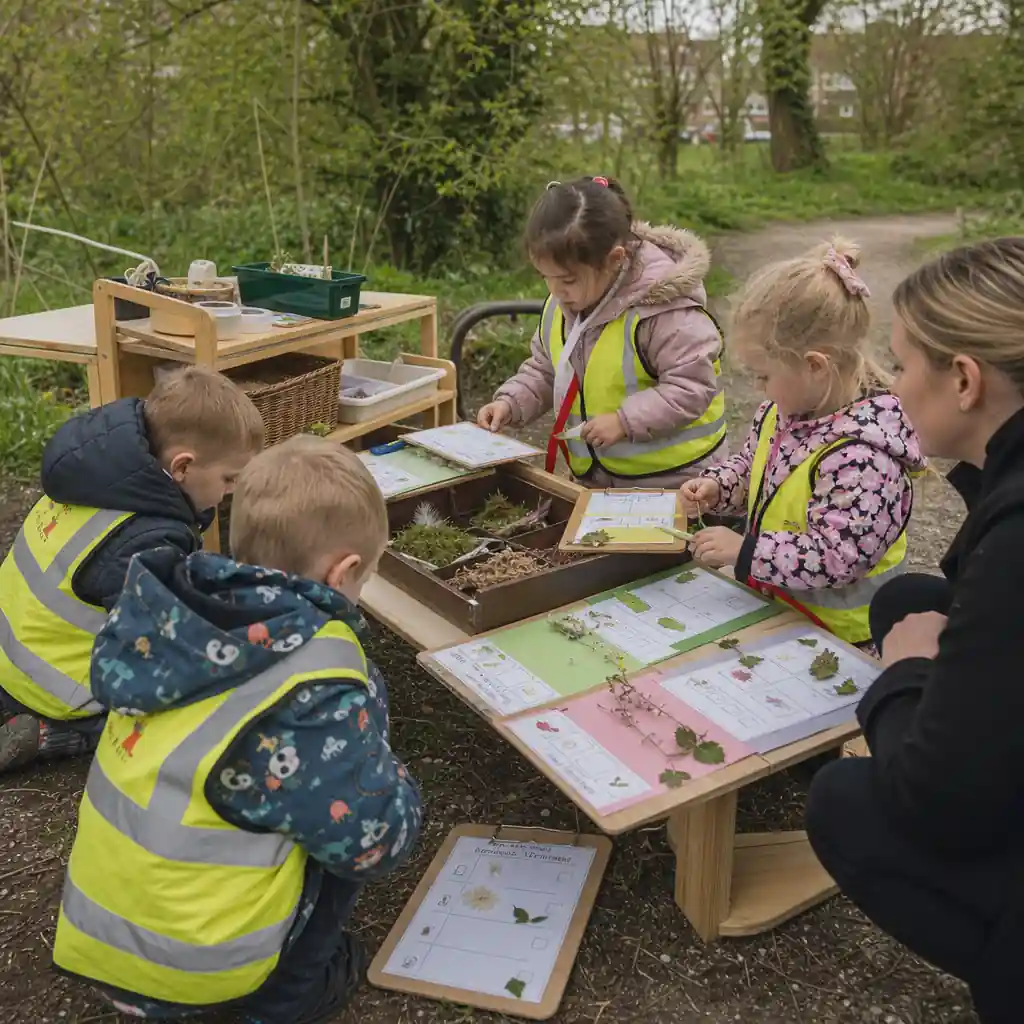
Ethos adaptation: Arrange the walk as a discovery route with low tables, trays and a visible materials cart near the starting point so children choose where and when to collect. Replace a single sticky card by a set of reusable cards and a tray of loose adhesives, natural fragments and fastening options so materials invite different attachments and combinations. Cards are left blank in places to allow children to invent categories, compare textures and decide what counts as a match.
The adult steps back as observer and co-researcher, using commentary such as "I can see you testing how that feather sticks" or "You’re noticing different leaf edges" rather than giving instructions. The child may select tools, pause, change route or abandon a find; this shapes how the group moves and what counts as evidence. Observation cues are embedded: repeated returns to a spot, negotiation over matches, novel mark-making on cards and language bursts during shared choices.

On a calm local route, the group walks to two or three agreed pause spots. A neutral cloth is laid at each stop to create a simple base for noticing and sorting. Materials are reduced to essentials: a plain paper checklist with simple images clipped to a small wooden board, graphite pencils, and kraft cards with a thin layer of beeswax for light finds. A small cotton pouch holds the cards and a few paper envelopes for loose items like small stones or feathers.
The adult models quietly: kneels, presses a fallen petal to the beeswax, makes a single tick on the checklist, then steps back, remaining present for safety on paths and roads. Language is spare and responsive, offering a word or short phrase when the child presents a find. The child chooses where to look, returns to the cloth to press or place items, makes marks to record, and may repeat this at each stop; there is no requirement to fill the card.