Spring mini-beast hunt in outdoor microhabitats with simple observation tools for ages 2–4
Spring
Small world play
World Wildlife Day
Mini beasts
Children explore an outdoor area in spring to look for mini-beasts in sheltered places and notice what those spaces are like. Adults support children to dress for the weather, choose whether to use simple observation tools, and handle living things with care. The focus stays on children’s questions, persistence, and how they share discoveries with others. Adults pay attention to vocabulary, teamwork, and emotional responses to getting messy or meeting unfamiliar creatures.
Children explore an outdoor area in spring to look for mini-beasts in likely hiding places such as under logs, rocks and plants. The experience supports curiosity about where creatures live and how to handle living things with care. It also offers a natural reason to practise getting ready for outdoors, including managing wellies and all-in-one suits. Adults tune in to children’s emotional responses, questions and problem-solving as discoveries happen.
Step-by-Step Guidance
1. Check the outdoor area for hazards and agree clear boundaries children can understand.
2. Set out wet suits and wellies in a consistent place so children can access them, and keep a small basket of any observation tools nearby.
3. Support children to dress for outdoors, allowing time for attempts, and offering help only where needed to keep the flow calm.
4. Introduce the focus in simple terms: looking for mini-beasts and noticing where they choose to hide in spring.
5. Invite children to explore freely, with adults positioned to supervise and to notice where children are drawn.
6. When children search under logs, rocks or plants, model gentle handling and careful replacing of natural items so habitats are respected.
7. Use in-the-moment language to name what children notice (body parts, movement, textures, damp/dry, dark/light) and to support questions and predictions.
8. If magnifiers or binoculars are used, show how to hold and share them, and step back so children can choose when to use tools.
9. Support peer collaboration when it arises, including turn-taking with tools and negotiating space around a discovery.
10. Close the experience by helping children return any moved items, checking clothing, and briefly revisiting what was noticed using children’s own words and gestures.
Learning Objectives
Children may build Understanding the World by noticing mini-beasts, where they are found, and what those places are like. Children may develop Communication and Language by using and extending vocabulary for creatures, habitats and actions, and by asking and answering questions. Children may practise Physical Development through outdoor movement and self-help dressing skills. Children may develop PSED by showing care for living things and by managing feelings during shared exploration.
Adult Role
Stay emotionally attuned by noticing children’s reactions to insects, mud, and unexpected movement, and respond with calm reassurance and clear choices. Model language that builds vocabulary and thinking, such as naming mini-beasts, describing habitats, and using question stems that invite children’s ideas. Scaffold independence by pausing for children to try dressing tasks, offering small prompts or partial help, and stepping back when children are managing. Observe in action by tracking which children persist, which avoid certain textures or creatures, and how children manage sharing and conflict around tools or discoveries. Hold safety responsibility by maintaining boundaries, supervising lifting and replacing natural items, and guiding gentle, respectful care for living things.
Observation Cues
Which mini-beasts do children name confidently, and which do they describe without naming? How do children respond to mud, damp ground, and getting messy during searching? What problem-solving strategies appear when a creature is hard to spot or a space is tricky to reach? Do children choose to pair up, share tools, and negotiate turns, or do they prefer independent searching? Which resources do children return to (magnifiers, binoculars, hands-on searching), and how does this affect attention and concentration? How do children react emotionally when they find a mini-beast (excitement, worry, hesitation), and what helps them regulate?
Time & Space
10–15 minutes to get ready and organise resources; exploration is open-ended based on children’s interest.
Outdoor space with natural features such as logs, rocks, plants and leaf litter; can be a setting garden, local park, or forest area with clear boundaries.
Materials
Safety
Age adaptations
Budding Adventurers
Keep the search area smaller with clear visual boundaries and fewer competing spaces. Offer one tool at a time (often a magnifier) and prioritise hands-on looking with adult support for gentle touch and replacing items. Focus language on simple labels and contrasts (wet/dry, under/on, fast/slow) and support dressing with clear, single-step prompts and plenty of time.
Curious Investigators
Widen the exploration zone and encourage children to suggest likely hiding places using their own reasoning. Offer magnifiers and binoculars as a choice and support turn-taking agreements when interest is high. Extend talk with simple questions about habitats and care, and invite children to make quick drawings or marks to represent what they found if they choose.
Confident Discoverers
Invite children to take more responsibility for planning where to look and for reminding peers about gentle handling and replacing logs or rocks. Add simple sorting and matching prompts about where mini-beasts live, using picture cards only if children want them. Encourage longer explanations using richer vocabulary, and support children to manage minor conflicts by coaching language for negotiation and shared problem-solving.
EYFS Links
Understanding the World: Children can notice living things in their local environment, where they are found, and how microhabitats support them, building early ecological awareness through direct experience. Communication and Language: Adults can model and extend vocabulary for mini-beasts, habitats and actions, and support children to ask questions, describe what they see, and listen to peers’ ideas. Physical Development: Outdoor movement supports balance and coordination on uneven ground, and dressing for weather supports self-help skills such as managing wellies and fastenings. PSED: Caring for mini-beasts supports empathy and respect for living things, and shared searching offers real opportunities to practise turn-taking, teamwork, and managing strong feelings like excitement or worry.
Ethos adaptations
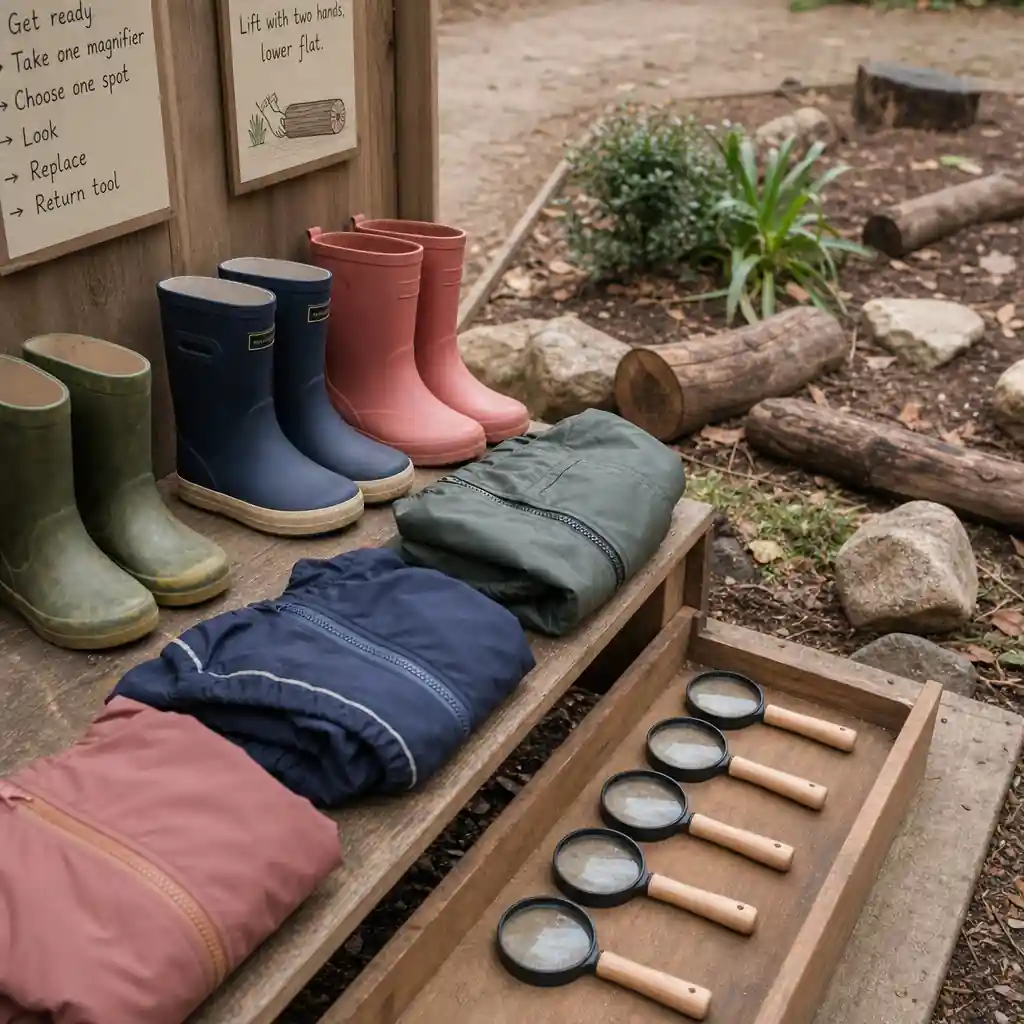
Place only what is needed at child height: wellies and all-in-one suits set left to right on a low bench (sit, feet in, fasten). Offer one magnifying glass per child on a tray; set binoculars aside. Define a small search zone using natural edges (path, bed, log pile) and select two or three microhabitats: one log, one stone, one plant clump. Keep the sequence clear: get ready, take one magnifier, choose one spot, look, replace habitat carefully, return tool. Misplaced logs or soil gaps make errors visible.
Bring a small group and give one slow, silent demonstration with a single safety phrase: “Lift with two hands, lower flat.” Show dress → take one magnifier → crouch → lift a corner → look → replace to fit → return tool. Then step back to the edge of the zone, hands free, speaking only for safety. Do not prompt or quiz. Watch dressing steps, controlled lifting and lowering, balance, where creatures are found, accurate habitat words, repetition, and signs of focus or worry.

In an outdoor microhabitat area—grass, bare earth, log piles, stones and plant borders—set out simple piles of leaf litter, overturned logs and rocks in loose, discoverable clusters rather than fixed stations. Materials such as magnifying glasses and binoculars are optional; children may use hands to gently turn over loose cover with supervision and collect small natural samples in open trays. The adult checks surfaces and footing, supports putting on wellies and suits, and leaves the setup imperfect and changeable for repeated exploration.
The adult observes from close enough to intervene, using short, responsive prompts or single words when needed and modelling calm, careful handling before stepping back. Children choose where to search, take turns, decide how long to stay at a spot, and may return to favourite hiding places; they practise fastening welly straps and helping peers. The adult verbally acknowledges discoveries, manages risk (lifting heavier items, slippery patches) and offers brief, practical support only when safety or dressing requires it.
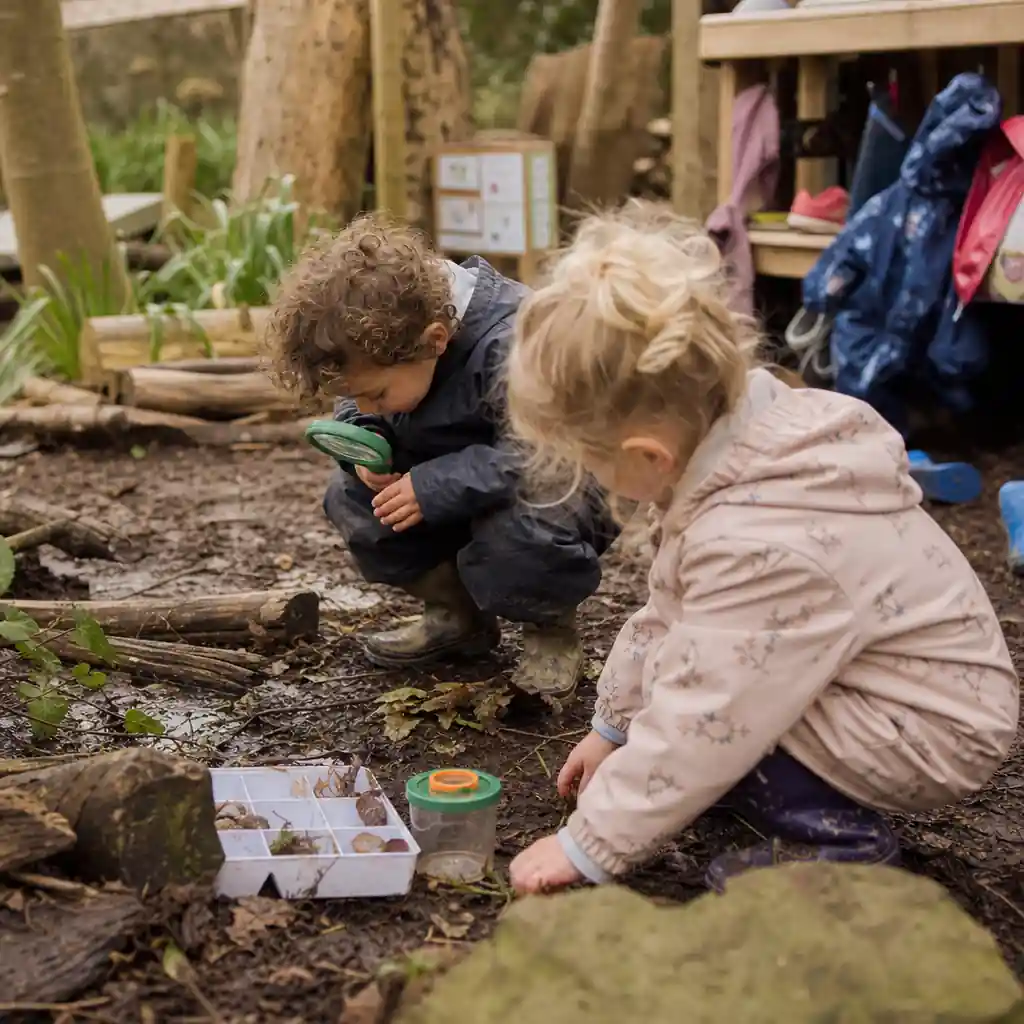
Arrange the outdoor area as a set of inviting microhabitat stations (log pile, stone shelter, leaf-litter patch, shallow puddle) with clear sight-lines and low boundaries so children move freely between them. Place open-ended, accessible resources nearby—small trays, clear jars with lids, loose spoons, soft brushes, fabric squares, and a few child-sized magnifiers—so materials invite collection, comparison and shelter-building rather than prescribing a single activity. Keep wet suits and wellies in a reachable rack to support independent dressing within safe outdoor limits.
The adult steps back as an observer and co-researcher, using observational commentary like "I can see you looking closely at the leaf cluster" or "You’re trying to make a hiding place" rather than giving instructions. The child may choose to examine, shelter, map or photograph discoveries, pause and return, or focus on dressing skills between searches; the adult follows these shifts and introduces language that extends thinking—"What happens if you move the stone?"—while noting embedded cues: emerging vocabulary, problem-solving strategies, fine-motor handling of creatures, turn-taking and emotional responses.

Steady, contained zones are prepared around a few natural features (a low log, a flat rock, a leaf-litter patch) each marked by a neutral cloth or shallow wooden tray to keep the area uncluttered. Only a small number of items are provided: wooden-handled magnifiers or a single low glass viewing jar with a cork lid, wool marker flags, and outdoor clothing laid at the edge; bright plastics and noisy gadgets are omitted. The layout is simple so children move from one small patch to the next in a predictable flow.
The adult demonstrates quiet, deliberate handling—lifting a log with two hands, cupping a beetle briefly on an open palm—then steps back to observe, using minimal language except for safety points. The adult remains an anchor nearby, modeling calm movements and repeating the same gentle actions across visits, intervening only for safety or to restore calm; the child returns to the same patch for repeated, self-paced inspection, naming or pointing as they wish.