Exploring the frog life cycle using taste-safe chia seed frogspawn in a spring sensory tray
Spring
Life cycles
Sensory Play
Children gather around a shallow tray of jelly-like chia mixture with a small basket of frog life cycle figures and a couple of scoops. An adult stays close, offering a cloth and naming textures as children squeeze, lift, and place items on lily pad shapes. Some children focus on filling cups and tipping them back, and others sort figures into small groups on a dry mat beside the tray.
Children explore a taste-safe, jelly-like chia mixture that resembles frogspawn and use it as a sensory base for representing stages in a frog’s life cycle. The experience invites close noticing of texture, movement, and change, with opportunities to place and retrieve small life-cycle figures. Children may choose to focus on messy sensory play, careful tool use, or simple sequencing ideas. Adults can keep the focus on curiosity and language rather than correct answers.
Step-by-Step Guidance
1. Prepare the environment: Place a waterproof mat under a low table or on the floor. Position the tray where children can reach from at least two sides.
2. Prepare the sensory base: Soak chia seeds in water ahead of time until they become jelly-like. Stir well so the texture is even and pour into the tray.
3. Set a simple pond invitation: Add a small number of lily pads, sticks, and a few large smooth stones to suggest a pond without overcrowding the tray.
4. Present the life cycle materials: Place the frog life cycle figures beside the tray in a small basket or bowl. Keep extras out of sight to reduce distraction.
5. Offer tools with choice: Put out two or three tools (e.g. spoon, scoop, ladle). Add bowls/cups for transferring. For older children, add tweezers/tongs as an optional challenge.
6. Open the play with neutral language: Name what is available and what children can explore (texture, scooping, placing figures). Avoid testing questions.
7. Support representation: If children show interest in the figures, introduce simple stage words (frogspawn/eggs, tadpole, froglet, frog) and allow children to place them anywhere they choose.
8. Extend fine motor play: Model one slow transfer (scoop to cup, cup to tray) and pause. Offer tweezers/tongs only when children are already steady with larger tools.
9. Follow children’s focus: If children prefer sensory exploration, stay with texture language. If they prefer sorting/ordering, provide a clear space beside the tray for grouping figures.
10. Close and reset: Give a clear ending signal, offer handwashing, and remove small items first. Dispose of or store the chia mixture according to your setting’s hygiene routine.
Learning Objectives
Children may build understanding of change over time by exploring a simple frog life cycle representation (Understanding the World). Children may develop hand control through scooping, squeezing, transferring, and placing small items with tools (Physical Development). Children may extend vocabulary for texture and for living things through shared talk during play (Communication and Language).
Adult Role
Stay emotionally attuned by noticing children’s comfort with mess and offering choices such as tools, a wipe, or a boundary area for “clean hands” play. Model calm, descriptive language for texture and for the life cycle stages, keeping talk responsive to what children are already doing. Scaffold only when needed: demonstrate one action slowly, offer a simpler tool, or reduce the number of items if children look overwhelmed; step back when children repeat and vary their own ideas. Observe in action by watching grip, bilateral coordination, persistence, and how children use figures to represent change over time. Hold safety responsibility by supervising closely, managing small parts, and maintaining hygiene around a taste-safe material that is used for play rather than eating.
Observation Cues
Reaches into the mixture with fingers or tools and adjusts grip when it slips or drips.
Uses words or gestures to describe texture (e.g. slimy, squishy, bumpy) or to request tools.
Places figures into the tray and retrieves them, repeating actions to test what happens.
Shows early sequencing by grouping or ordering figures, or by moving between stages in any order.
Sustains attention by returning to a preferred action (stirring, scooping, hiding, finding) and varying it over time.
Time & Space
15–35 minutes, with flexible entry and exit for children who prefer shorter sensory bursts.
A wipe-clean floor area or low table with a waterproof mat; space for 2–4 children to access the tray from more than one side; nearby handwashing.
Materials
Safety
Age adaptations
Budding Adventurers
Offer three stage figures (frogspawn/eggs, tadpole, frog) and a small basket for “finding” and “returning” them. Add a ladle and a scoop, plus two cups to encourage pouring and transferring. Provide a clear dry area beside the tray for placing figures if children want to line them up. Use simple sequencing language only when it matches the child’s play (e.g. eggs and tadpole) and accept non-linear ordering.
Curious Investigators
Provide the full set of life cycle figures and add a small sorting tray or shallow dish with four sections for children who choose to group stages. Introduce tweezers/tongs as an optional tool for lifting smaller figures, alongside a larger scoop for regulation. Add a few lily pads and sticks to support habitat talk without turning it into a craft. Encourage children to describe what changes between stages using observable features (tail, legs) and to compare textures and resistance when scooping.
Confident Discoverers
Offer the full life cycle set plus an extra set of one stage to support comparing and grouping. Provide a choice of tools including tweezers/tongs and a small ladle, and add a defined “pond edge” area (stones/lily pads) for children who want to create zones. Invite children to explain their own ordering and to adjust their representation if they notice differences (e.g. where frogspawn belongs). Support longer attention by suggesting a clean-up role such as returning figures to the correct basket sections, without turning it into a test.
EYFS Links
Understanding the World: Children can explore living things and talk about change over time by using figures to represent frogspawn, tadpoles, froglets, and frogs. The sensory base supports noticing and describing what “frogspawn-like” might feel like, linking observation to simple scientific ideas.
Physical Development: Scooping, transferring, squeezing, and using tongs can support hand strength, coordination, and controlled release. Children can practise adjusting pressure and grip when materials are slippery.
Communication and Language: Adults can model and extend vocabulary for texture and for life cycle stages, responding to children’s gestures and comments. Shared attention around the tray supports turn-taking in conversation and listening to others’ ideas.
Ethos adaptations
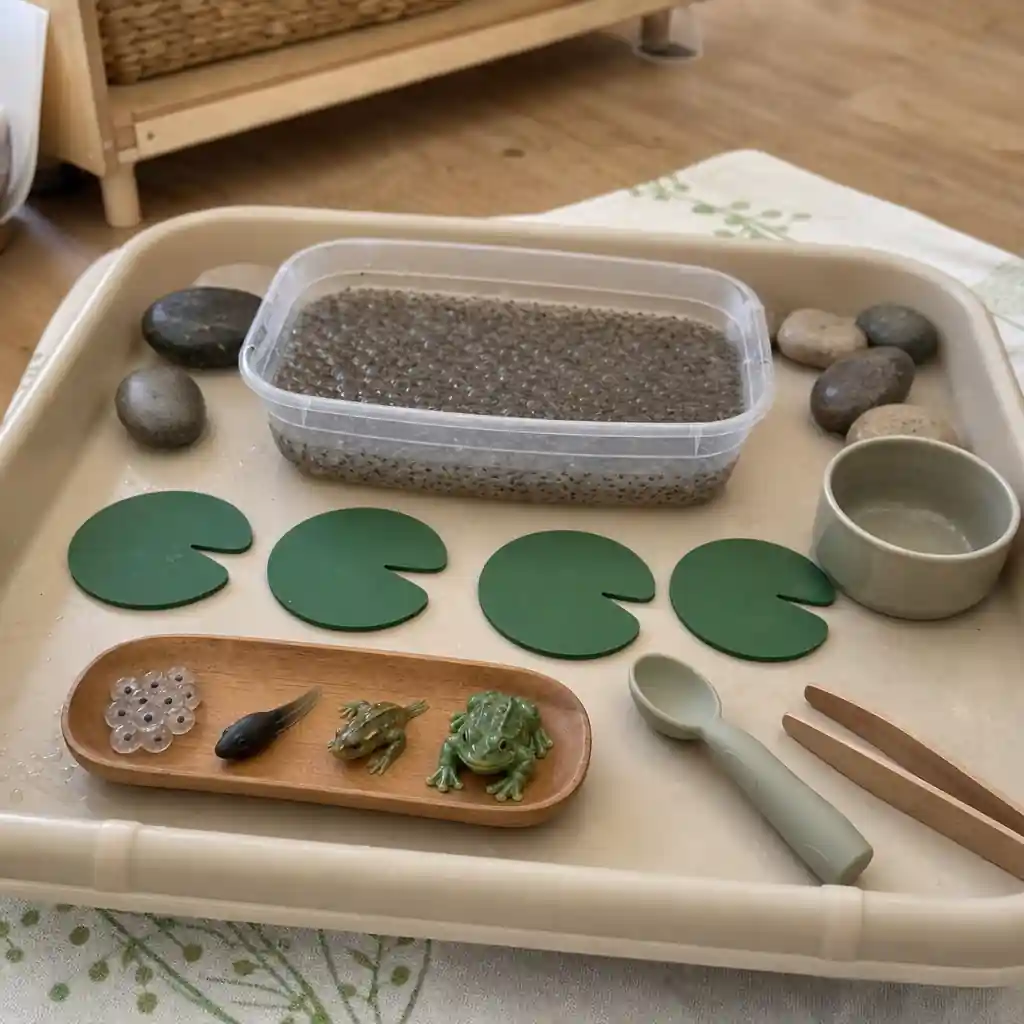
Set one low tray on a mat with the chia mix in a shallow tub at the centre. Offer four lily-pad shapes in a left-to-right line with clear spaces between them, and place the life-cycle figures in a small dish ordered egg → tadpole → froglet → frog. Provide one child-sized spoon and one small bowl; keep tongs available only if needed. Remove extra toys, keeping just a few smooth stones at the tray edge to define the pond. This isolates careful transferring and simple sequencing; overflow or misplacement is visible to the child.
Give a slow, single demonstration without commentary: roll sleeves, put on apron, scoop a small amount into the bowl, place the egg figure on the first pad, return tools, wash hands, and step back. After that, use brief, factual words only if invited (e.g., “tadpole”, “slippery”). Do not correct order. Watch for steady scooping, controlled release, and whether the child notices spills and adjusts. Notice any left-to-right placing, repetition, and periods of quiet focus or signs of fatigue, then decide when to offer tongs or to tidy the space.

In an outdoor or nature-integrated space such as a sheltered corner of the garden or a shaded bench on soft grass, the sensory tray is placed on a waterproof mat or low table with an uneven surface nearby for movement. Materials are arranged with real natural additions: chia “frogspawn” in the tray, smooth pond stones, clean sticks, leaves, and collected seedpods instead of only foam lily pads; small life-cycle figures remain but are kept alongside natural items for comparison. Children may work seated on logs or standing on grass to notice texture and temperature differences.
The adult observes from close by, checking anchors, hygiene and safety, then steps back to offer minimal, responsive prompts and single-word observations when needed. Materials are provided openly so children choose scoops, tweezers or hands, transfer into bowls, hide or retrieve figures, and experiment with squeezing, lifting and sequencing at their own pace. The adult intervenes only to manage risk, help with fastening aprons or demonstrate one safe grip, then returns to observational stance.
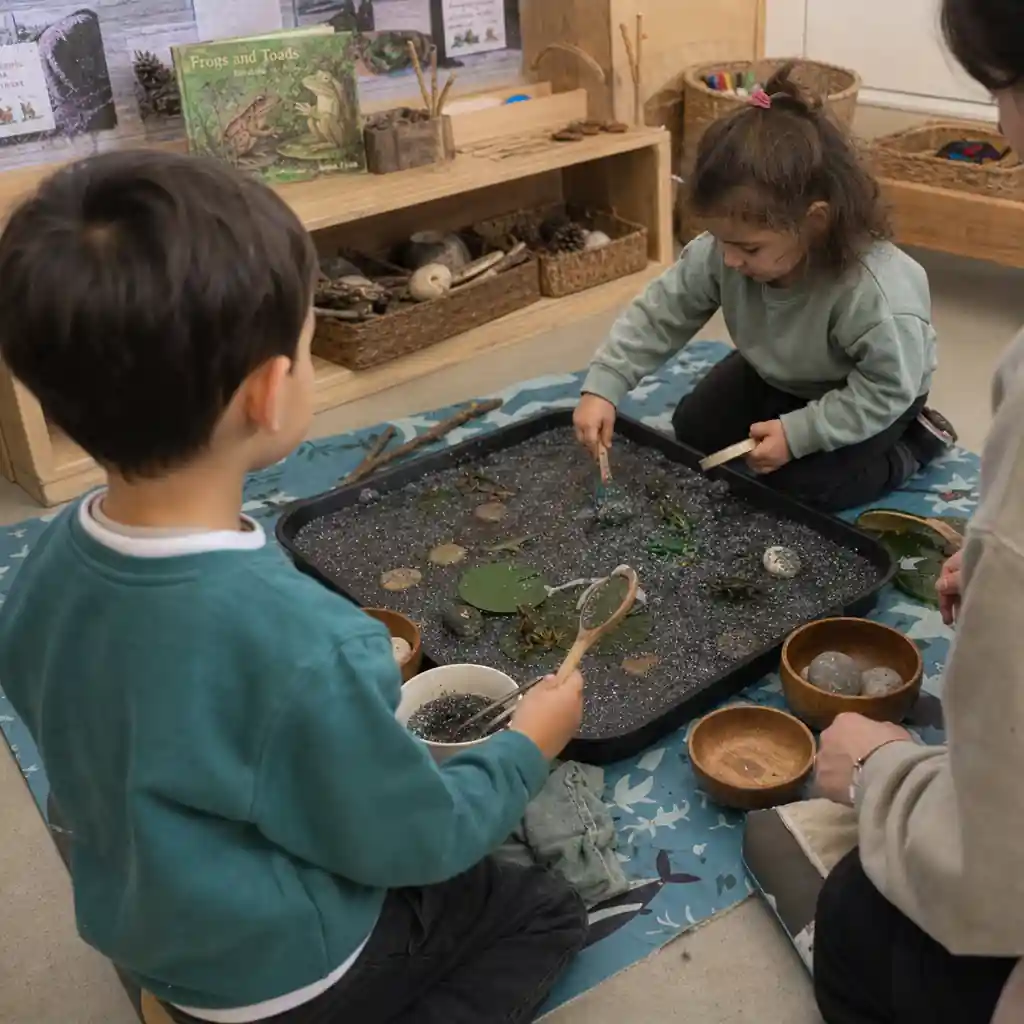
Ethos adaptation: Set the chia tray as a reachable, communal exploration island with space for two or three independent entry points rather than a single sit-and-do station. Spread open-ended loose parts (stones, sticks, lily pads, bowls, scoops, tweezers) nearby on low shelves so the child may choose and combine materials; keep chia in a single large shallow tray so its texture invites repeated touching, scooping, transferring, and settlement rather than a prebuilt scene. Keep choking-safe sizes and wipes available; do not present a fixed sequence or finished example.
The adult steps back as observer and co-researcher, using commentary like "I can see the chia moving" or "You’re trying to move the tadpole with the spoon" and occasional prompts such as "What happens if you press here?" rather than instructions. The child may shift between messy exploration, careful tool use, or arranging life-cycle figures into sequences; these choices reveal different understandings. The adult notices moments for EYFS-linked observations: sustained concentration, changing grip and control, vocabulary emergence about texture and life stages, and collaborative negotiation during shared turns.

Set up a quiet corner near natural light with an undyed cotton cloth marking the workspace. A shallow wooden tray holds the prepared chia “frogspawn,” with only a small selection of natural items set out: smooth river stones, clean sticks, a few wool-felt lily pads, and four small carved wooden forms suggesting egg, tadpole, froglet, and frog. Provide wooden or metal spoons, a single small wooden tong for older children, and two or three wooden or ceramic bowls. A waxed-cotton mat, aprons, and cloths sit at the edge for practical care.
The adult demonstrates a slow scoop, gentle squeeze, and quiet placing of a wooden form in the chia, then steps back to observe. Language is minimal and descriptive, offered in response to the child’s noticing of texture, movement, and simple stage words, with intervention only for safety and turn-taking. The child returns to transferring, arranging, or loosely sequencing the forms on stones or felt pads, or simply exploring the gel repeatedly at their own pace. The session closes with a calm, modelled tidy: forms lifted out, bowls emptied, hands washed.