Creating spring flowers with coloured playdough and loose parts for child-led design
Spring
Sensory Play
Children use coloured playdough as a base for spring flower designs, choosing from cutters and a small range of loose parts to add detail and texture. Adults keep the materials inviting and manageable, supporting safe handling and offering vocabulary that matches children’s choices. Practitioners may notice how children organise items, adjust pressure, and return to ideas to change or refine their designs.
Children explore coloured playdough as a base for making spring flower designs using cutters and a small selection of loose parts. The open-ended format supports individual ideas, repeated attempts, and changes of plan. Children may notice colour contrasts, patterns, and how different items press, bend, or sit on the dough surface.
Step-by-Step Guidance
1. Prepare the space with wipe-clean mats and a central loose-parts tray. Offer playdough as either one larger ball per child or several smaller balls in different colours.
2. Present a limited selection of loose parts at first (2–4 types) so children can see what is available without being overwhelmed. Keep additional items nearby to rotate in.
3. Invite children to explore the dough with hands first. Place cutters and rolling tools within reach without demonstrating a finished model.
4. As children begin making flower shapes, offer language for what you notice: colour choices, pressing, flattening, joining, and adding details. Avoid directing the design.
5. Support children to test how loose parts attach: pressing in, balancing on top, or embedding partway. Offer a small piece of spare dough for “trying out” if a child seems unsure.
6. If children want stems or curved shapes, make pipe cleaners available in short lengths and show how to bend them safely without sharp ends. Step back once the child has the idea.
7. Rotate materials based on interest. If children are repeatedly dropping or mouthing items, simplify the loose parts and increase supervision.
8. Create a clear end point by offering a tray or board for children who want to keep their flower briefly for display or to revisit later. Support tidy-up by sorting loose parts back into sections and returning dough to containers.
Learning Objectives
Children may develop fine motor control as they pinch, roll, press, and place small items into playdough (Physical Development). Children may explore colour, shape, and pattern through self-chosen designs (Expressive Arts and Design). Children may build vocabulary for describing what they notice and what they are trying to make, with adult modelling (Communication and Language).
Adult Role
Stay emotionally attuned by noticing frustration, pride, or hesitation and responding with calm presence and simple reassurance. Model language that matches what children are doing, such as describing colours, shapes, and actions (press, roll, pinch, bend, balance), and add new words only when they fit the child’s focus. Scaffold when a child is stuck with a tool, cannot make a piece stay in place, or is unsure how to use a material safely; step back when the child is repeating a method, experimenting, or clearly leading the idea. Observe in action by watching grip changes, persistence, and how children organise materials, and use this to decide whether to simplify choices or add challenge. Hold responsibility for safety by selecting age-appropriate loose parts, supervising closely, and removing items immediately if they are mouthed or thrown.
Observation Cues
Chooses between single-colour and mixed-colour dough and explains or shows a preference through repeated selection. Uses different grips to press cutters or place small items, adjusting pressure when pieces do not stick. Groups loose parts by colour, size, or type without being prompted. Returns to a design to add details, remove items, or rebuild after it collapses. Names features such as petals, stem, centre, or uses own labels for parts of the flower. Notices and responds to others’ ideas by copying, adapting, or offering materials.
Time & Space
20–45 minutes, with the option to leave materials available for return play.
Table-top or floor mat area with a wipe-clean surface and space for a central materials tray plus individual mats.
Materials
Safety
Age adaptations
Budding Adventurers
Provide 2–3 dough colours as small balls to encourage mixing and separating. Offer 3–4 loose-part types with clear sections in the tray so children can independently choose and return items. Adult supports children to notice petals/centre/stem as optional features, and offers a spare dough piece for testing how items stick without taking over the design.
Curious Investigators
Add a wider range of loose parts, including pipe cleaners cut to safe lengths and a second cutter shape for layering. Introduce child-safe tweezers for placing small items if appropriate for the group. Adult encourages children to describe patterns and make comparisons (same/different, more/less, bigger/smaller) and observes planning, persistence, and how children revise designs.
Confident Discoverers
Offer multiple dough colours and invite children to choose between keeping colours separate or blending for new shades. Provide a broader loose-parts palette and optional tools (tweezers, rolling pin) for precision. Adult supports children to plan a design, name steps in their own words, and reflect on what changed when they pressed harder, used different bases, or layered shapes, without requiring a finished product.
EYFS Links
Physical Development: Children practise hand strength and coordination through squeezing dough, pressing cutters, and placing loose parts with control. Communication and Language: Adults can model descriptive vocabulary and support children to express choices, plans, and changes as they work. Expressive Arts and Design: Children explore materials and techniques to represent spring flowers in their own way, experimenting with colour, texture, and arrangement. Personal, Social and Emotional Development: Shared trays and open-ended outcomes can support turn-taking, confidence to try ideas, and managing frustration when designs change or collapse.
Ethos adaptations
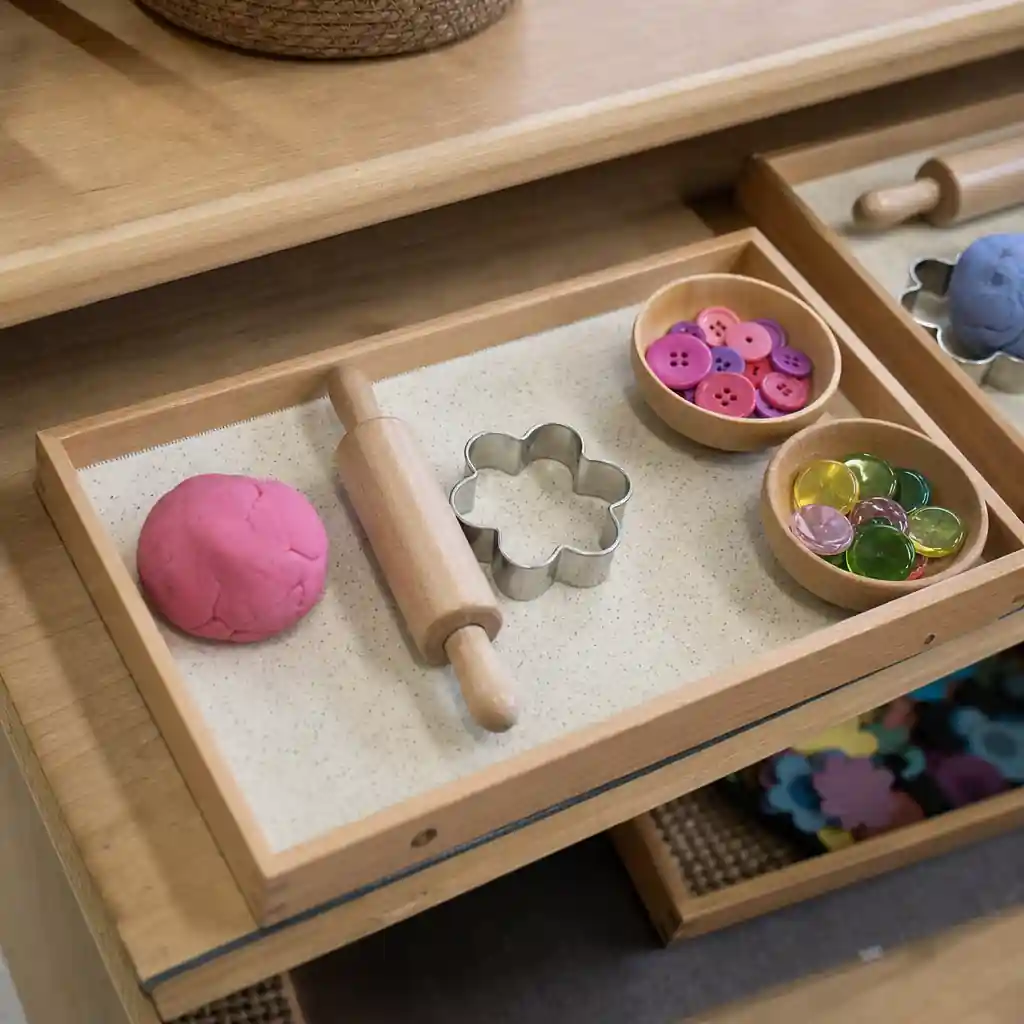
Set up individual trays on a low shelf, each with a mat, one palm‑sized ball of dough in a single colour, one small rolling pin, and one flower cutter. Offer two types of loose parts only (e.g., large buttons and flat gems) in small bowls with 6–8 pieces each, placed left‑to‑right: dough → roller/cutter → bowls. Keep tweezers only on trays for older children. This isolates pressing, placing, and pattern. Control of error is visible: flat parts that aren’t pressed don’t stay, and overcrowded areas spill or tilt.
Give one slow demonstration: carry the tray, roll a small “pancake,” press the cutter once, place two parts and press flat, then return unused pieces and the tray. Use few words, naming just one or two terms like “petal” and “centre,” then step back. Watch for pincer use, steady pressure, repeated attempts, and whether the child notices when items lift and tries again. Note any self‑chosen patterns, colour choices, and spontaneous words, intervening only for safety.

In an outdoor or nature-integrated space, set up on grass, bark or a sheltered patio so surfaces are uneven and sensory. Materials such as small pots of homemade or plain playdough, real flower petals, seedheads, small smooth stones, twigs, leaves and large wooden buttons are provided in an open-ended way rather than pre-arranged. Mats or shallow trays keep work tidy and allow children to experiment with natural textures and colours as they press, roll and shape.
The adult observes from close by, checking safety and modelling single words or short phrases only when asked, then stepping back. Materials are arranged for easy choice and replenishing rather than instruction. Children choose tools and loose parts, test pressings, swap materials and repeat attempts, describing what they notice while the adult offers responsive comments or brief questions to extend vocabulary and fine-motor exploration.

Arrange low trays and small mats across a low table so children can approach from any side; make multiple colour balls of playdough and a wide, visible selection of loose parts (natural petals, large buttons, feathers, short pipe-cleaners, flat gems) in open dishes rather than handed-out packs. Leave cutters and rollers accessible but not prescriptive; the child may choose to flatten, roll, press, layer, or combine materials in unexpected ways and may move between stations, repeat attempts, or abandon and return.
The adult steps back as an observer and co-learner, using commentary such as "I can see the dots you’re making" or "You’re trying to balance that bead—what happens if…" rather than giving step instructions. The child may direct sequence, mix colours, or invent tools from loose parts; the adult notices emerging fine-motor patterns, colour choices, problem-solving strategies, turn-taking, and language attempts and records or photographs these moments as they unfold.

A quiet table is cleared and covered with a plain cotton cloth; each child has a small wooden board within a clearly defined space. The materials are arranged in shallow wooden bowls: a modest amount of homemade, plant-tinted dough in one or two soft spring tones; short wool threads, small smooth pebbles, acorn caps, dried petals and leaves, and a few small natural feathers. A single small wooden roller is available if wanted. Cotton aprons and a nearby bowl for hand washing are placed to one side.
The adult demonstrates calmly by rolling a small ball, pressing it gently into a disc, and making simple imprints with a pebble, using minimal words. The adult observes children’s choices, adding occasional descriptive language that mirrors what is happening, and stepping in only for safety with small pieces. The child returns to rolling, pinching, and arranging natural parts into flower-like forms or shifting patterns, repeating or changing plans at their own pace, then restores items to the bowls for a simple close.