Spring flower printing using celery heads and everyday mark-making tools for ages 2–4
Understanding the World
Communication and Language
Literacy
Children use everyday tools such as celery heads, sponges, forks and cardboard tubes to explore spring flower shapes through paint. Adults offer flower images to support noticing and vocabulary, keeping the focus on children’s own ideas rather than copying. Children may explore repeated prints, colour choices and different pressures, and adults can watch for fine motor control, sharing needs, and the language children use to describe what they have made.
Children explore spring flowers through printing and painting with alternative tools such as celery heads, forks, sponges and cardboard tubes. The experience invites children to notice shape, colour and pattern, and to connect what they create with real flowers they may have seen outdoors. Adults can support children to choose tools, experiment with marks, and use flower names in conversation. The focus stays on exploration and personal ideas rather than making identical outcomes.
Step-by-Step Guidance
1. Prepare the space with a messy mat, aprons, and a clear drying area. Place paper at each place setting, with extra sheets nearby for children who want more than one.
2. Set out paint in trays or small pots. Offer a limited number of colours at first, adding more if children ask or if the space becomes crowded.
3. Arrange tools in a simple layout so each tool is easy to see and pick up. Include celery heads, forks, sponges, cardboard tubes and brushes, each with enough space to return items without mixing piles.
4. Place spring flower images where children can view them without paint splashing onto them (e.g., on a stand, wall, or a separate “look here” table). Keep the images optional rather than a template to copy.
5. Introduce the invitation briefly: name a few tools and a few flowers, and show one example of making a print without demonstrating a finished picture.
6. Support children to choose a tool and paint colour. Allow time for experimenting with single marks, repeated prints, and combining tools on one page.
7. As children work, offer language that matches what they are doing (colour words, shape words, flower names) and reflect their choices. Keep questions simple and specific.
8. Support turn-taking by offering duplicates of popular tools where possible, or by creating a clear “waiting spot” for a tool. Acknowledge feelings and help children negotiate.
9. Offer additional paper when children request it, or when they appear constrained by wanting to restart. Keep the focus on process rather than “finishing”.
10. Close the activity by helping children place work to dry and wash hands. If children want to share, invite them to point to a flower image that matches their idea, or to name their artwork in their own words.
Learning Objectives
Within Expressive Arts and Design, children may explore how different tools create different prints, textures and lines when used with paint. Within Communication and Language, children may build vocabulary by naming spring flowers and describing colours, shapes and choices. Within Physical Development, children may practise fine motor control through grasping, pressing, dabbing and brushing with a range of tools. Within Understanding the World, children may begin to connect flowers with seasons and notice that different flowers appear in spring.
Adult Role
Stay emotionally attuned by noticing children’s comfort with mess, waiting, and sensory input, and respond calmly with practical support such as wipes, a pause, or a different tool. Model language in the moment by naming spring flowers, colours and actions (press, dab, swipe, print) and by repeating children’s words back clearly. Scaffold when a child is stuck, frustrated, or unsure how to access a resource; step back when a child is absorbed in experimenting or repeating a technique. Observe tool choices, grip, pressure, and social interactions to inform what to offer next time, including whether to simplify the selection or add challenge. Hold responsibility for safe use of tools and materials, checking edges, monitoring paint use, and managing any food-allergy considerations linked to celery.
Observation Cues
Chooses between tools with a clear preference and returns to repeat a technique.
Adjusts grip, pressure or angle to change the mark made.
Uses or attempts flower names when looking at images or describing artwork.
Shows sustained attention, or moves quickly between tools and surfaces.
Manages waiting, sharing paint pots or tools, and seeks adult support when frustrated.
Communicates pride, uncertainty or sensory discomfort through facial expression, posture or gesture.
Time & Space
10–20 minutes to set up; 15–45 minutes for children’s exploration depending on interest and group size.
Indoor table space with wipe-clean flooring nearby, or an outdoor table area with access to handwashing. A separate drying space is needed where paintings can lie flat or be racked without being touched.
Materials
Safety
Age adaptations
Budding Adventurers
Offer fewer tools at once (e.g., sponge, brush, celery head) and larger paper to reduce crowding. Use thicker paint in shallow trays to support dabbing and printing without paint running. Keep flower images to 2–3 clear photos and focus language on simple labels (tulip, daffodil) and action words (dab, press). Adult support stays close for turn-taking and to help with loading paint and placing prints where the child intends.
Curious Investigators
Offer a wider tool choice including forks and cardboard tubes, and add a second sheet of paper ready for children who want to restart. Provide a broader set of flower images and invite children to compare shapes (long petals, round centres) without expecting copying. Adults can introduce gentle prompts about seasons (spring flowers) and encourage children to describe their marks using colour and shape words. Support children to negotiate sharing by offering a simple timer or a clear “my turn/your turn” routine if needed.
Confident Discoverers
Add opportunities for planning by offering a choice of paper sizes and a space to place images beside the work area for reference. Include more nuanced colours (light/dark shades) and invite children to mix colours in a separate tray if appropriate for the group. Adults can extend vocabulary (petal, stem, bud) and support children to label their artwork with adult-scribed words or child mark-making, linking sounds to initial letters when the child shows interest. Encourage children to reflect on tool effects (which tool made the best petal shape) and to collaborate on a shared large sheet if they choose.
EYFS Links
Expressive Arts and Design: Children explore materials and tools, noticing how different actions create different marks and textures, and making choices about colour and composition.
Communication and Language: Adults model and repeat vocabulary for spring flowers and descriptive words, supporting children to talk about what they notice and what they are trying.
Understanding the World: Flower images and seasonal talk help children connect real-world experiences of spring with what they create, building early awareness of seasonal change.
Physical Development: Using a range of tools supports hand strength, coordination and control through pressing, dabbing, brushing and controlled movement.
Literacy: Children may begin to distinguish between different marks and patterns, and some may show interest in linking sounds to letters when adults scribe titles or labels based on children’s words.
Ethos adaptations
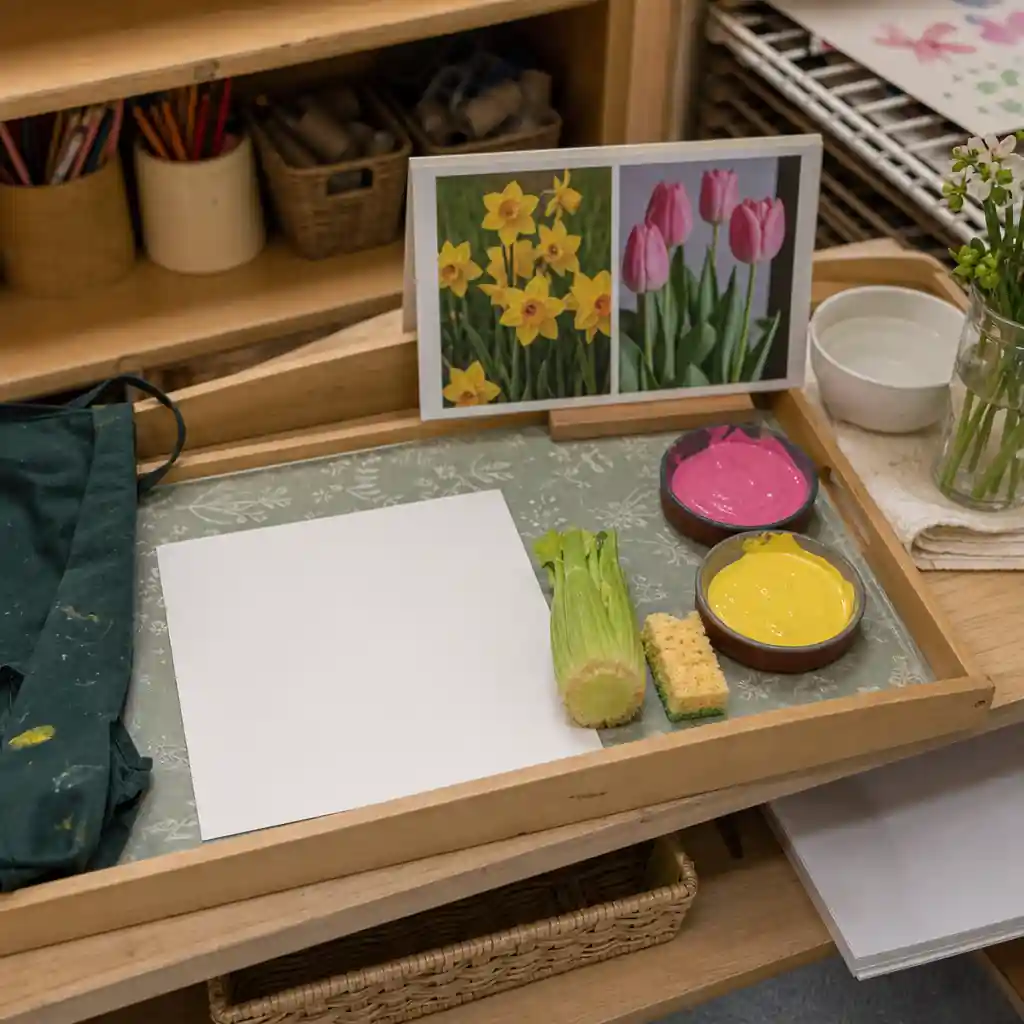
Set one tray per child with just two tools: a celery head and one other (fork or small sponge), plus two spring colours in shallow paint trays with a small amount of paint. Place one sheet of thick paper on the tray; keep extra paper stacked nearby. Arrange left-to-right: apron, paper, tools, paint, wipes and warm soapy water, then the drying area. Put one or two flower images upright by the trays. Store other tools on a low shelf so children may swap trays. Limited paint and clear prints give visible self-correction.
Give one brief, quiet demonstration: put on apron, choose a flower image, load one tool lightly, make a single print, notice the shape, place paper to dry, wipe the tool, wash hands, and return the tray. Step back and use words only for safety or names if the child initiates. Watch for repetition, grip changes, controlled pressure, and independent sequencing, including swapping trays or paper. Notice spontaneous flower vocabulary and colour talk, mixing choices, signs of deep focus, or when the child stops or seeks help.
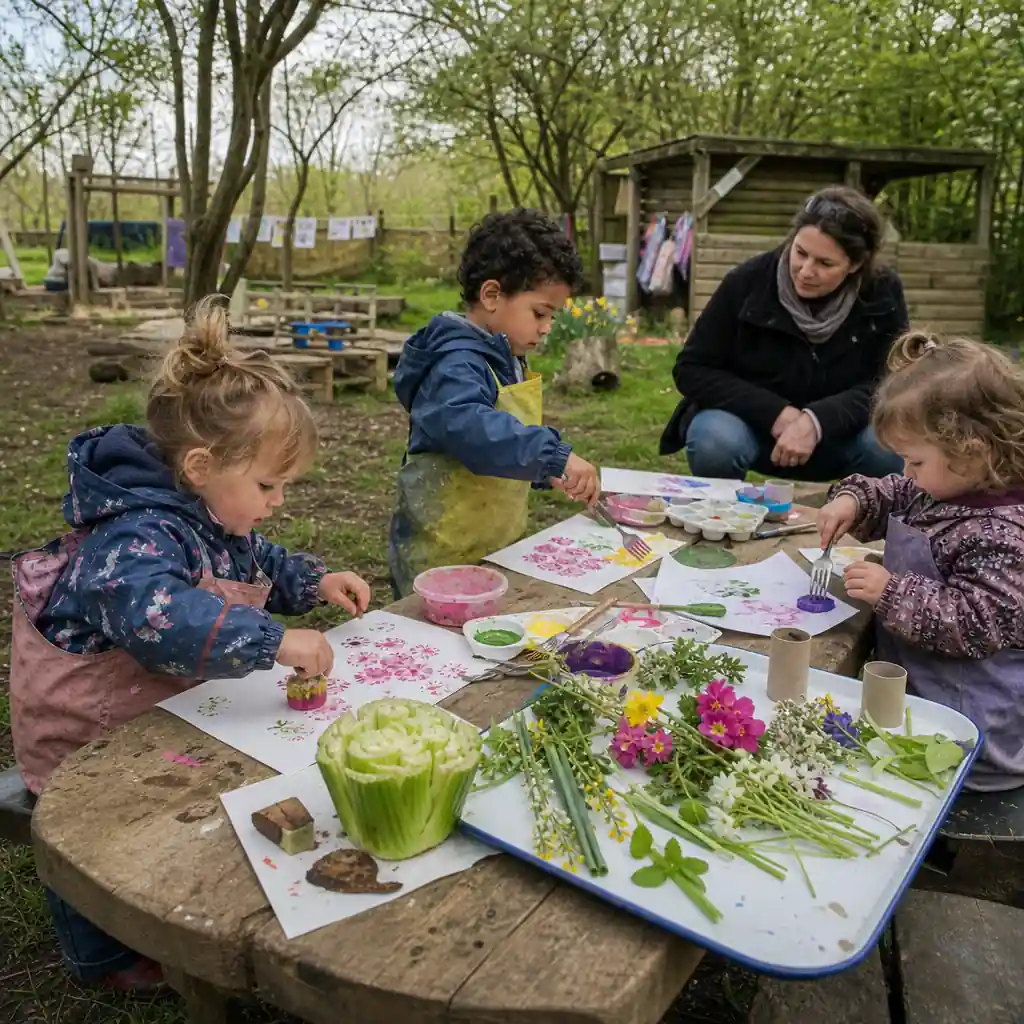
In an outdoor or nature-integrated space, set up on a low picnic bench, tree stump table or on a waterproof cloth on grass so surfaces are varied and slightly uneven. Materials such as celery heads, collected flower petals, leaves, small stones, natural bark stamps and simple cardboard tubes are provided alongside child-safe forks and brushes; materials are arranged in an open-ended way rather than pre-arranged trays. Real spring flowers for looking and comparing are available nearby so children can match shapes, colours and textures as they print and paint.
The adult observes from close by, checking anchors, supervising uneven ground and offering minimal, responsive prompts or single-word descriptors rather than instructions. Children choose tools, gather natural materials, stamp, dab and layer marks at their own pace, testing pressure and grip to explore texture and control. The adult may name flowers or repeat children’s words briefly, step in only to manage safety, and then step back to let children continue their explorations without a fixed outcome.
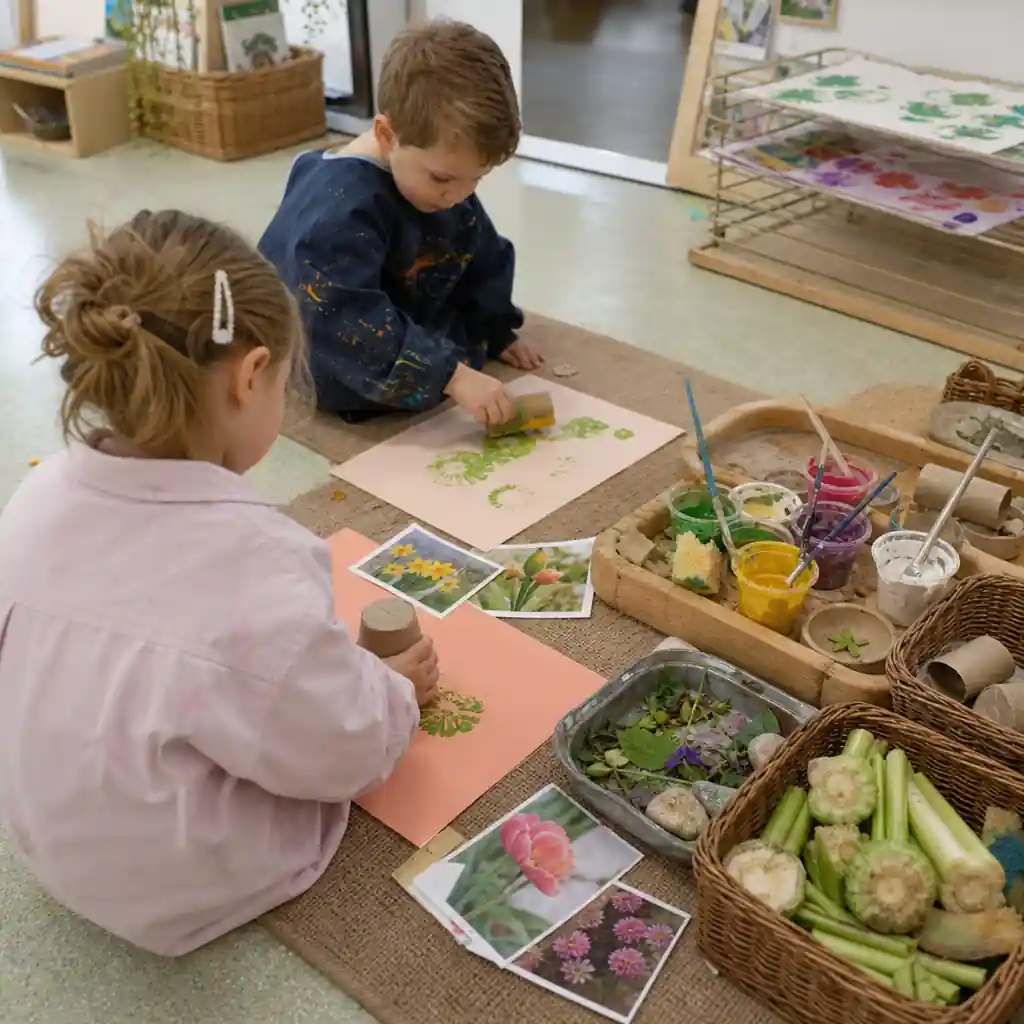
Ethos adaptation — the workspace is laid out so materials sit within easy reach on low trays and open baskets across the table and floor, inviting self-selection rather than a single prepared station. Celery heads, forks, sponges, tubes, paint pots, flower images and natural loose parts (stones, leaves, petals) are mixed together so the child may combine items in new ways; paper is available in varied sizes and orientations to support multiple entry points and repeated return.
The adult steps back as observer and co-researcher, using commentary such as "I can see the circles you’re making" or "You’re trying the celery and the tube together" rather than giving directions. The child may choose tools, change media, pause or abandon marks; the adult notices moments of problem-solving, language use and fine-motor effort and places these observations alongside drying work or a simple photo record to support EYFS-linked learning without steering outcomes.

Steiner (Waldorf) Adaptation
The materials are arranged on a neutral cloth over a low table or tray to create a calm, contained workspace; only a few items are offered at once. Celery heads, small natural sea sponges, short lengths of plain cardboard tube and a couple of smooth wooden sticks replace bright or plastic tools. Paints are limited to muted, earth-toned washable colours in small pots, thick paper is provided, and flower images sit quietly at the cloth edge for reference.
The adult demonstrates a single calm press or roll of a tool without step-by-step instruction, then steps back to observe closely. The adult speaks minimally, naming a flower or colour when naturally relevant, and remains ready to support for safety or to model a repeat action. The child returns to printing at their own pace, repeating marks and pauses as they choose, and joins a short, shared tidy ritual when finished.