Sorting and building with mixed construction blocks by colour in a low-shelf provision
Mathematics
Communication and Language
An open container of mixed construction pieces sits beside shallow trays, inviting children to notice and group colours while designing their own structures. The activity centres on children’s decisions about organising and building, with adults offering concise language and observing how colour choices influence play.
Children explore a mixed collection of construction materials and notice colour differences as they sort and select pieces. The experience combines organising and building, with children moving between grouping, comparing and using chosen pieces in their own structures. Adults can keep the focus on children’s ideas by offering simple language for colour and by making the materials easy to access and return.
Step-by-Step Guidance
1. Prepare the space: choose a low table or floor mat with enough room for several trays and a building area beside them. Keep walkways clear.
2. Prepare the materials: place the mixed blocks in one open container. Set out 3–6 empty trays with space between them. Keep extra trays nearby in case children want more groups.
3. Invite exploration: bring the container to the area and allow children to handle pieces. Let children decide whether to sort first, build first, or move between both.
4. Support sorting choices: if children start grouping by colour, name what you see in simple terms (for example, “You’re putting the red pieces together”). If they sort by another feature, follow their rule and reflect it back.
5. Make building available: keep a clear space for building next to the trays. Allow children to take from any group and return pieces when they choose.
6. Offer light scaffolds: if a child looks stuck, offer one small option (for example, adding an empty tray, reducing the number of colours, or suggesting a “same colour” pile). Avoid taking over the sorting.
7. Encourage tidy return: near the end, support children to decide how pieces go back (by colour groups into the tub, or all together), keeping the routine consistent with your setting.
Learning Objectives
Children may develop early mathematical thinking through sorting, matching and comparing by colour (Mathematics). Children may strengthen fine motor control as they pick up, connect, stack and balance pieces (Physical Development). Children may extend vocabulary and attention as they hear and use colour words and simple descriptive language (Communication and Language).
Adult Role
Stay emotionally attuned by noticing frustration, pride, or hesitation and responding with calm presence and time. Model simple, accurate language for colour and for actions children are already doing, such as “match”, “same”, “different”, “more”, “fewer”, “tall”, and “flat”. Step in to scaffold when a child is stuck or when the space becomes too crowded; step back when children are sustaining their own sorting rule or building plan. Observe how children choose categories, how they manage changes of mind, and how they coordinate hands and eyes when connecting or stacking. Hold responsibility for safe use of small pieces, clear floor space, and respectful sharing of materials.
Observation Cues
Chooses a sorting rule and keeps it going, or changes the rule and explains it with gestures or words. Notices when a piece “doesn’t belong” and moves it to a different group. Uses colour to plan or revise a build (for example, searching for a specific colour to complete a section). Persists with connecting or stacking when pieces slip or do not fit. Invites others to join, offers pieces, or negotiates shared space around the sorted groups.
Time & Space
10–30 minutes, with the option to return to it across the session.
A defined floor mat or low table area with room for several trays and a separate building space, plus clear walkways to reduce trips.
Materials
Safety
Age adaptations
Budding Adventurers
Offer a wider mix of materials (Duplo plus wooden blocks), with 3–5 colours and 3–5 trays. Add a plain mat with empty spaces to help children keep groups separate without needing printed prompts. Adults can introduce one optional challenge that stays child-led, such as “Can you find another that matches?” and then return to observation. Expect children to begin combining colour choices with simple structures like towers, lines, or enclosures.
Curious Investigators
Offer mixed materials including smaller interlocking bricks if appropriate for the group, with 4–6 colours and enough trays for children to create sub-groups. Invite children to decide their own sorting rule and to explain it using colour words and comparative language. Adults can support children to notice when one colour runs out and to adapt their build plan. Encourage collaborative builds where children agree how colour groups will be used, without insisting on a shared outcome.
Confident Discoverers
Offer a larger quantity and variety of blocks, including pieces that allow more complex builds, with 5–8 colours and extra trays for children who want to sort by shade or by two features (for example, colour and size). Provide a simple recording option such as a blank sheet and pencil for children who choose to mark how many are in each colour group. Adults can support children to compare quantities between groups and to plan builds that use repeating colour patterns, staying responsive to children’s own goals.
EYFS Links
Mathematics: children may sort and match by colour, compare groups, and begin to notice patterns when selecting pieces for building. Communication and Language: adults can model and extend vocabulary for colours and describing words, supporting children to express choices and explain their sorting rule. Physical Development: handling, connecting, stacking and transporting blocks can support hand strength, coordination and control. Expressive Arts and Design: children may use colour choices to represent ideas in their structures and to explore simple design decisions.
Ethos adaptations

Remove excess pieces and present only three to four clear colours, each in a small shallow tray or marked space on a low shelf or plain mat. Limit each tray to a fixed small set of pieces so children can sort without overwhelm; arrange trays left-to-right in the order they will be used and place one tray of loose building pieces next to the sorting spaces. Use neutral trays and a tidy brush for spills so the visual rule (colour → tray) is obvious and misplacements are immediately visible for self-correction.
Show the child the sequence once: take a piece, place it in its colour tray, then use one chosen piece from a tray to add to a simple build, spoken in single words only (colour, put). Step back and remain seated while offering no prompts, only brief safety reminders if needed. Observe how steadily the child sorts, the control of their grip and connections, repetition or persistence with a colour choice, and whether they return pieces to trays without adult prompting.
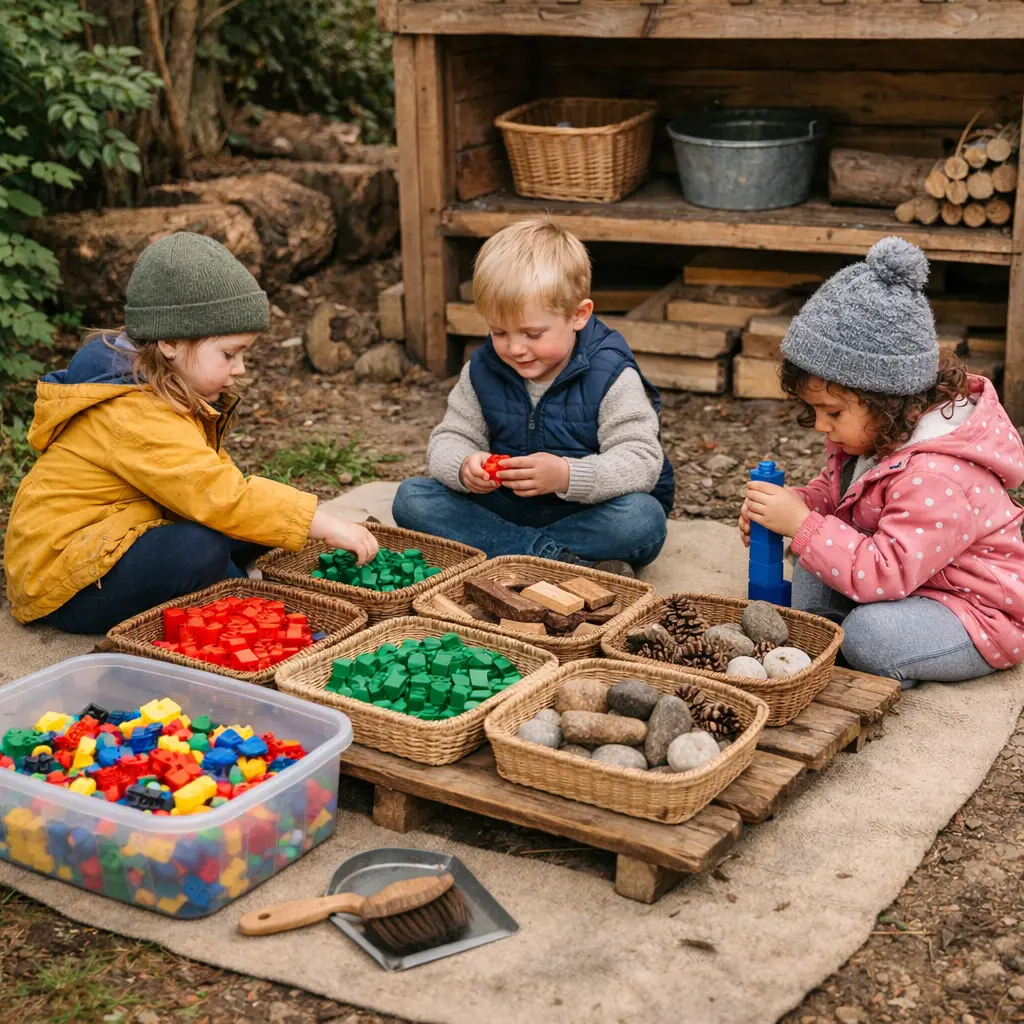
In an outdoor or nature-integrated space, move the low-shelf provision to a sheltered corner of the garden or a paved courtyard mat where grass, uneven surfaces and natural light invite exploration. Materials such as wooden blocks, bark planks, smooth stones, pinecones and a selection of the original coloured pieces are provided in an open-ended way rather than pre-arranged; 3–6 neutral trays or baskets sit on a low pallet or mat for sorting, with a small brush and dustpan for safe tidy-up.
The adult observes from close by, checking safety and offering single-word colour labels or short invitations when useful, then steps back to watch. Materials are arranged so children can reach, move and choose independently; children may sort by colour, texture or size, combine natural and coloured pieces, and build at their own pace. The adult responds with brief, descriptive prompts and intervenes only to manage risk or support turn-taking.

Move the low shelf into a U-shaped reach zone so materials are visible from several sides and children can work beside each other. Replace a single prepared task with a mixed, open tub of Lego, Duplo and wooden pieces arranged in small clusters across 3–6 neutral trays and an empty plain mat for child-defined sorting. Keep connectors, odd shapes and loose parts together so colour becomes one of many affordances; pieces remain freely chosen rather than pre-assigned to a tray.
The adult steps back as observer and co-researcher, using commentary such as “I can see red pieces are moving together” or “You’re trying to make those balance” and prompts like “What happens if you swap this shape?” The child may invent personal sorting systems, move between comparing, stacking and combining, or abandon and return to sets. Observation cues are embedded in the flow: repetitions, negotiation over pieces, vocabulary use around colour and shape, and changes in fine-motor strategies are noted rather than corrected.

A low wooden shelf holds 3–6 small wicker or wooden baskets, each lined with a soft wool-felt square in muted tones to suggest colour families. The materials are pared back to natural wooden blocks (plain and plant-dyed in soft hues), short wood planks, cork bricks, and a few smooth stones in clearly different natural shades; quantities are modest to keep the area calm. A neutral cotton or linen mat defines the workspace, with simple wool cords marking empty spaces for sorting. A wooden-handled brush with a small metal dustpan sits at the edge for tidying.
The adult demonstrates quietly by placing a few pieces on the mat, resting similar-coloured items on the matching felt and making a slow, stable two- or three-block stack, without step-by-step direction. Language is minimal and precise; the adult names a single colour or simple descriptor only when needed for clarity or safety, then returns to observation. The child moves between grouping, comparing and building at their own pace, repeats actions freely, transports pieces between mat and shelf, and returns items to baskets as the play winds down.