Snow painting with ice blocks using spray bottles and watercolors (Winter)
Winter
Nature/rainbows and weather
Creative arts and design
Messy play
Outdoor exploration
A teaser for a winter colour exploration using ice and snow. The setup emphasizes natural materials, a calm pace, and child-led colour discovery, with a seasonal frame to invite imagination. Full guidance and adaptations follow in the gated content.
This activity invites children to explore colour, temperature and texture as they paint ice blocks or collected snow. They use spray bottles filled with water and plant-based dyes or watercolors to reveal colour on a cold surface. The open-ended setup encourages experimentation, language around colours, and fine-motor control as children move between ice, water and paint.
Step-by-Step Guidance
1) Prepare a low, wide tray on a protected surface and lay out towels and aprons. 2) If using snow, place a mound in the tub; if using ice, arrange several blocks to form a loose surface. 3) Fill spray bottles with water and add a few drops of plant-based colour; provide bowls of liquid watercolors for dipping brushes. 4) Demonstrate a gentle spray onto the ice or snow and a light brush stroke to paint, inviting children to try different pressures and angles. 5) Invite children to move pieces, rotate the tray, and experiment with mixing colours on the surface. 6) Pause to name colours, describe what they see, and ask open-ended questions like “What colour do you want next?” 7) When finished, wipe surfaces, wash hands, and return materials to storage.
Learning Objectives
This activity supports understanding of colour and cause-and-effect as children see how water and paint change on ice. It offers opportunities to describe colours and actions, supporting early language and communication. It also develops fine motor control through spraying, brushing, and handling ice blocks, and invites children to explore textures and temperatures, linking to Understanding the World and Expressive Arts and Design.
Adult Role
Provide calm, observant presence and ensure safety around cold materials. Model precise colour vocabulary and describe actions as children explore. Balance guiding prompts with space for child-led choices; support turn-taking and sharing; monitor temperature and comfort, supporting transitions to washing and putting materials away.
Observation Cues
Child names colours and describes what happens when water meets the ice; Child uses spray bottle with deliberate, controlled squeezes and varying spray patterns; Child moves ice blocks or snow around the tray to create patterns; Child shows interest in color mixing by combining two colours and commenting; Peer interactions: child shares materials or helps another to spray
Time & Space
20–40 minutes
Indoor space with a low, wide tray on a protected surface, plus nearby sink; mat or protective covering on the floor; room for children to move freely and for easy hand-washing
Materials
Safety
Age adaptations
Budding Adventurers
Promote more independent exploration by placing materials within easy reach on a low tray. Introduce simple colour mixing by offering two colours on the surface and inviting the child to observe the new colour that appears where they blend. Support more sustained painting by rotating a few ice blocks and offering multiple tools (brush, dropper, spray) to build hand strength and control.
Curious Investigators
Encourage questions and deliberate exploration of colour changes (e.g., “What happens when red and blue mix on the ice?”). Provide a dedicated palette or mixing zone where children can place two colours to observe new outcomes. Promote collaborative painting with a peer by sharing a larger ice surface and taking turns, while the adult projects language prompts and scaffolds more complex descriptions.
Confident Discoverers
Invite small-group collaboration to plan a rainbow on the ice, assigning roles (sprayer, brush, observer). Encourage children to document their process with marks or simple drawings on paper, and to discuss which colours created the most vibrant effects. Extend by inviting reflective talk about what worked, what didn’t, and how temperature influenced the paint and ice.
EYFS Links
Understanding the World: children explore weather, temperature and materials; Expressive Arts and Design: they express colour, texture and movement through painting; Communication and Language: they describe colours, actions and observations; Physical Development: they coordinate spraying and brushing to control tools; the activity also offers opportunities for social interaction and collaborative play
Ethos adaptations

Place one shallow tray per child at low table height with a single ice block or compact snow mound, one spray bottle with a visible fill line and one small pot of watercolour with a single brush. Remove extra containers, spoons and aprons; arrange items on a small mat in the order they will be used and position the tray on a non-slip mat so children can reach, use and return each item independently. Keep materials limited to isolate spraying and brushing skills.
Give a single, slow demonstration showing pick up, aim, one short spray, replace and one brush stroke, then step back and limit language to brief safety reminders. Do not prompt or question during exploration; instead quietly observe patterns of repetition, steady hand control, how children correct over-spraying, their use of one or two colours and signs of sustained concentration or disengagement, recording notable language and fine-motor progress rather than directing next steps.

In an outdoor or nature-integrated space, set the tray of snow or ice blocks on a low log or sturdy stone table in a sheltered garden patch or paved courtyard so surfaces are uneven and sensory. Materials are arranged with real snow or frozen water in bowls, wooden spoons, fabric rags, refillable spray bottles and plant-based dyes (berry, beet, tea) in small containers rather than single-use plastics. Children may move between ice, water and paint, feeling temperature and texture as colours spread and melt.
The adult observes from nearby, checks anchors and clothing, and offers single-word prompts or short questions while modelling safe handling before stepping back. Children choose tools, experiment with spray strength, brushing and pouring, repeat actions and change mixes to notice cause and effect and describe colours. The adult intervenes only for safety, to refill supplies or dry hands, allowing child-led pacing and collaborative exploration under supervision.
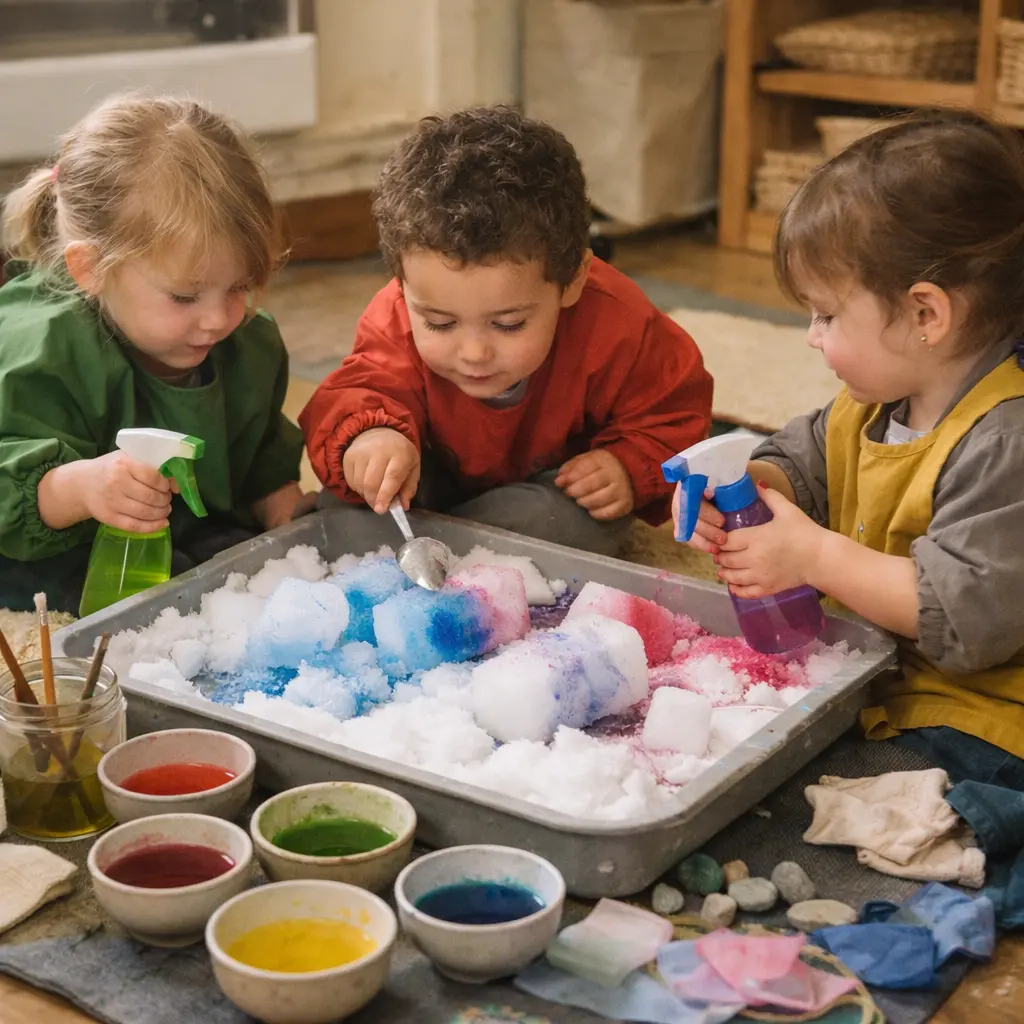
The tray is arranged as an exploration zone: low table or outdoor bench with tubs of snow and different-sized ice blocks within reach, grouped with spray bottles, small bowls of plant-based dyes, brushes, spoons, cloths and loose parts (pebbles, fabric scraps, translucent sheets) so materials invite combination rather than a single task. Materials are presented openly on a non-slip surface and rotated during play so the child may choose tools, mix colours, pour or press ice, and move between cold and liquid textures without a fixed sequence.
The adult steps back as an observer and co-researcher, offering short commentaries such as "I can see the blue spreading" or "You’re trying a thinner spray" and posing open prompts like "What happens if you press the spoon?" The child may lead by choosing sprays, layering colours, or abandoning and returning to a motif; this reveals fine-motor control, colour cause-and-effect, and descriptive language. The adult notices moments for recording: changing diffusion patterns, repeated movements, problem-solving attempts and spontaneous vocabulary, embedding observation in the flow.

Steiner (Waldorf) Adaptation — The materials are arranged on a low wooden tray set over a neutral wool cloth beside the outdoor snow or ice area to create a calm, contained workspace. Only a small number of items are provided: one ice block or shallow tray of collected snow, plant-based pigments in small ceramic dishes, wooden spoons, natural-bristle brushes and metal spray bottles; cotton aprons and plain cloths are available. Bright plastics and excess containers are removed so texture and temperature remain central while preserving the EYFS focus on colour, sensation and fine-motor action.
The adult demonstrates a single, slow spray or a gentle brush stroke once, then remains close, quiet and observant, using minimal language beyond safety prompts. The child returns to spraying, brushing and feeling the melting surface at their own pace, repeating actions to explore cause-and-effect and describe visible colours; the adult models calm movement, intervenes only for safety or practical help, and names colours or simple sensations briefly when naturally prompted.