Exploring space-themed moon sand with cornflour and oil and small world astronauts
Sensory Play
Messy play
Small world play
Space
Children explore a space-themed tray of moon sand with a small set of astronauts and rockets, noticing how the material feels and how it holds or falls apart. The adult supports children to choose hands or tools, and models simple words for texture and position linked to what children are doing. Practitioners can watch for preferences around mess, repeated hand movements, and early small world ideas emerging through object placement.
Children explore a space-themed sensory tray filled with soft, mouldable “moon sand” and a small selection of astronauts and rockets. The experience invites children to notice texture, pressure, and change as they handle the material and move objects through it. It can support sustained attention and early imaginative play as children connect what they feel with what they see. Adults can keep the play open-ended and responsive, following children’s ideas and comfort with mess.
Step-by-Step Guidance
1. Prepare the space: choose a wipe-clean floor area or a table with a protective mat. Place the tray where children can reach comfortably without leaning across others.
2. Make the moon sand: combine cornflour (or flour) with a small amount of oil until it holds shape when squeezed but still crumbles when released. Adjust gradually so it is not wet or runny.
3. Present the materials: place the moon sand in the tray and add a small number of astronauts and rockets. Keep extra tools (scoop/bowl) nearby rather than in the tray at first.
4. Invite exploration: allow children to approach in their own way. Offer a smock and show where cloths are for wiping hands, without interrupting play.
5. Support early play: if a child hesitates, model a simple touch (pressing fingertips or making a small mound) and pause. If a child is ready, add one tool to extend transferring or filling.
6. Follow children’s ideas: respond to what they do with the figures (burying, making tracks, standing them up). Add language for texture and position linked to their actions.
7. Manage the flow: keep the tray uncluttered by rotating figures or tools if play becomes crowded. Offer a second wiping cloth or a separate “clean hands” spot for children who need it.
8. Close the activity: give a clear, calm ending. Support children to tap sand back into the tray and place figures into a container. Wipe hands and surfaces.
Learning Objectives
Children may develop sensory awareness and fine motor control as they squeeze, pat, scoop, and release the moon sand (Physical Development). Children may build early vocabulary for texture, quantity, and position as they describe what they notice and where objects are placed (Communication and Language). Children may practise sharing space and resources, and begin to develop simple play narratives with the figures (Personal, Social and Emotional Development; Expressive Arts and Design).
Adult Role
Stay emotionally attuned to children’s comfort with mess. Notice signs of hesitation, sensory overload, or excitement, and offer choices such as using a tool, touching with one finger, or wiping hands without comment.
Model simple, accurate language linked to what children are doing: texture words (soft, crumbly), action words (press, squeeze), and position words (in, under, on). Keep language short and timed to the child’s focus.
Scaffold lightly when a child is stuck or frustrated, for example by demonstrating one action and handing control back. Step back when children repeat actions, concentrate, or begin their own small world ideas.
Observe in action by watching how children approach touch, how they use hands and tools, and how they include others. Use these observations to decide whether to simplify (fewer items) or extend (add a scoop or extra figure).
Maintain safety by supervising closely, keeping materials away from mouths, checking the size and condition of figures, and managing the space to reduce slipping or crowding.
Observation Cues
Reaches in confidently or tests with fingertips before committing to touch.
Uses different hand actions (pinch, press, pat, rub) and repeats actions to check what changes.
Moves astronauts/rockets through the sand and notices resistance, tracks, or buried parts.
Uses or attempts descriptive words such as soft, dry, sticky, smooth, heavy, more, less, in, under.
Shows preferences (avoids mess, seeks deep pressure, requests wiping hands) and returns to play after support.
Negotiates space or resources (waits, offers, watches others, copies ideas).
Time & Space
15–35 minutes, depending on children’s interest and tolerance for messy play.
A wipe-clean floor area or table space for one large shallow tray, with room for 2–4 children to stand or sit around without leaning over each other.
Materials
Safety
Age adaptations
Budding Adventurers
Provide a medium-depth layer of moon sand and a small set of figures (astronauts and one rocket) to reduce clutter. Add a bowl for transferring and one tool that supports control, such as a short-handled scoop.
Support early imaginative play by naming what the child is already doing (burying, rescuing, making footprints) and offering simple choices to extend (more sand in the bowl, or a different figure). Keep expectations flexible around mess and offer predictable hand-wiping routines.
Curious Investigators
Offer a wider tray and a slightly larger set of space figures, keeping duplicates minimal to reduce conflict. Include two tools with different effects (scoop and a flat spatula) so children can compare pressing and lifting.
Encourage children to describe what they notice about tracks, piles, and how the sand changes when squeezed. Support cooperative play by helping children agree where the rocket “lands” and by modelling language for sharing space and resources.
Confident Discoverers
Provide a larger small world set (astronauts, rocket) and a defined “landing area” within the tray using a clear boundary such as an empty corner of the tray for parking figures. Add a small container for “moon samples” to support purposeful transferring.
Invite children to plan and explain their ideas using richer vocabulary (deeper, shallower, packed, loose) and to reflect on what makes the best tracks or stable standing points. Step back to allow sustained narratives, stepping in mainly to support negotiation and safe use of tools.
EYFS Links
Communication and Language: adults can model and respond to vocabulary linked to what children can see and feel (texture, actions, positions), supporting children to express preferences and describe experiences.
Physical Development: handling moon sand and moving figures through resistance can support hand strength, coordination, and controlled movements, alongside self-care routines such as wiping hands and washing.
Personal, Social and Emotional Development: children may practise managing feelings about mess, sharing a defined space, and negotiating access to popular objects with adult support.
Expressive Arts and Design: small world astronauts and rockets can prompt imaginative play, with children combining sensory exploration and simple story-making in their own ways.
Ethos adaptations
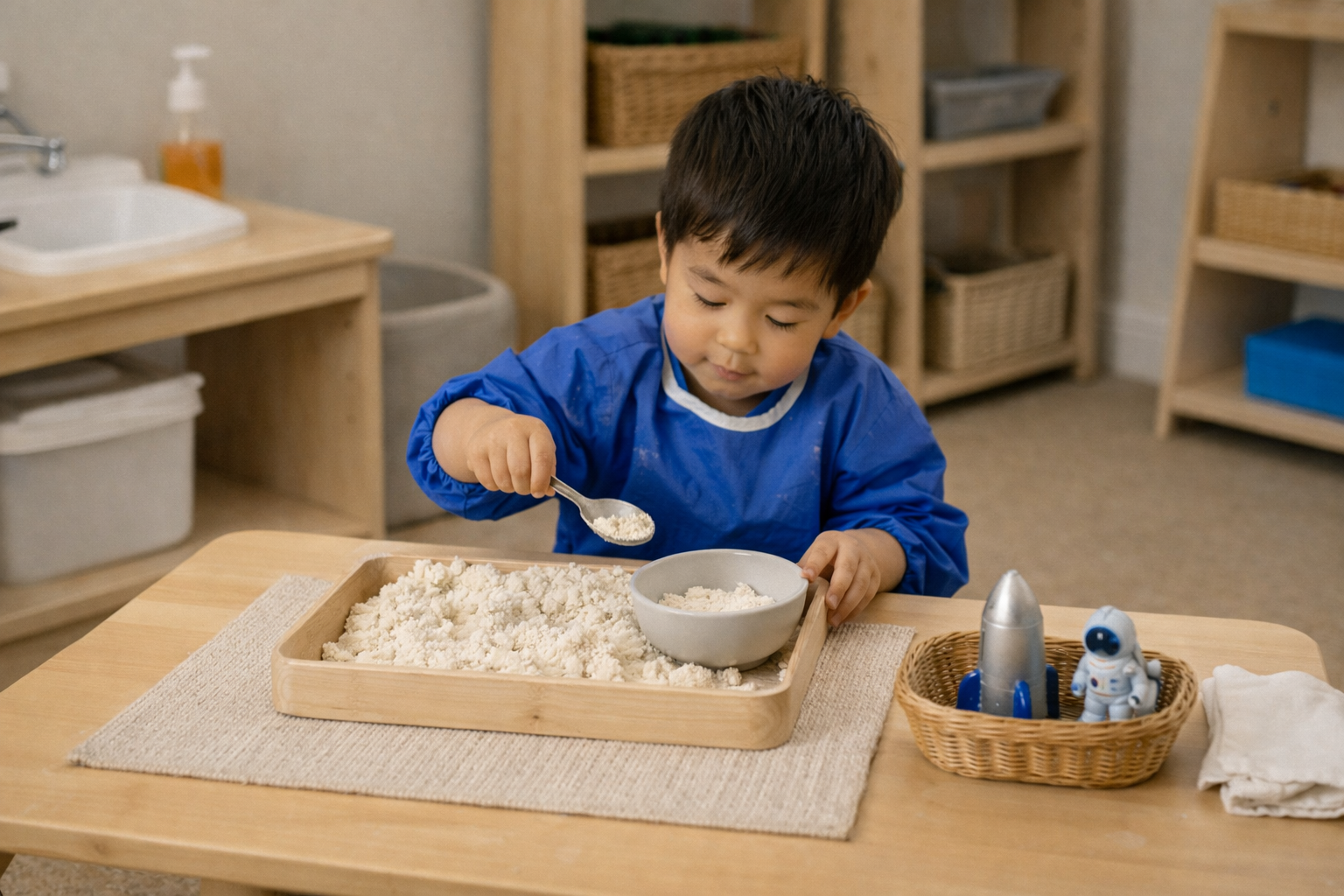
Pre-mix the moon sand so it holds a simple squeeze-and-release shape, then offer a single low tray on a table the child can reach. Set out one small bowl with a visible tape line and one scoop to the left, moon sand in the centre, and two figures (one astronaut, one rocket) to the right. Place the cloth and apron nearby for the child to access and return. This reduced set isolates hand pressure, simple transferring, and placing figures; the bowl line and any spillage act as clear self-correction.
Show the sequence once, slowly and mostly silent: put on apron, scoop to the line, level with a finger, tip back if too full, pat the sand, then place one figure and pause. Step back, keep language minimal, and avoid questions; respond only to safety or care needs. Watch for sustained concentration, repeated attempts to meet the line, smoother hand movements, spontaneous words about texture and position, and moments of turn-taking or simple story play with the two figures.
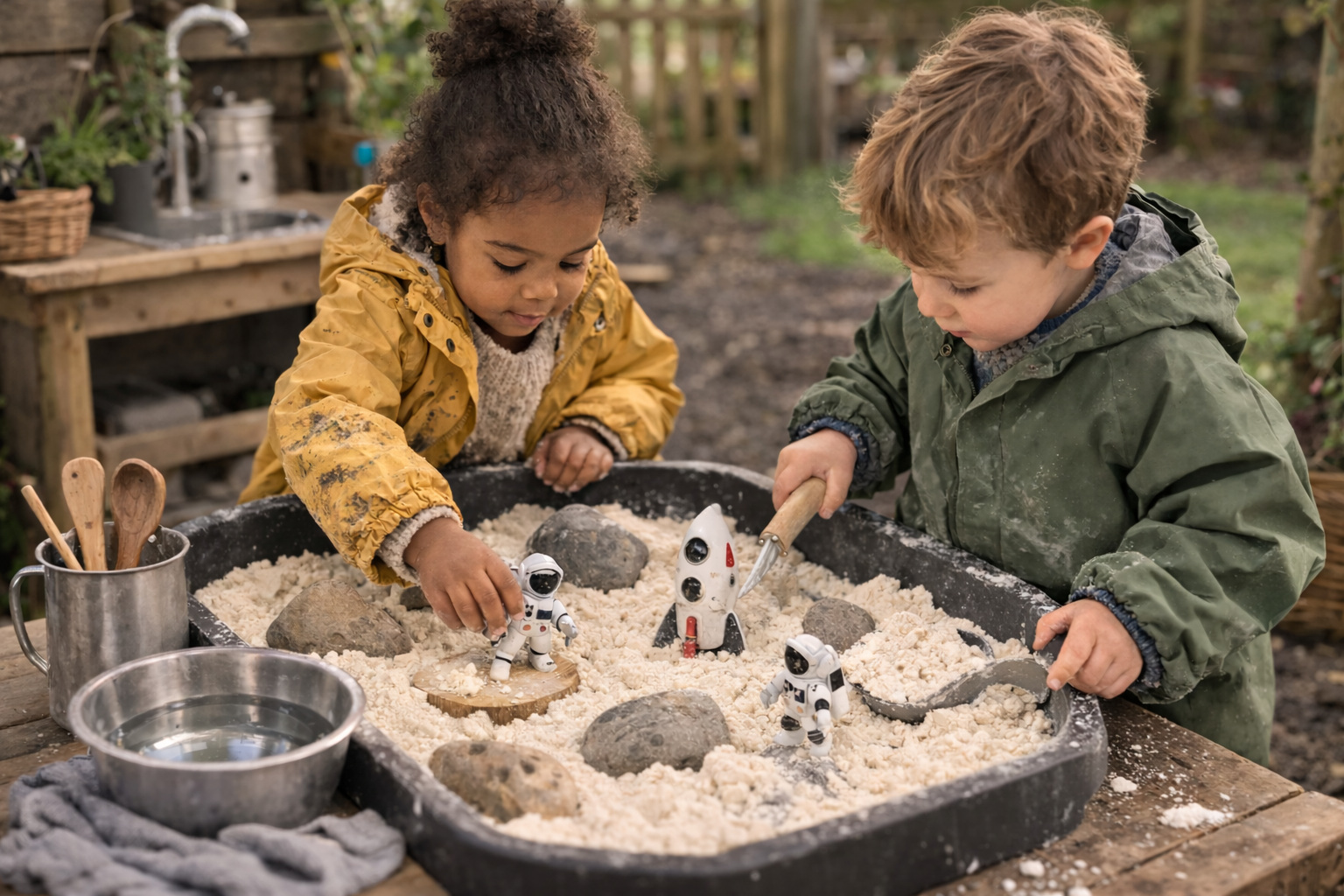
In an outdoor or nature-integrated space, move the moon-sand tray to a sheltered table, patio or grassy clearing with uneven ground and a nearby water container for washing. Materials such as cornflour and a little vegetable oil remain in the shallow tray but sit alongside natural counters: smooth stones, wooden spoons, shell scoops and larger wooden or fabric “astronaut” figures (all checked for size and safety). Materials are arranged openly so children may press, pat, scoop or press the mixture into hollows and natural molds.
The adult observes from close by, offering single-word prompts or short questions and stepping in only to manage safety, clean hands or check anchors. Children choose tools, swap roles, experiment with pressure and position, and move figures through the mixture at their own pace without a prescribed end product. The adult responds with concise descriptions of what they notice, models calm handling when needed, and supports sharing or turn-taking through gentle, minimal intervention.
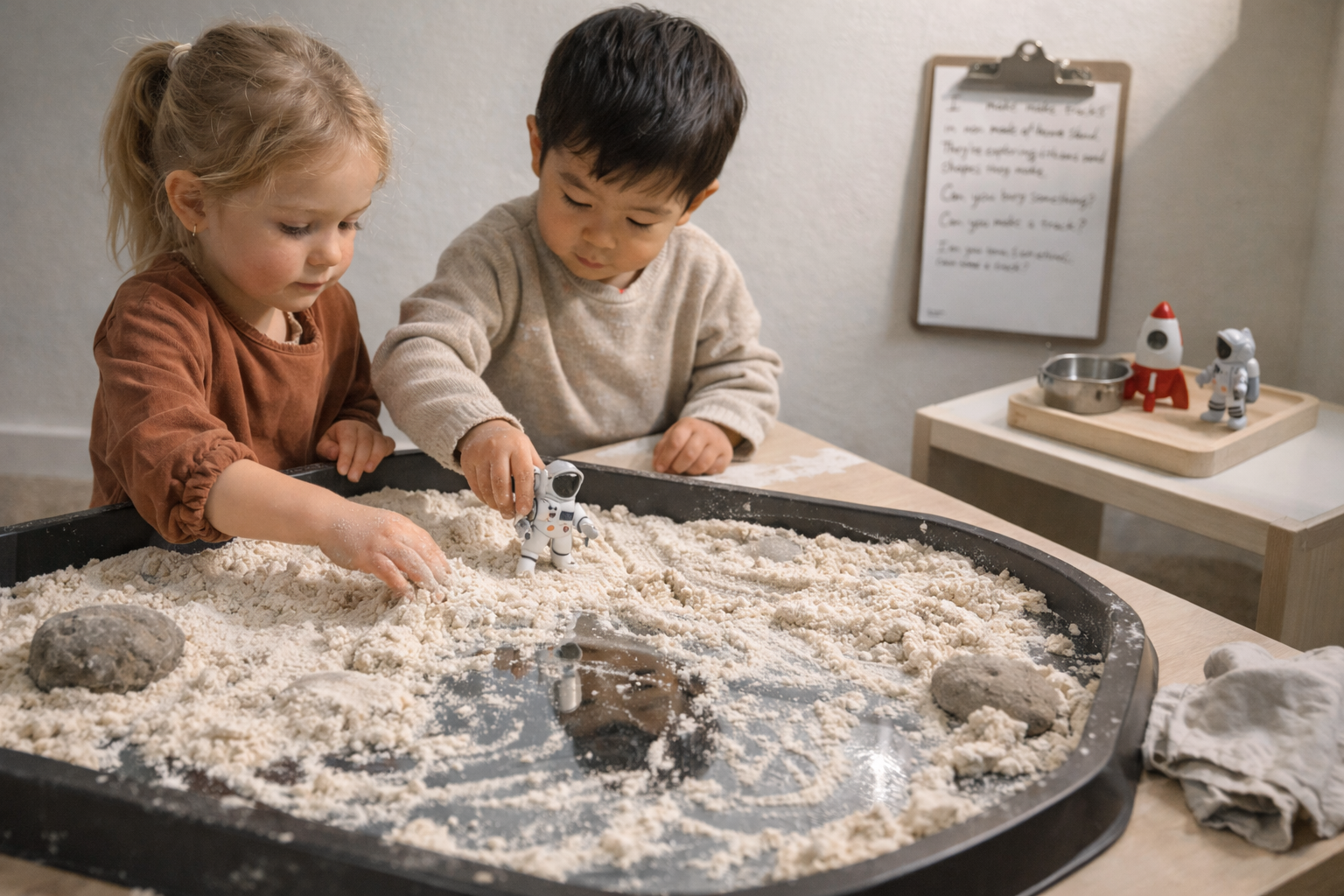
Set the shallow tray on the floor with access on all sides. Create three invitations: a patch of dry cornflour, an area of pre-mixed moon sand, and small bowls with a little vegetable oil plus spoons so children can change texture and proportion. Place astronauts and rockets at the edges and half-buried; add the small bowl for transporting. Keep aprons and a cloth visible. Materials stay open-ended: cornflour, oil, spoons, bowl, and figures can be used for printing, covering, balancing, mixing, burying, or leaving untouched.
The adult watches first, using light commentary: “I can see your hand sinking,” “You’re making a deep line,” “What happens if more oil goes in this bit?” Follow emerging stories and routes rather than setting tasks. The child may test pressure, compare quantities (“more/less”), and position figures (“on/in/under/next to”). The adult notices grip changes, repeated mixing patterns, turn-taking around popular figures, words used for texture and place, and moments of self-care like wiping hands.
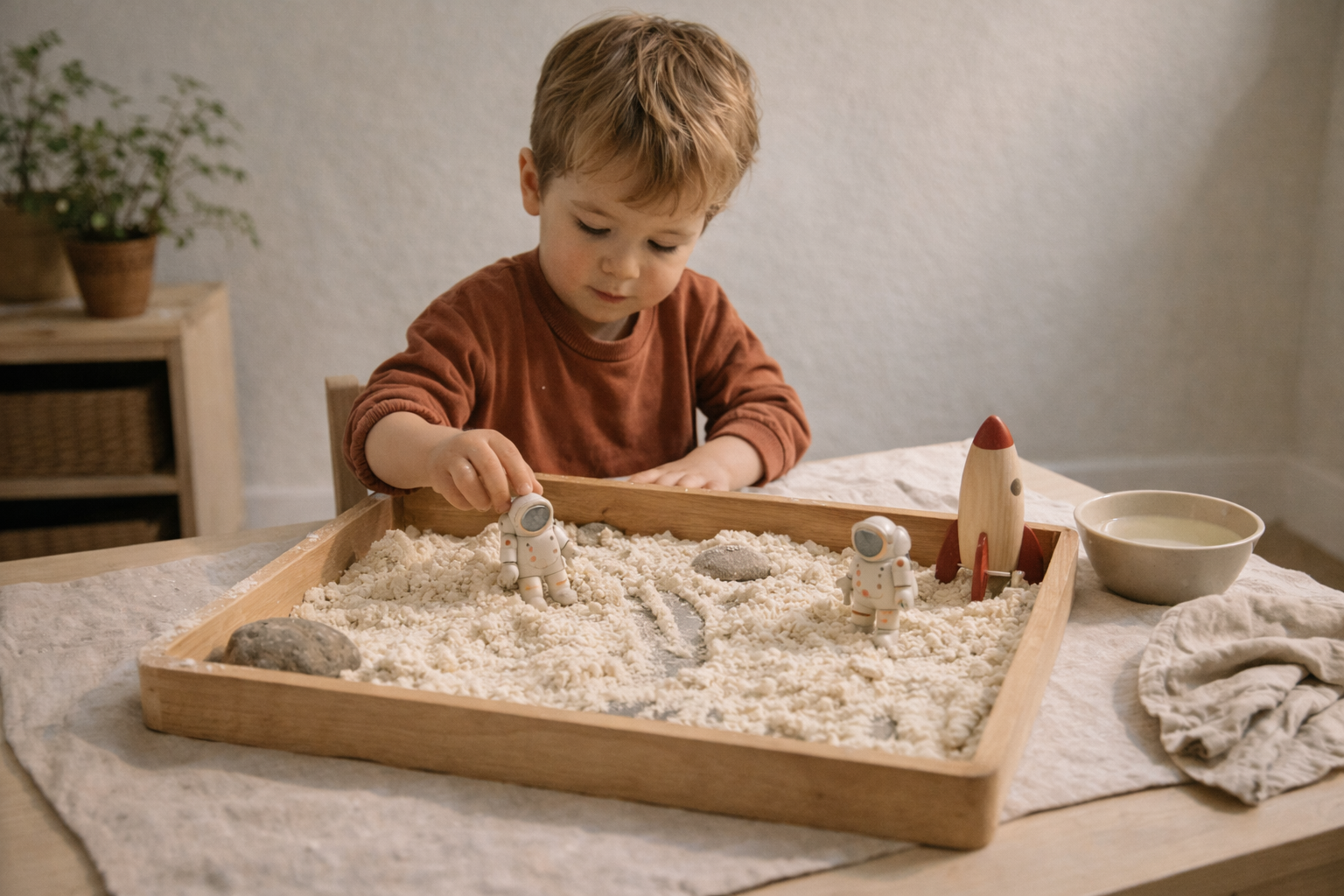
A low, uncluttered corner is set with an undyed cotton cloth marking the workspace and a shallow wooden tray holding cornflour mixed with a little vegetable oil. Only a few items are placed: two simple unfinished wooden figures, a small wooden rocket, a smooth river stone or two as “moon rocks,” and a single metal spoon with a small metal bowl for transferring. Cotton aprons and a warm damp cotton cloth for hands sit just beyond the cloth, maintaining a calm, predictable area with soft, natural tones.
The adult demonstrates quietly how to press, squeeze, and smooth the moon sand and how to draw a slow path with a figure, then steps back, observing nearby. Language is minimal and responsive, with occasional naming of textures, amounts, and positions noticed in the child’s actions. The child returns to scooping, patting, making tracks and simple footprints, and moving figures at their own pace, repeating sequences as desired. The rhythm closes with hands wiped and tools brushed clear into the tray.