Sharing favourite stories by bringing home books and creating a 'my favourites' basket for group exploration (3–4 years)
Literacy
All about me
Children bring home books and contribute to a shared basket for group discussion. A calm, child-led sharing moment invites peer listening and language development. This preview hints at ethos adaptations and age-specific scaffolding—full guidance available in the gated content.
This activity invites children to bring a book from home and contribute to a shared 'my favourites' basket. Through short, child-led conversations, children practise talking about stories, pictures, and favorites while peers listen and respond. The setup supports early literacy interest, vocabulary development and social sharing in a small group.
Step-by-Step Guidance
1) Set up a quiet shared space with a central 'My favourites' basket and a small seating area. 2) Invite children to place their home book in the basket and sit in a circle. 3) Model a short turn: pick a book, name it, and say why it is a favourite. 4) Invite each child to have a turn talking about their book, using simple phrases. 5) Encourage peers to respond with a question or a comment. 6) After a few turns, invite children to return books to the basket and reflect on what they learned about each other. 7) If time allows, offer an optional extension where children swap one book and preview a new favourite. 8) Clean up and record a few notable language moments for reflection.
Learning Objectives
Children may begin to verbally share a favourite book and describe reasons. This activity supports Communication and Language (speaking, listening, vocabulary), Literacy (interest in books, print awareness), and Personal, Social and Emotional Development (turn-taking, sharing, listening to others). It also offers a foundation for Understanding the World by recognising family and home contexts.
Adult Role
Be present and attuned, modelling calm turn-taking language and active listening. Use short, open prompts to extend talk (e.g., 'What part do you like best and why?'). Keep the pace child-led, stepping back when children speak and stepping in to support younger or less confident talkers. Ensure safe handling of books and manage time so all children have a turn.
Observation Cues
- Child explains why the book is a favourite, using simple sentences.\n- Peers listen with eye contact and respond with comments or questions.\n- Child points to or names pictures on the pages.\n- Child returns the book to the basket and signals for another turn.\n- Use of new vocabulary or phrases such as 'I like...' and 'This part is my favourite because...'.\n- Child shows engagement by asking a peer to share their favourite page or character.
Time & Space
15–25 minutes; shorter for younger children, longer for older groups or richer discussion.
Indoor quiet corner with a low circle seating area; space for a central basket and 4–6 personal book selections; clear pathways for movement and safe handling of books.
Materials
Safety
Age adaptations
Budding Adventurers
Provide a slightly larger basket (4–6 books) and longer but still simple prompts. Children begin to describe why they chose a book using two to three word phrases. The adult supports with turn-taking cues and uses simple questions to elicit responses (e.g., 'Who is in this story?', 'What part did you like?'). Consider a buddy system to support peer listening and interaction.
Curious Investigators
Children participate in a small group discussion with 4–6 books available. The adult introduces more open-ended prompts (e.g., 'Tell us about your favourite page and what happens next'). Children practice longer sentences, share reasons, and respond to others with specific comments. The session includes a brief reflective moment and a simple group agreement to listen when others speak.
Confident Discoverers
Children lead the activity with minimal prompts. They curate the basket by helping peers choose books and can ask peers questions about their favourites. The adult models richer language and asks reflective questions ('How would you retell this part using your own words?'). The activity may include a short follow-up drawing or one-sentence retelling to extend literacy and expressive language.
EYFS Links
This activity supports Communication and Language (listening, turn-taking, speaking with growing confidence); Literacy (interest in print, print awareness, vocabulary expansion); Personal, Social and Emotional Development (sharing, empathy, cooperative play); Understanding the World (family contexts, book genres, cultural variety). It provides rich opportunities for adult observation and documentation while remaining play-based and child-led.
Ethos adaptations
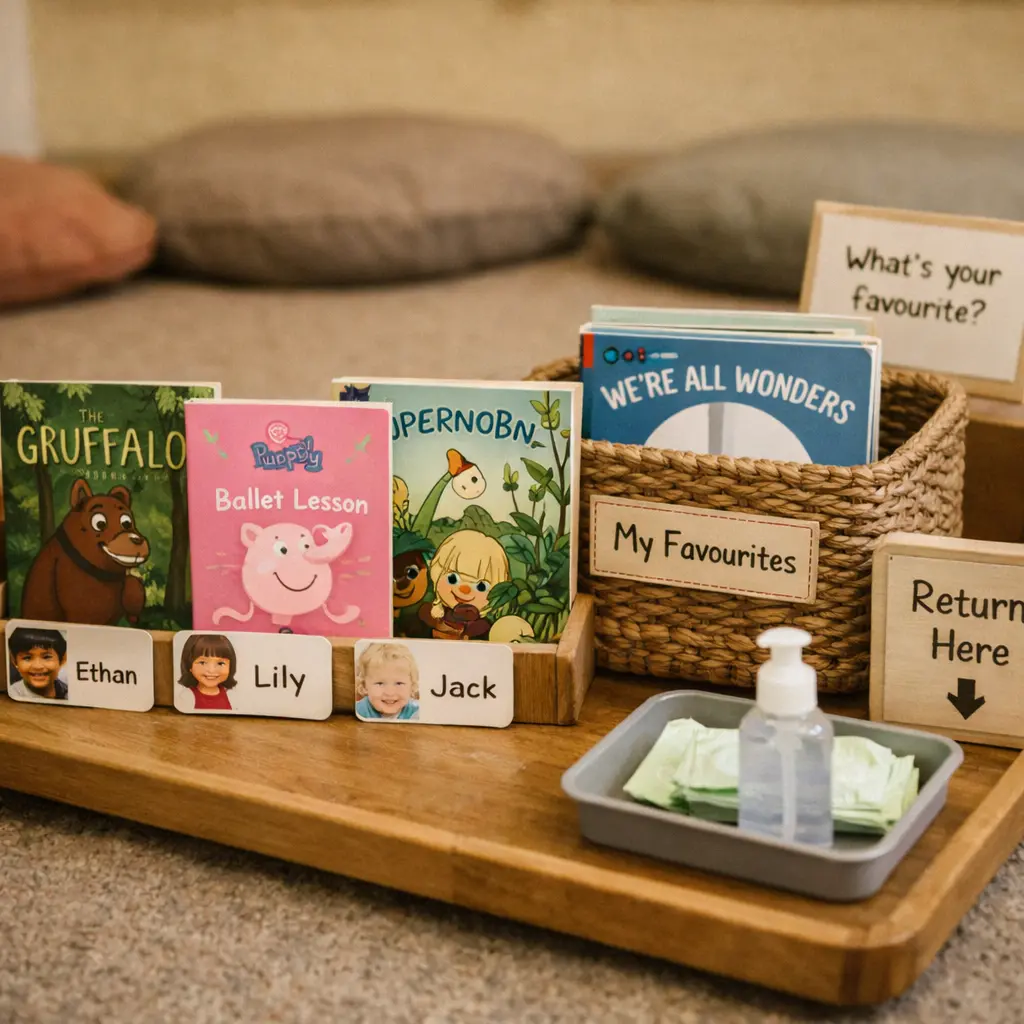
Select a small number of books (three to five) and place them in the 'My favourites' basket on a low shelf or tray so children can reach and return them independently. Add individual name cards or photos beside each book slot and a labelled return spot to make the sequence visible and self-correcting. Remove the optional prompts card or keep only one simple prompt to isolate the skill of describing a favourite, and place wipes or hand gel nearby in a small tray for independent use.
Introduce the routine with one short, silent demonstration of taking a book, showing the name card, and placing it in the basket, then step back and limit speech to one brief cue at transitions. Avoid asking prompting questions during sharing; instead watch how a child organises the book, how long they speak, whether peers wait their turn or lean in to listen. Note repetition, clarity of description, and signs of concentration or disengagement to plan next steps.

In an outdoor or nature-integrated space, the 'my favourites' basket is placed on a low blanket or wooden crate under a tree or sheltered area so books are explored with natural light and sounds. Materials are arranged in a wicker or wooden basket with name photos, waterproof mats, simple clipboards for drawing, and natural cushions or tree-stump seats so books and pages may be handled alongside leaves and twigs.
The adult observes and remains nearby, offering brief, open questions and gentle prompts rather than directing the sharing sequence. Children choose which book to show, pass items, and may sit or wander while talking about pictures and stories, with the adult responding to language and turn-taking needs and noting observations for EYFS outcomes.
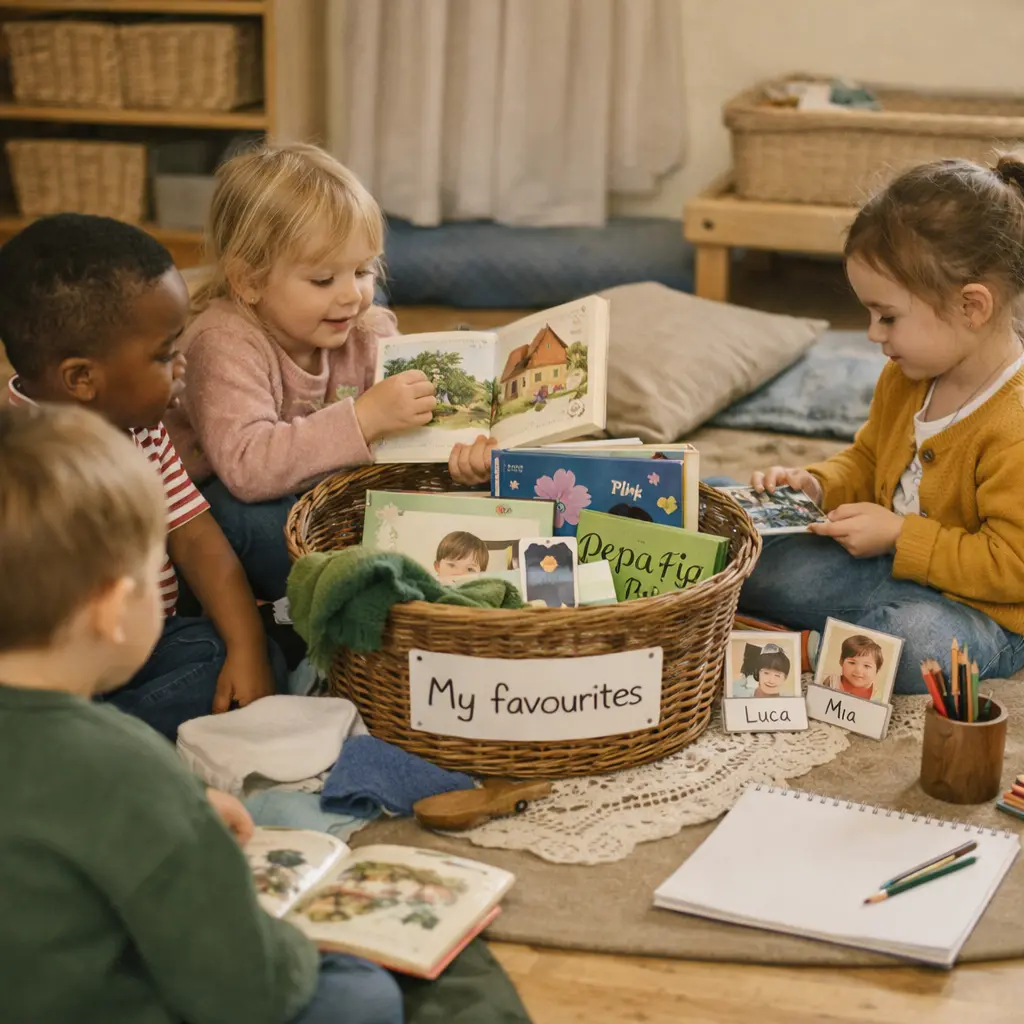
Reggio Emilia adaptation: rearrange the carpet and low table into several small, reachable stations so the 'My favourites' basket can be approached from different sides; books are displayed face-out, mixed with loose parts such as small fabrics, family-photo cards, lightweight scarves and a blank sketchpad so handling, pairing, drawing or role-play are all equally available. Remove directive prompt cards; replace them with name/photo markers and open labels so the environment itself invites multiple entry points and uses while preserving the original literacy and social aims.
The adult steps back as observer and co-researcher, using commentary not instruction: "I can see you notice the pictures," "You’re showing the house," "What happens if you share that page?" The child may choose to lead a short share, pair up for listening, retell with props, or return to a book later. Observation cues are embedded in the flow: language length, turn-taking signals, book-handling choices, moments of negotiation, and references to home contexts for EYFS-linked documentation.

Steiner (Waldorf) Adaptation
A small, calm corner is prepared with a neutral-coloured cloth on a low table or carpeted mat and a single shallow wicker basket labelled with wooden name tokens or soft cotton photo tags. Only a few books are displayed at a time, each placed spine-up for gentle handling; no bright posters or plastic holders are used. The space is uncluttered so the materials’ textures—paper, cloth, wood—are the dominant sensory qualities and children can approach the basket at their own pace.
The adult demonstrates quietly by selecting a book, turning pages slowly and naming one simple detail, then sits slightly back and watches. The adult uses minimal language, intervening only for safety or to mirror a child’s phrasing; short child-led conversations naturally repeat across sessions. The child returns to the basket multiple times, sharing or listening without a required outcome, while the adult records observations unobtrusively for EYFS links to speaking, listening and personal development.