Rolling metal cars through paint on paper ramps to explore colour mixing and track patterns
Sensory Play
Communication and Language
Children use small cars and paint to create rolling tracks on long paper, noticing how wheel marks repeat and how colours change when they meet. Adults can support colour naming and pattern language, and watch for children testing speed, slope and pressure in their own ways. The setup suits small-group exploration where children can compare different marks and return to favourite combinations.
Children explore paint, colour and movement by rolling small cars down ramps onto paper. The experience invites noticing how colours meet, change and spread, and how wheels leave repeating tracks. Children may choose different speeds, angles and colour combinations as they experiment. Adults can support language for colour, pattern and cause-and-effect without taking over the exploration.
Step-by-Step Guidance
1. Prepare the space on a wipe-clean floor area. Tape down a long strip of paper so it cannot slide, and place a floor covering under the ends where paint may drip.
2. Set up 1–2 ramps to start. Angle each ramp so the bottom lands on the paper. Stabilise ramps with tape or a heavy object at the top so they do not shift.
3. Pour small amounts of two paint colours into separate shallow trays. Keep lids nearby to refresh small amounts rather than leaving large pools.
4. Present the materials simply: place a tray of paint near the top of a ramp and a small set of cars beside it. Keep extra colours and cars out of reach until needed to reduce crowding.
5. Invite exploration with a brief, neutral prompt such as noticing that the wheels can pick up paint and leave tracks. Allow children to choose a car and decide how to use it.
6. As children roll cars, keep the paper clear and replace sections when saturated. Offer a fresh strip beside the first so children can compare marks.
7. Introduce colour mixing gradually by adding a second tray near the same ramp or by offering a second colour on a different ramp. Let children decide whether to combine colours on one paper area.
8. Support pattern noticing by pointing out repeated wheel marks, parallel lines, or changes when the car rolls faster or slower. Avoid directing children to make a specific picture.
9. Manage flow by limiting the number of children per ramp. Add another ramp or a second paper lane if children are waiting.
10. Close the activity by offering a place to park cars for washing, wiping ramps, and moving finished paper to a drying area. Keep one section of paper for later revisiting and talking about colours and tracks.
Learning Objectives
Children may develop early understanding of cause and effect as they explore how rolling changes paint marks and colour mixing (Understanding the World). Children may build vocabulary for colours, marks and patterns through shared attention and simple descriptive language (Communication and Language). Children may practise control and coordination as they position cars and manage tools and materials (Physical Development). Children may explore self-expression through choosing colours and noticing the visual results (Expressive Arts and Design).
Adult Role
Stay emotionally attuned by noticing children’s comfort with mess, offering aprons without pressure, and acknowledging feelings such as uncertainty or excitement. Model simple, accurate language linked to what children can see, such as colour names, “lighter/darker”, “lines”, “tracks”, “fast/slow”, and “mix”. Scaffold when a child is stuck (e.g., a ramp slips, paint tray tips, or a child cannot manage turn-taking) and step back when children are repeating experiments or concentrating. Observe closely for how children test ideas, persist, and communicate choices, and use short comments rather than questions that interrupt focus. Hold responsibility for safety by controlling numbers at each ramp, keeping paint amounts small, and checking that cars and ramps are used in the intended area.
Observation Cues
Chooses a colour deliberately and returns to it, or avoids a colour after a change in the paint. Notices and comments on changes when two colours meet, such as pointing, pausing, or looking closely at the paper. Adjusts how the car rolls (higher/lower start point, faster/slower push) and watches for different track marks. Repeats a rolling action to recreate a pattern, or changes direction to make a new one. Uses or attempts colour and pattern words (e.g., red, blue, lines, dots, stripes) or gestures to communicate choices. Manages turn-taking around a ramp or waits for space before rolling.
Time & Space
20–45 minutes, depending on group size and drying/refresh needs.
A wipe-clean floor area with space for 1–3 ramps and long paper runs, plus a nearby drying area. Ideally set up where paint splashes will not create slip hazards for through-traffic.
Materials
Safety
Age adaptations
Budding Adventurers
Offer 2–3 ramps with different slopes and a wider choice of cars, including one with different wheel textures if available. Introduce a third colour only after children have explored two, and provide a clean paper lane for children who want “no mixing”. Expect children to begin repeating actions to recreate tracks; the adult can support by holding a ramp steady, offering a fresh paper section, and naming patterns such as “two lines” or “lots of dots”.
Curious Investigators
Add simple variables children can control, such as a marked start line on the ramp (tape line) and two paper lanes for comparing tracks. Offer 3–4 colours and encourage children to predict what might happen when colours meet, without requiring a correct answer. Provide a tray for “clean wheels” and another for “paint wheels” so children can choose how much mixing they want. Adult support includes introducing words like “pattern”, “repeat”, “lighter”, and “darker”, and helping children reflect by looking back at earlier tracks.
Confident Discoverers
Offer multiple ramps with clearly different heights and a longer paper run so children can compare distance and track clarity. Provide tools for children to manage the process, such as a small sponge for wiping wheels between colours and a simple chart card with colour swatches for matching and naming. Invite children to plan a pattern goal (e.g., alternating colours or parallel tracks) while keeping the activity open-ended. Adult support focuses on helping children articulate their approach, negotiate shared space, and revisit results to notice mixing, symmetry, and repeated marks.
EYFS Links
Expressive Arts and Design: Children explore colour, texture and mark-making through wheel tracks and paint movement, making choices about how their work looks. Communication and Language: Adults can model and extend vocabulary for colours, patterns and comparisons during shared attention, supporting children to express preferences and describe what they notice. Physical Development: Handling cars, positioning them on ramps, and managing paint supports hand control and coordination, alongside awareness of space when sharing ramps. Understanding the World: Children explore cause and effect by noticing how slope, speed and paint amount change the marks, and how colours combine to create new shades.
Ethos adaptations

Secure one long run of paper under 2–3 taped ramps and mark a simple start line at the top of each. Offer two paint trays only, one colour per tray, set left-to-right beside the ramp tops; place one metal car on each ramp and keep duplicates stored until a car needs replacing. Put a wipe and the water bowl at the end of the run for quick wheel cleaning so mixed colours or smudged tracks show as the self-correction.
Give one slow, quiet demonstration: dip just the wheels, pause over the tray to let drips fall, set back wheels on the line, release without pushing, then carry the car to clean the wheels. Step back and keep words to brief safety or care notes, avoiding questions or suggestions about choices. Observe steady placement and controlled release, repeated trials on one ramp, cleaning before new colours, and moments when the child notices how angle, speed or paint amount change tracks and colours.
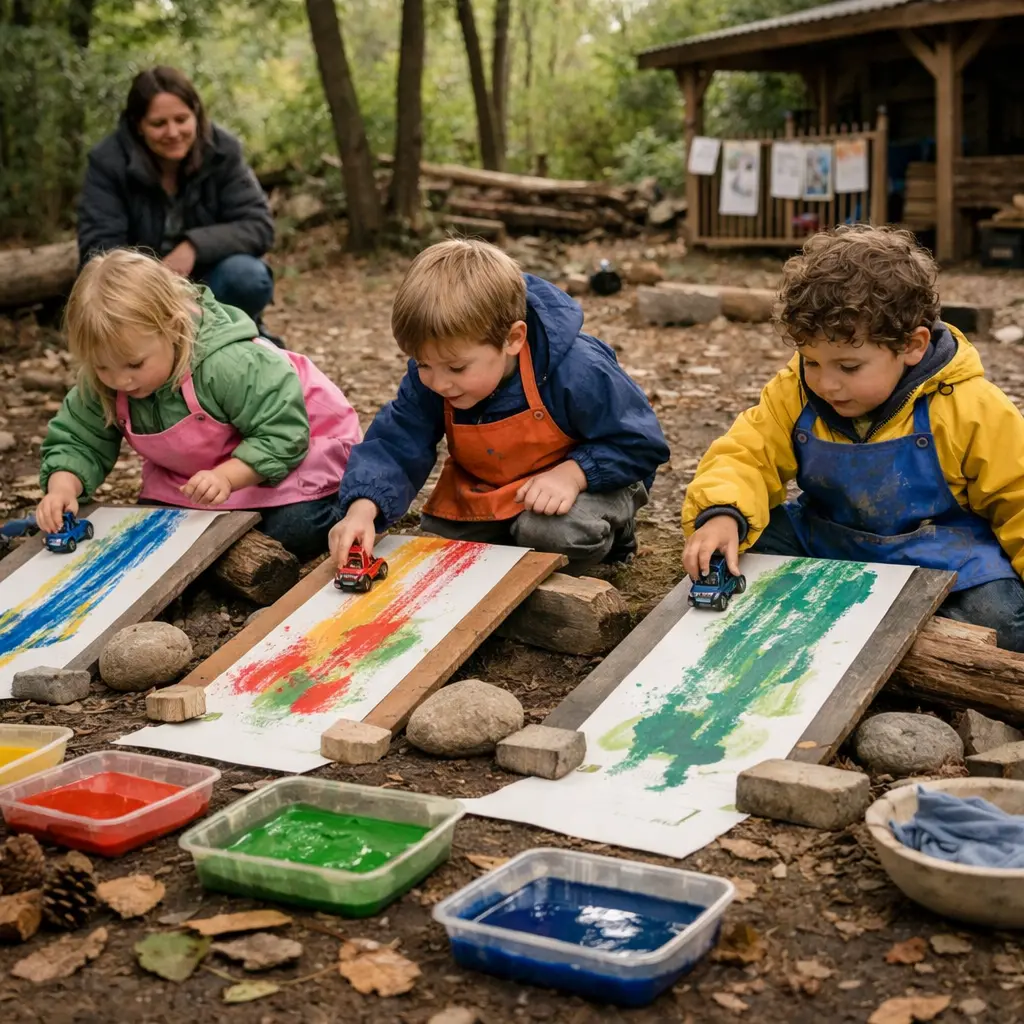
In an outdoor or nature-integrated space, lay long roll paper on grass, paving or a sheltered decking spot and secure edges with flat stones or logs so the surface is uneven and inviting. Materials are arranged using wooden planks or short tree offcuts as ramps, shallow trays of washable paint, metal toy cars, and natural anchors (stones, pinecones) instead of only plastic clips; additional loose items such as leaves or bark pieces are available to add texture to the paint and tracks.
The adult observes from close enough to intervene, checking anchoring and handling safety, then steps back to offer minimal, responsive prompts or single-word descriptions. Children choose ramps, speeds, paint colours and natural add-ins, repeat runs, compare marks and test changes; the adult models calm handling when needed and only intervenes to manage risk or support language when children ask.

Ethos adaptation: Arrange the room so a long sheet of paper runs beneath a cluster of ramps at different heights and angles, with ramps left fixed to invite comparative play. Paint sits in low trays and shallow dishes spread across the surface so children can choose, refill and move colours; add loose parts (spoons, funnels, fabric, stones, alternate wheels) and extra cars so materials remain open-ended and reusable. Keep cleaning supplies and aprons accessible; spacing allows several children to work side-by-side without teacher direction.
The adult steps back as observer and co-researcher, using commentary such as "I can see the blue spreading where the wheel turned" or "You're trying a steeper ramp—what happens if you slow the car?" The child may vary speed, angle, colour mixes and decide to pause, repeat or combine tracks; this supports cause-and-effect talk, new colour vocabulary and fine-motor control. Notice and record moments of problem-solving, sustained attention, negotiation and evolving ideas about pattern and mixing as they naturally occur.

On a neutral canvas cloth, two low wooden ramps rest on wooden blocks and lead onto heavy A3 paper in a clear floor space. The paper is secured with wooden clips and smooth stones; ceramic dishes hold 2–3 plant- or earth-pigment paints thinned for rolling, with cotton aprons, a warm-water bowl, and cotton cloths set to one side. A small set of metal cars with smooth wheels is offered, and a simple wooden rail with pegs serves as the drying area.
The adult demonstrates a single, unhurried roll and then steps back, offering occasional quiet descriptors during shared attention and observing. The child chooses ramp angle, returns to preferred colours, repeats rolls to watch how speed, slope, and paint amount change tracks and mixing, and replaces paper when needed within a simple rhythm of lay paper, roll, look, and tidy. The adult stays close for safety and resets materials as required, adding brief, concrete words for colour and pattern without directing the process.