Role-play family routines using small world houses and family figurines for early years
All about me
Communication and Language
Children use small world houses and family figurines to explore home routines, relationships and feelings through pretend play. Adults keep the materials open-ended and notice how children name people, share roles, and include others in their storylines. The setup can reflect a range of families without asking children to explain their own. Practitioners may pay attention to repeated themes such as comfort, separation, mealtimes, and bedtime.
Children explore familiar home experiences using small world houses and family figurines. The open-ended setup supports children to represent their own family routines, relationships and feelings through play. Adults can notice how children use language, take turns, and negotiate roles as they build shared storylines. The activity can be revisited to reflect changes in children’s interests and home experiences.
Step-by-Step Guidance
1. Prepare the space: choose a quiet area with enough room for 2–4 children to sit or kneel comfortably. Place a mat or low tray to mark the play boundary and reduce pieces spreading.
2. Set out the houses: position 2–3 houses with clear access on more than one side so children can reach without crowding. Keep the layout simple rather than fully furnished.
3. Offer a small, curated set of figures: place a few family figures in a basket beside the houses. Include a range of ages and appearances, and avoid putting out every piece at once.
4. Invite exploration with a neutral prompt: introduce the materials as “houses and people for home play” and allow children to choose where to start. Avoid assigning roles or storylines.
5. Follow children’s lead: watch for what children focus on (rooms, routines, relationships). Add one small piece of furniture only when it supports the play the child is already building.
6. Support shared play: if children compete for a house or figure, offer a second similar option, suggest a swap, or help them agree on roles. Keep language practical and calm.
7. Model language that fits the play: name actions and feelings you can see (e.g. “The baby is on the bed”, “That person looks worried”). Use short sentences and repeat key words.
8. Extend gently with routine or feeling prompts: if play stalls, offer a simple idea linked to home life (e.g. meal time, getting ready, visitors) or an emotion card for children to match to a figure.
9. Close and reset: give a short warning before tidy-up. Invite children to place figures back in the basket and furniture into a container, keeping the houses in place if the play will continue later.
Learning Objectives
Communication and Language: children may use words, gestures and simple sentences to share ideas, describe people and events, and respond to others in play. Personal, Social and Emotional Development: children may practise turn-taking, role negotiation and empathy as they represent family life. Expressive Arts and Design: children may use pretend play to develop storylines and express experiences in different ways.
Adult Role
Stay emotionally attuned by noticing children’s tone, pace and body language, and offering reassurance if home themes bring up worry or separation feelings. Use language modelling that matches what children are doing: name people, places, actions and feelings, and expand children’s words without correcting their play. Scaffold only when needed—support turn-taking, help children enter play, or offer a second resource—then step back to allow children to lead the storyline. Observe in action by tracking who initiates, who follows, how children negotiate roles, and which routines repeat across sessions. Hold safety responsibility by checking pieces for damage, supervising closely for mouthing, and keeping the play area uncluttered to prevent trips and conflicts.
Observation Cues
Uses names or labels for family members, pets, rooms or objects, and repeats new words modelled by an adult.
Sustains a role (e.g. caregiver, baby, sibling) and shows awareness of what that role does.
Invites others into play, offers a figure, or responds to another child’s idea.
Shows feelings through play themes (comforting, separation, bedtime, mealtimes) and seeks adult reassurance.
Negotiates space and resources (shares a house, swaps figures, waits for a turn) with adult support.
Creates or changes a storyline (moves figures between rooms, adds a problem to solve, repeats a routine).
Time & Space
15–40 minutes, with the option to leave set up for repeated play across the week.
A quiet floor area or low table space for 2–4 children, with a defined boundary (mat/tray) and nearby storage for quick reset.
Materials
Safety
Age adaptations
Budding Adventurers
Provide two houses and a wider range of figures so children can represent different family structures without adult labelling. Add a small basket of furniture and soft fabric pieces for children to use flexibly, but limit the total to avoid overwhelm. Adults support role negotiation with simple language (“Who is this person?” “Where do they live?”) and reflect feelings seen in play. Notice repeated themes (bedtime, leaving, visitors) and offer a gentle extension that stays within the child’s storyline.
Curious Investigators
Set up two or three houses to encourage collaborative storylines and shared spaces (e.g. neighbours, visiting). Include a small selection of props that support richer routines (tableware, cot/bed, bath) without turning it into a fixed set. Adults model longer sentences and vocabulary for relationships and time words used in everyday talk (morning/night, before/after) without directing the plot. Support children to plan together, solve disagreements, and explain their ideas to peers.
Confident Discoverers
Offer multiple houses and a broader set of figures that allow children to represent extended family and different home experiences. Add open-ended materials for making additions (small blocks for walls, fabric for blankets) while keeping the core small world pieces accessible. Adults support children to sustain complex narratives, include others, and reflect on feelings and perspectives (“What might that person need?”). Observe how children use language to negotiate rules, organise roles, and adapt storylines when peers introduce new ideas.
EYFS Links
Communication and Language: children may practise back-and-forth interactions as they name people, describe actions, and respond to peers’ ideas in shared pretend play. Personal, Social and Emotional Development: small world family play can support children to explore relationships, practise turn-taking, and show care through comforting and helping roles. Expressive Arts and Design: children may develop and adapt storylines, using figures and props to represent experiences and express ideas in different ways. Understanding the World: children may notice similarities and differences in families and homes through respectful, open-ended representation in play.
Ethos adaptations

Place one small world house on a low mat per child, with one family set (3–4 figures: baby/child/adult/older adult) and 3–4 matching furniture pieces only. Arrange items in order of use: figures lined along the mat edge, furniture grouped by room, and two photo cards of a single home routine set left-to-right. Keep other houses and pieces in a labelled basket out of reach for easy reset. Space duplicate setups apart so children can choose, carry, use, and return materials independently.
Give a slow, brief demonstration: carry the tray, unroll the mat, place the house, choose one photo card, silently act the routine with the figures, then return each item to its spot. Offer the space with a gesture and step back, using minimal words and avoiding questions or prompts. Observe who initiates play, repeats sequences, or adjusts roles; watch turn-taking at parallel setups, language used to describe actions, care shown between figures, and independent resetting as a natural end point.
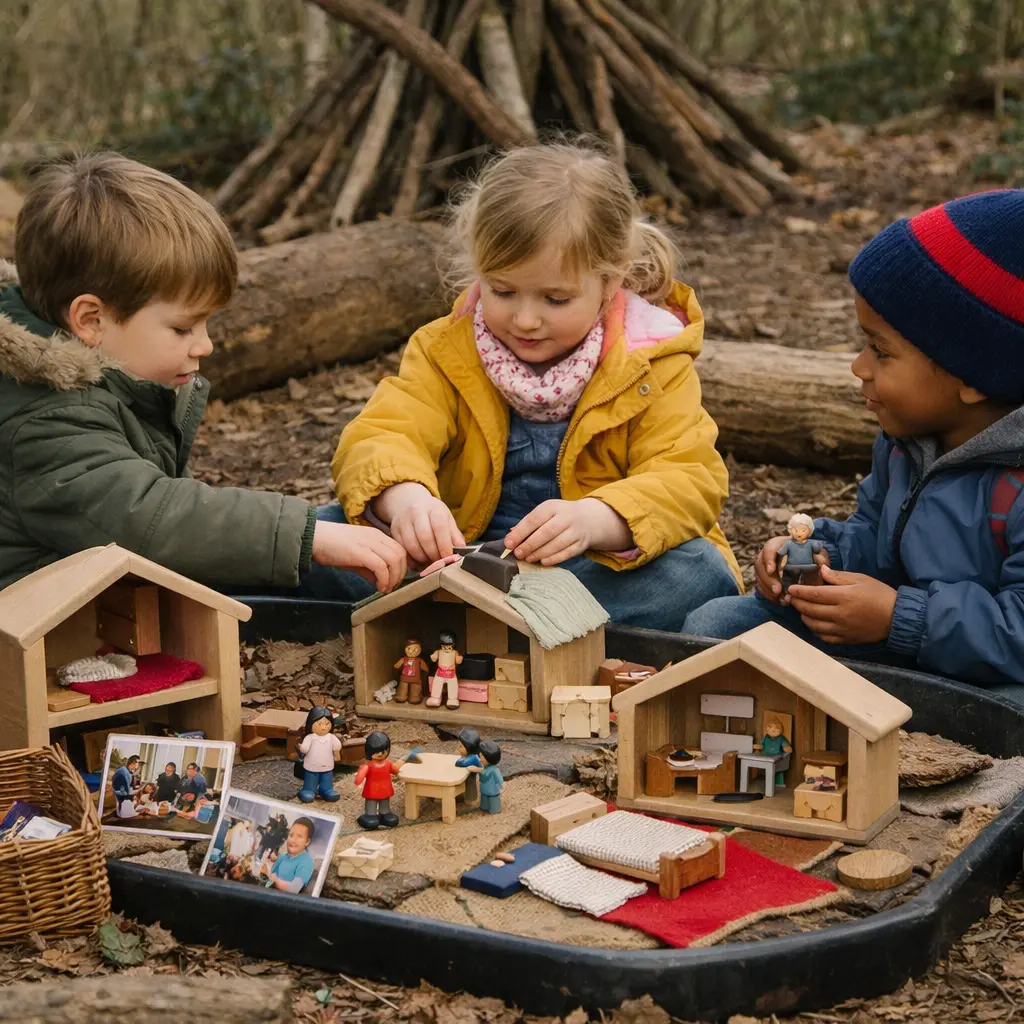
In an outdoor or nature-integrated space such as a sheltered yard, garden or paved courtyard, set the small-world area on a low tray or mat among logs, bark pieces and leaf litter so surfaces vary slightly. Materials are arranged using wooden or natural-finish small houses and small wooden family figures, with twigs, flat stones and soft fabric scraps for furniture, blankets and curtains; photo cards remain optional. Children may move pieces freely, gather extra natural props and revisit scenes without a fixed end product.
The adult observes from close by, briefly checks anchors and surfaces for safety, and steps back to offer minimal, responsive prompts or single-word reflections rather than step-by-step direction. Children choose roles, negotiate routines and language, experiment with placement on uneven surfaces, and take turns leading or changing storylines; the adult intervenes only to manage risk or scaffold with a short question to extend play.
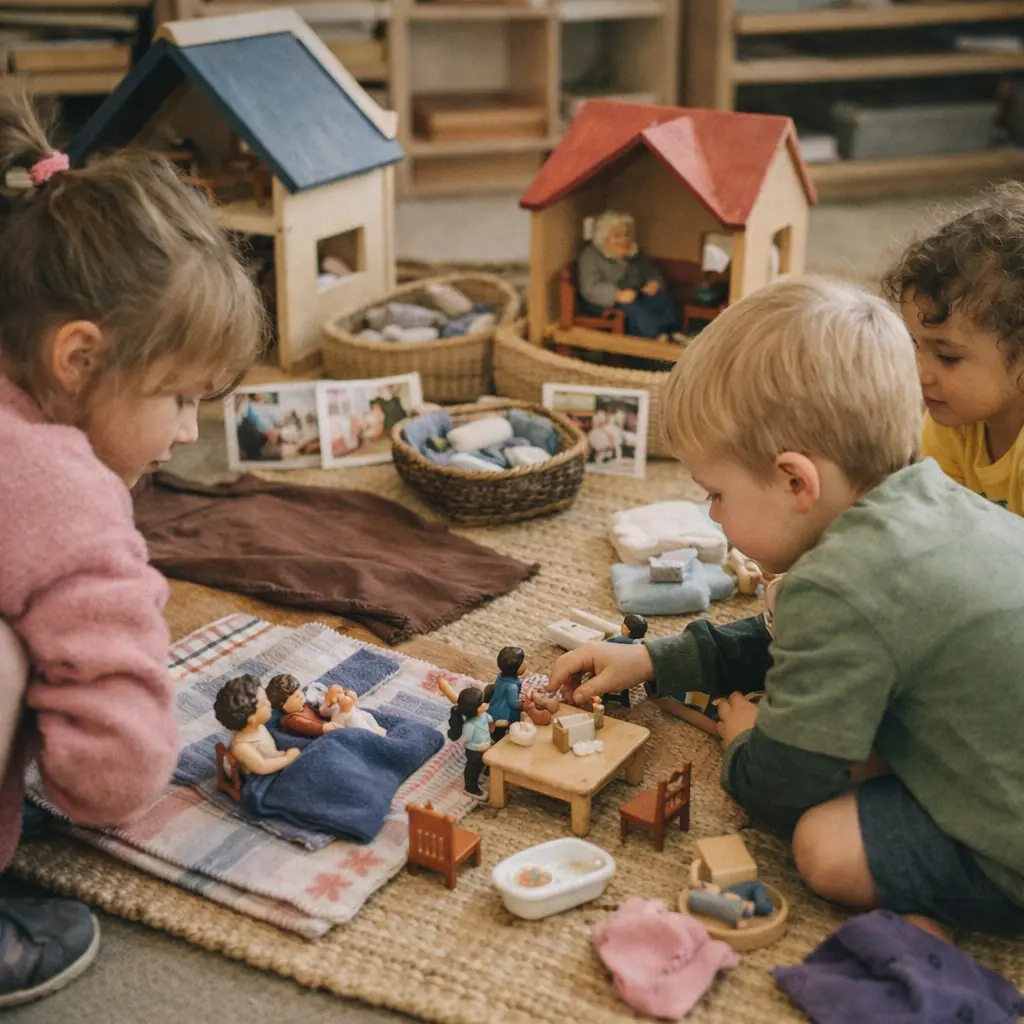
Ethos adaptation: Arrange the houses and loose parts at child height across a low mat so the layout invites movement between scenes and shared play; place furniture, fabric scraps and a varied set of family figures in open baskets so children select and combine items freely. Remove recipe-like sets and keep photo cards optional and nearby rather than fixed; the child may use a blanket as a road, a chair as a bus, or layer fabrics as rooms, allowing multiple, shifting uses.
The adult steps back as observer and co-researcher, offering short commentaries such as "I can see a bedtime story starting" or "You’re trying different ways to share the table" and asking open prompts like "What happens if you move the chair here?" The child may initiate role swaps, repeat routines or abandon and return to plots; the adult notices language turns, negotiation moments and empathic play as embedded observation cues without directing outcomes.
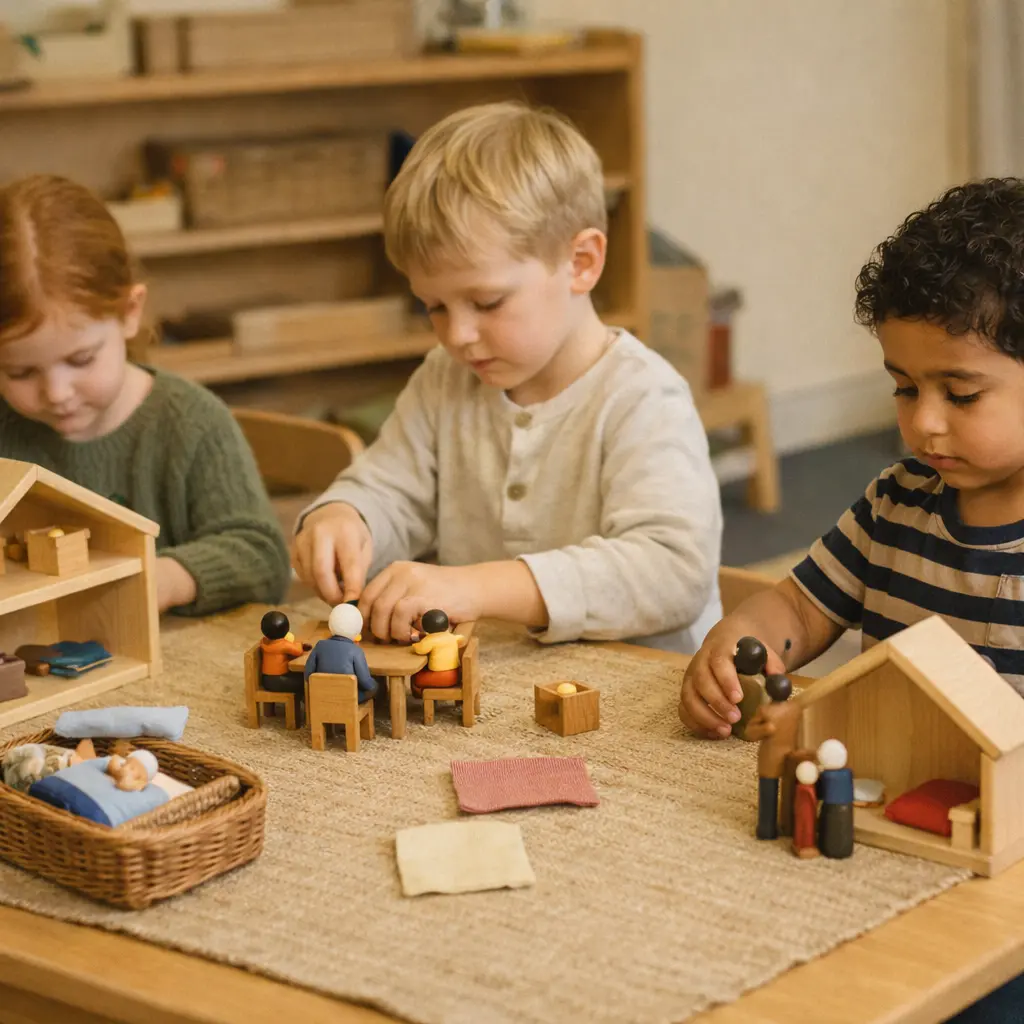
A neutral woven mat or wooden tray defines a small, uncluttered home corner. The materials are reduced to two simple wooden houses with open rooms, a small set of solid wooden family figures stained in varied skin tones and ages, a few wooden furniture pieces, and several small squares of cotton or wool felt for blankets or curtains (no long cords). A single wicker basket sits nearby for reset. Any photo cards are kept aside for practitioner reference so the play space remains calm and open-ended.
The adult settles close by and quietly models placing two figures and a simple greeting before returning the figures and observing. Language is minimal and factual, offered only to support safety or clarify emerging roles. The child chooses figures, returns to familiar routines such as mealtime, tidying, or bedtime, and repeats sequences at their own pace, inviting others when ready. Turn-taking, role negotiation, and shared storylines arise in the play; the adult notes language and interactions and steps in lightly if needed.