Repetitive spring song time with a small basket of simple props for actions and early communication
Music and movement
Communication and Language
Children and adults sit together on a mat with a small basket holding a soft bunny, a toy caterpillar and a scarf. Children handle one item at a time, copy a simple action from the adult, or add sounds to a familiar line. The adult keeps the singing steady and watches for children who signal a turn by reaching, waiting with hands in their lap, or passing a prop back.
This is a short, predictable song time using a small set of spring-themed songs and a basket of simple props. Children may join in through looking, reaching, copying actions, vocalising, or moving their bodies in time. Keeping the same songs across sessions can help children anticipate what comes next and choose how to take part. The focus stays on shared attention, turn-taking, and enjoyment of familiar rhythms and words.
Step-by-Step Guidance
1. Prepare a calm, defined space with enough room for children to sit or stand, and place the prop basket slightly to the side so it is visible but not distracting.
2. Choose a small set of spring songs (for example, three) and keep the same order each time so the routine feels predictable.
3. Begin with the same short opening cue each session (a consistent start phrase or a simple clap pattern) and wait a moment for children to orient towards you.
4. Introduce the first song by showing one prop at a time at chest height, keeping your movements slow so children can track what you are holding.
5. Model the key action for the song using your own body first, then offer the prop to a child who is reaching or watching closely; keep extra props in the basket to reduce grabbing.
6. Sing at a steady pace and repeat the chorus or key line, allowing children time to join in with movement, sounds, or still watching.
7. Between songs, return the prop to the basket in the same place each time and show the next prop as a clear cue that the song is changing.
8. If children begin their own actions or use props in a different way, keep singing and mirror their movement when it fits the rhythm, so their contribution stays part of the group.
9. End with the same closing song or closing cue each session, then invite children to help place props back into the basket if they are ready.
10. Store the basket in the same accessible place so children can see it and anticipate the routine next time.
Learning Objectives
Children may build confidence to take part in group routines through familiar songs, supporting Personal, Social and Emotional Development. Children may explore new words, sounds, and non-verbal ways to communicate through actions and repeated phrases, supporting Communication and Language. Children may practise listening and attention by noticing cues in music and movement, supporting Communication and Language.
Adult Role
Stay emotionally attuned by noticing who wants closeness, who prefers space, and who joins in by watching rather than moving. Model simple, clear language linked to what children can see and do, using repeated key words from the songs and naming actions and props without over-explaining. Scaffold lightly by slowing the tempo, simplifying actions, or offering a prop to a child who is showing interest; step back when children begin to initiate actions, vocalise, or lead a repeated part. Observe how children communicate preferences and readiness, and adjust the group size, distance, and prop access to keep the experience calm and inclusive. Hold responsibility for safe prop use, managing turn-taking with minimal interruption and removing any item that becomes unsafe or overly distracting.
Observation Cues
Looks towards the adult or prop when a familiar song begins, or shifts body position to join in.
Copies a repeated action (hopping, wiggling fingers, patting knees) with increasing timing.
Uses a gesture to request a prop or a song (reaching, pointing, handing an item back).
Vocalises on repeated parts (single sounds, key words, humming) or pauses as if waiting for a cue.
Shows preference by choosing a prop, moving closer, or turning away and returning later.
Time & Space
8–15 minutes, depending on group size and attention.
A clear carpet/mat area indoors, or a sheltered outdoor space, with enough room for children to sit in a loose semicircle and stand to move safely.
Materials
Safety
Age adaptations
Budding Adventurers
Add a predictable “helper” role such as carrying one prop from the basket to the adult at the start of each song. Increase action complexity slightly (hop-stop, crawl like a caterpillar, pretend to dig) while keeping the same songs and order. Use short phrases that match the song actions (dig, pour, grow, hop) and pause to let children fill in a repeated word or sound if they choose. Offer a small set of props on the floor in front of the group so children can select and swap without the adult handing every item out.
Curious Investigators
Invite children to suggest an action for a repeated line, keeping the song words the same so the structure stays familiar. Add a simple visual cue card for each song (bunny, caterpillar, garden) so children can help choose the next song by pointing. Support children to notice tempo and volume changes by using clear body cues (big/small movements) rather than verbal instruction. Allow children to lead one verse with actions while the adult maintains the steady rhythm and keeps the group together.
Confident Discoverers
Keep the same core songs but add opportunities for children to lead the routine, such as choosing the order from the cue cards or leading the actions for one song. Introduce simple call-and-response moments within the song structure (a repeated sound or key word) without turning it into a performance. Provide a slightly wider range of garden props (pot, trowel, watering can) and allow children to combine them in their actions as long as the group remains safe and settled. Notice and support children who include others by offering a prop, making space, or copying a peer’s action.
EYFS Links
Communication and Language: Repeated songs and actions give children a familiar structure to practise listening, attention, and joining in through sounds, words, or gestures. Personal, Social and Emotional Development: A predictable group routine can support children to feel secure, take turns with shared props, and cope with waiting. Expressive Arts and Design: Children explore rhythm, voice, and movement, and may adapt actions to express their own ideas within a shared song structure. Physical Development: Action songs offer whole-body movement and coordination, and handling props can involve grasping, passing, and controlled movement.
Ethos adaptations
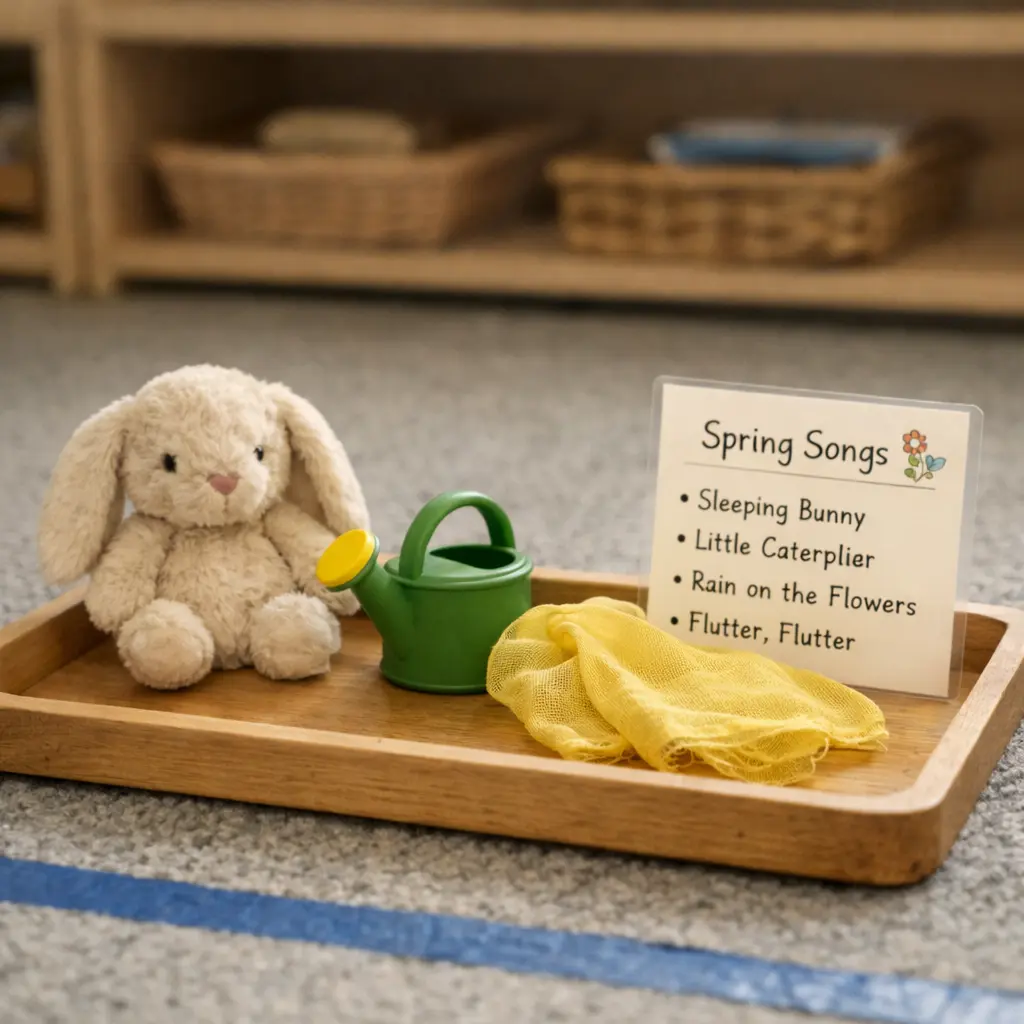
Place only three props from the basket on a low tray (bunny, watering can, one scarf) arranged left-to-right with the song list card beside them. Set the tray within reach on a marked mat so each child can see and take a turn, and remove extra items so the sequence of song→prop→action is clear. Keep songs consistent and shorten to two repeated verses to isolate listening, turn-taking and simple action vocabulary.
Introduce the session with one slow, silent demonstration: pick up the first prop, perform the associated action once while singing the verse, then put the prop back and step away. After that, use brief labels or single words only, do not prompt through questions, and limit gestures. Observe who repeats actions or words, who waits and passes props, and signs of steady attention or repeated practice rather than directing their choices.
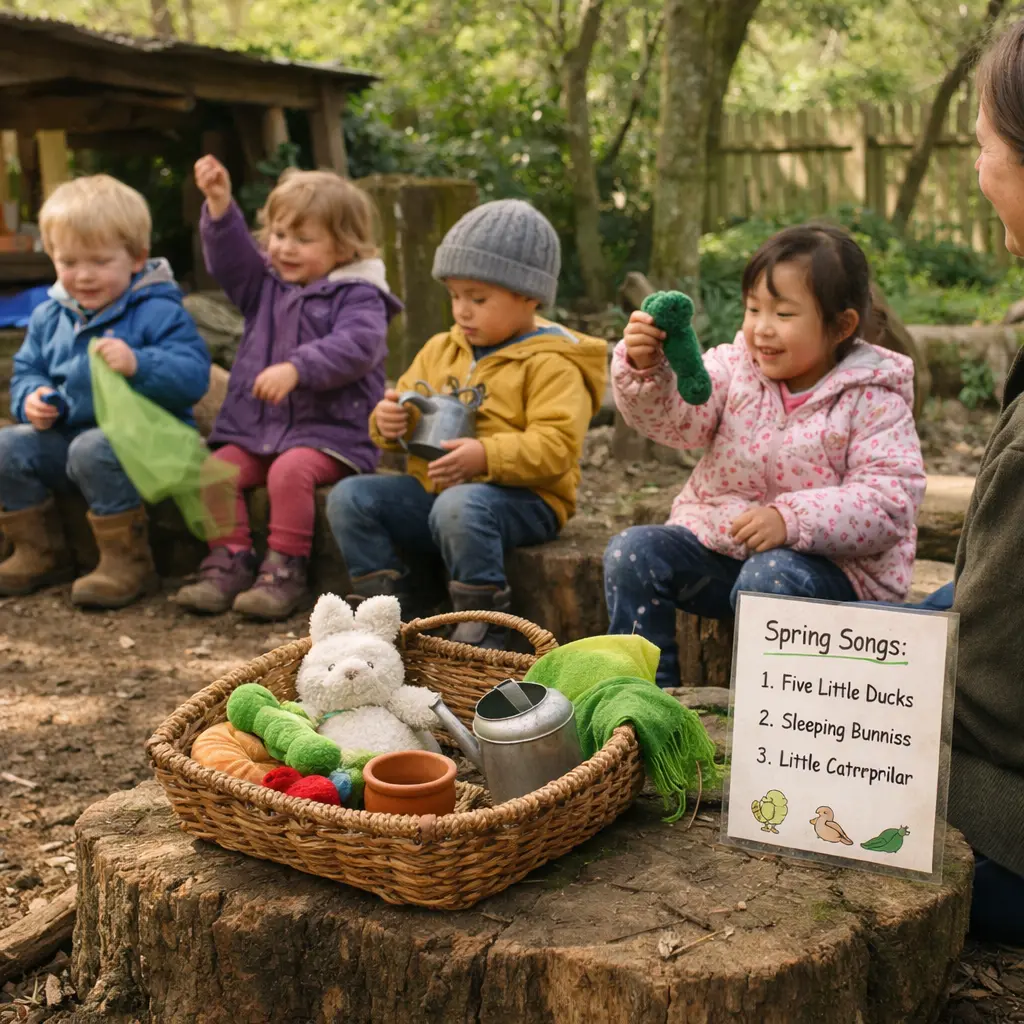
In an outdoor or nature-integrated space, move song time to a sheltered corner of the garden or green space with varied surfaces and places to sit or stand. Materials such as a small woven basket hold natural and tactile props: a soft fabric bunny or hand puppet tucked among a pinecone, a felted caterpillar or wooden bead string, a small metal watering can or clay pot, and scarves made from leaves or fabric. Materials are arranged loosely so items can be found, handled and returned.
The adult observes from close by, naming one or two sounds or sights and offering a single prompt rather than a full script. Children choose when to join, reach, copy actions, vocalise or move, and may take a prop or swap roles in their own time. The adult checks safety, models calm handling and short phrases, then steps back to listen and respond briefly to children’s cues, allowing repetition and varied participation without a fixed outcome.

Ethos adaptation: arrange the space so the basket and props sit within reach around a low, open rug or table area rather than handed out from an adult; props are spread so children can choose, combine or leave items (bunny, caterpillar, watering can, fabric leaves, scarves, natural loose parts or simple shakers) and add personal items from the setting. Keep the familiar song list as a quietly available prompt for adults only, not a scripted sequence, so children may enter, pause, repeat or abandon songs while the learning intent for attention, turn-taking and communication remains intact.
The adult steps back as observer and co-learner, using commentary not instruction: "I can see you’re watching the scarf," "You’re trying to make the bunny hop," "What happens if we sing more slowly?" The child may select props, change actions, lead a verse or invent sounds; observation cues are embedded in the flow—notice shifts in gaze, attempts at vocalising, repeated movements, choices to wait or take a prop, and emerging peer turns for assessment and planning.
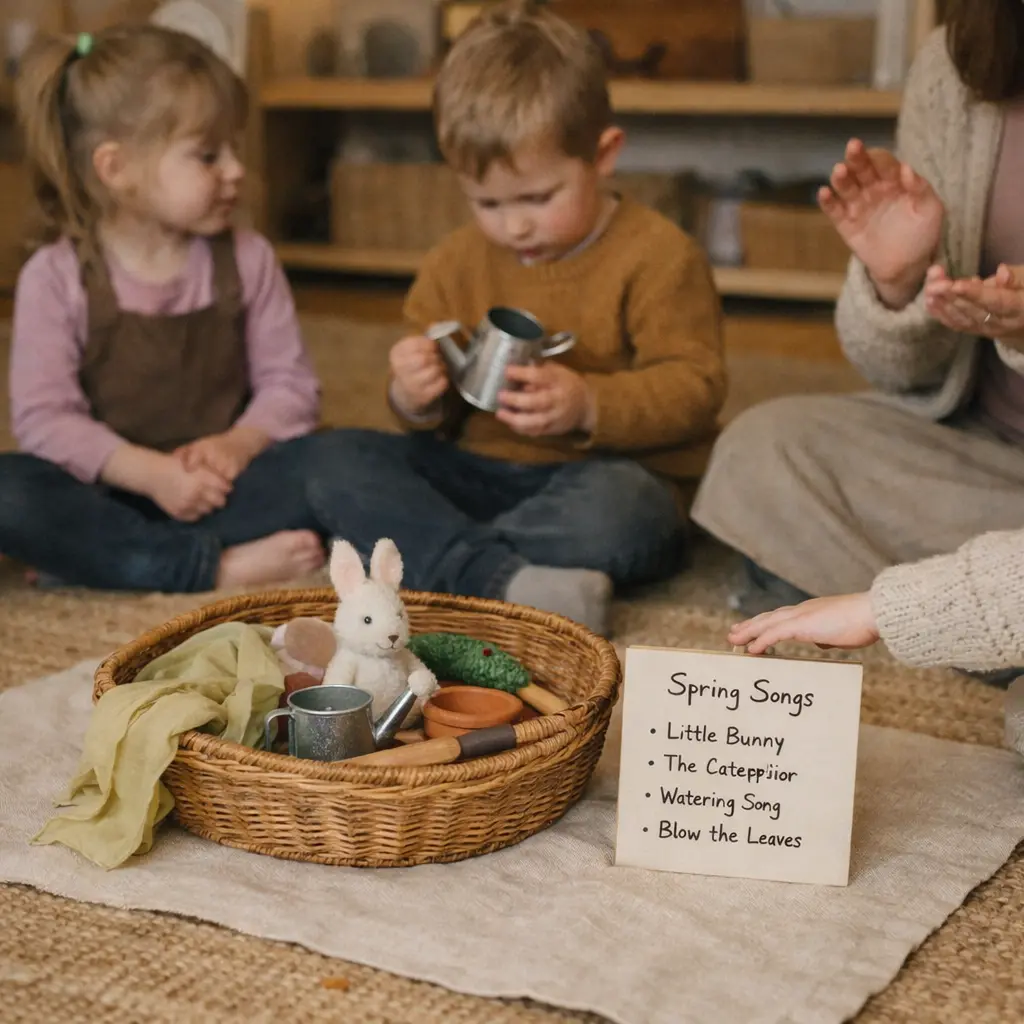
A calm corner is prepared with a neutral wool rug; children and adult sit in a loose circle. A small woven basket holds only a few spring props: a wool-felt bunny and caterpillar finger puppet, a small metal watering can, a wooden trowel, a clay pot, and two or three cotton or silk scarves/leaves in soft tones. The basket rests on a plain cotton cloth to define the space. The same songs are used each session, in a steady order, with space for repeats.
The adult begins with a quiet, unhurried melody and simple hand actions, modelling how to hold and pass a single prop without verbal directions beyond names for safety if needed. The adult watches children’s gaze, reach, and breath, pausing to let them join with sounds, gestures, or rocking to the beat. Children choose from the basket one at a time, return items to the cloth, and revisit favourite songs; the adult sustains tempo and endings, allowing repetition and tidy-away to close the rhythm.