Reaching and grasping spring textures on a sensory hoop during tummy time (0–12 months)
Sensory Play
Communication and Language
Tummy Time
An adult sits on the floor beside a folded blanket and holds a lightweight hoop steady a short distance in front of a baby on their tummy. A smooth yellow strip sways as the baby kicks, and a bumpy green strip brushes the baby’s knuckles. The baby pauses, then reaches again, fingers curling and uncurling until the fabric catches. The adult says, “Bumpy,” then goes quiet, watching as the baby rests their cheek for a moment and lifts their head to look back at the moving strips.
This tummy time invitation uses a simple hoop with spring-coloured fabrics and textures that hang within easy reach. Babies can notice movement, track with their eyes, and explore different feels through hands and mouth as they choose. The set-up creates a clear focus point that can make short tummy time periods feel more purposeful and calm.
Step-by-Step Guidance
1. Check the floor space is warm, clean, and free from small items. Place a tummy time mat or folded blanket on the floor.
2. Prepare the hoop by attaching a small number of scarves, ribbons, and textured fabric strips around the hoop. Keep lengths short enough that they cannot wrap around baby’s neck or fingers.
3. Position the hoop so the hanging pieces sit just in front of baby’s hands when baby is on their tummy. Keep baby’s face clear and ensure nothing covers the nose or mouth.
4. Place baby on their tummy for a short period, staying close at floor level. Let baby notice the hoop first before you move anything.
5. If baby is unsure, gently brush one fabric near their hand and pause. Allow time for baby to reach, swipe, or grasp in their own way.
6. Use simple language to label what is happening (“soft”, “tickly”, “you’re holding the ribbon”) and follow baby’s focus rather than switching textures quickly.
7. If baby tires, offer a brief rest (side-lying or cuddle) and return if baby shows readiness. End when baby shows clear signs of fatigue or frustration.
8. Remove the hoop and store it out of reach. Wipe washable items as needed and check attachments before the next use.
Learning Objectives
In Physical Development, babies can practise lifting and turning their head, shifting weight through shoulders, and reaching with increasing control. In Communication and Language, babies may show attention by tracking, pausing, and responding to an adult’s voice as they explore. In Personal, Social and Emotional Development, the predictable, close-by interaction can support a sense of security during a sometimes-challenging position.
Adult Role
Stay physically close and emotionally steady, especially if tummy time is challenging for the baby. Use calm, simple language that matches what the baby is looking at or touching, and pause often so the baby has time to respond. Scaffold lightly by adjusting the hoop distance, reducing the number of hanging items, or offering one texture at a time; step back when the baby is reaching and repeating actions independently. Observe breathing, face colour, and signs of fatigue, and end the experience promptly when the baby has had enough. Take responsibility for safety by checking attachments, keeping fabrics away from the nose and mouth, and supervising continuously.
Observation Cues
Baby lifts head and holds it for longer before resting, then tries again. Baby tracks a hanging ribbon with eyes, then reaches with one hand and later both hands. Baby opens and closes fingers around a scarf, then adjusts grip when it slips. Baby brings a texture to mouth, then turns head away or pushes it aside when finished. Baby vocalises or changes facial expression when a new texture brushes their hand or cheek. Baby shows preference by repeatedly reaching for one colour/texture or ignoring another.
Time & Space
5–15 minutes, in short bursts with rests as needed.
A clear floor area large enough for an adult to sit beside the baby, with the hoop positioned safely in front (around 2m x 2m).
Materials
Safety
Age adaptations
Budding Adventurers
Turn the hoop into a “spring touch ring” for standing and moving around, with a small number of textures spaced out so the child can walk, reach, and compare. Offer a basket with two extra scarves for the child to thread through the hoop holes or tie with adult help, then return to exploring. Keep expectations open-ended and prioritise safe handling of ribbons.
Curious Investigators
Invite children to help design the hoop by choosing where to attach green/yellow fabrics and noticing how spacing changes movement. Add a simple sorting prompt nearby (two bowls labelled by colour) for any spare scarves, without making it a required task. Model descriptive language (“smooth”, “scratchy”, “slippery”) and follow children’s comparisons.
Confident Discoverers
Offer a small selection of spring materials and let children plan a pattern around the hoop (alternating colours or textures) before testing how it moves when pulled. Provide a clipboard with paper for children who want to mark which textures feel “softest” or “most tickly” using their own symbols. Step back to allow peer discussion and only intervene to keep ribbons used safely.
EYFS Links
Physical Development: tummy time with a reachable focus can support head control, shoulder strength, and early hand control through repeated reaching and grasping. Communication and Language: the adult’s responsive commentary and waiting time can support attention, turn-taking rhythms, and early understanding of simple descriptive words linked to what baby is experiencing. Personal, Social and Emotional Development: staying close, reading cues, and ending when baby has had enough can support trust and emotional regulation during a physically demanding position.
Ethos adaptations
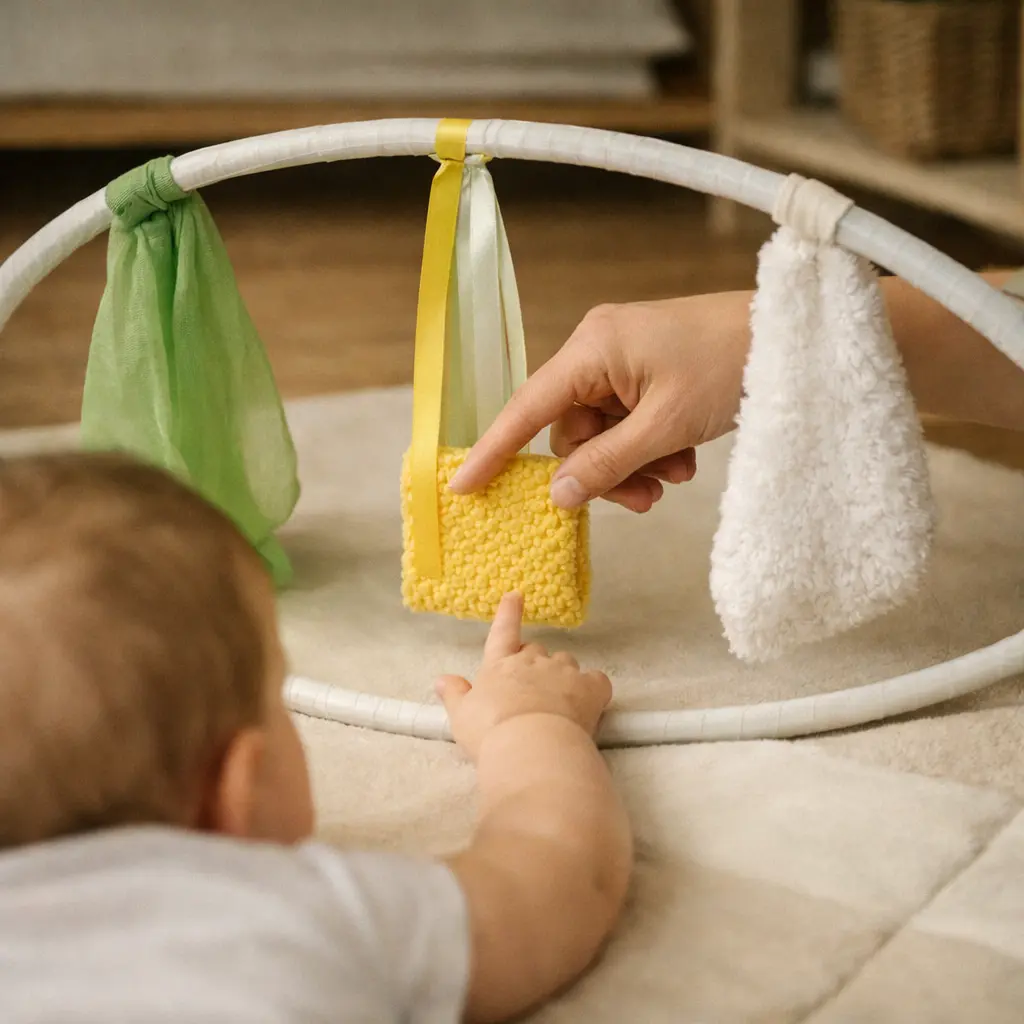
Place the hoop on the mat so its lowest hanging point sits just within an average baby’s arm reach when on tummy; remove the mirror and reduce hanging items to three short, clearly different textures arranged left-to-right at equal lengths. Use a single soft mat area with the hoop anchored to one side so the focus is central and the dominant skill—lifting the head and reaching—is isolated; keep extras out of reach so the baby can choose and the visual order shows which item to target.
Show the sequence once: place baby on tummy, draw one quiet attention gesture to the centre item and slowly touch it, then step back to a nearby seated position. Keep language minimal and factual, avoid prompts, and limit handling; observe repetition of reaching, steady head lift, shoulder weight shift and hand placement, and note signs of concentration or fatigue to end or repeat the short invitation.
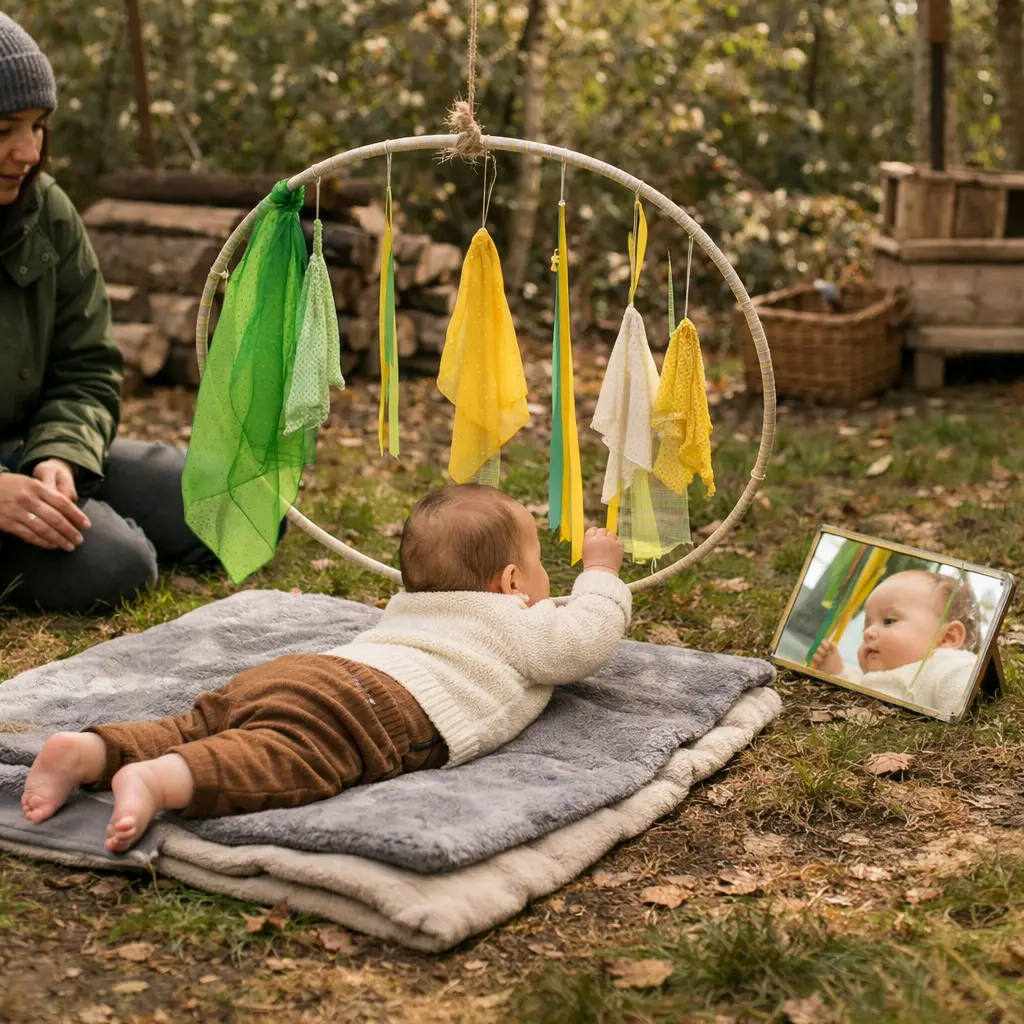
In an outdoor or nature-integrated space, the invitation is set on a soft mat or folded blanket on grass or a sheltered patio so surfaces are slightly uneven and sensory underfoot. The lightweight hoop is hung low and within easy reach, and materials such as the green and yellow scarves, ribbons and different textured cloths are arranged loosely so they move in the breeze rather than held rigidly; a low mirror may sit to the side for additional visual interest. The setup is simple and repeatable so sessions can be short and frequent.
The adult observes from close by, checking anchor points and safety, using minimal, responsive language and short prompts rather than step-by-step instruction. Children choose when to lift, turn their head, reach or mouth fabrics and may pause to listen or look; the adult models calm handling only when needed and steps in to adjust height or comfort, then steps back to allow self-directed exploration and repeated attempts within supervised limits.
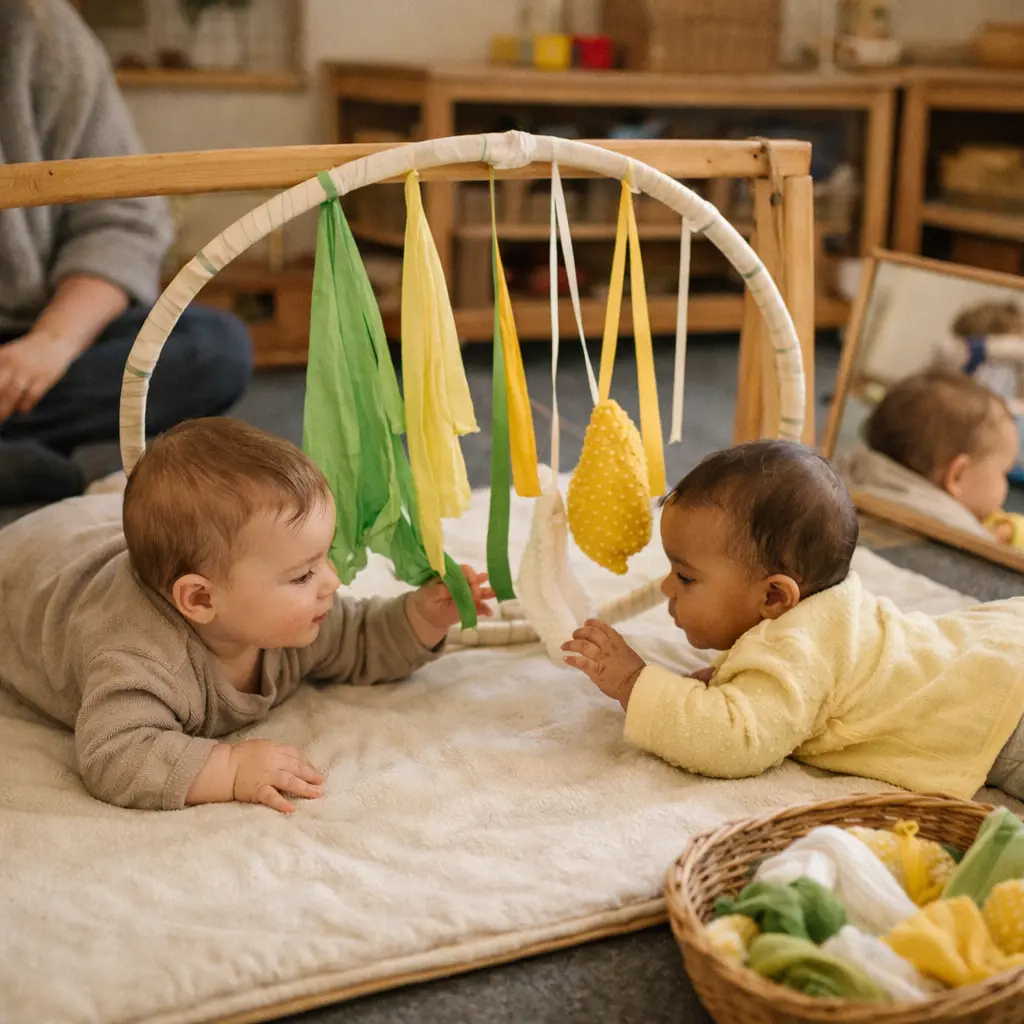
Ethos adaptation: Reconfigure the tummy-time area so the hoop hangs at infant eye level from a low frame or arch that the baby can approach from different angles; place the mat with space to move toward or away so the environment invites choice. Replace any single-use attachments with a selection of loose, washable textiles and tactile scraps (scarves, ribbon lengths, soft and bumpy fabric pieces) presented in an open basket nearby so the infant or adult may add, remove or rearrange textures during the session.
The adult stays low and still as an observer and co-researcher, offering commentary such as “I can see you watching the ribbons” or “What happens if the scarf moves?” rather than directing actions. The child may reach, bat at, mouth, or turn away and return; the adult notices changes in gaze, shoulder weight-shifts and hand opening, and records these moments within the flow (short notes, photos or a quick tick) to inform next invitations while leaving the child’s choices primary.
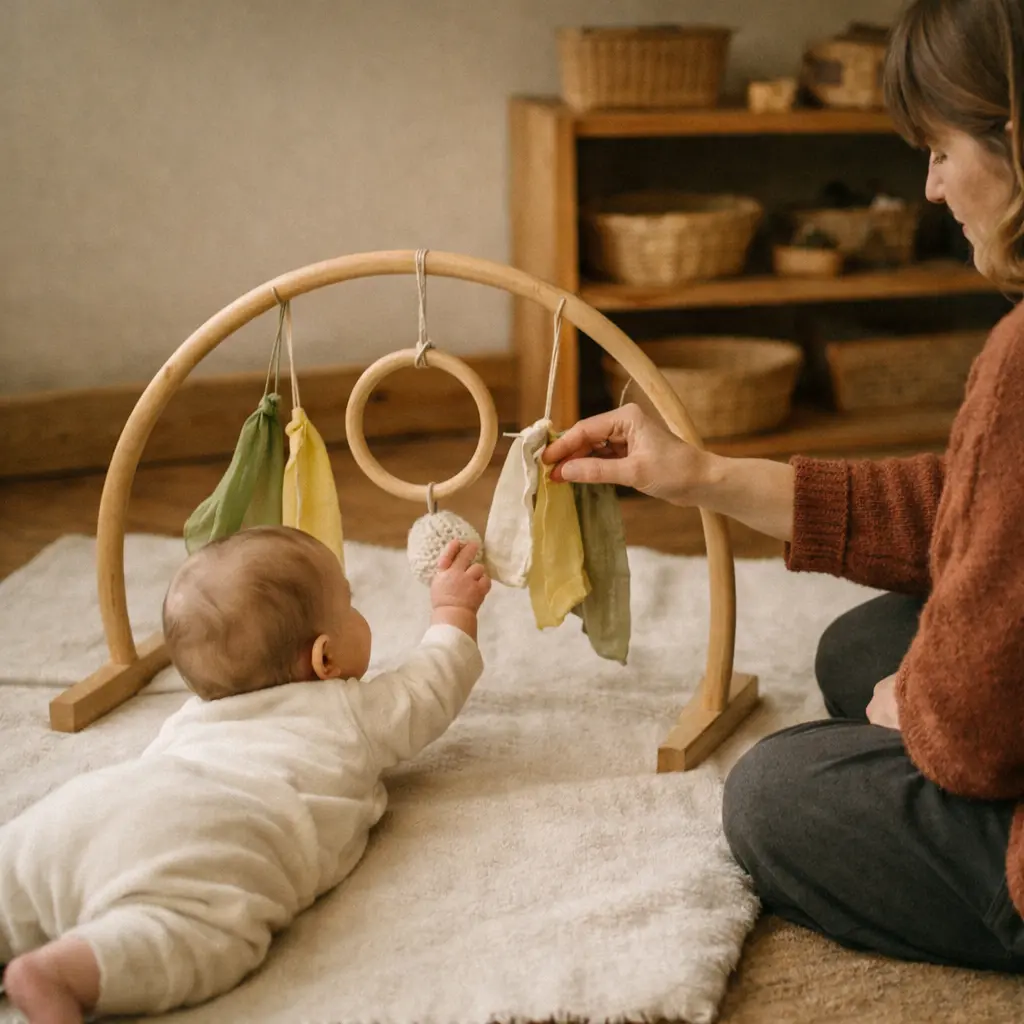
A calm floor space is defined with a plain wool blanket on a firm surface, with a smooth, untreated wooden ring suspended low from a stable wooden arch so it hangs within easy reach when the baby is prone. Only a small number of items are provided: short lengths of natural silk or soft cotton in muted spring tones, a square of linen, and a small knitted wool bobble, each securely knotted and no longer than the baby’s forearm. The area is softly lit, uncluttered, and free of additional mirrors or bright elements.
The adult sits at the baby’s side at floor level, quietly setting a gentle rhythm by giving one light tap to the ring so the fabrics sway, then remaining present and observant. Words are few and warm, offered in pauses (for example, “soft,” “slow”) while watching breathing, gaze, and muscle tone to judge comfort and timing. The child leads the pacing, returning to lifting, turning, reaching, grasping, and mouthing as desired; the adult adjusts height or removes an item if needed for safety, and ends the invitation when cues show fatigue.