Puddle splashing and rain listening in waterproof outdoor clothing for mixed ages
Sensory Play
Children explore rain and puddles outdoors in waterproofs and wellies, focusing on the feel of water and the sounds it makes on clothing and the ground. Adults support children to notice differences between puddles and to find movements that feel safe and satisfying. Practitioners pay attention to balance on wet surfaces, sensory preferences, and the language children use to describe what they hear and feel.
Children spend time outdoors in wet weather to explore puddles and rainfall through movement, sound and touch. The experience is open-ended and child-led, with space for children to test how different puddles respond to steps, jumps and stillness. Adults support children to notice what their bodies feel and hear, and to build confidence in being outside in the rain.
Step-by-Step Guidance
1. Check the outdoor area for hazards: depth of puddles, slippery surfaces, hidden kerbs, sharp litter, and vehicle access. Choose a clear boundary and a safe route back indoors.
2. Support children to put on waterproof clothing and wellies. Offer choices that keep the activity child-led (hood up or down, gloves or no gloves if appropriate).
3. Gather briefly at the threshold so children can notice the rain on clothing and skin. Name what is happening in simple, factual language.
4. Invite children to explore puddles in their own way. Keep the space open so children can move between puddles, stand still to listen, or watch water movement.
5. Stay close enough to support safe movement on wet ground. Use short prompts that direct attention without taking over, such as noticing the sound of different splashes or the feel of rain on hands.
6. If children cluster around one puddle, support turn-taking by creating space and suggesting nearby puddles, without insisting on a single “right” puddle.
7. Offer moments of stillness for listening. Adults can model pausing to hear rain on hoods, coats, and puddle surfaces.
8. Transition out by giving a clear time cue and a simple end point (e.g. returning to the threshold). Support children to remove wet clothing and move into warm, dry routines.
Learning Objectives
Children may develop confidence and enjoyment in being outdoors in different weather, supporting Personal, Social and Emotional Development. Children may explore how their bodies move in wet, uneven spaces, supporting Physical Development. Children may build vocabulary for sounds, sensations and weather, supporting Communication and Language.
Adult Role
Tune in to children’s comfort and confidence, noticing signs of overwhelm (flinching from raindrops, avoiding puddles) and offering closeness, a hand to hold, or a sheltered pause. Model language for sensations and sounds in the moment, keeping it descriptive rather than quizzing. Scaffold only when needed: support balance on slippery ground, help children judge puddle depth, and step back when children are safely repeating their own experiments. Observe patterns in children’s choices, movement, and sensory preferences, and use these observations to adjust boundaries, pacing, and the level of adult input. Hold responsibility for safety by maintaining supervision, checking the ground as children move, and ending the activity if conditions change.
Observation Cues
Notices and reacts to different sounds (rain on hood, splashes, dripping). Chooses different ways of moving (stamping, tiptoeing, jumping) and adjusts balance on wet ground. Seeks out puddles of different sizes or depths and compares the effects. Shows preferences for sensory input (hood up/down, hands out/in pockets, standing close to rain). Uses or responds to words about weather and sound (rainy, loud, quiet, splash). Manages waiting and turn-taking around a popular puddle with adult support.
Time & Space
10–30 minutes, depending on weather intensity, clothing comfort, and children’s interest.
Outdoor area with safe access to puddles and a clear boundary, plus a nearby sheltered threshold for regrouping and returning indoors.
Materials
Safety
Age adaptations
Budding Adventurers
Provide access to a few puddles with clear differences (size, surface sound, nearby dripping) within a safe area. Encourage children to try different movements if they choose, and support them to notice how splashes change with speed and force. Adults can introduce simple comparisons (big splash/small splash) and support turn-taking when a puddle becomes a shared focus.
Curious Investigators
Offer a wider area with several puddle options and a clear listening spot where children can pause. Support children to describe what they hear and feel, and to notice changes in rain intensity. Adults can extend thinking with gentle prompts about sound and movement, and support children to negotiate space around popular puddles.
Confident Discoverers
Allow children to plan where to go within agreed boundaries and to revisit puddles to compare effects. Encourage children to use richer descriptive language for sound and sensation, and to reflect on what changes the splash (movement, puddle size, rain rate). Adults step back for sustained child-led exploration, stepping in mainly for safety checks, conflict support, and vocabulary that matches children’s observations.
EYFS Links
Personal, Social and Emotional Development: children may build confidence with outdoor experiences and manage feelings about wet weather with adult attunement and predictable routines. Physical Development: children may practise balance, coordination and whole-body movements on wet ground, adjusting force and control as they splash and step. Communication and Language: children may listen closely to environmental sounds and use words to describe rain, puddles, and sensory experiences, supported by adults modelling descriptive vocabulary. Understanding the World: children may notice weather conditions, rainfall patterns, and how water behaves in puddles, building familiarity with natural changes over time.
Ethos adaptations

Lay out one small, clearly defined puddle area for the session by choosing a single shallow puddle or a short stretch of wet ground and marking its edge with a low natural border (stones or sticks). Put waterproof suits and boots on low hooks or a single tray near the chosen spot so each child can dress independently, and remove extra loose items or toys so the task is simply to step, jump or stand at the marked edge. Limit choices to the marked space to isolate balance, controlled force in stepping, and listening to rain.
Show the children a single, slow demonstration—walk to the edge, make one gentle step, listen quietly, then return to the regroup spot—and then step back. Use minimal language afterwards: brief safety reminders only and quiet prompts like “watch” if needed. Observe instead of instructing: watch for steady control in steps, repeated patterns of movement, changes in force when splashing, signs of focused listening, and when a child moves toward or away from the puddle to self-regulate.

In an outdoor or nature-integrated space, activities take place across varied wet surfaces (puddled grass, shallow ruts, stone edges) with a nearby sheltered spot for regrouping. Materials are arranged as open-ended natural items: stones, sticks, leaves and small funnels or cups for exploring water movement rather than prepared trays. Waterproof suits and wellies remain essential and spare dry clothes are kept indoors; the setting allows uneven footing and changing puddle depths for managed challenge.
The adult observes from a safe distance, checks clothing and footing, and offers single-word labels or short, responsive comments rather than step-by-step instruction. Children choose how to move—tiptoeing, stomping, balancing or still listening—and may collect natural items to test splash, sound and buoyancy. The adult intervenes only for safety, models descriptive words briefly when asked, and stays close enough to manage risk while allowing child-led exploration.
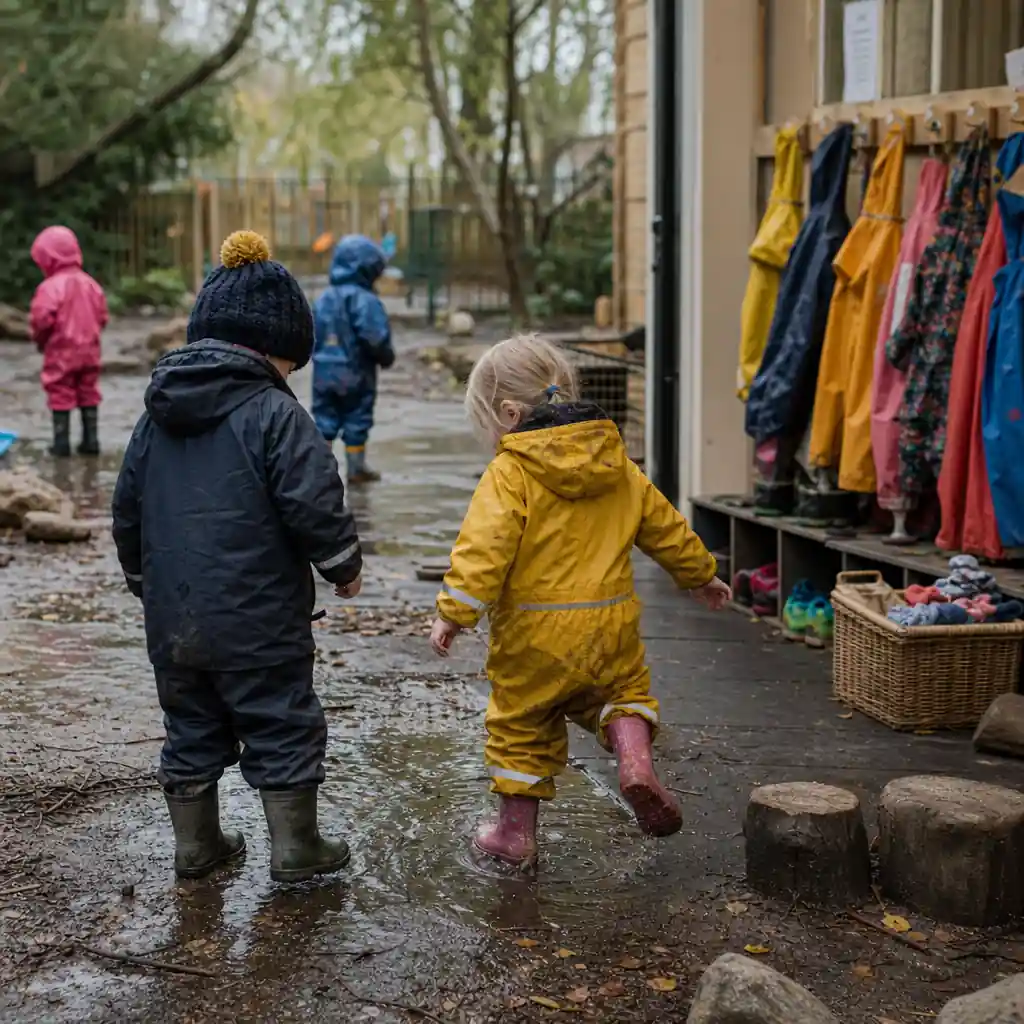
Arrange the outdoor area as a set of accessible zones: shallow and deeper puddles, a few uneven paths, and a clearly visible sheltered regrouping spot. Store waterproof suits, coats, wellies and spare socks on low hooks or in open baskets so children can choose independently; add loose natural items (sticks, leaves, pebbles) nearby for optional investigation. Keep boundaries safe but flexible so the space itself invites different approaches to movement, sound and touch rather than prescribing a single task.
The adult steps back as observer and co-researcher, using commentary not instruction—for example, "I can see your feet make different splashes," "You’re trying to jump without slipping," or "What happens if you stand very still?" The child may select where to play, which puddles to test and whether to use loose parts; embedded observation focuses on balance changes, repeated movement choices, vocal labels for sensations and moments of hesitation or joy that indicate learning and confidence.
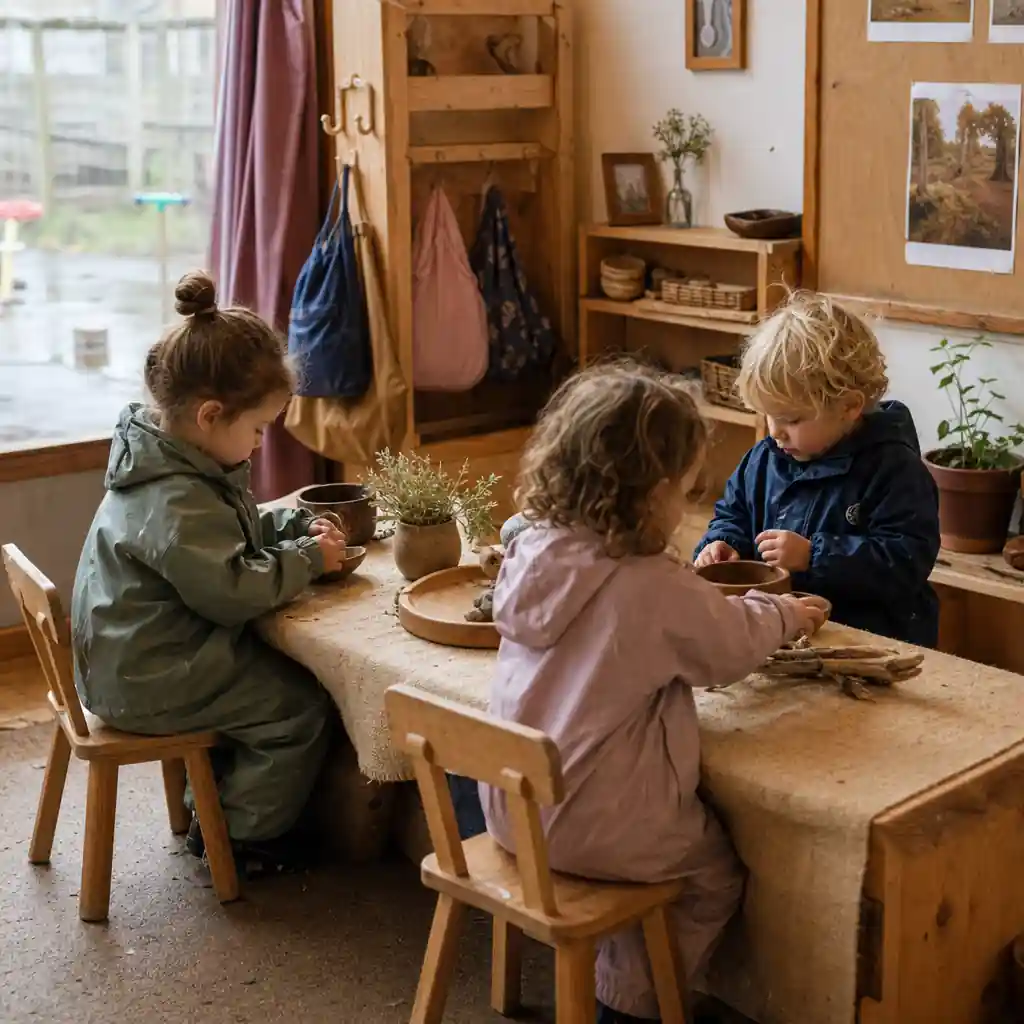
Offer simple, natural-feeling waterproof clothing in calm colours where possible, and keep the outdoor entry routine unhurried with a predictable rhythm for dressing, going out, and returning to warmth. Choose a gentle outdoor route that includes a few safe puddles and avoids overstimulating noise or crowded transitions. Create a cosy return point indoors with warm towels and a quiet settling activity to support the shift back from wet weather.
Use warm, steady language that names the weather and the body’s experience without over-explaining. Allow children to move in their own rhythm, with the adult modelling calm presence and careful stepping rather than directing. Observe children’s mood, energy, and comfort with the rain, responding with pacing, warmth breaks, and supportive closeness when needed.