Outdoor bird nest building with foraged natural materials for children aged 2–4 years
Communication and Language
Children use twigs, leaves, straw and wool outdoors to explore how a bird’s nest might be shaped, lined and supported. Adults offer a small set of materials and language about birds and habitats, and notice how children choose to work alone or with others. The focus stays on children’s own designs, including how they respond when a structure shifts or collapses and what they try to change.
Children explore how birds might build nests by designing and constructing their own nests using natural and craft materials outdoors. The experience invites children to test ideas, change their design, and decide how to combine materials to make a stable structure. It can be offered after a short resource-collecting walk so children connect what they find with where birds live. Adults support children to use new vocabulary about birds and habitats and to work alongside others when they choose.
Step-by-Step Guidance
1. Plan a short pre-activity collection: choose a garden area, outdoor space, or a short walk route where children can safely gather suitable nest materials.
2. Complete an outdoor check: scan the area for hazards and agree simple boundaries with children for where collecting and building can happen.
3. Invite children to collect: encourage choosing a small range of items (twigs, leaves, straw/grass) and noticing where they are found.
4. Prepare the building area: lay out a messy mat/ground sheet if using, and place materials either in separate bowls/containers or in small piles that children can access.
5. Introduce the focus: briefly connect the materials to birds and nests, and name a few key words children can use (nest, habitat, twig, leaf, straw, egg).
6. Offer the materials: allow children to choose where to start and whether to build alone or with others. Keep the invitation open-ended so children can create different nest shapes and sizes.
7. Support problem solving in the moment: when a structure won’t hold, pause and prompt children to notice what is happening (e.g., balance, gaps, softness, stiffness) and to try an alternative material or arrangement.
8. Add optional “eggs”: if children choose, offer cotton wool balls and observe how this changes their design decisions (size, depth, protection).
9. Extend vocabulary and knowledge: weave in simple facts linked to what children are doing (e.g., nests can be hidden, nests can be soft inside) and encourage children to describe their choices.
10. Close and reflect: invite children to look at each other’s nests, notice differences, and decide whether to keep, rebuild, or leave the nests in place. Tidy together by returning reusable items and composting/disposing of natural materials appropriately.
Learning Objectives
Children may develop problem solving and perseverance as they plan, build, and adjust a nest design using available resources (Expressive Arts and Design). Children may extend their understanding of the world by linking materials and nest features to birds and habitats they notice outdoors (Understanding the World). Children may practise using words and longer sentences to describe choices, explain ideas, and respond to others during shared play (Communication and Language).
Adult Role
Stay emotionally attuned by noticing frustration, pride, or hesitation and responding with calm reassurance and time to try again. Model language that fits the moment, naming materials and actions (twist, tuck, balance, layer) and adding simple bird and habitat vocabulary without turning the play into a lesson. Scaffold only when needed: offer a prompt or a single suggestion, then step back so children can test their own ideas and lead the design. Observe social dynamics closely, supporting turn-taking and negotiation if children want shared materials or a shared nest, and helping children find a way to continue if conflict appears. Hold responsibility for safety by checking collected items for sharp points, supervising closely outdoors, and maintaining agreed boundaries during collecting and building.
Observation Cues
Sustained attention: Do children stay with the building for a period, return to it, or restart with a new idea?
Design thinking: Do children test stability, change materials, or alter the shape when something collapses?
Language use: Do children use or attempt vocabulary such as nest, twig, straw, feather, egg, habitat, bird names?
Social approach: Do children choose to build alone, alongside others, or collaborate on one shared nest?
Resource choice: Which materials do children select first, and do they sort, group, or combine them in consistent ways?
Time & Space
Set-up: 10–15 minutes. Activity time: 20–40 minutes depending on whether a collection walk is included.
Outdoor space with a defined collecting area and a separate, calmer building area (ground sheet/messy mat optional).
Materials
Safety
Age adaptations
Budding Adventurers
Use larger, softer materials with fewer sharp edges (bigger leaves, thicker straw/grass, short wool lengths) and offer a smaller selection at one time to reduce overwhelm. Provide a clear base area on the mat where the nest “belongs” and accept simpler constructions such as piling, lining, and filling. Adults can model a few action words (in, on, under, soft, scratchy) and support perseverance by pausing with the child to notice what fell and offering one alternative material to try.
Curious Investigators
Offer a wider range of materials in separate bowls so children can make deliberate choices and compare textures and stiffness. Encourage children to describe a plan (e.g., soft inside, strong outside) and to test whether the nest can hold cotton wool “eggs” without them rolling away. Adults can extend language with bird and habitat words and support collaboration by helping children agree roles (collector, builder, decorator) if they choose to work as a team.
Confident Discoverers
Add a design challenge that stays optional, such as making a nest that can be moved without falling apart or making a deeper nest for multiple “eggs.” Provide sorting containers and invite children to classify materials by properties (soft/rough, bendy/stiff) and to explain why they chose them. Adults can support longer conversations, encourage children to compare different nest designs, and note children’s strategies for planning, revising, and persisting when their first idea does not work.
EYFS Links
Understanding the World: Children connect what they find outdoors with where birds live, and they may begin to talk about habitats and why nests are built in certain places. Expressive Arts and Design: Children explore materials openly, combine them in different ways, and represent ideas through their own nest designs. Communication and Language: Children practise naming materials, describing plans, and responding to others’ ideas during shared building and reflection. Literacy: Children may notice and use sound patterns in bird names and key words, and adults can sensitively draw attention to initial sounds during natural conversation without turning it into a formal phonics task.
Ethos adaptations
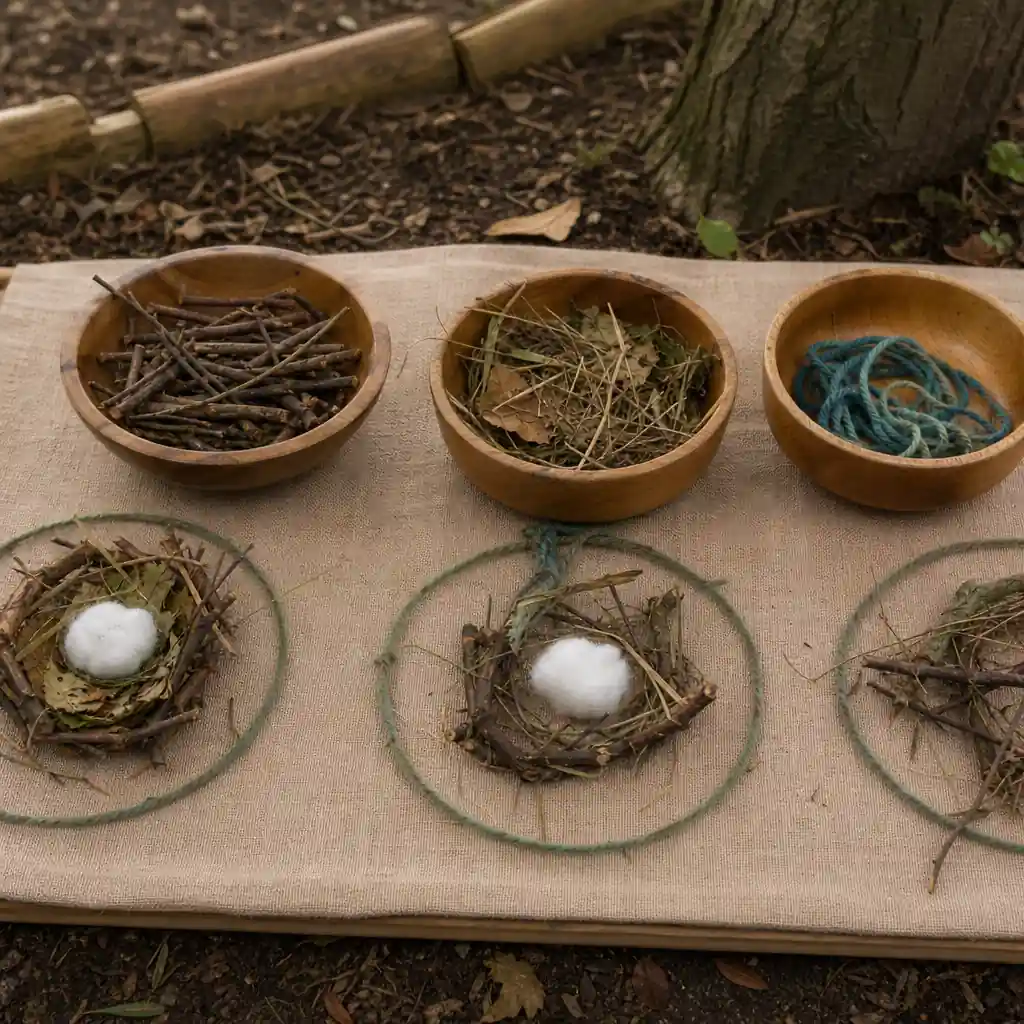
Set out a single ground sheet with two or three low bowls arranged left-to-right: twigs, leaves/grass, short wool. Remove picture cards and extra items unless a child asks for them. Offer one small work area per child; place a loose loop of wool to mark each building space. Keep quantities modest so choices are clear. Show the sequence in the layout: choose sturdy twigs for a rim, add leaves/grass to line, use a little wool to secure. A cotton wool ball placed inside shows if gaps or wobble need fixing.
Give one slow, quiet demonstration from start to finish, naming only a few words: twig, line, test, then step back and limit language to brief safety notes. Observe hand control and deliberate placement, whether the child selects sturdier twigs for the rim, and how they test stability by lifting an edge or placing the cotton ball. Watch for repetition, problem-solving without prompts, shared turns at bowls, growing vocabulary about habitats, and signs of deep focus or fatigue.

In an outdoor or nature-integrated space, set the activity on grass, a sheltered corner of the garden or beneath low branches with natural uneven surfaces and a nearby place to rest. Materials such as foraged twigs (checked for safety), dry leaves, straw, short lengths of wool and cotton-wool “eggs” are provided in an open-ended way rather than pre-arranged kits; children may also use logs, stones or a ground sheet as a base and may revisit a short collecting walk to add new finds.
The adult observes from close enough to intervene for safety but steps back to avoid directing the build, offering short, responsive prompts or single-word vocabulary when useful. Children choose roles, test and change their designs, balance and bundle materials, and work alongside peers while describing choices; the adult checks sharp points, models calm handling when needed, and names materials or birds in brief exchanges to support conversation.
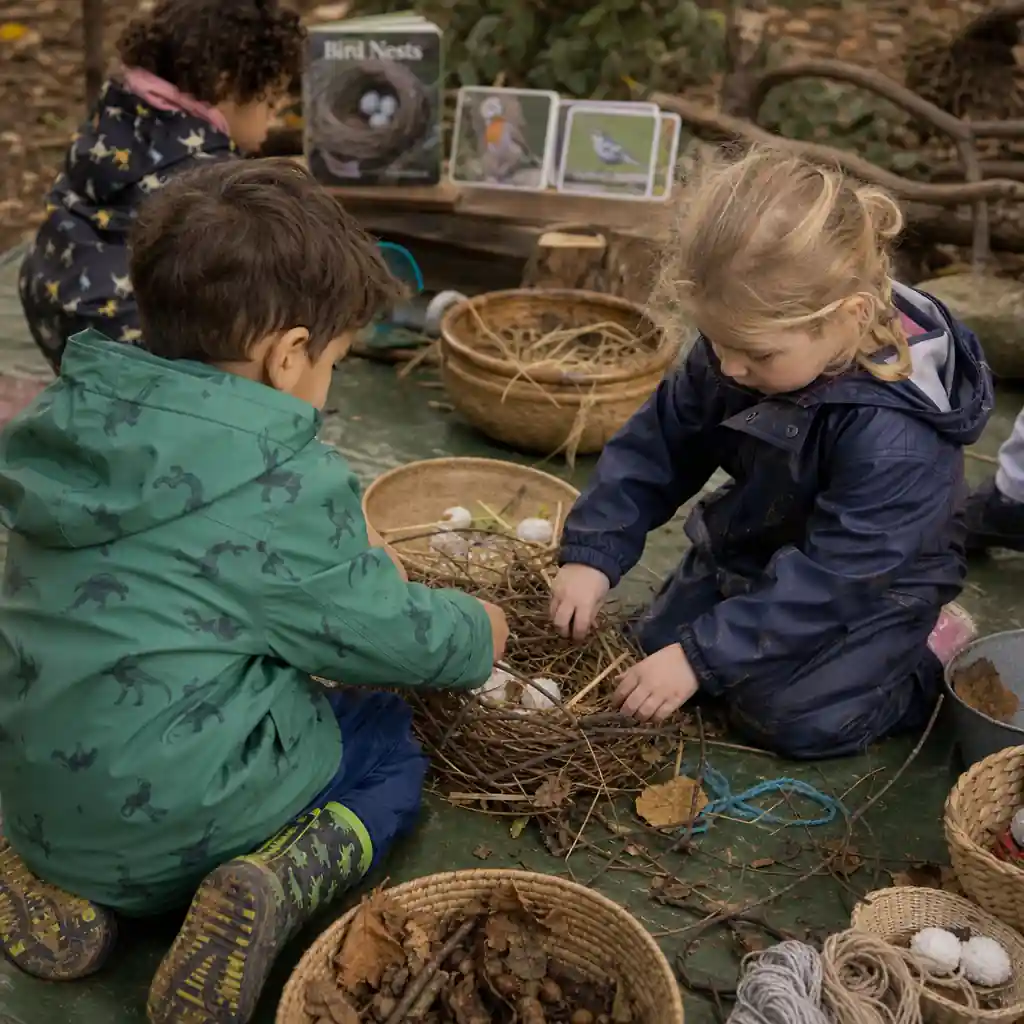
Lay a ground sheet in a quiet outdoor spot with nearby low branches, stones, or nooks where a nest could rest. Offer twigs (checked), dry leaves, straw/grass, and short wool in open baskets with plenty of empty space and a few shallow containers for self-chosen sorting. Place picture cards or a simple bird book on a low surface as a browsing prompt, not a guide. Nothing is pre-started; children choose where to work, whether on the ground, tucked into a crevice, or suspended in a fork.
The adult stays alongside as co-researcher, using noticing language: “I can see you’re testing how the leaves stay together,” “You’re trying to make this side stronger,” “What happens if the wind reaches it here?” Children may shift focus—piling, weaving, lining, abandoning, or relocating nests—and negotiate roles with others. The adult watches for problem-solving, persistence, material comparisons, and talk linking features to habitats, capturing brief notes of strategies, new vocabulary, peer collaboration, and design changes.

Steady, contained work areas are laid out on neutral cloths or a single ground sheet to define each child’s nest space; only a small number of collected twigs (checked for safety), dry leaves, straw and short wool lengths are presented in wooden or wicker bowls so the layout stays calm and uncluttered. Cotton balls for “eggs” and a single non-fiction bird picture card may sit at the edge for optional reference, but bright or synthetic items are omitted and excess choice is avoided to keep sensory input simple.
The adult demonstrates a quiet handling of materials—showing how to lay and tuck twigs or gently wrap wool—then stands nearby, observant and using minimal language unless safety requires intervention. The child returns to their chosen actions, repeating placement and adjustment at their own pace, sharing observations in conversation as they build; the adult models vocabulary sparingly and supports turn-taking or safety without directing the design or prescribing outcomes.