Observing UK garden and park birds using binoculars and simple picture references
Communication and Language
Literacy
Children observe birds in a garden or park and compare what they notice about colour, size, and movement. Adults offer binoculars as an optional tool and keep a small set of picture references nearby to support naming and matching. The experience can highlight similarities and differences between common UK birds without needing perfect identification. Adults pay attention to how children sustain attention, communicate observations, and use reference materials.
Children spend time noticing birds in a familiar outdoor space such as a garden or park. The focus is on looking carefully and comparing what they can see, such as size, colour, beaks, and where birds choose to sit or feed. Adults support children to use simple picture references to help name birds and talk about similarities and differences. The experience can be calm and unhurried, with children choosing how close to watch and how long to stay.
Step-by-Step Guidance
1. Choose a spot where birds are likely to be seen without needing to move quickly, such as near trees, hedges, or open grass.
2. Prepare the space for calm watching by placing a blanket or choosing a bench with a clear view upward and outward.
3. Introduce the idea of “watching like a scientist” in simple terms: looking carefully, staying still, and noticing details.
4. Offer binoculars as an option and show how to hold them steady; also offer watching with eyes only so children can choose.
5. Present one reference source (cards, book, or iPad) and keep it nearby rather than in children’s hands if it distracts from looking.
6. Encourage children to share what they notice using prompts that invite comparison, such as colour, size, and where the bird is.
7. When a child indicates a bird, support them to look back and forth between the bird and the reference pictures to find a close match.
8. Name birds when helpful, and accept approximations; keep the emphasis on noticing features and similarities/differences.
9. Offer a simple way to record interest if children want it, such as a quick mark, a sketch, or circling a picture on a card.
10. Close the session by revisiting one or two observations children made, and leave open the option to return later in the day or week.
Learning Objectives
Children may build understanding of the natural world by noticing living things in their local environment (Understanding the World). Children may develop Communication and Language by using words, gestures, and simple descriptions to share what they notice. Children may also practise early literacy behaviours by using a book or visual cards as a reference and by noticing that pictures and labels carry meaning (Literacy).
Adult Role
Stay emotionally attuned by keeping the pace slow and calm, noticing when children need quiet, closeness, or a change of position. Model language that fits what children can see, using short phrases that label features and comparisons, and repeat children’s words back with a small extension. Scaffold when children are stuck (for example, by narrowing choices to two pictures or pointing out one clear feature), and step back when children are absorbed in watching. Observe in action by noting what draws attention (movement, sound, colour) and which comparisons children attempt. Hold responsibility for safety by choosing a stable viewing spot, supervising binocular use, and supporting children to keep respectful distance from wildlife and other park users.
Observation Cues
Looks up and tracks movement in trees or sky, returning attention to the same spot.
Uses comparative language such as bigger/smaller, same/different, light/dark, long/short.
Points to a feature (beak, wings, tail) and waits for an adult to label or confirm.
Matches a seen bird to a picture, even if the match is approximate.
Shows awareness of birds’ behaviour, such as hopping, pecking, flying off, or calling.
Sustains quiet watching for longer periods, or chooses short bursts and returns later.
Time & Space
10–25 minutes, with the option to repeat in short bursts across a week.
Outdoor space with sightlines to trees, hedges, or open sky; a garden, park edge, or quiet area of a playground works well. A seated base (blanket or bench) supports calm observation.
Materials
Safety
Age adaptations
Budding Adventurers
Introduce a simple “look for” set using a few picture cards and invite children to find a close match rather than an exact identification. Provide child-safe binoculars as an optional tool and support turn-taking if children are watching together. Adults can encourage two-part descriptions such as colour + place (for example, “brown bird, on the fence”) and help children compare two birds they notice in the same area.
Curious Investigators
Expand the comparison focus by inviting children to notice beaks, feet, and how birds move (hop, walk, fly). Offer a child-friendly book or iPad reference with a small number of bookmarked pages/images to reduce scrolling and distraction. Adults can support children to make a simple record such as a quick sketch or a tally mark for each bird type they think they saw, keeping the emphasis on observation rather than accuracy.
Confident Discoverers
Support children to use more specific comparison language such as “similar because…” and “different because…”, using visible features and behaviour. Provide a small set of reference options that include similar-looking birds so children can practise careful noticing. Adults can invite children to suggest where to watch from (bench, blanket, under a tree) and to reflect on what helped them see more clearly, such as stillness, quiet, or changing viewpoint.
EYFS Links
Understanding the World: Children notice birds as living things in their local environment and begin to compare what they see, supporting early scientific thinking through observation and simple classification.
Communication and Language: Children practise attention and listening in a real outdoor context and use words, gestures, and short phrases to describe features, locations, and differences.
Literacy: Children use pictures and labels in books/cards/digital references as sources of information, building familiarity with non-fiction features and the idea that print and images carry meaning.
Ethos adaptations

Choose one quiet viewing spot with clear sight of branches or a feeder. Lay the blanket as the workspace. Set out one pair of child-safe binoculars (or the cardboard tube), four simple UK bird cards, and one small notebook with a chunky pencil, arranged left-to-right so the sequence is clear: look → match → mark → return. Keep the iPad and extra cards out of sight. Place cards face up with space between them. Use the top edge of the blanket as a visible return line so children can reset materials themselves.
Give one slow, silent demonstration: sit, raise binoculars, find one bird, lower, slide the closest matching card beside you, make a single dot in the notebook, then return each item to the line. Offer one brief safety note, then step back and keep language minimal. Avoid questions. Watch for independent repetition, steady hand-to-eye control, visual checking between bird and picture, chosen distance or seat, and self-correction when a card doesn’t fit what they see. Note any emerging descriptive words or gestures.

In an outdoor or nature-integrated space, move the activity to a garden, park edge or grassy clearing with varied sightlines and natural seating such as logs, low walls or a blanket on uneven ground. Materials are arranged to favour real and open-ended items: child-safe binoculars or cardboard tubes, laminated UK bird cards or a small field book, a clipboard and chunky pencil, and natural markers (twigs, leaves, stones) children may use to mark where birds were seen. Avoid overly tidy setups; leave space to wander and pause.
The adult observes from close enough to manage safety but far enough to allow birds to behave naturally, offering minimal, responsive prompts or single words (eg. “Where?” “Colour?”) rather than step-by-step instruction. Children choose how near to sit, when to move, and whether to sketch, photograph or use cards to name birds; the adult checks anchors (logs/benches), models calm handling of binoculars, and steps back to listen and note observations while supporting turn-taking and safe use of any tools.

Shape the space into self-chosen lookout zones: a blanket under shrubs for ground views, a bench for higher sightlines, and an open patch for sky watching. Place child-safe binoculars and cardboard tube “binoculars” in open baskets; lay bird picture cards loose and unsequenced; keep the bird book/iPad guide flat and reachable; leave the clipboard with chunky pencil/crayon untethered. Materials stay open-ended: binoculars as viewfinders or “listening frames”; cards for free grouping or “maybe” piles; book/images for browsing; clipboard for marks, tallies, maps, or stories. Children drift, pause, and return.
The adult stays alongside as co-watcher, using light commentary: “I can see a small bird on the fence,” “You’re checking the beak shape,” “What happens if we look from the bench?” Follow the child’s focus (naming, describing, counting, or marking), letting picture references be consulted, ignored, or rearranged. Observe sustained attention, spontaneous categories (size/colour/place), turn-taking with binoculars, gestures and new vocabulary, mark-making that represents features, and how children use pictures and labels to make meaning in their own ways.
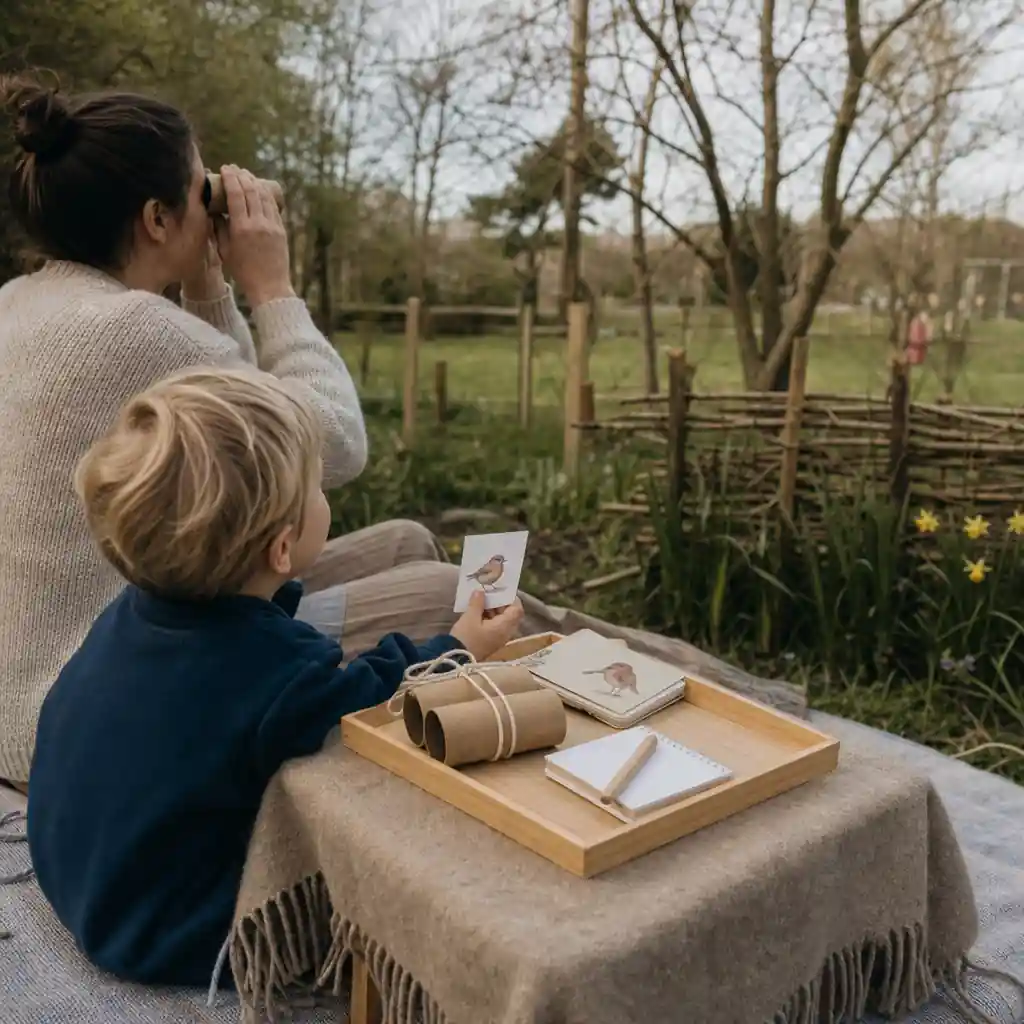
Choose a quiet edge of the garden or park and define it with a soft, neutral wool blanket; nearby branches or a low fence act as natural boundaries. The materials are arranged on a small wooden tray: one or two paired cardboard tubes tied with cotton twine as “binoculars,” a set of simple paper picture cards or a slim bird book, and a small recycled-paper notebook with a wooden pencil or beeswax crayon. Only these items are provided to keep the space uncluttered and the focus on calm, sustained looking.
The adult demonstrates slow, steady gazing by lifting the tube to the eyes and tracing a line from ground to branches without commentary, then rests and looks again. The child chooses where to sit or stand, returns to the same spot as wished, compares size, colour, beaks, and perching or feeding places, and quietly matches a card or book image, making a simple mark if desired. The adult observes, offers a quiet word only for safety or gentle naming, and keeps a predictable rhythm of watch, pause, and tidy.