Nature colour hunt using an egg carton with colour dots for collecting found items
Colours
Children venture outdoors with a compact sorting container that invites them to notice and compare the colours they discover in nature. The experience blends open-ended collecting with reflective pauses, prompting subtle conversations about shade, texture, and where hues appear across the landscape. Adults watch for emerging strategies and gently shape language without directing the hunt.
Children explore an outdoor area to look for natural items that match colours shown inside an egg carton. The carton acts as a simple collecting and sorting tray that can be carried and revisited. The experience supports careful looking, comparing, and talking about colour in the real world. It can be repeated across seasons to notice change in what is available.
Step-by-Step Guidance
1. Choose an outdoor area with natural loose parts available (e.g., leaves, petals, small stones, seed pods). Do a quick scan for hazards and remove sharp litter.
2. Prepare the egg carton by placing one coloured dot in each cup. Keep the number of colours low for younger children.
3. Introduce the carton as a place to collect “matching colours” from nature. Show one cup and point to the dot so children understand the matching idea.
4. Offer the carton to the child or small group and agree simple boundaries for where they can search.
5. Allow children to move and choose what to collect. Stay close enough to support safety and to notice how they are matching.
6. When a child selects an item, pause with them to compare it to the dot. Use simple language such as naming the colour and one extra descriptor (light/dark, smooth/rough).
7. If a colour is difficult to find, acknowledge it and invite children to decide what to do (keep looking, choose a similar shade, or leave that cup empty).
8. Periodically stop in a shared spot to look at the carton together. Encourage children to notice similarities and differences across sections.
9. Close the activity by returning items to nature where appropriate, or by placing them in a designated spot if your setting keeps found items for short-term investigation.
10. Store the carton for reuse, or refresh the dots for a new hunt on another day.
Learning Objectives
Children may develop colour recognition and visual discrimination as they compare found items to colour prompts (Expressive Arts and Design). They may build vocabulary for describing what they notice, including colour words and simple descriptive language (Communication and Language). Children may also practise sustained attention and self-chosen problem-solving as they decide what to collect and where to look (Characteristics of Effective Learning).
Adult Role
Stay emotionally attuned by following children’s pace and interest, and by noticing when a child feels stuck or rushed. Model calm, specific language for colour and comparison, adding one new word at a time and repeating it naturally. Scaffold lightly by offering a single prompt (e.g., “Which cup looks closest?”) and step back when children are independently checking and sorting. Observe how children make decisions about “matching” and whether they seek adult confirmation or trust their own judgement. Hold responsibility for safe boundaries, checking items before they go into the carton, and intervening promptly if children pick unsafe objects or move into unsafe areas.
Observation Cues
Looks closely at an item and checks it against a colour dot before placing it in a section.
Uses colour words spontaneously or repeats adult-modelled colour language.
Changes strategy when a colour is hard to find (moves area, looks up/down, checks different surfaces).
Sorts by shade or makes a “close enough” decision and explains it with gestures or words.
Shows care with the carton and items, adjusting grip or pace to avoid dropping.
Returns to a previously filled section to compare items or swap choices.
Time & Space
10–25 minutes, depending on area size and number of colours.
Outdoor space with natural loose parts available, such as a garden, playground edge, woodland area, or park. A small base spot for regrouping and looking at collections together.
Materials
Safety
Age adaptations
Budding Adventurers
Use 6–8 colours and include one “wild card” cup with no dot for items children want to collect that do not match. Encourage children to carry the carton and choose their own search route within clear boundaries. The adult models simple comparison language (same, different, lighter, darker) and supports children to decide whether a near match is acceptable.
Curious Investigators
Use 10–12 colours, including two similar shades (e.g., light green and dark green) to invite closer looking. Add a simple rule children can choose to adopt, such as one item per cup or multiple items per cup, and let them explain their choice. The adult prompts children to justify matches using observable features and notices emerging strategies such as scanning patterns or grouping by habitat area.
Confident Discoverers
Use a full carton with a mix of primary, secondary, and neutral colours, and include one cup labelled “pattern” for speckled or striped finds. Invite children to create their own colour dots for a second round, choosing which colours are “easy” or “tricky” in the current season. The adult supports children to compare shades more precisely, to negotiate sharing in a group, and to reflect on which areas produced certain colours.
EYFS Links
Communication and Language: Children may use and extend vocabulary as they name colours, describe items, and listen to adult modelling of comparison words.
Expressive Arts and Design: Children may explore colour in the natural world and notice variation in shade and tone, linking what they see to colour prompts.
Physical Development: Children may practise coordination as they carry the carton, pick up items carefully, and place them into small spaces.
Understanding the World: Children may notice features of the outdoor environment and begin to connect where items are found with what they look like.
Characteristics of Effective Learning: Children may show active learning by persisting with hard-to-find colours and by adapting their search strategies.
Ethos adaptations
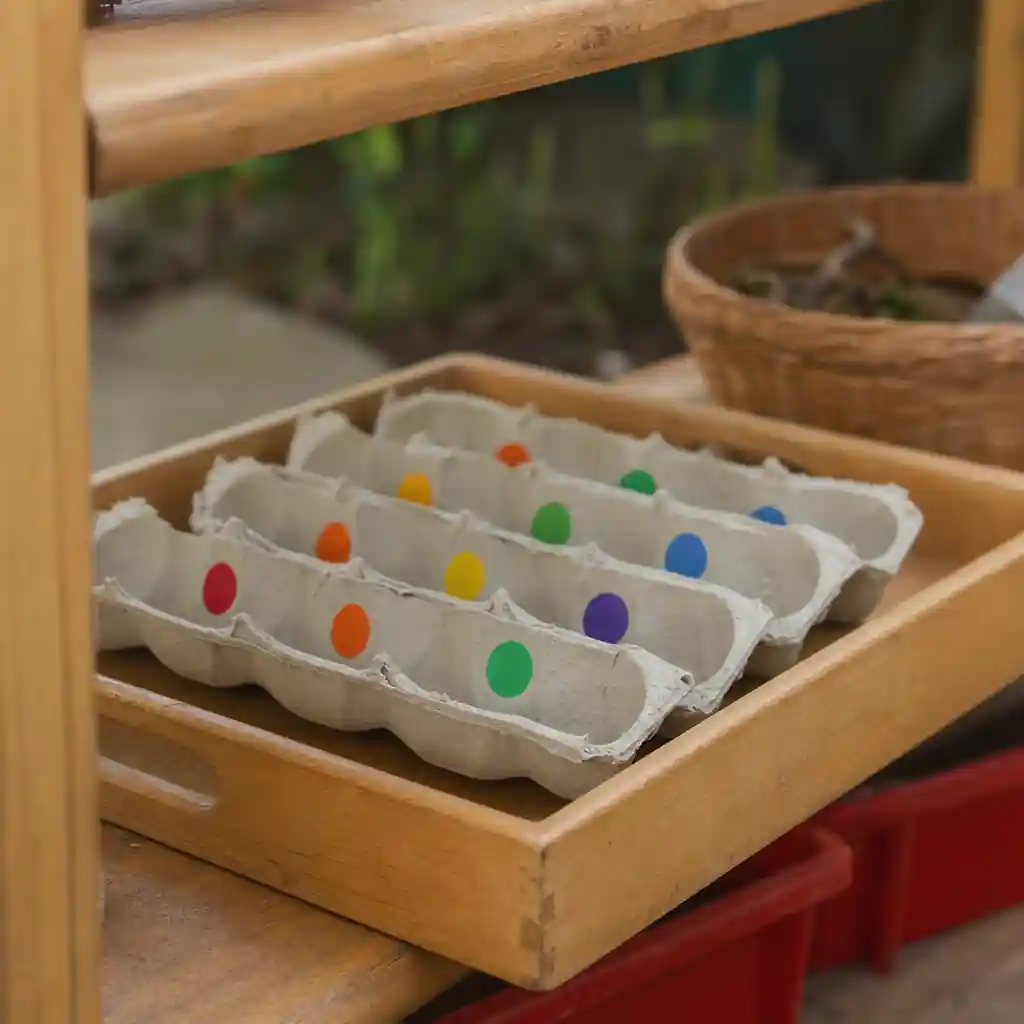
Prepare one small egg carton per child with 6 clear, contrasting colour dots placed inside each cup in a simple left-to-right order. Remove the lid and any extra tools; keep only the carton, and an optional shallow basket for oversized finds. Place cartons on a low shelf or tray so children can take and return them independently. Define a small search area outdoors to reduce overwhelm. The dot inside each cup acts as control of error—items that don’t match are visibly different.
Give a brief, slow demonstration: pick up the carton, find one natural item, hold it against a dot to compare, decide, then place it in the matching cup and return the carton to the tray. Step back and limit language to safety or end signals; avoid naming colours or directing where to look. Observe repetition, careful placing, and self-correction when a shade doesn’t fit. Note any use of colour words, where children choose to search, persistence with tricky colours, and seasonal links they notice.
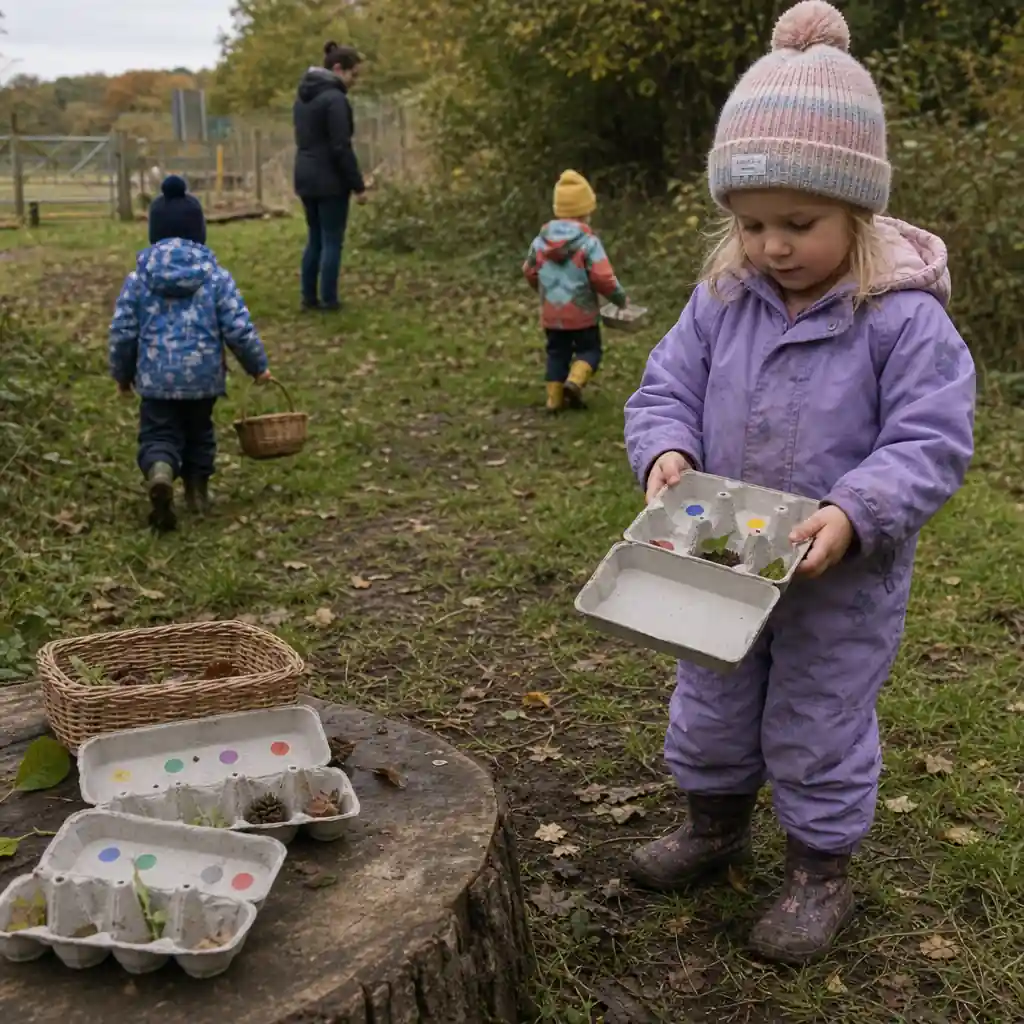
In a defined outdoor area with mixed surfaces, grass, and shrubs, materials are set on a log or flat stump: each child or pair takes a cardboard egg carton with colour dots inside and, if needed, a shallow basket for larger finds. Children range within agreed boundaries to collect fallen natural items only, comparing shades to the dots and deciding where to place them. They may revisit patches, swap items between cups, and return to the base to sort on the stump, with weather-appropriate clothing for varied conditions.
The adult observes from nearby, checks the boundary and ground conditions, and steps in only for safety or to hold space for turn-taking. Prompts are brief and responsive: naming or echoing colour words, offering single descriptors like “lighter/darker,” or wondering “Where might you look next?” Children choose routes, negotiate close matches, test items in different light, and decide when their carton feels “complete,” carrying and handling finds carefully on uneven terrain with the adult monitoring risk calmly.
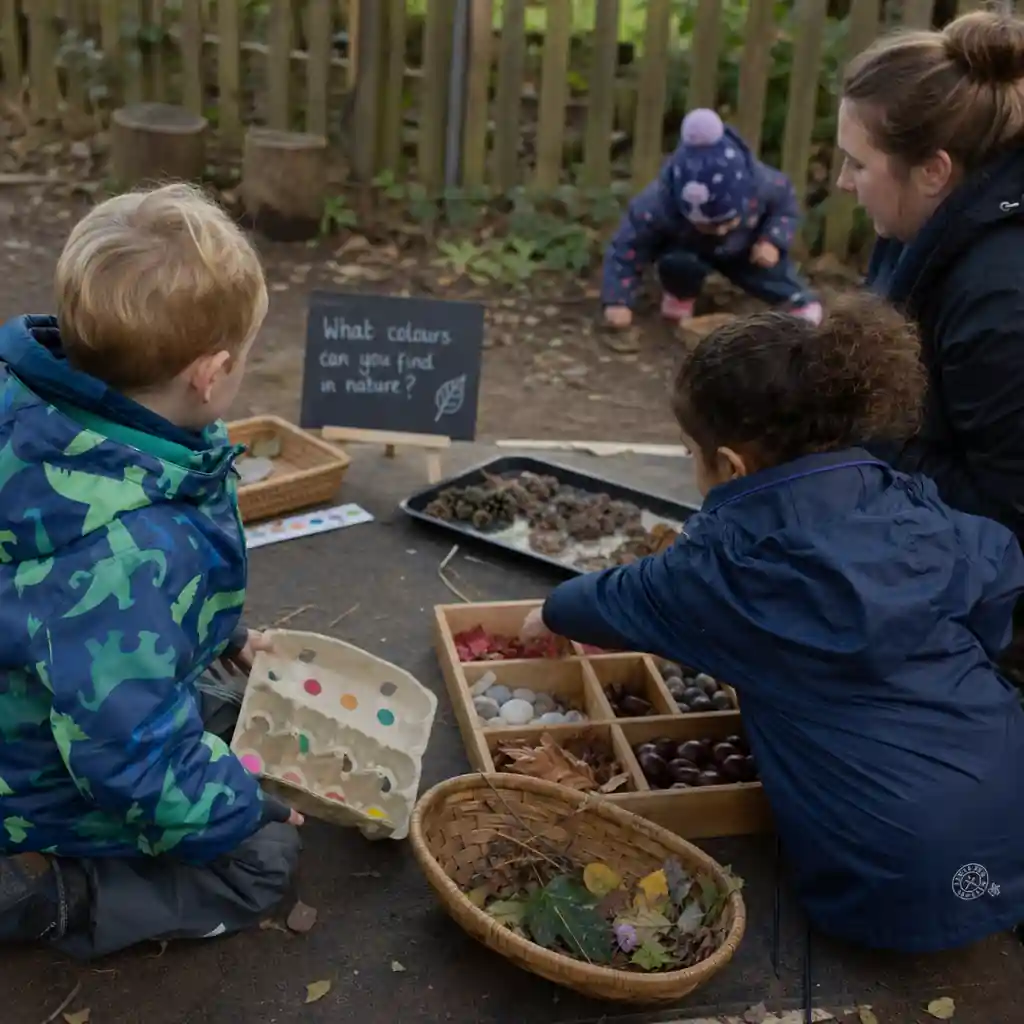
Arrange a low, accessible base-station outdoors where several egg cartons, a shallow basket, trays of loose natural loose parts (stones, leaves, petals, bark strips) and a few colour-dot cartons sit openly for the children to choose. Materials are grouped so children can move between picking, comparing and storing without adult handing-out; cartons are presented as one of many collecting options and larger finds can be left in the shared tray. Weather clothing and clear sightlines are kept for safety while preserving freedom of movement.
The adult adopts an observing, co-researcher stance: stay nearby, narrate observations and extend thinking with phrases such as "I can see a lot of red here" or "You’re trying different leaves against that dot — what happens if you turn it?" The child may shift focus, invent matching systems, abandon and return to searches, or combine items by shade rather than strict colour. Observation cues are embedded as moments to note: sustained searching, comparisons between tones, use of language for description, and emerging problem-solving when an exact match isn’t found.
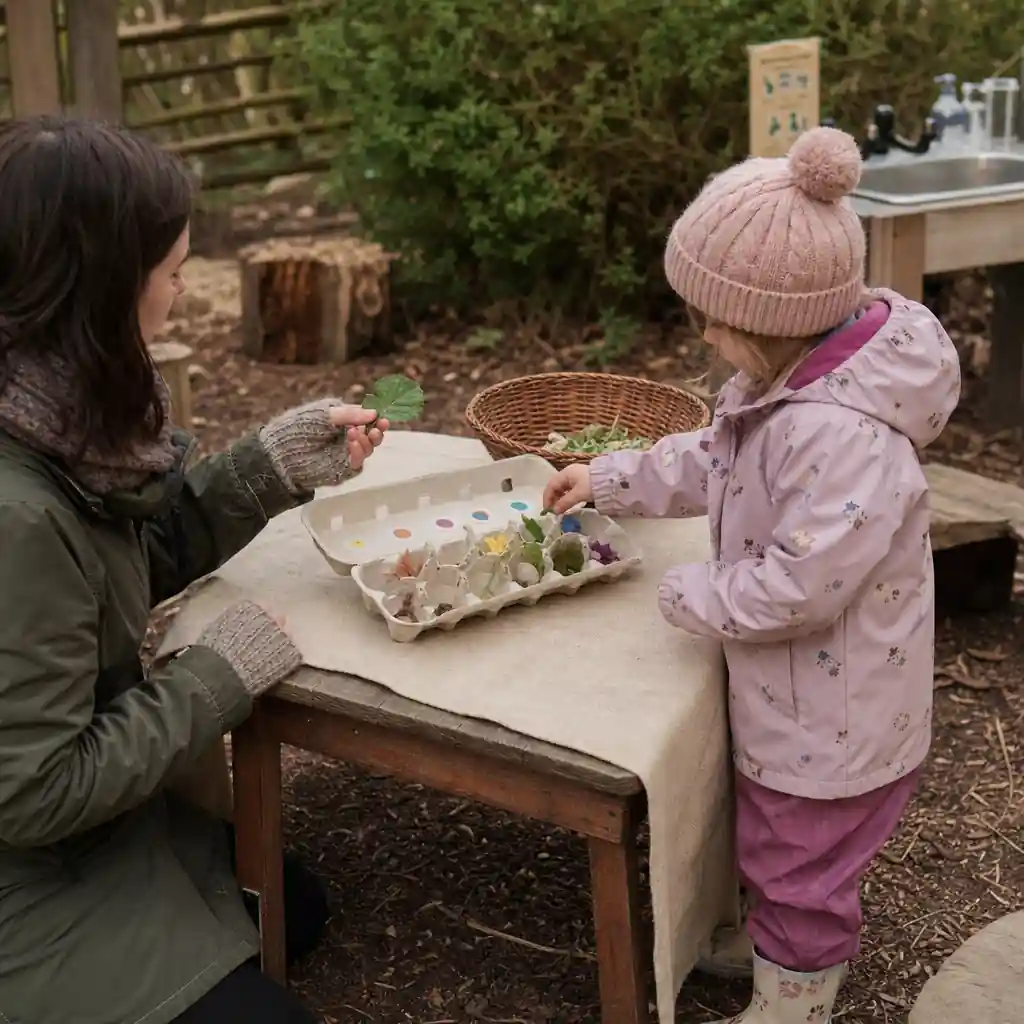
A quiet patch of the outdoor area is defined with a neutral cotton cloth on the ground or a low wooden table. On it sits one plain cardboard egg carton with a lid; inside each cup is a small hand-painted watercolour swatch in muted tones (or a tuft of naturally dyed wool) to act as the colour prompts. A simple willow basket is available for items too large for the cups. Only these materials are presented, with weather gear and handwashing nearby but set to the side.
The adult demonstrates slow looking by matching one found leaf to a swatch, using minimal words such as “deep green” or “paler brown,” then steps back to observe. The child moves freely between searching and returning to the cloth to place, compare, and reconsider items, repeating as wished. The adult maintains a calm pace, ensures safe foraging, and quietly models care for living plants. A simple rhythm is kept: open the carton, explore, return and sort, then close and carry; there is no fixed target for how many cups are filled.