Creating a rainbow collage with tissue paper and textured coloured materials
Colours
Sensory Play
Children sit at a table with an adult nearby, using tissue paper, felt scraps and corrugated card to explore colour order, texture and pattern on a large sheet of card. The adult places glue sticks and small pots of PVA within reach and names colours and textures as children choose, tear and press pieces into place. Children may focus on repeating one colour, filling gaps, or making stripes, and the adult watches for persistence, repositioning and emerging talk about rain and sunshine.
Children explore colour, pattern and texture by arranging and attaching coloured materials to create a rainbow-style collage. The experience can stay open-ended, with children choosing whether to follow a familiar rainbow order or invent their own sequences. As children handle, tear, scrunch and place materials, they may notice differences in feel, thickness and how colours sit next to each other. Adults can introduce simple, accurate language about how rainbows appear, linked to light and water droplets.
Step-by-Step Guidance
1. Prepare a clear table space and cover it if needed for easy clean-up. Place the base paper flat and secure it with small pieces of masking tape if it slides.
2. Arrange materials in shallow trays by colour, keeping the selection manageable and visible. Include both tissue paper and a few textured options for each colour where possible.
3. Decide how much structure to offer: leave the paper blank for open exploration, or draw a light arc guide to suggest a rainbow shape without fixing the outcome.
4. Introduce the materials briefly by naming a few textures and showing where glue is placed. Keep the introduction short so children can begin choosing.
5. Offer glue in a way children can manage (glue sticks for drier sticking; small pots of PVA for thicker materials). Place a small cloth or wipes nearby for sticky fingers.
6. As children work, support colour and pattern noticing with simple commentary, such as naming colours placed together or describing a repeated sequence.
7. If children show interest, introduce a simple explanation of how rainbows appear: sunlight and rain together can make colours show in the sky.
8. Allow children to continue, pause, or return to the collage. Offer extra paper for children who want to start again or make a different version.
9. Close with a calm tidy routine: children place leftover pieces back into colour trays, close glue, and choose where the collage can dry safely.
Learning Objectives
Children explore Expressive Arts and Design by selecting and combining materials to represent ideas through collage. Children develop Communication and Language as they hear and use words for colour, texture and pattern in a meaningful context. Children build Physical Development through controlled hand movements such as tearing, pinching, placing and smoothing materials.
Adult Role
Stay emotionally attuned by noticing when children feel frustrated by tearing, sticking, or waiting for a turn, and offer calm reassurance and practical help without taking over. Model language that fits what children are doing, naming colours, textures and patterns as they appear, and adding a simple, accurate explanation of rainbows only when it connects to the child’s focus. Scaffold only at the point of need, such as showing one slow tear, offering a smaller piece, or stabilising the paper, and step back when the child is absorbed or repeating a method. Observe how children choose materials, whether they follow a colour order, and how they solve problems like filling gaps or making pieces stick, and use this to decide whether to simplify materials or extend choices. Maintain safety by supervising glue use, keeping small pieces age-appropriate, and managing shared space so children can reach materials without crowding.
Observation Cues
Chooses colours with intent, such as repeating a favourite colour or matching to a remembered rainbow order.
Uses hands in different ways (tear, scrunch, smooth, pinch) and adjusts grip when materials resist.
Notices and comments on texture differences, such as rough/smooth, bumpy/soft, thin/thick.
Creates a pattern (stripes, blocks, repeating sequence) and returns to it after a pause.
Persists with sticking or positioning, including repositioning pieces to fit a space.
Links the collage to real-world experiences, such as rain, sun, or seeing a rainbow outside.
Time & Space
15–40 minutes, depending on age, group size, and whether children return to add more later.
Table space for trays and a flat drying area; floor space can work for larger collaborative collages.
Materials
Safety
Age adaptations
Budding Adventurers
Offer the full set of rainbow colours with a small number of textured options per colour, and include both pre-cut pieces and a small pile of larger tissue for tearing and scrunching. Provide a choice of glue stick or a small pot of PVA with a spreader, and a defined space on the table for each child’s work. Children may begin to create bands or sequences, or may prefer blocks and patches; accept both and reflect what you see in their patterns. The adult supports turn-taking at the colour trays and notices when a child is trying to match a remembered rainbow order, offering vocabulary like “stripe”, “next to”, “same”, and “different”.
Curious Investigators
Add an optional reference image of a rainbow placed nearby (not on the table) so children can choose whether to use it. Include a wider range of textures (e.g. corrugated card, cellophane, ribbon, fabric) and invite children to compare how each material changes the look of a colour. Offer a larger base sheet so children can plan bigger arcs, add repeated patterns within a band, or create multiple rainbows. The adult introduces a simple cause explanation when relevant, linking rain and sunlight to seeing colours, and observes how children explain their choices, negotiate shared materials, and revise their design.
Confident Discoverers
Provide two base options: a blank sheet for self-designed layout and a lightly marked arc guide for children who want structure. Add tools that increase precision, such as child-safe scissors for cutting tissue and fabric scraps, and small glue brushes for controlled application. Invite children to create deliberate patterns (e.g. repeating textures within one colour band) or to experiment with invented rainbow orders and explain their reasoning. The adult supports sustained planning by offering space to sort materials, and listens for children’s theories about how rainbows form, responding with clear, simple facts and open prompts that keep ownership with the child.
EYFS Links
Expressive Arts and Design: Children explore colour, texture and pattern as they select, combine and arrange materials to represent an idea in their own way. Communication and Language: Adults model and extend vocabulary for colours, textures, positions and sequences, and children may share choices and explanations as they work. Physical Development: Collage actions such as tearing, pinching, placing, smoothing and using glue tools build hand strength and control in a purposeful context. Understanding the World: Simple discussion about sunlight and rain can connect the collage to real weather experiences and children’s observations of the sky.
Ethos adaptations

Place a single large paper with a faint arc drawn on the work surface and offer one shallow tray holding a limited set of pre-cut tissue squares (one colour group per compartment) and a small separate pile of larger pieces for tearing. Provide only one glue pot and one short brush per child, and reduce textured scraps to a few clearly different types arranged left-to-right by colour. This ordered, simplified layout isolates the skills of selecting, tearing and gluing and makes the sequence and material choices obvious and reachable.
Demonstrate the full sequence once: choose a colour, tear or take a piece, place it on the arc and put the brush back, using only slow actions and two short phrases for safety. Then step back and speak minimally, intervening only for safety or sustained frustration. Observe for steady hand placement, repetition and persistence, control in tearing and smoothing, and whether the child follows or varies the colour sequence, noting moments of concentration and self-correction.

In an outdoor or nature-integrated space, lay the large sheet of paper or card on a low log, picnic table, or on the ground with a waterproof mat underneath; uneven grass, leaf litter and a sheltered spot add sensory variety. Materials such as fallen leaves, petals, strips of bark, feathers, grasses and pieces of fabric or cellophane are provided in trays alongside some tissue paper and felt scraps so children can compare natural and made textures. Materials are arranged openly for choice rather than pre-fixed patterns.
The adult observes from nearby, checking anchors and hygiene, naming colours and textures only when children ask or show interest, and offering one-word prompts or short questions to extend thinking. Children choose where to sit, collect and combine items, tear and press materials, and may revisit sections or change sequences; the adult steps in briefly to model safe use of glue tools and then returns to a quiet observer role, responding to requests and managing any small risks.

Lay out a low table or floor mat with the large paper fixed lightly so children can return and change work; arrange shallow trays of mixed-sized tissue sheets, whole sheets to tear, fabric offcuts, cellophane, ribbons and textured offcuts grouped by colour but reachable from all sides. Remove single-use kits and the pre-drawn arc as a requirement; instead provide an optional faint arc or loose string for reference. Keep glue pots and spreaders accessible but supervised so choice and physical manipulation remain open-ended and exploratory.
The adult steps back as observer and co-researcher, offering short commentaries such as, "I can see you testing the thin tissue beside the foam," or "You’re trying to make a change in colour there" and questions like, "What happens if you layer the cellophane over fabric?" The child may choose colour order, tear sizes, layering or collage abandonment and return; the adult notices hand control, pattern-making, language used for texture and sequence, and documents moments of problem-solving and shared negotiation as part of the activity flow.
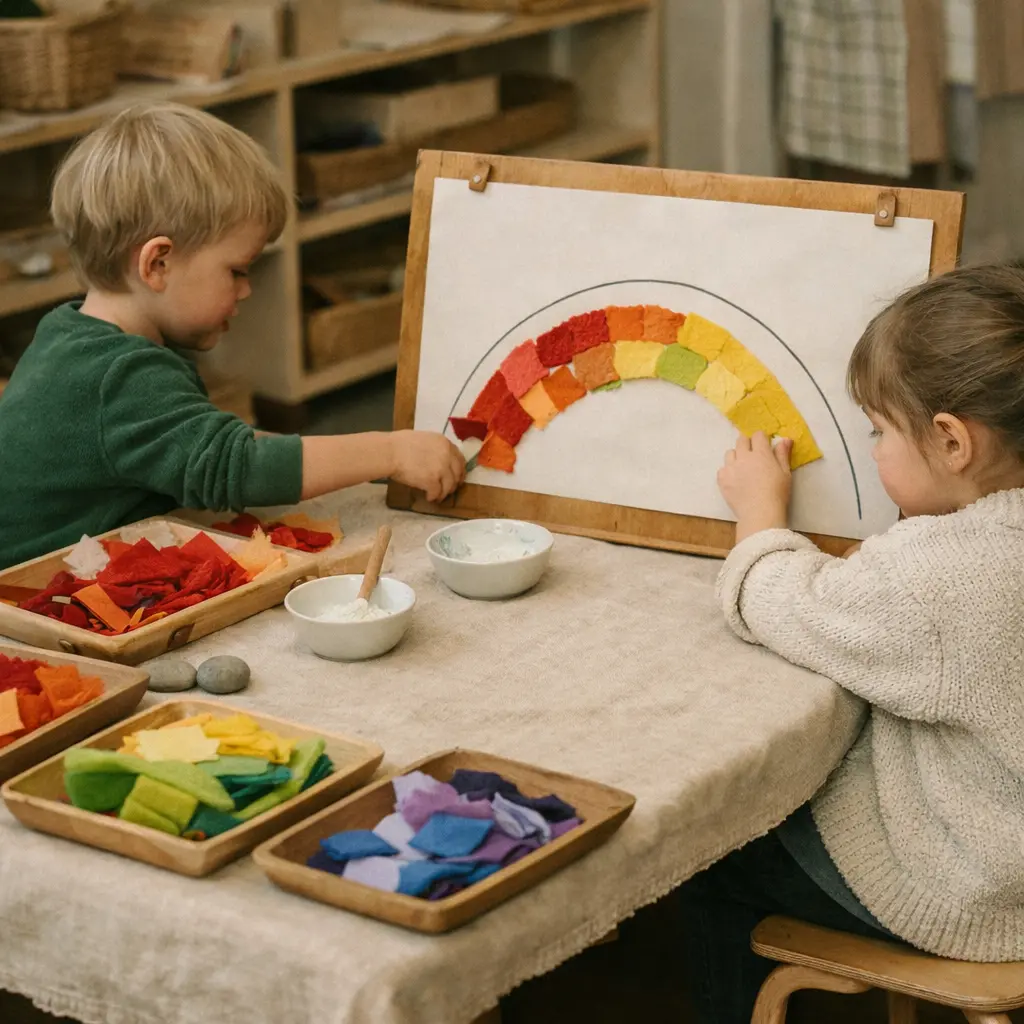
A quiet table is cleared and covered with a neutral cotton cloth; a large sheet of heavyweight recycled paper is clipped on a wooden board to define the workspace. Only a small selection is set out in shallow wooden trays: wool felt pieces, cotton and silk fabric offcuts in soft rainbow hues, textured handmade paper and corrugated card, plus small smooth pebbles or shells as optional weights. Starch paste is offered in small ceramic bowls with short wooden spreaders or natural-bristle brushes.
The adult demonstrates quietly how to dab a little paste, tear a soft edge, and press pieces with a flat palm, then steps back to watch. Words for colour, texture and pattern are offered sparingly in response to the child’s actions; brief, accurate links to sun, rain and light are made only when the child shows interest. The child chooses an arc or their own sequence, returning to tearing, pinching, placing and smoothing at their pace; repetition is welcomed, with pauses for calm tidying when finished.