Multi-sensory mini beast investigation with toy insects set in jelly on a messy tray
Sensory Play
Firm jelly embedded with brightly coloured plastic mini beasts creates a cool, wobbly sensory provocation that invites tactile exploration and early classification. The experience highlights texture language, fine-motor coordination and careful adult observation while keeping the exact presentation method undisclosed.
Children explore toy mini beasts embedded in jelly as a tactile, slippery investigation. The changing texture can invite careful touch, squeezing, poking and pulling, with lots of opportunities to notice and describe what they feel. The activity often supports curiosity about small creatures and encourages children to compare, sort and revisit ideas in their own time.
Step-by-Step Guidance
1. Prepare the environment: place the messy tray on a wipeable floor area, add a mat underneath, and set out a clear wiping/hand-cleaning station nearby.
2. Prepare the jelly: set jelly firmly in a shallow layer so it holds shape when pressed. Embed the toy mini beasts at different depths so some are visible and some partly hidden.
3. Present materials simply: place the jelly in the tray, add 2–3 tools in a small pot, and put a few empty bowls to one side for any retrieved mini beasts. Keep extra tools out of sight to reduce clutter.
4. Invite exploration: bring children to the tray in small numbers. Offer a choice to touch with fingers, use a tool, or start by looking only.
5. Support sensory entry: if a child hesitates, model a small action such as a fingertip press on the edge, or offer a tool as a bridge. Respect refusals and offer wipes without comment.
6. Encourage noticing and language: name what is observable and felt (wobbly, slippery, cold, stuck). Use short phrases and pause so children can add their own words or gestures.
7. Follow children’s investigations: some may focus on freeing mini beasts, others on squashing jelly, cutting lines, or filling bowls. Keep the play open and respond to their chosen focus.
8. Add gentle prompts when useful: suggest comparing two mini beasts (legs, wings), counting legs, or sorting into bowls. Avoid turning it into a test; keep prompts optional.
9. Manage transitions: when interest dips, offer a clear endpoint such as placing found mini beasts into a “safe dish” and wiping hands. Keep a lidded container ready for jelly disposal.
10. Close and reset: remove jelly, wash toys and tools, wipe the tray, and note any new vocabulary, sensory preferences, or problem-solving approaches observed.
Learning Objectives
Children may build sensory awareness by noticing and describing texture, temperature and resistance through hands and tools (EYFS: Physical Development). Children may extend vocabulary linked to mini beasts and descriptive language such as slippery, wobbly, smooth and sticky (EYFS: Communication and Language). Children may practise early scientific thinking by observing changes, making comparisons and sharing simple ideas about what they notice (EYFS: Understanding the World).
Adult Role
Stay emotionally attuned to children’s sensory comfort. Notice signs of delight, uncertainty or disgust, and offer choices such as tools, a smaller jelly piece, or watching from a distance without pressure. Model calm, descriptive language that matches what children can see and feel, using simple words and repeating key vocabulary without correcting.
Step in to scaffold when a child is stuck or frustrated, for example by offering a different tool or showing a slower, gentler pull. Step back when children are absorbed, repeating their words and allowing long pauses. Observe closely for how children approach texture, how they communicate needs, and how they persist or change strategy. Maintain safety by supervising tool use, checking that mini beasts are large enough, and managing hygiene and clean-up routines.
Observation Cues
Reaches in with fingertips or whole hand, pauses, withdraws, returns, or changes approach when the texture shifts. Uses or repeats descriptive words (e.g., slippery, cold, wobbly) or gestures to communicate sensations. Attempts different ways to free a mini beast (pulling, scooping, scraping) and adjusts effort when it resists. Sorts or groups mini beasts by visible features (legs, wings, size) or by how easy they are to retrieve. Watches others closely, imitates tool use, or offers a found mini beast to an adult or peer. Shows self-regulation signals such as asking for wiping, avoiding certain textures, or persisting for longer periods over repeated sessions.
Time & Space
15–35 minutes, plus preparation and clean-up time.
Indoor or sheltered outdoor area with a wipeable floor surface; space for a messy tray, a hand-wiping station, and a nearby table or shelf for tools and bowls.
Materials
Safety
Age adaptations
Budding Adventurers
Increase variety of mini beasts and include a couple partly hidden to invite searching. Add two tool choices (scoop and blunt tweezers) and a few sorting dishes. Adult supports simple comparisons (same/different, more/less jelly) and helps children manage frustration by naming feelings and offering a new strategy rather than taking over.
Curious Investigators
Embed mini beasts at varied depths and include a small set of picture cards for matching or naming. Offer a wider tool set (spatula, tweezers, spoon) and encourage children to decide which tool suits which problem. Adult prompts observation questions without demanding answers, and notes children’s explanations about why some mini beasts are harder to free.
Confident Discoverers
Add a simple sorting challenge option such as grouping by number of legs, wings/no wings, or habitat (garden/pond) using labelled bowls or drawn symbols. Provide a timer or sand timer for children who want to measure how long retrieval takes, without making it competitive. Adult supports richer vocabulary (squishy, firm, stretchy, slippery) and encourages children to record findings with quick drawings or marks if they choose.
EYFS Links
Communication and Language: Children may practise naming mini beasts and describing sensations, with adults modelling precise words and giving time for children to respond in speech, gesture or signs.
Physical Development: Handling slippery jelly can support hand strength, finger control and coordination, especially when children choose between hands and tools.
Understanding the World: Children may notice features of mini beasts (legs, wings, body parts) and begin to compare, sort and talk about living things, using toys as a safe starting point.
Personal, Social and Emotional Development: Children may manage strong sensory preferences, practise asking for help or wipes, and negotiate space and tools with peers with adult support.
Ethos adaptations

Set up each child’s workspace with a single low-sided tray containing one shallow block of firm jelly with three toy mini beasts embedded, one set of tools (spoon, scooping scoop or blunt tweezers) arranged left-to-right, and two small bowls for revealed creatures and waste. Remove extra tubs and the optional second bowl so the sequence of reach → reveal → sort is clear; place wipes and apron to the side. Use firm jelly and larger toys so the child can see when a creature is exposed, making over-scooping and misalignment visibly obvious for self-correction.
Show the full sequence once: point and move slowly as you lift a tool to reveal one beetle, place it in the bowl, then step back. After that, keep language minimal—short safety prompts only—and avoid questions or step-by-step direction. Observe and note hand control, choice of tool, steady repetition, signs of concentration or frustration, and whether the child adjusts pressure or technique after a visible mistake, using those observations to decide whether to offer a brief gesture or remove materials.
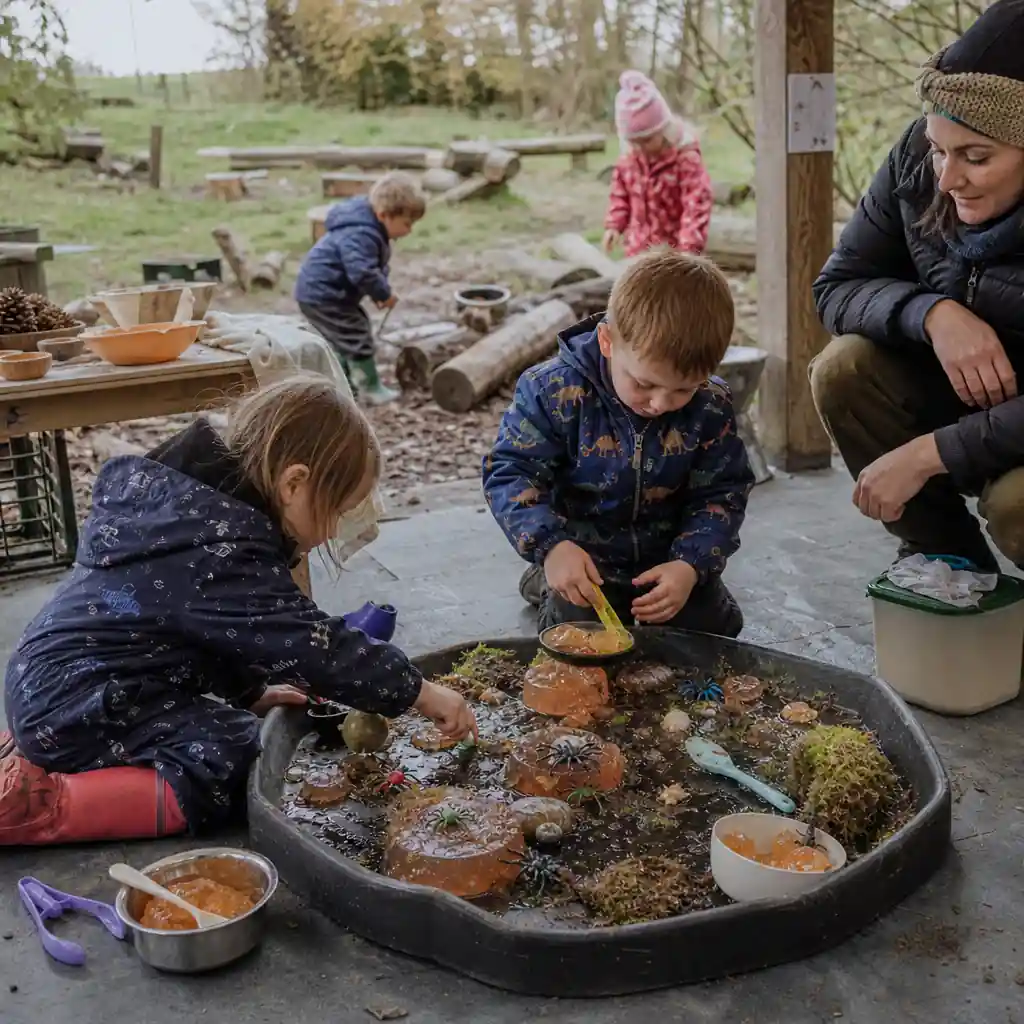
In an outdoor or nature-integrated space, the messy-tray investigation is moved to a sheltered garden patch, patio or grassy clearing with nearby logs and stones for varied textures and slight slopes. Materials such as plant-based jelly or agar set in shallow dishes, moss, soil, smooth stones, wooden beads, pinecone “mini-beasts” and large safe natural loose parts are provided in an open-ended way rather than pre-arranged, alongside simple tools and bowls for sorting. Materials are arranged to invite exploration, allow spills and natural variability.
The adult observes from a close, safe distance, supervising slippery surfaces and hygiene, offering wipes or apron when needed and intervening only to manage risk or check anchors. Children choose whether to use hands or tools, scoop, squeeze, poke and compare temperature and resistance, sort items into dishes, and repeat investigations at their own pace without a prescribed outcome. The adult offers minimal, responsive prompts and models careful handling before stepping back to listen and notice.
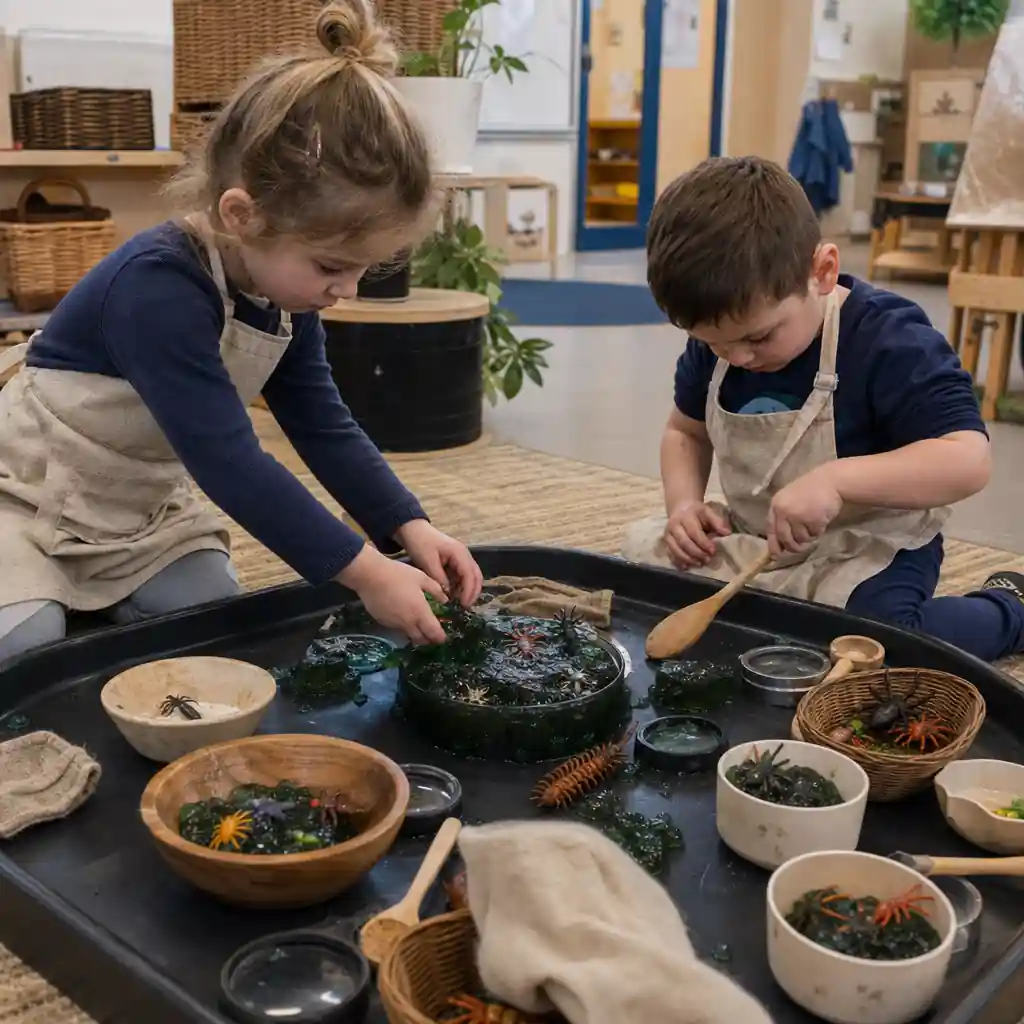
Ethos adaptation: Reconfigure the tray area so several shallow dishes and loose containers sit within reach on a low table or floor mat, spaced to invite solitary or shared exploration rather than a single prepared task. Replace fixed portions with a range of open, reusable loose parts: firm jelly in a communal bowl, separate small jelly chunks, natural scoops (wooden spoons, shells), fabric pieces, magnifying lenses and a few larger toy mini‑beasts; materials are visible and accessible so children choose, combine and change uses over time.
The adult withdraws from directing and stays nearby as observer and co‑researcher, offering commentary: "I can see the jelly stretches when you pull" or "You’re exploring how it slips between two spoons." The child may decide to bury, sort, count or compare textures, move between tools and hands, or pause and return later. The adult notices moments to document—repeated strategies, language used for texture, turn‑taking negotiations—and places simple photographic or written notes where they emerged, not as an added task.

A calm space is defined with a neutral cotton cloth on the floor and a low-sided wooden or enamel tray set at child height. A firm-set, fruit-juice jelly (gelatine or agar) is prepared in a shallow enamel dish for a cool, wobbly texture without added bright colours. Only a small number of items are provided: a few solid wooden mini‑beast figures (large enough for safe handling), a metal spoon, a small wooden scoop or tongs, and two or three stoneware or wooden bowls for sorting, plus cotton cloths for hands and a lidded glass jar for used jelly.
The adult demonstrates a slow press, scoop and release with minimal words, quietly naming one or two sensations and a creature. The adult then steps back, watching hand use, tool choice and shared space, intervening only for safety or to model steady movements. The child returns to squeezing, lifting and sorting figures and jelly pieces, noticing features and textures in their own time, repeating as needed, then placing tools and figures back in bowls and tipping used jelly into the jar.