Multi-sensory mini beast investigation with toy insects set in jelly on a messy tray
Sensory Play
Communication and Language
Children and adults share a messy-tray investigation where toy mini beasts sit within firm jelly and can be examined with magnifiers and child-safe tweezers. Children may focus on the jelly’s feel, the resistance around hidden objects, or the mini beasts’ features alongside simple picture cards. Adults stay close to manage comfort with mess and tool handling, noticing how children choose hands or tools and how their language changes around texture and movement.
Children explore toy mini beasts embedded in jelly as a tactile, slippery investigation. The experience invites noticing texture, temperature, resistance, and the way jelly changes when squeezed or pulled. Children may connect what they find to simple images of mini beasts and use tools in different ways to retrieve them. Adults can tune in to children’s sensory preferences and emerging vocabulary as the play unfolds.
Step-by-Step Guidance
1. Prepare the environment: Place the messy tray on a wipe-clean floor area or outdoors. Set out aprons and position the wash station within easy reach but slightly away from the tray to reduce slipping.
2. Prepare the jelly: Set jelly in a shallow container so it forms a thick layer. Before it fully sets, place toy mini beasts inside at different depths so some are partly visible and some are hidden.
3. Arrange materials: Turn the jelly out onto the tray or place the container in the tray. Put magnifying glasses and tweezers beside the tray. Place mini beast images around the edge where children can see them without them getting soaked.
4. Introduce the experience: Bring children to the tray in small numbers. Name the materials simply and allow children to choose whether to use hands or tools.
5. Support investigation: Stay close and describe what children are doing using texture and action words. Offer a magnifier when a child pauses to look closely, and offer tweezers when a child seems to want a different way to retrieve an item.
6. Link to images: When a mini beast is found, hold an image nearby for children to compare. Keep this optional and responsive, following the child’s interest rather than turning it into a quiz.
7. Manage comfort and transitions: Point out the wash station for children who want to clean hands, and support returning to play if they choose. Replace towels and refresh water as needed.
8. Close the activity: Give a clear, calm ending. Invite children to place tools in a designated spot and help wipe the tray edge. Dispose of jelly hygienically and clean the area thoroughly.
Learning Objectives
Children explore materials through touch and close looking, building curiosity about living things and their features (Understanding the World). Children may extend vocabulary linked to texture, action, and simple mini beast names (Communication and Language). Children can practise handling tools such as tweezers and magnifiers in ways that suit their current control (Physical Development).
Adult Role
Stay emotionally attuned to children’s responses to mess and texture, noticing who seeks strong sensory input and who needs distance or a tool. Model language in the moment by naming actions and sensations, and by offering simple mini beast names when children show interest. Scaffold lightly by placing a tool within reach or demonstrating a single grip, then step back so children can try their own methods. Observe patterns such as repeated squeezing, careful picking, or matching to images, and use these observations to decide whether to add words, pause, or reduce input. Maintain safety by supervising closely, checking items remain intact, and keeping the wash station and floor area managed to reduce slipping.
Observation Cues
Reaches for jelly with hands or avoids it; returns after watching others
Uses action words such as squeeze, pull, squash, slippery, wobbly, stuck
Shows sustained attention when searching for a hidden mini beast
Chooses a tool (tweezers, fingers, spoon) and adjusts grip or approach
Matches a found mini beast to an image, or compares features (legs, wings, spots)
Moves between messy tray and wash station to manage comfort with the texture
Time & Space
15–35 minutes, depending on group size and children’s tolerance for messy play.
Wipe-clean floor area indoors or an outdoor space with a stable surface for a messy tray. Space for a nearby wash station and a clear walkway to reduce slipping.
Materials
Safety
Age adaptations
Budding Adventurers
Embed a wider variety of mini beasts at mixed depths and include a magnifying glass for close looking at legs, wings, and patterns. Provide tweezers and a small dish for children who want to collect found items, keeping the focus on investigation rather than completing a set. Add more descriptive vocabulary (slippery, wobbly, stretchy) alongside mini beast names when children show interest. The adult notices when children switch strategies and reflects this back in simple language.
Curious Investigators
Add a larger set of mini beasts and a fuller ring of images around the tray so children can compare and sort by features they notice (many legs, wings, long body). Offer tweezers and magnifiers as standard, and include a second empty tray or plate for children who want to group their finds. The adult uses open prompts that stay grounded in observation, such as noticing where children look and what they compare, without turning it into a test. Support turn-taking around tools by providing duplicates or a clear place to return items.
Confident Discoverers
Embed mini beasts so some are fully hidden and require sustained searching, and provide multiple magnifiers and tweezers to support independent investigation. Add more detailed images (including simple labels) for children who want to identify and compare, and provide a wipeable board for children to place images next to found items. The adult extends language with feature words (antennae, segments, wings) when children are already focused on details, and steps back when children collaborate on strategies. Observe how children negotiate tool sharing and how they justify matches to images.
EYFS Links
Communication and Language: Adults model and repeat words for actions, textures, and mini beast names in response to what children are doing, supporting children to connect words with real sensory experiences. Physical Development: Handling jelly, grasping tweezers, and positioning a magnifier involve hand strength, coordination, and controlled movements at a level children choose. Understanding the World: Mini beast images and close observation invite children to notice features and similarities, building early interest in living things and how they can be identified. Personal, Social and Emotional Development: Children manage comfort with mess, choose tools or washing breaks, and may practise sharing resources such as magnifiers and tweezers with adult support.
Ethos adaptations
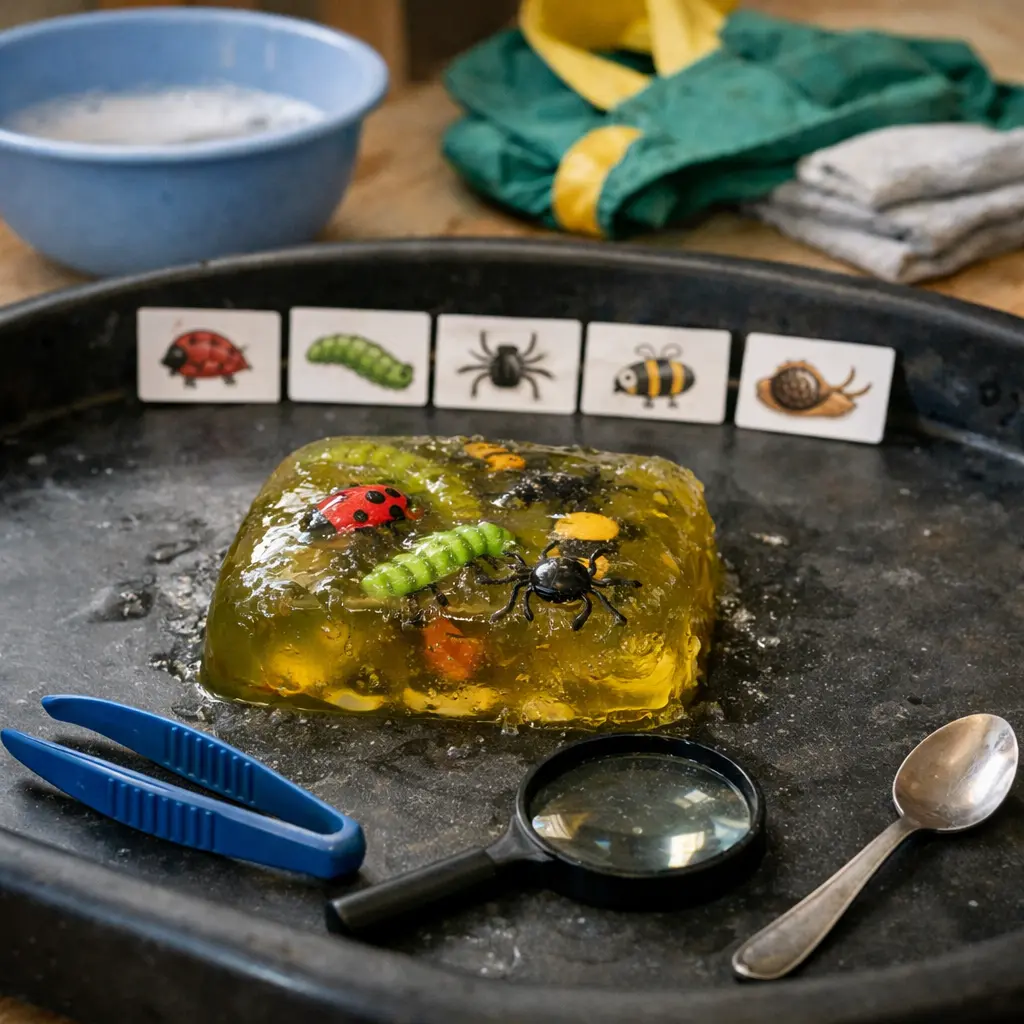
Place a single firm jelly block in the centre of a low tuff tray with 4–6 large toy mini beasts visible inside. Set only one pair of child-safe tweezers and one magnifier per child on the tray edge, arranged left to right in order of use. Lay out picture cards for the same mini beasts in a clear row above the jelly so children can self-check matches. Keep one spoon per child at the far edge for those who prefer it. Position aprons and the wash station within easy reach.
Give a slow, one-time demonstration with few words: touch the jelly, lift one mini beast with tweezers, place it beneath its matching picture, then rinse hands and return the tool. Step back and stay quiet unless needed for safety. Watch for how children choose touch or tools, grip and wrist control, matching by sight, repetition, and sustained focus. Notice spontaneous words for texture and names, and signs that a wash break supports continued exploration.

In an outdoor or nature-integrated space, set the messy tray on a low stable table on grass or on a sheltered bark/stone area so surfaces vary and natural scents are present. Materials such as a firm jelly block remain but are surrounded by leaves, soil clumps, sticks and stones; toy mini‑beasts are embedded at safe sizes alongside natural finds and simple photo cards are pegged to nearby branches. Materials are arranged openly so textures, temperatures and resistance mix with natural elements and can be revisited.
The adult observes from close enough to intervene, checking anchors and hygiene, then steps back to offer short responsive prompts or single-word labels when asked. Children choose whether to touch, use tweezers, spoons or magnifiers, experiment with pulling, squishing or digging out items, and may swap roles or tools; the adult models calm handling, offers brief safety checks, helps access the wash station when needed, and listens to extend language from what children notice.
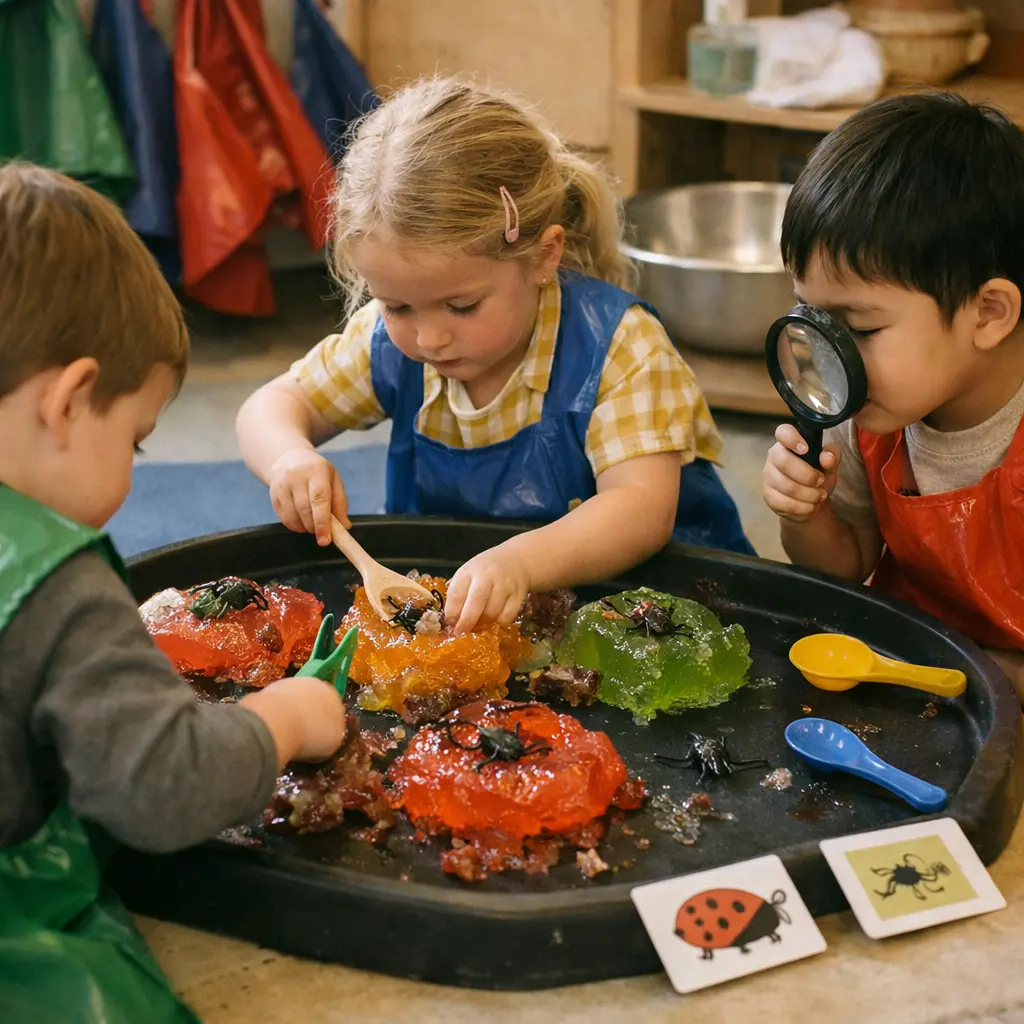
Ethos adaptation: Set a low tuff tray at floor level with several firm jelly mounds and a few already-broken, slippery sections, leaving clear empty spaces for regrouping finds. Place toy mini beasts within different depths and some on the surface. Arrange magnifiers, tweezers, spoons/scoops, and picture cards around the tray in reachable clusters, not assigned. Keep aprons visible for self-serve and a nearby wash station children can access independently. Materials stay open-ended: jelly to press, tear, slide, or relocate; tools chosen or hands used as preferred.
Adult adopts a watching, narrating stance: I can see that jelly wobbling as you pull; you’re trying to free this one; what happens if you look through the magnifier now? Follow the child’s route—matching to images, testing resistance, rescuing, or leaving creatures buried for later. Some may rinse fingers or tools then return, shaping tempo and comfort. The adult notices descriptive words, comparison to picture features, grip changes with tweezers or scoops, turn-taking around tools, persistence with tricky depths, and shifts in curiosity.
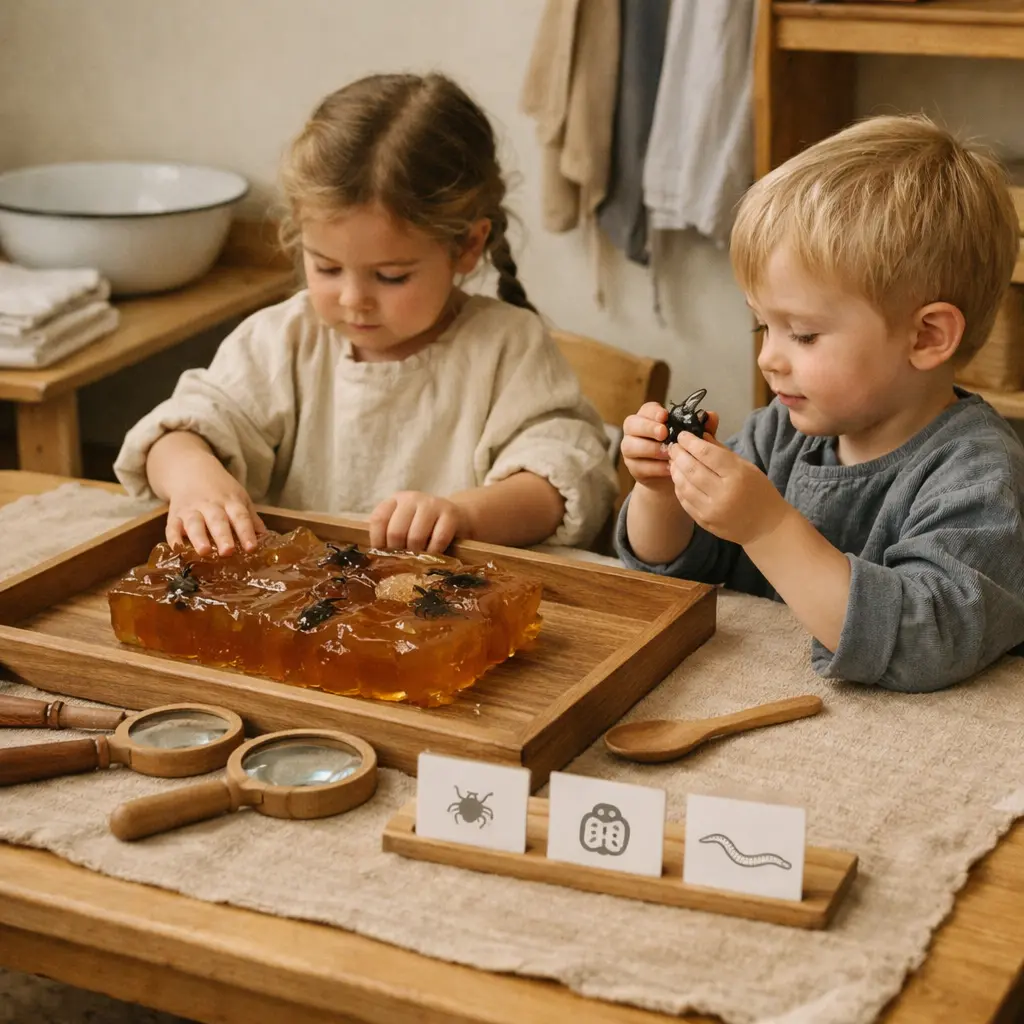
A quiet corner is defined with a neutral cotton cloth and a wooden tray to contain the activity; distractions are reduced. The materials are arranged simply: a firm block of naturally set fruit jelly in the tray; a small set of smooth carved wooden mini beasts; two wooden-handled glass magnifiers; one pair of blunt stainless-steel tweezers or bamboo tongs; two wooden spoons. Simple mini beast line drawings on card sit at the edge. An enamel bowl with warm water, mild soap, cotton towels, and cotton aprons stands nearby.
The adult demonstrates a slow press, scoop, and gentle lift from the jelly without giving steps, then rests alongside, attentive and quiet. Brief, responsive words name what is already happening (cool, wobbly, sticky, squeeze) and the mini beast noticed, with pauses left for the child. The child returns to touching, watching the jelly change, testing resistance, retrieving a figure, and comparing it with a drawing if interested. Tools are taken up or set aside as control allows. The rhythm is setup, unhurried exploration, and tidy.