Moving through an indoor obstacle course using pillows, tape lines, chairs and baskets (0–4 years)
Communication and Language
Mathematics
An adult smooths a strip of masking tape onto the floor, pressing down the corners with a palm. Two children hover at the edge of the zig-zag line; one child tiptoes along it with arms out, while the other steps off, backs up, and tries again more slowly. Near the chairs, a child lifts the blanket edge and crawls through, then sits up and pats the floor for the next child to follow. At the basket, a child gathers two rolled socks, throws one underarm, and pauses to look at where it landed before choosing a closer spot.
This indoor obstacle course offers children a flexible way to use their whole body in a familiar space using simple household items. Children can choose routes, repeat favourite sections, and adjust their speed as they move between crawling, balancing, stepping and throwing. The course can be changed in small ways across the week so children can revisit the same challenge with growing confidence and new ideas.
Step-by-Step Guidance
1. Choose a clear indoor space with a safe run-through route (living room, hallway, or a cleared playroom). Move breakables and create a clear boundary for where the course starts and ends.
2. Use masking tape to make a simple floor pathway. Include straight lines, gentle zig-zags, and a taped “parking spot” where children can pause before the next section.
3. Build a low “tunnel” by draping a blanket over two sturdy chairs. Keep the blanket high enough for crawling without snagging and leave the sides open so an adult can see through.
4. Place pillows or cushions as a “river” to step across. Space them so children can choose big steps or small steps, and leave a clear walk-around route.
5. Set up a throwing station using a laundry basket. Mark a standing line with tape and place a few soft throwers in a small pile beside it.
6. Walk the route once at a slow pace so children can see what is available. Use simple positional language (over, under, across, stop) and keep the demonstration brief.
7. Invite children to start where they want. Some will begin with the tape maze, others will go straight to the tunnel or basket.
8. Stay near the highest-risk point (often the chairs/tunnel or the cushion stepping). Offer a hand only when a child asks or looks unsure, then release support as soon as they steady themselves.
9. Keep the flow moving by offering turn cues at busy points (a “waiting spot” on tape, or one child in the tunnel at a time). Let children repeat sections as often as they choose.
10. Make small adjustments based on what you observe: move cushions closer for steadier stepping, widen the taped path for new walkers, or move the basket nearer/further to change the throwing challenge.
11. End with a calm reset: invite children to help peel up tape (if appropriate), stack cushions, and return throwers to the basket so the space feels ready for the next activity.
Learning Objectives
Physical Development: children may practise moving in different ways, including crawling, balancing, stepping, jumping and throwing, while noticing what their bodies need to do to stay steady. Communication and Language: children may use words, gestures or sounds to share plans, ask for help, and describe what they are doing. Personal, Social and Emotional Development: children may practise turn-taking, coping with small frustrations, and feeling proud of effort when a section feels tricky.
Adult Role
Stay emotionally attuned by noticing when a child is excited, hesitant, or frustrated, and respond with calm presence and a steady voice. Model simple, useful language in the moment, such as “under the blanket”, “one at a time”, “try again”, and “I’m here if you want a hand”, without turning the course into a test. Scaffold only when needed: offer a hand at the tunnel entrance, suggest slowing down on cushions, or reduce the distance to the basket, then step back so the child can take over. Observe how each child chooses risk and repetition, and use what you see to adjust spacing, waiting points, and the level of challenge. Hold responsibility for safety by checking chair stability, keeping the route clear, managing turn-taking at pinch points, and stopping the activity if children begin to crash into each other or use materials in unsafe ways.
Observation Cues
Does the child choose to crawl, step, jump or go around when they meet a barrier?
Do they adjust their body position to balance (arms out, slower steps, looking down then ahead)?
Do they repeat one section many times, changing speed or adding a new idea?
Do they use language or gesture to negotiate turns, ask for space, or invite someone to join?
Do they aim throws differently after a miss (closer, higher, two hands, underarm)?
Do they notice and talk about position and measure words such as over, under, through, next to, far, near, longer, shorter?
Time & Space
15–35 minutes, with the option to leave one section set up for short revisits.
A cleared indoor area with a continuous route (hallway, living room, or playroom), plus a visible adult supervision position near the tunnel/chairs.
Materials
Safety
Age adaptations
Budding Adventurers
Add a simple choice point: two taped routes leading to the same next section (zig-zag or straight). Space cushions so children can try a small jump or a long step, and place the basket at two distances marked with tape so children can choose “near” or “far”. The adult models one safe way to move through each section, then watches for children creating their own variations and supports with brief reminders like “feet on cushions” and “one throw at a time”.
Curious Investigators
Invite children to help design one section, such as deciding where the tape turns go or how many cushions make the river. Add a simple counting element at the throwing station (each child collects three throwers, then returns them to the pile), and include a balance challenge like heel-to-toe walking along a taped line. The adult listens to children’s plans, reflects their ideas back, and supports negotiation when children disagree about the route or rules.
Confident Discoverers
Offer a more complex tape maze with a clear start and finish and a “no stepping off the line” option for children who want it. Increase the challenge by widening cushion gaps slightly, adding a turn-and-throw sequence (move through tunnel then throw), or placing two baskets with different distances. The adult supports children to agree fair turn systems, encourages children to describe their strategy, and steps back to let them manage the course while staying close enough to intervene if speed and crowding increase risk.
EYFS Links
Physical Development: children can practise large movements (crawling, stepping, jumping, throwing) and begin to judge space, speed and balance as they move through different sections. Communication and Language: the course creates natural reasons to listen, respond, and use positional words such as under, over, through, next to, and stop, alongside simple negotiation language. Personal, Social and Emotional Development: children may practise waiting, taking turns, managing excitement, and returning to a tricky section after a wobble. Mathematics: taped lines, distances to the basket, and cushion spacing give real reasons to notice shape, route, counting small sets, and compare near/far or longer/shorter.
Ethos adaptations
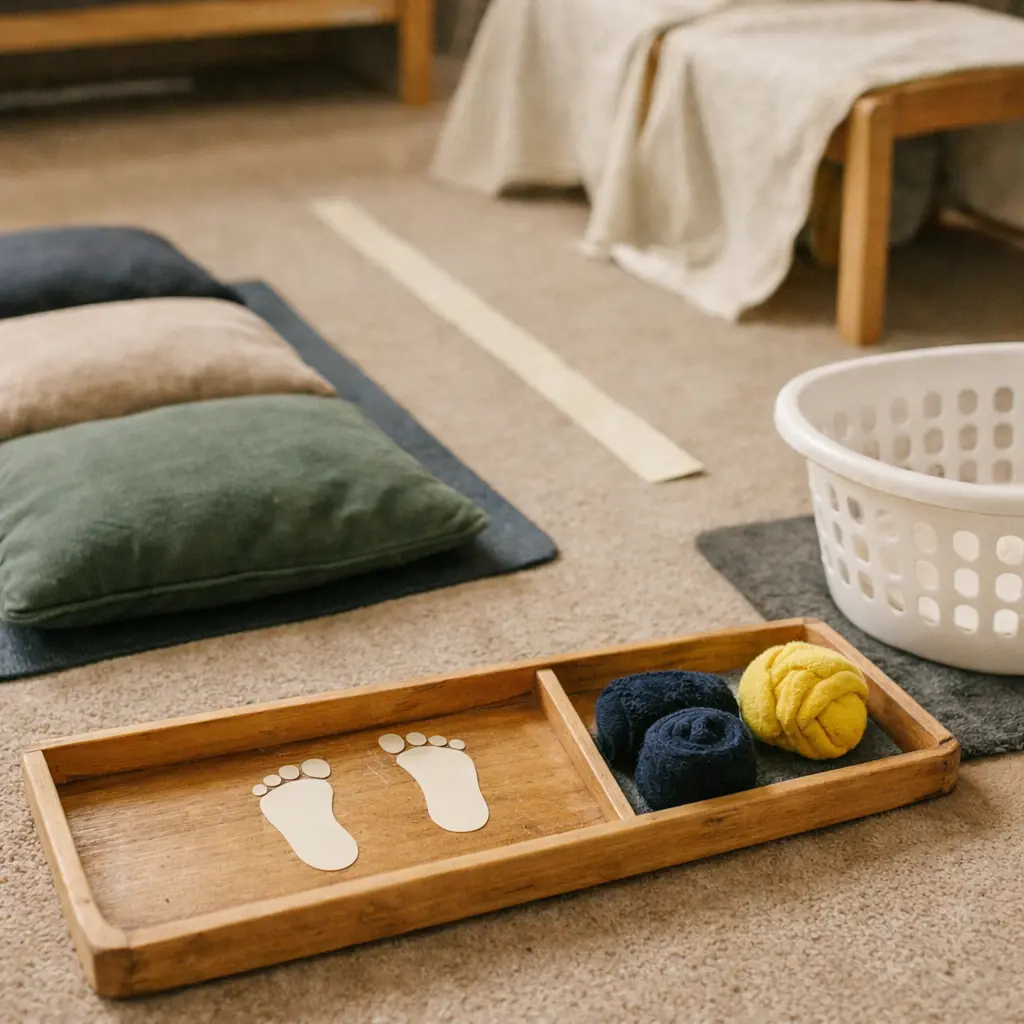
Set the course as a small number of clearly defined stations rather than a long route: one taped line to follow, one cushion “bridge”, one short chair tunnel, and one basket throw. Place each station on its own marked space with only the needed items, and keep extra cushions and throwers stored away so the choices stay clear and the movement focus stays narrow.
Demonstrate each station once with slow, precise movement and minimal words, then sit back so children can repeat without interruption. The adult decides to offer help only after a clear signal (reaching out, pausing and looking), and removes support as soon as the child steadies. The adult watches for repetition, careful foot placement, and self-correction such as stopping to reposition a cushion or stepping off and restarting, and quietly resets materials back to their marked place between turns to keep the control of error visible.
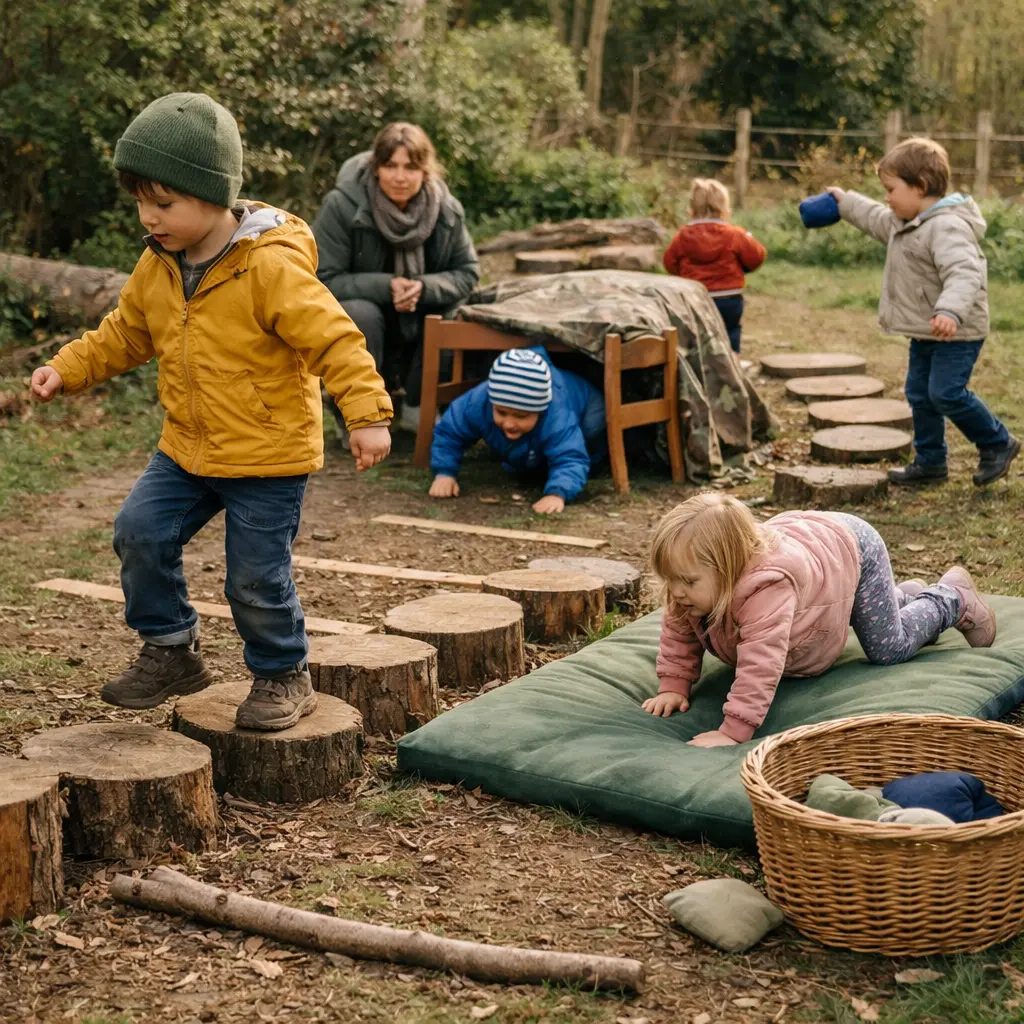
In an outdoor or nature-integrated space such as a sheltered corner of the garden, grass clearing or paved play area, the obstacle course uses natural features and simple real materials: low logs or wooden discs for balancing, flat stones or planks for stepping, a blanket or folded mat on grass for soft landings, sticks or chalk lines instead of masking tape, and a wide basket for target throws. Materials are arranged openly and imperfectly so routes vary; uneven ground and slight slopes replace a perfectly flat indoor setup while remaining supervised and checked for safety.
The adult observes from close enough to intervene, checking stability of logs and chair swaps, then steps back to offer minimal, responsive prompts or single-word cues only when needed. Children choose their route, pace and role, experiment with crawling, jumping and throwing, and negotiate turns and challenges with peers while the adult watches for manageable risk and uses brief language prompts to name positions or ask one-word questions.

Ethos adaptation: rearrange the play area so materials sit in clearly visible clusters with open access rather than a single linear course — tape lines mark flexible zones not fixed tracks, cushions form loose stepping islands or dens, chairs create varied openings and the basket is one of several destination choices. Materials are presented as interchangeable loose parts (rolled socks, blankets, cushions, chairs) so the child may reconfigure spacing, combine elements or leave sections incomplete; non-slip mats remain where safety limits freedom.
The adult steps back as observer and co-researcher, using commentary such as "I can see you testing the gap" or "You’re trying a faster route" and questions like "What happens if you move the cushion?" The child may choose to repeat, pause, invent rules or recruit others; patterns of negotiation, balance adjustments, counting steps, gesture-led plans and emotional responses are visible within play. Observation notes focus on changing strategies, communication bursts and moments of sustained concentration.

A calm corner of the room is cleared so the route is simple and unhurried, with a wool rug marking the beginning and end. Cotton ribbons or wool cords are laid to show straight lines and gentle curves; wooden chairs (checked for stability) hold a cotton blanket as a low tunnel; cotton-covered cushions make “islands.” A wicker basket stands as the target. Only a small number of items are provided at once, with soft cotton socks or cloths for throwing and a non-slip natural-fibre mat under any balancing section.
The adult demonstrates one slow circuit without instructions, showing steady crawling, quiet stepping along a ribbon, pausing to balance on a cushion, and a gentle throw to the basket, then steps back to observe. The child chooses the order and pace, repeats favourite parts, and waits nearby when another is on the route. The adult stays close for safety, offers a hand only if needed, uses brief positional words when helpful, and supports resetting ribbons and cushions as part of a simple tidy rhythm.