Mixing secondary colours by rubbing two painted handprints together
Sensory Play
A sensory paint invitation highlights how two primary colours can merge through movement, sparking close observation and simple colour talk. Children steer tempo and pressure while adults tune into comfort cues and emerging language.
Children explore colour mixing by having different paint colours placed on each hand and noticing what happens when their hands meet. The experience is immediate and body-based, which can help children attend to change, pattern, and cause and effect. Adults can keep the focus on noticing and describing, rather than producing a finished picture.
Step-by-Step Guidance
1. Prepare a wipe-clean surface and place a large sheet of paper or mat in the centre. Set out aprons and a clear route to handwashing.
2. Pour a small amount of each primary colour into separate shallow trays. Keep extra paint out of reach so the adult controls refills.
3. Invite the child to place hands where you can comfortably support them. Offer a brief choice of colours if appropriate, keeping to two primary colours.
4. Paint one colour onto one hand and the other colour onto the other hand. Cover the palm and fingers lightly so the paint can transfer without dripping.
5. Pause for noticing. Hold hands still for a moment so the child can look closely at each colour.
6. Support the child to bring hands together and rub palms. Allow the child to set the pace. Watch for the colour shift as the paints combine.
7. Offer the paper or mat for the child to press or stamp hands if they choose, so they can compare the colour on skin with the colour left behind.
8. If the child wants to repeat, refresh paint on each hand with the same two colours. Keep the focus on noticing what changes and what stays the same.
9. Transition to cleaning by guiding the child to the sink or water bowl. Name the steps simply and keep the tone calm.
10. End by checking skin is clean and comfortable, and wipe the surface. Store paint safely out of reach.
Learning Objectives
Children may explore early scientific thinking through cause and effect as they combine two colours and notice changes (Understanding the World). Children may develop confidence using their hands as tools and adjusting pressure and movement (Physical Development). Children may build vocabulary for colour, change, and comparison through shared talk (Communication and Language).
Adult Role
Stay emotionally attuned. Some children enjoy messy play immediately, and others need time, a smaller amount of paint, or the option to watch first. Use calm, descriptive language that matches what the child can see, such as naming the two colours and describing the change when hands meet.
Scaffold only as needed. Support hand positioning and gentle rubbing if the child is unsure, and step back when the child begins to control the action. Observe closely for cues about sensory comfort, pressure, and interest in repeating. Hold responsibility for safe paint use, preventing paint from going near eyes or mouths, and guiding handwashing without rushing the child.
Observation Cues
Looks closely at hands and paint as colours begin to change.
Repeats rubbing or pressing actions to check what happens again.
Changes speed or pressure and watches for differences in the colour result.
Uses or attempts colour words (red, blue, purple) or change words (mix, darker, same).
Shows preferences or choices by offering one hand first or resisting paint on a hand.
Seeks adult attention to share the change, pointing or holding hands up for viewing.
Time & Space
10–20 minutes, plus cleaning time
A wipe-clean table area or hard floor space with room for an adult to sit alongside children and a clear route to handwashing. A protected surface for stamping and a nearby drying spot for paper if used.
Materials
Safety
Age adaptations
Budding Adventurers
Invite the child to hold hands up for comparison before mixing and to decide how to rub (fast/slow, gentle/firm). Offer paper for alternating between rubbing hands and making handprints so the child can compare separate colours with the mixed colour. Keep language focused on observable change, and allow repetition with the same colour pair to support the child’s own predictions.
Curious Investigators
Introduce a simple prediction prompt such as asking what colour they think might appear when the two hands meet, without requiring a correct answer. Offer a way to record results by making one print of each separate hand and one print after mixing, so the child can compare. Encourage the child to notice differences in shade when they rub more or less, and to describe what they see using colour and change words.
Confident Discoverers
Offer a limited set of primary colour pairs across repeats (for example red/blue, blue/yellow, red/yellow) so children can compare different outcomes without turning it into a worksheet. Invite children to decide how much paint to use within clear boundaries and to test how pressure and time affect the shade. Support children to organise their prints on paper in a way that helps them compare, and to explain their thinking using clear, observable language.
EYFS Links
Communication and Language: Adults can model simple, accurate vocabulary for colours and change, and give children time to respond with words, gestures, or pointing.
Physical Development: Children can practise controlled hand movements, adjusting pressure and speed as they rub or press, and build tolerance for different textures.
Understanding the World: Children can explore cause and effect by combining two colours and noticing a new colour appear, building early ideas about change through direct experience.
Expressive Arts and Design: Children can explore paint as a material and use their hands to create marks, focusing on process and experimentation rather than a finished product.
Ethos adaptations

Set up a low table with two small, identical paint dishes and a clear handwashing station with a jug, bowl, soap, and towel laid out in order. Offer a defined work mat and a single sheet of paper for optional printing, keeping the environment uncluttered and consistent. Provide a small hand brush for the adult to apply paint neatly, and a basket for used towels.
Use precise, minimal language and a slow demonstration of how paint is placed on each hand. Allow the child to choose which hand receives which colour and to control the rubbing, stepping back to observe concentration and repetition. Notice whether the child refines movement (lighter pressure, slower rub) and respond by offering time and space rather than adding new colours or extra prompts.

In an outdoor or nature-integrated space, relocate the activity to a grassy patch, sheltered courtyard or garden table with uneven surfaces and natural shade. Materials such as washable poster paint remain but are paired with open-ended natural items: shallow leaf trays, baked-clay dishes, smooth stones to press, bark sections and a large wipe-clean groundsheet or mat. Materials are arranged loosely so children can take paint on one hand and explore prints against leaves, stones or paper rather than a fixed template.
The adult observes nearby, checking safety and wet-wipe access, then steps back to offer very brief, responsive prompts or single words. Children choose how hard to press, which natural surface to use and whether to rub, stamp or fold hands together; they may use a mirror or peer comparisons. The adult gently models a handling skill when needed, otherwise listening, naming colours or changes in short phrases and allowing repeated, self-directed experimentation.

Ethos adaptation: Arrange a low table or floor tray as an invitation rather than a station, with paint trays spaced so children can choose who and where to sit. Offer more than two colours and loose parts—scraps of fabric, clear lids, small wooden spoons, water pots and a child-height mirror—so materials suggest multiple actions (rubbing, pressing, smearing, lifting). Lay a large wipe-clean mat and keep cleaning supplies visible and reachable to support safe, independent exploration while preserving the sensory, body-based focus.
The adult steps back as co-researcher, using commentary such as "I can see the blue spreading" or "You’re trying a firmer press" and open prompts like "What happens if you press lightly?" rather than giving directions. The child may choose partners, change pressure, repeat or pause; these choices create pathways to the EYFS goals for movement, vocabulary and cause–effect. The adult notices patterns in pressure, repeated gestures, spontaneous language and turn-taking, using these moments as embedded observation points.
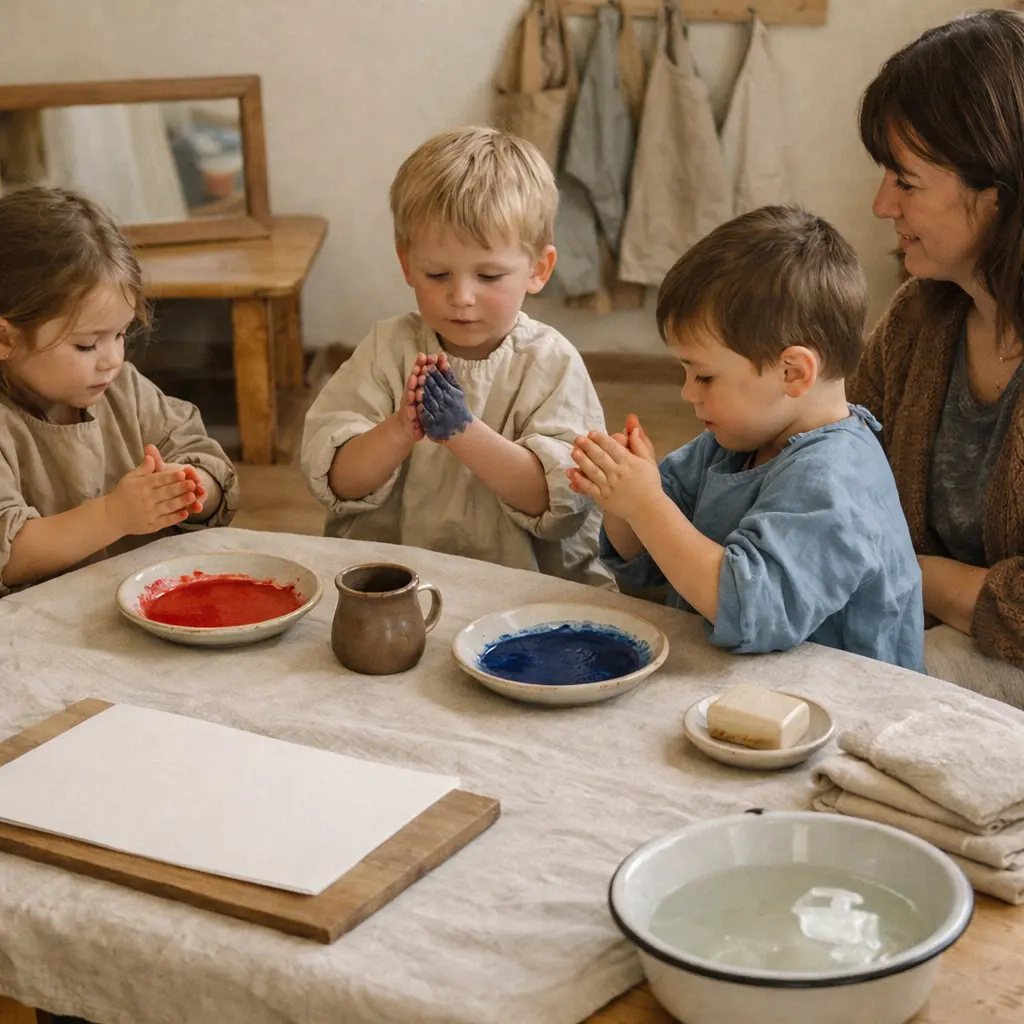
A quiet table is set with a neutral cotton cloth defining the space. Only two shallow ceramic dishes hold plant-based watercolour or natural earth pigment in red and blue, with a small jug of water nearby to adjust consistency. A sheet of heavyweight watercolour paper rests on a wooden board, and simple cotton aprons hang within reach. An enamel basin with warm water, a bar of mild soap, and cotton towels sits at the edge. If used, a wooden-framed glass mirror is placed at child height. No plastic or bright synthetic items are present.
The adult demonstrates slowly: one hand dipped in red, the other in blue, excess gently wiped on the dish rim, palms pressed together once and opened to reveal the change, naming the colours softly, then stepping back. The child returns to dipping, pressing, rubbing, and pausing to look, varying pressure and movement at their own pace, repeating as desired and making prints if they choose. The adult observes, offers quiet, accurate words when invited, and supports washing and simple tidy rhythms.