Matching Arctic animal pairs using family figures and simple picture cards
Communication and Language
Mathematics
Children handle arctic animal figures and picture cards to look for items that belong together, using visual clues such as colour, outline, and markings. Adults sit nearby and offer a small set of choices, noticing how children check a match and how they respond when it does not fit. Children may name animals, compare sizes, and share a tray or basket of resources with others.
Children explore arctic animals by finding and matching pairs, using small animal figures and/or simple picture cards. The experience supports careful looking, remembering what has been seen, and talking about similarities and differences. It can be offered as a calm table-top activity or as a floor-based search, depending on space and group needs.
Step-by-Step Guidance
1. Prepare the space: choose a quiet floor area or table with enough room for children to spread items without crowding.
2. Select the set: start with 3–4 animal types (two of each) and keep the rest out of sight to reduce overload.
3. Present materials clearly: place the figures in a shallow tray or basket, and place picture cards in a separate small pile if using them.
4. Introduce the aim in one sentence: explain that children can find two that match, either figure-to-figure or figure-to-card.
5. Offer a simple starting point: place one animal figure (or one card) as a “focus” item and invite children to look for its pair.
6. Support matching: encourage children to compare features such as colour, shape, and size, and to check by placing items side by side.
7. Extend gently: add one new animal type at a time, or introduce a second matching rule (e.g., match baby/adult within the same animal family if available).
8. Manage turn-taking: if playing with a small group, agree on a simple turn structure (choose one item, check, return if not a match) without making it competitive.
9. Close the activity: invite children to return animals to the tray by pairs, naming them as they tidy, and store the set ready for repeat play.
Learning Objectives
Children may develop attention and recall as they look for two of the same arctic animal. Within Mathematics, children may begin to notice sameness and difference and use early matching and sorting. Within Communication and Language, children may build vocabulary for animals and use simple descriptive language when comparing pictures and figures.
Adult Role
Stay emotionally attuned by noticing frustration, waiting, or excitement, and offering calm reassurance without taking over. Model simple language that supports thinking, such as naming the animal and describing one feature to compare, and repeat children’s words back with a slightly richer phrase. Scaffold when a child is stuck by reducing the number of choices, placing two options near the focus item, or prompting them to check side by side; step back when children are scanning, testing, and self-correcting. Observe how children approach the task (memory, visual discrimination, turn-taking) and adjust the level of challenge. Hold responsibility for safe use of small parts, spacing, and fair access to materials.
Observation Cues
Looks closely at markings or shape to decide if two animals match. Remembers where a particular animal was seen and returns to it. Uses words or gestures to request a specific animal or card. Notices and corrects a mismatch without adult prompting. Sorts animals into small groups (same animal, same size, same colour) without being asked. Waits, watches, and takes turns when playing with others.
Time & Space
10–20 minutes, with the option to revisit across the week.
Small table area or a clear floor mat space for 1–4 children, with room to spread cards/figures without overlap.
Materials
Safety
Age adaptations
Budding Adventurers
Offer 3–5 animal types and introduce simple picture cards to match figure-to-card. Add a small sorting area (two or three hoops or marked spaces) so children can place matched pairs together. The adult supports by modelling one comparison word at a time (same, different, bigger) and by inviting children to tidy by pairs to reinforce the matching idea.
Curious Investigators
Use a full pairs set of cards (two of each) or a mixed set (figures and cards) and invite children to choose the matching rule before starting. Add a light memory element by keeping some items face down or partially covered, depending on children’s confidence. The adult supports by encouraging children to explain how they know it matches and by noticing strategies such as scanning, remembering locations, and checking carefully.
Confident Discoverers
Increase challenge by adding similar-looking animals (e.g., different seal images) or multiple sizes within the same animal family if available. Introduce simple labels (word cards) for matching to pictures or figures, and invite children to create their own mini “arctic set” by choosing which animals to include. The adult supports by prompting children to justify choices using features, supporting cooperative rule-making, and observing persistence and flexible thinking when rules change.
EYFS Links
Communication and Language: children may listen to simple instructions about matching and use words to name animals and describe features such as colour or size. Mathematics: children may notice patterns of sameness and difference, match identical items, and begin to sort into sets. Personal, Social and Emotional Development: children may practise turn-taking, coping with not finding a match straight away, and sharing limited resources. Understanding the World: children may build familiarity with arctic animals and begin to talk about where animals live and what they look like.
Ethos adaptations

Place a small mat on the floor or a low table. Select four arctic animals and present either figures or picture cards, not both. On a shallow tray, lay one of each animal in a left-to-right control row; put the matching four in a basket on the right. Leave labels and the cloth aside to keep the focus on visual matching. The child works by placing each match beneath its control; any mismatch is obvious by shape/markings, and an extra item left over signals an error.
Offer one brief, slow demonstration: point to a control animal, search the basket, compare a single detail, place the match below, then pause. Step back to the side with quiet hands; use only the animal name if asked, and avoid hints or questions. Observe for steady scanning, visual checking, and self-correction when a piece doesn’t fit the control row. Note focus and recall, early matching/sorting language, and whether the child chooses to repeat.
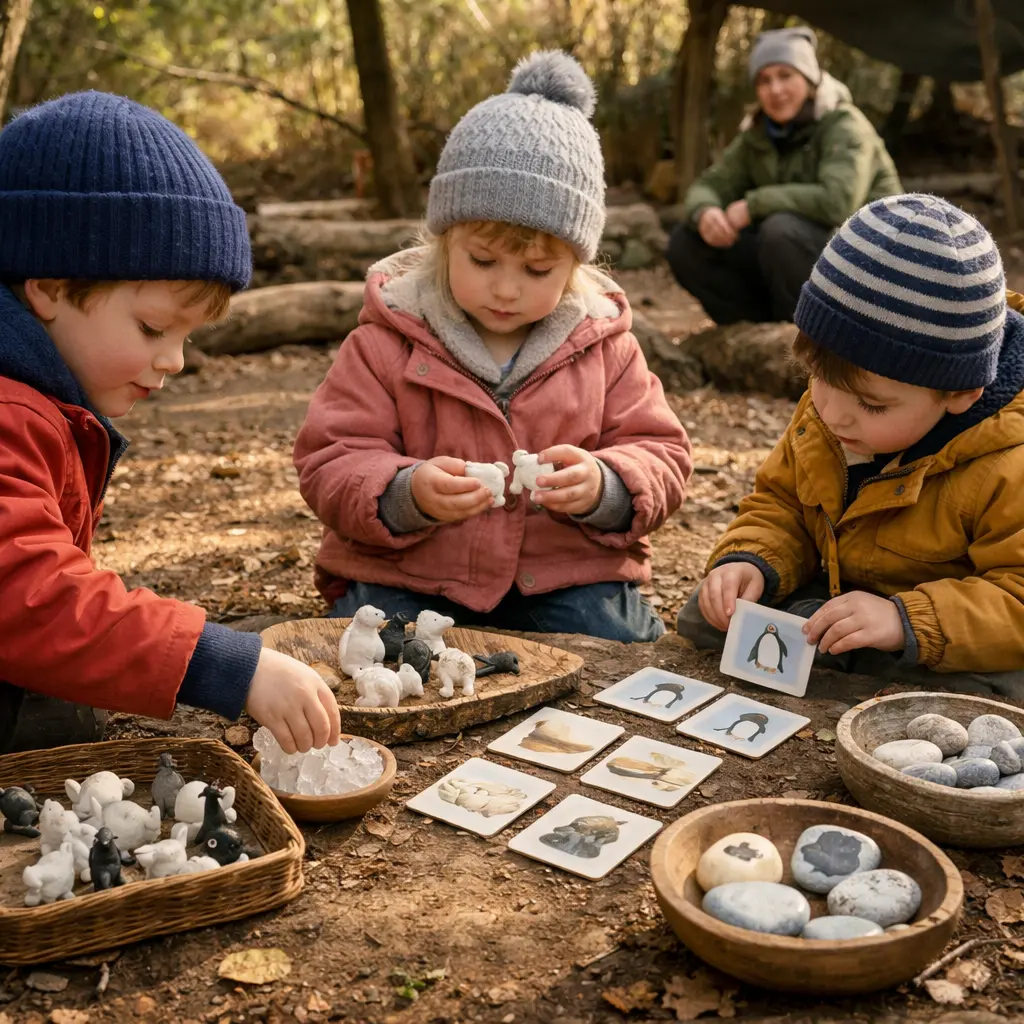
In an outdoor or nature-integrated space, set the activity on a low log circle, a sheltered patio or grassy patch with varied surfaces and small clearings; scatter shallow wooden trays, a basket, or natural bowls of stone and bark to present the items rather than a tidy table. Materials such as the arctic animal figures and picture cards sit alongside natural tokens—painted stones, shells, or small ice blocks—to be paired or used as markers so children can search, collect and match in an open-ended way without a fixed layout.
The adult observes from a short distance, checking anchors and supervising any water or uneven ground while avoiding step-by-step direction. Children choose where to search, hide or display pairs, take turns and talk about features; the adult uses brief, responsive prompts or single words and models calm handling when needed, stepping in only for safety or to reframe a question that extends matching and vocabulary.

Arrange the space so animals, loose natural materials (stones, shells, fabric scraps, trays, small wooden blocks) and picture cards are openly accessible across a low surface and a nearby rug; group items in small visible collections rather than handed sets and leave gaps (some animals partly hidden under cloths, some mixed with non-animal loose parts) so the child may choose matching, sorting, habitat-building or storytelling paths while EYFS safety and ratios are maintained.
The adult steps back as observer and co-researcher, using commentary not instruction: "I can see you’re looking for the white one," "You’re trying different pairs," "What happens if you group by size?" The child may follow a memory hunt, create pairs by feature, or arrange scenes; embedded observation cues include sustained attention, recall attempts, descriptive vocabulary, sorting strategies and social negotiation during turns.

A small, uncluttered space is prepared on a neutral wool mat or a low wooden table. The materials are arranged on a shallow wooden tray or woven basket: a limited set of pairs (3–5 species) of carved wooden or felted-wool arctic animals, with matching images on plain, uncoated card in soft tones. A simple cotton cloth is available to partially cover a few items for a quiet memory element. Only these essentials are presented, spaced with clear gaps so each figure and card can be seen and handled calmly.
The adult quietly models one match by placing a figure beside its card, softly naming it once, then returns both to the tray and observes without directing. The child handles the figures, turns them to compare shape and markings, places pairs together, and repeats figure-to-figure or figure-to-card matches at their own pace. The child may slide the cloth to cover, pause to remember, and reveal to check. The adult stays nearby, offering minimal words and a steady presence, and models an unhurried tidy at the close.