Making eco-friendly bird feeders using ice cream cones, lard and bird seed
Understanding the World
Communication and Language
Children use simple ingredients to create bird feeders that can be offered to local wildlife. The experience invites sensory exploration of sticky and dry textures, careful hand movements, and shared talk about birds and outdoor places. Adults pay attention to how children manage mess, tools and turn-taking, and to the words and gestures children use to explain what they notice. The activity can be revisited through brief outdoor checks for signs of visits.
Children explore how to make simple bird feeders using everyday materials and notice how food can be offered to local wildlife. The experience supports careful handling, sensory exploration and early ideas about living things and seasonal change. It can be revisited over days as children watch for signs that birds have visited and talk about what they notice.
Step-by-Step Guidance
1. Prepare the environment: choose a table that can be wiped and place a tray or paper underneath to catch seed. Set out cones, a bowl of softened lard, and a shallow tray of bird seed so children can reach without leaning across others.
2. Present materials simply: show the cone, the lard and the seed, and name each item. Offer a child-safe spreader and demonstrate a small, slow spreading motion on one area only, keeping the rest for children to explore.
3. Invite children to choose how to cover the cone: some may prefer spreading with a tool, others may use fingers. Allow time for sensory exploration and support turn-taking around shared bowls.
4. Support coating with seed: keep the seed in a shallow tray so children can press or sprinkle in a controlled way. Offer the cone back to the child to decide where to add more seed.
5. Add a hanging method: adults attach string to the cone in a secure way and check it can be carried without tipping. Keep this part adult-led to reduce frustration and manage safety.
6. Transition to outdoors: carry feeders on a tray to reduce dropping. Adults choose a suitable hanging spot that is visible for later observation and away from busy walkways.
7. Return to the experience over time: revisit the hanging area briefly across the week to notice changes. Adults record children’s comments and any signs of birds visiting, keeping the focus on observation rather than results.
Learning Objectives
Children may develop understanding of the world by noticing that birds need food and that outdoor environments change over time. Children may strengthen physical development through squeezing, spreading and controlling small movements when handling seed and shaping the feeder. Children may build communication and language by naming materials, describing textures and sharing observations about birds and outdoor signs.
Adult Role
Stay emotionally attuned by noticing children’s comfort with messy textures and offering wipes or a tool choice without pressure. Model simple, accurate language such as cone, seed, soft, sticky, sprinkle, press, bird, feather, and empty, and repeat children’s words back to extend meaning. Scaffold only when needed: steady a bowl, slow the pace, or offer a smaller amount of lard; step back when children are absorbed in spreading or pressing. Observe closely for fine-motor control, persistence, sensory preferences and emerging talk about living things, and use these observations to plan a repeat visit outdoors. Hold responsibility for hygiene, safe handling of lard, managing string and hanging points, and ensuring children do not mouth materials.
Observation Cues
Reaches for and explores materials by touch, showing preferences for textures (soft lard, dry seed, rough cone). Uses increasing control to pinch, sprinkle or press seed onto a surface. Sustains attention long enough to complete a chosen part of the making process. Uses words, sounds or gestures to label birds, seed, cone, or to indicate more/stop. Notices changes outdoors over time, such as missing seed, peck marks, or birds nearby.
Time & Space
20–35 minutes for making and hanging, plus 5–10 minute observation check-ins on later days.
A wipe-clean table area indoors for making, plus access to an outdoor space with an adult-reachable hanging point that can be revisited safely.
Materials
Safety
Age adaptations
Budding Adventurers
Offer a choice of tool or fingers for spreading and a small portion of seed per child to reduce crowding. Encourage children to notice coverage by looking for bare patches and deciding where to add more seed, without insisting on a finished look. Adults can support short turns to hang feeders and revisit the spot to compare what looks the same or different over days.
Curious Investigators
Add a simple decision point such as choosing a hanging location from two adult-approved options (sunny/shady, near hedge/open). Encourage children to describe textures and quantities using everyday language like lots, a little, heavy, and light. Adults can introduce careful observation of signs of visits (seed missing, marks) and support children to record with a simple mark, drawing, or adult scribed note.
Confident Discoverers
Invite children to plan for repeat observation by agreeing what to look for and when to check, keeping it brief and realistic. Offer a wider range of seed textures if available (e.g., mixed seed with sunflower hearts) and encourage children to compare which sticks more easily and why it might. Adults can support children to take responsibility for clean-up routines and to share explanations about caring for wildlife with peers.
EYFS Links
Understanding the World: children may notice birds as living things in their local environment and begin to connect care actions (providing food) with what they observe outdoors over time. Physical Development: spreading, pressing and sprinkling can support hand strength, coordination and controlled movements, alongside routines for hygiene and self-care. Communication and Language: adults can model vocabulary for materials, actions and observations, supporting children to describe what they notice and to listen to others’ ideas. Expressive Arts and Design: children can make choices about how their feeder looks and explore materials in an open-ended, sensory way.
Ethos adaptations
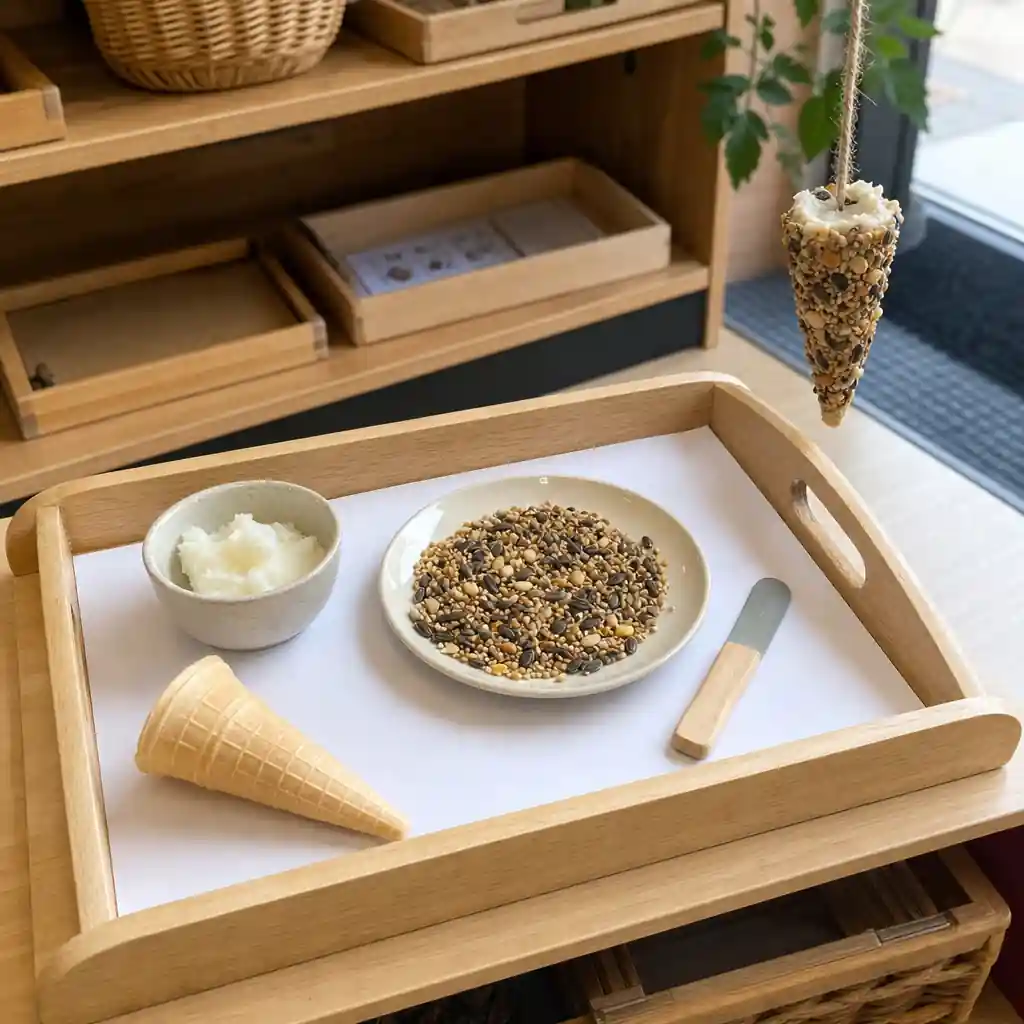
Set up a low tray for each child with one plain cone, a small pre-portioned lump of softened lard in a bowl, a shallow plate of seed and one child-safe spreader. Limit quantities to one cone and one portion of lard so the sequence is clear; place trays on marked spots and keep string and scissors stored with the adult. Remove extra materials and put paper under the tray to isolate spreading and sprinkling as the main fine-motor task and make overfill or missing coverage visibly obvious.
Show the full sequence once: place the cone on the tray, use the spreader to smooth lard to the rim and roll in seed, then hang an example feeder; use only brief, factual language and a single slow demonstration before stepping back. Adults manage any cutting or knotting, offer a quick safety reminder, then limit talking and prompts; quietly observe repetition, control of wrist and grip, precision of spreading, whether the child checks and corrects coverage, and any signs of sustained attention or interest in watching for birds.

In an outdoor or nature-integrated space, move the activity to a garden, courtyard or green area with a mix of grass, low branches and a sheltered table or stump. Materials such as plain ice‑cream cones, softened lard or suet, loose garden bird seed, natural string and shallow trays are provided in open-ended bowls rather than pre-measured kits. Children may collect small, safe natural bits (twigs, leaves) to press into feeders and use uneven ground and tree branches for varied hanging heights.
The adult observes from close by, setting up materials and checking knots or high-placed hang points but avoiding step-by-step direction. The adult uses short, responsive prompts and single-word descriptors, offers one-to-one help with any scissors or knots, and models calm handling before stepping back. Children choose who makes, who hangs and who watches, revisit feeders over days, describe textures and sightings, and experiment with where feeders are placed while the adult monitors safety.

Reconfigure the space into self-serve stations: low table with open tray of ice cream cones (whole and broken pieces), shallow tray of bird seed, small bowl of softened lard, pre-cut twine lengths, child-safe spreaders, aprons, wipes, and paper underlay, all reachable. Nothing is preassembled; materials are open-use—cones can hold, scoop, or crumble; seed can be sprinkled, pressed, or rolled; lard can be smeared, dotted, or left separate. Create clear routes to an outdoor hanging line/branch visible from indoors and a safe ledge/ground spot for placing food.
The adult waits, noticing and narrating: “I can see you pressing the mixture,” “You’re trying to make this balance,” “What happens if the cone is on its side?” Children may shift direction—crumbing a cone into seed, layering textures, testing weight with shorter or longer twine, or choosing where to place food; the adult manages knots and final placement for safety. Observation sits within the flow: hand strength and control, shared decisions, descriptive vocabulary, cause-and-effect thinking, and later revisits to spot changes outdoors.

A small table by a window or a sheltered outdoor bench is cleared and covered with a plain cotton cloth to define the workspace. Only a few items are set out on a wooden tray: open pine cones, a ceramic bowl of softened lard, a shallow wooden dish of bird seed, short cotton twine, and small wooden spreaders. Cotton aprons and a bowl of warm water with cloths sit at the edge for clean hands. If needed, a sheet of plain brown paper is placed beneath for an easy, contained tidy.
The adult demonstrates a slow, quiet smear of lard onto a pine cone and a gentle press or roll into seed, then ties the twine, speaking minimally and stepping in only for safety, hygiene, and knot-tying. The child returns to spreading, pressing, and sprinkling at their own pace, repeats as wanted, and indicates a hanging place; the adult secures height and fixings. Over days the child revisits to look for changes, notice visiting birds, and share observations.