Making a rain cloud in a clear container using shaving foam, water and food colouring for ages 2–4 years
Understanding the World
Communication and Language
Children watch coloured water interact with a shaving-foam “cloud” in a clear container and notice how changes appear over time. Adults support children to share predictions, use simple weather and materials vocabulary, and compare ideas with what they can see. Some children choose to sketch patterns or colour movement, giving adults a window into what they noticed and how they explained it.
Children explore a simple rain cloud model using everyday materials, watching colour move through a “cloud” and into “rain”. The experience supports early scientific thinking as children make predictions and notice changes over time. It also offers a calm focus point for listening, waiting and talking about what they can see. Sketching what they notice can help children represent ideas in their own way.
Step-by-Step Guidance
1. Prepare the space: Cover the table, place the clear container in the centre, and arrange chairs so children can see without leaning over the container.
2. Gather and control materials: Keep food colouring and shaving foam in adult reach. Place pipettes where they can be handed out when needed.
3. Introduce the focus: Name the materials and invite children to look closely at the empty container. Offer a simple prompt for prediction about what might happen when colour meets the “cloud”.
4. Build the model: Add water to the container, leaving space at the top. Add a layer of shaving foam on the surface to represent a cloud.
5. Support predictions: Pause for children to share ideas. Record a few predictions with simple marks or words, or invite children to sketch what they think they might see.
6. Add colour with intention: Use the pipette to place small drops of food colouring onto the shaving foam. Offer turns, keeping the pace slow enough for watching and waiting.
7. Observe together: Give quiet time for children to notice changes. Prompt attention to what they can see in the foam and in the water below.
8. Extend thinking: Invite children to compare what they predicted with what they observed. Encourage children to sketch the result or the patterns they noticed.
9. Transition to follow-on play (optional): Decant the coloured water and foam into a water tray for supervised wet play with pots and tools, keeping staining risk in mind.
10. Close and tidy: Wash hands, wipe the table covering, and store food colouring out of reach.
Learning Objectives
Children may build Understanding the World by taking part in a simple experiment and noticing cause and effect. Children may develop Communication and Language as they hear and use new vocabulary linked to weather and materials. Children may explore Expressive Arts and Design by observing colour, pattern and movement and choosing ways to represent what they notice through marks or sketches.
Adult Role
Stay emotionally attuned by keeping the pace calm and predictable, noticing when children need more time to watch or when anticipation becomes hard to manage. Model language that matches what children can see, using simple scientific vocabulary such as predict, observe, cloud, rain, drip, float, sink, liquid and colour, and repeat key words without over-correcting. Scaffold by offering one clear prompt at a time and by demonstrating pipette control if needed; step back when children are watching closely or sharing their own ideas. Observe in action by tracking who is drawn to the materials, who is focused on the change over time, and who needs support to wait and listen. Hold responsibility for safety by keeping food colouring and glass out of children’s independent reach, supervising all pipette use, and preventing ingestion of any materials.
Observation Cues
Notices and comments on changes, such as colour spreading, sinking or pooling
Makes a prediction using simple language, such as what might happen to the colour or “rain”
Waits and watches for a change, or seeks to speed the process by adding more drops
Uses or repeats new vocabulary, such as cloud, rain, water, colour, drip, float, sink
Follows a short sequence with support, such as watching, predicting, adding colour, observing
Shows preferences or strong interest in a particular aspect, such as the pipette, the anticipation, or the final colour effect
Time & Space
10 minutes to gather resources and set up; 10–15 minutes for the experiment and discussion; optional additional time for supervised water tray play.
Indoor or outdoor table space with chairs arranged so children can see clearly without crowding; access to a sink or wipes for clean-up is helpful.
Materials
Safety
Age adaptations
Budding Adventurers
Use a wider, stable clear plastic container and limit to one colour at a time to reduce visual overload. Offer adult-led pipette use with children taking turns to point, choose a colour, or squeeze the dropper with hand-over-hand support. Keep language concrete and immediate (cloud, rain, drip, blue) and allow longer watching time with fewer turns. Provide chunky crayons for simple marks rather than detailed sketching.
Curious Investigators
Offer two colours and invite children to predict differences, such as whether one colour might move faster or make new shades in the water. Support children to use the pipette with reminders about gentle squeezing and waiting between drops. Encourage children to sketch what they notice in the foam versus the water, and to describe changes using words like spread, sink, mix and puddle. Invite short peer discussion by collecting a few different predictions before adding more drops.
Confident Discoverers
Invite children to record predictions with simple drawings or adult-scribed words and revisit them after observing. Offer more independence with pipettes, with clear boundaries about where drops go and how many at a time. Extend vocabulary to include solid, liquid and gas, linking shaving foam, water and air in simple terms, and introduce water cycle language such as evaporation and condensation as optional prompts. Encourage children to compare outcomes when using different numbers of drops or different colours, keeping changes small and observable.
EYFS Links
Understanding the World: Children explore a simple model of rainfall and begin to connect what they see with ideas about weather and early water cycle concepts. They practise predicting and noticing outcomes, supporting early scientific thinking through observation.
Communication and Language: Adults model and extend vocabulary linked to materials and change, and children have reasons to ask questions, explain predictions and describe what they notice.
Expressive Arts and Design: Children explore colour, pattern and movement in a real-time visual effect, and may represent ideas through sketching or mark making, choosing what details matter to them.
Ethos adaptations
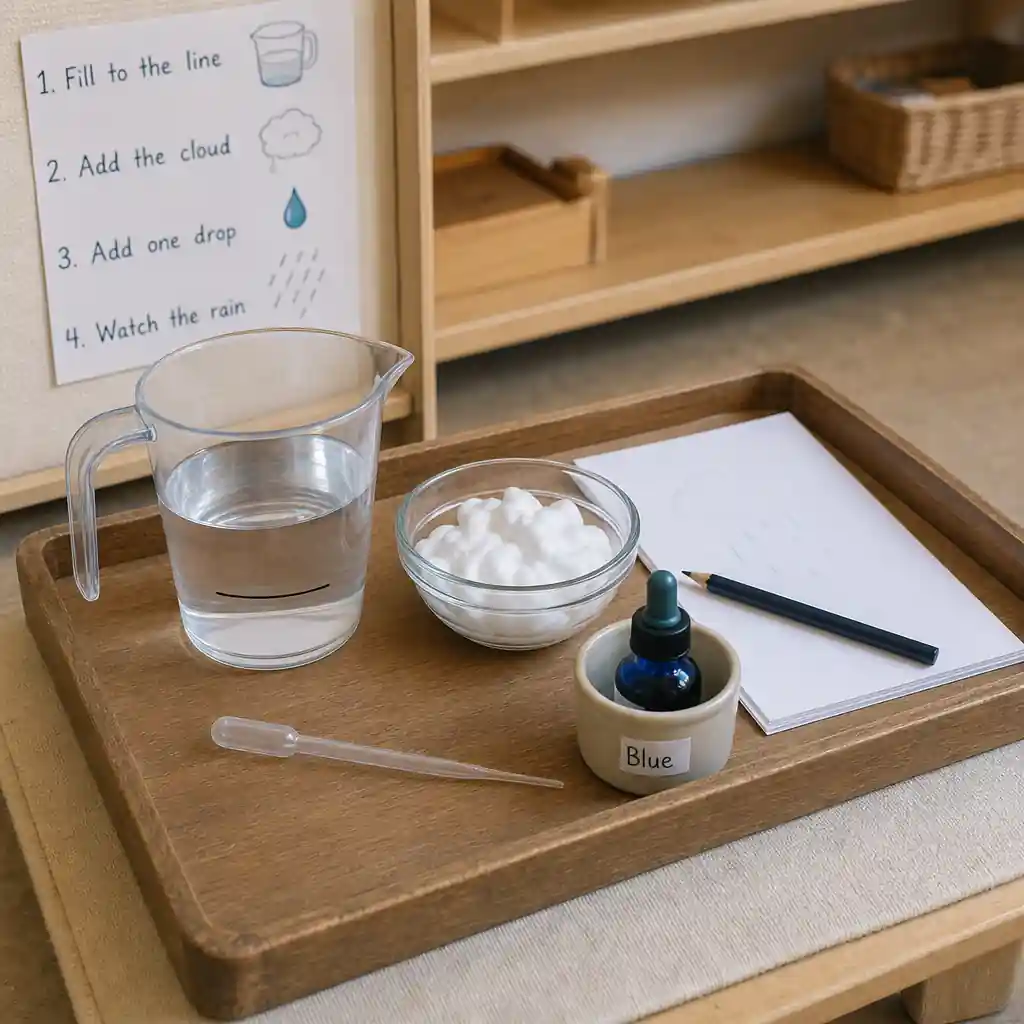
Set up a shallow tray with one clear jug per child or one shared jug on a low table, a small measured water fill line, a single portion of shaving foam in a shallow dish, one labelled bottle of food colouring placed in a small container out of reach and one pipette per child. Remove extra materials so the sequence (fill to line → place foam → drop colour) is obvious, and provide pencil and paper nearby for quick sketches to capture what they notice.
Show the full sequence once with a slow, controlled demonstration: fill to the line, place the foam, squeeze one drop and watch. Then step back, keep language brief and factual (safety reminders only), and resist prompting. Observe who repeats the action, how children control the pipette and steady their hand, whether they wait and watch the colour move, and how they choose to record or talk about what they saw.
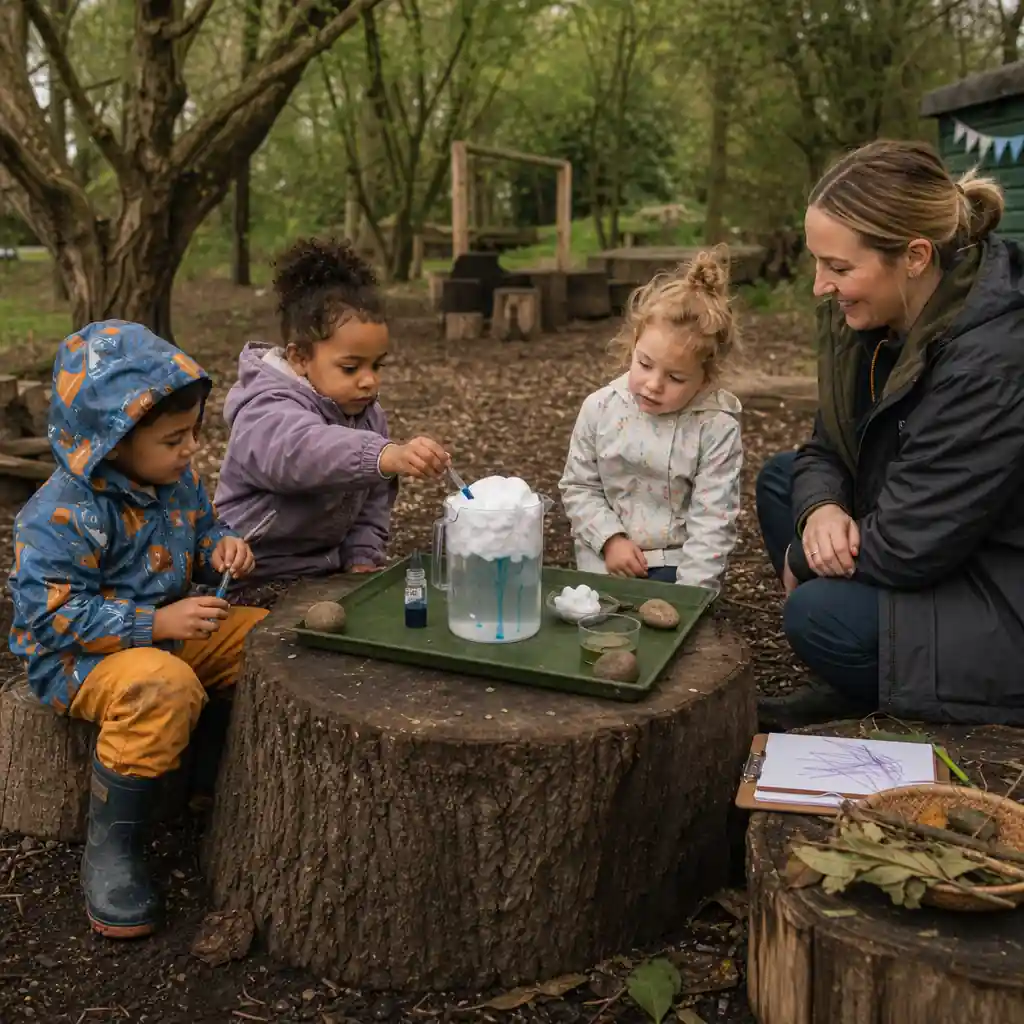
In an outdoor or nature-integrated space, set up the clear container on a low tray or stable tree-stump table on grass or a bark-mulch area so surfaces are varied. Materials such as the clear jug, water and a small amount of shaving foam (kept adult-handled), food colouring in tiny, secured bottles and droppers are provided alongside natural items—stones to anchor the tray, leaves for gentle stirring, and paper on clipboards—arranged in an open-ended way rather than pre-set steps.
The adult observes from close by, checks anchors and handles the shaving foam and colour if needed, then steps back and uses short, responsive prompts or single-word descriptors rather than instructions. Children choose where and when to drop colour, repeat trials, listen and watch the slow movement, take turns with droppers and may sketch or mark what they notice while the adult notices safety and offers minimal encouragement.
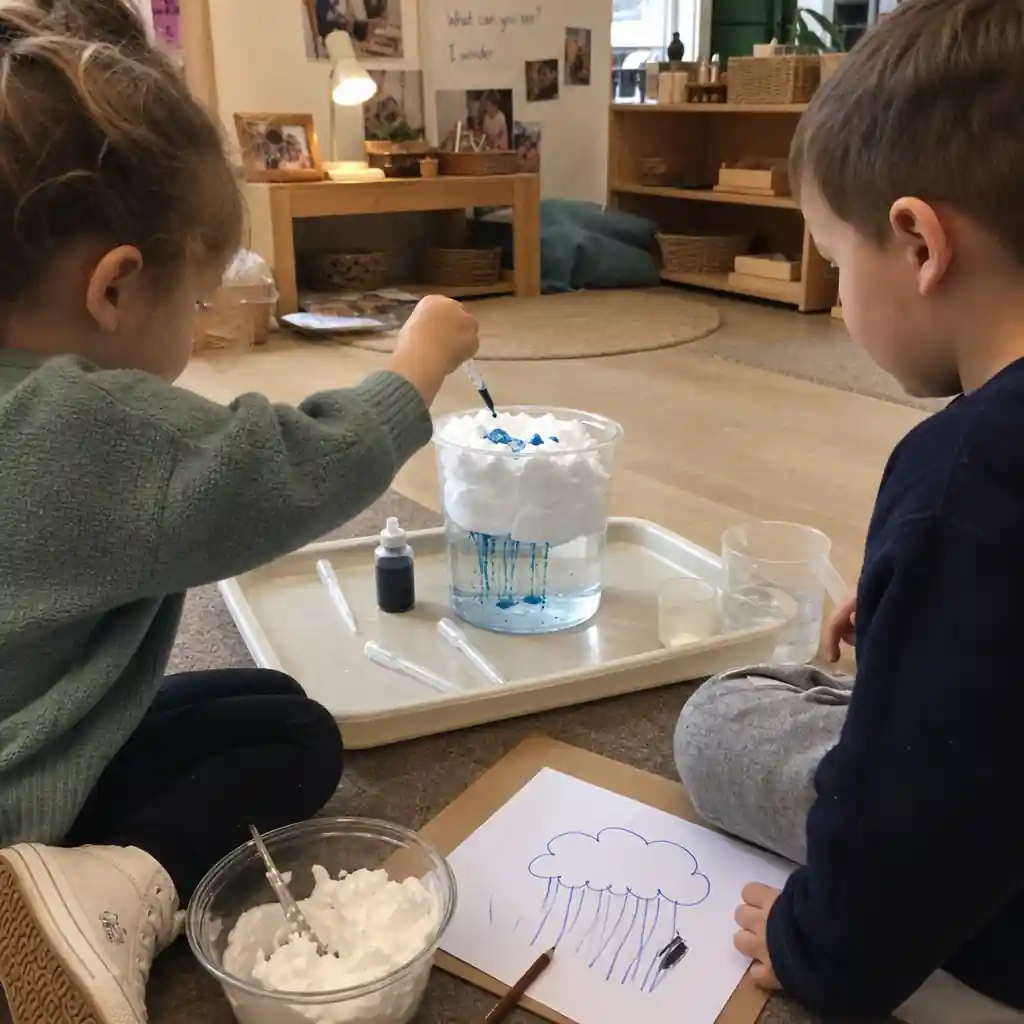
Set up low tables in a calm corner with clear containers spaced so each child can choose a station; arrange trays of water, shaving foam in a communal bowl, droppers, small spoons, extra clear vessels, natural dyes or food colouring in small sealed pots, and paper for sketching so materials are visible and reachable rather than handed out. Materials are presented as loose parts (multiple droppers, various vessel sizes, spare lids, light source like a lamp) so the child may combine items, repeat actions, pause or abandon an idea without a prescribed outcome.
The adult stays beside the area as an observer and co-researcher, using commentary not instruction: "I can see the colour gathering," "You’re trying a big drop," "What happens if you press the pipette gently?" The child may select tools, sequence actions, or shift to sketching observations; the adult notices choice patterns, persistence, language used and moments of surprise and records brief notes or photos as the activity unfolds so documentation is embedded in the flow.
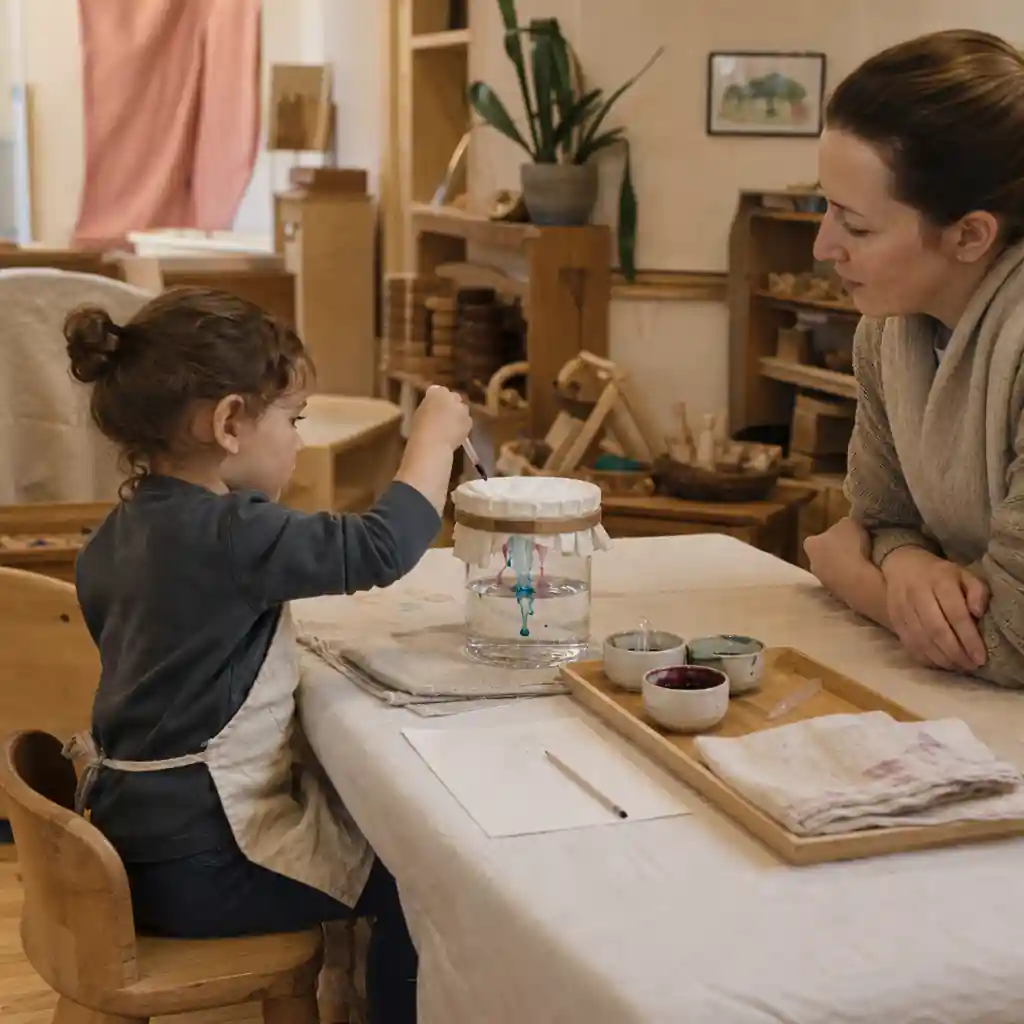
A small, uncluttered table is set with a neutral cotton cloth and a low wooden tray holding one clear glass jar of water (glass handled by the adult). An unbleached cotton muslin is secured across the jar mouth with a wooden ring to form the “cloud.” Small ceramic dishes hold plant-based colour infusions (e.g., blueberry, beetroot) and a single glass dropper or a small wooden spoon rests beside them. A second cloth sits nearby to catch drips. Plain paper and a graphite pencil are placed at the edge for quiet sketching.
The adult demonstrates slowly letting a few coloured drops fall onto the muslin, then steps back, remaining present and quiet, naming only what is seen if needed for clarity or safety. The child returns to dripping, watching the colour gather and seep as “rain,” pausing and repeating at their own pace. They may sketch what they notice, moving between looking and marking. The flow stays predictable: calm setup, unhurried exploration with refills as needed, then shared, simple tidy.