Ingredient mystery box for guessing foods by scent and touch with eyes closed
Sensory Play
Communication and Language
Children explore a small set of familiar ingredients using smell and touch without relying on sight, focusing on noticing and describing rather than getting a right answer. Adults offer clear choices about taking part, keep hygiene routines close by, and pay attention to how children manage uncertainty and turn-taking. Materials are contained to control mess and reduce the urge to taste, and the ingredient selection can reflect the group’s everyday foods.
Children explore a small selection of familiar food ingredients using smell and touch without relying on sight. The experience invites careful noticing, comparing, and describing, with plenty of space for children to opt in or out. It can sit alongside snack time or a cooking focus, and it often sparks talk about preferences, memories, and family foods.
Step-by-Step Guidance
1. Prepare the environment: choose a calm table or floor space with a clear boundary (tray or mat). Place hand wipes/handwashing access nearby and keep ingredient packets to hand for allergen checking.
2. Select ingredients: choose a small number of familiar items with clear sensory differences. Avoid high-risk choking items for younger children and avoid unknown foods for children with anxiety around sensory play.
3. Portion and contain: place each ingredient into its own small pot. For strong scents or wet items, use a lid and open only when needed. For liquids (e.g. vanilla), apply to a cotton pad inside a pot rather than offering free liquid.
4. Introduce the experience: explain that children can use smell and touch to work out what an ingredient might be. Offer choice: eyes closed, looking away, or watching only.
5. Model boundaries and hygiene: show how hands go into the box/bag one at a time, and that ingredients stay in the pot. Agree what children can do if they want to stop (e.g. hands out, wipe, take a break).
6. Present one ingredient at a time: place a single pot into the box/bag. Invite a child to explore with fingertips and smell, without rushing to name it.
7. Support describing before guessing: prompt for what they notice (texture, temperature, strength of smell) and accept non-verbal responses. Offer a small set of words if needed.
8. Invite a guess and a check: children can name the ingredient, point to a picture card, or choose from two options you offer. Reveal the ingredient visually only after the child has finished exploring.
9. Repeat with variation: rotate turns, adjust the number of ingredients, and include a “same or different” comparison if children are interested.
10. Close and reset: end with handwashing, tidy away ingredients safely, and note any strong preferences, worries, or allergy-related considerations for future planning.
Learning Objectives
Children may build confidence in exploring sensory information in a supported way, linking to Personal, Social and Emotional Development (self-regulation and managing self). Children may extend Communication and Language by using words, gestures, and facial expressions to describe what they notice. Children may also draw on Understanding the World by connecting sensory clues to familiar foods and routines.
Adult Role
Stay emotionally attuned by watching for hesitation, sensory overload, or excitement, and offer clear opt-out routes without pressure. Model calm language for uncertainty, such as naming observations rather than pushing for correct answers, and validate children who prefer to watch. Scaffold lightly by offering a small choice of descriptive words, slowing the pace, or reducing the number of ingredients; step back when children begin to compare, describe, or take turns independently. Observe in action by noting how each child approaches touch and smell, how they manage waiting and turn-taking, and what vocabulary or strategies they use. Hold responsibility for safety by checking allergies and dietary requirements, controlling portion sizes, preventing mouthing, and maintaining hygiene routines throughout.
Observation Cues
Reaches in quickly or pauses to gather information through fingertips and smell before naming.
Uses descriptive language (e.g. rough, smooth, powdery, cold, strong) or substitutes with gestures.
Checks in with the adult for reassurance, asks to stop, or chooses to watch instead.
Compares two ingredients and changes their guess after new sensory information.
Shows awareness of hygiene routines, such as waiting for a wipe before touching their face or food.
Listens to peers’ ideas and adapts their own thinking or vocabulary.
Time & Space
10–25 minutes, depending on group size and number of ingredients.
A calm table or floor area with space for a small group (2–6 children) and a defined boundary mat/tray; nearby access to handwashing.
Materials
Safety
Age adaptations
Budding Adventurers
Offer 5–7 ingredients with clearer contrasts (dry oats, orange peel, mint, bread, cucumber) and introduce the idea of “describe it first” using a simple prompt card with 2–3 icons (smell, feel, warm/cold). Children can choose eyes closed or a scarf held at the side of the face to reduce visual input without pressure. Add a matching option by placing 3–4 picture cards on the mat and inviting children to point after exploring.
Curious Investigators
Offer 6–10 ingredients including a few that are similar (lemon vs orange peel; oats vs rice) to support careful comparison. Invite children to suggest their own descriptive words and to sort ingredients into groups (smooth/rough, sweet-smelling/savoury-smelling) after revealing. The adult can record children’s words on a small whiteboard and revisit them during snack or cooking time, noticing who revises a guess and how they explain their thinking.
Confident Discoverers
Include a wider range of ingredients and introduce a simple recording choice: children can place a token on a picture chart for their guess or draw a quick mark for “strong smell” versus “mild smell”. Add a fairness rule children can help manage (one hand in, one turn each) and invite children to design one round by choosing which ingredients go in and how many clues are allowed. The adult listens for precise vocabulary and supports respectful disagreement when children make different guesses.
EYFS Links
Communication and Language: children may practise listening to others’ ideas, finding words for sensory experiences, and using questions or gestures when they are unsure. Personal, Social and Emotional Development: children may manage turn-taking, cope with uncertainty, and use adult support to pause or opt out when sensations feel too strong. Understanding the World: children may connect smells and textures to familiar foods, routines, and experiences, noticing similarities and differences between ingredients. Physical Development: children may refine hand control as they explore with fingertips, grasp, and release, alongside hygiene routines such as handwashing.
Ethos adaptations
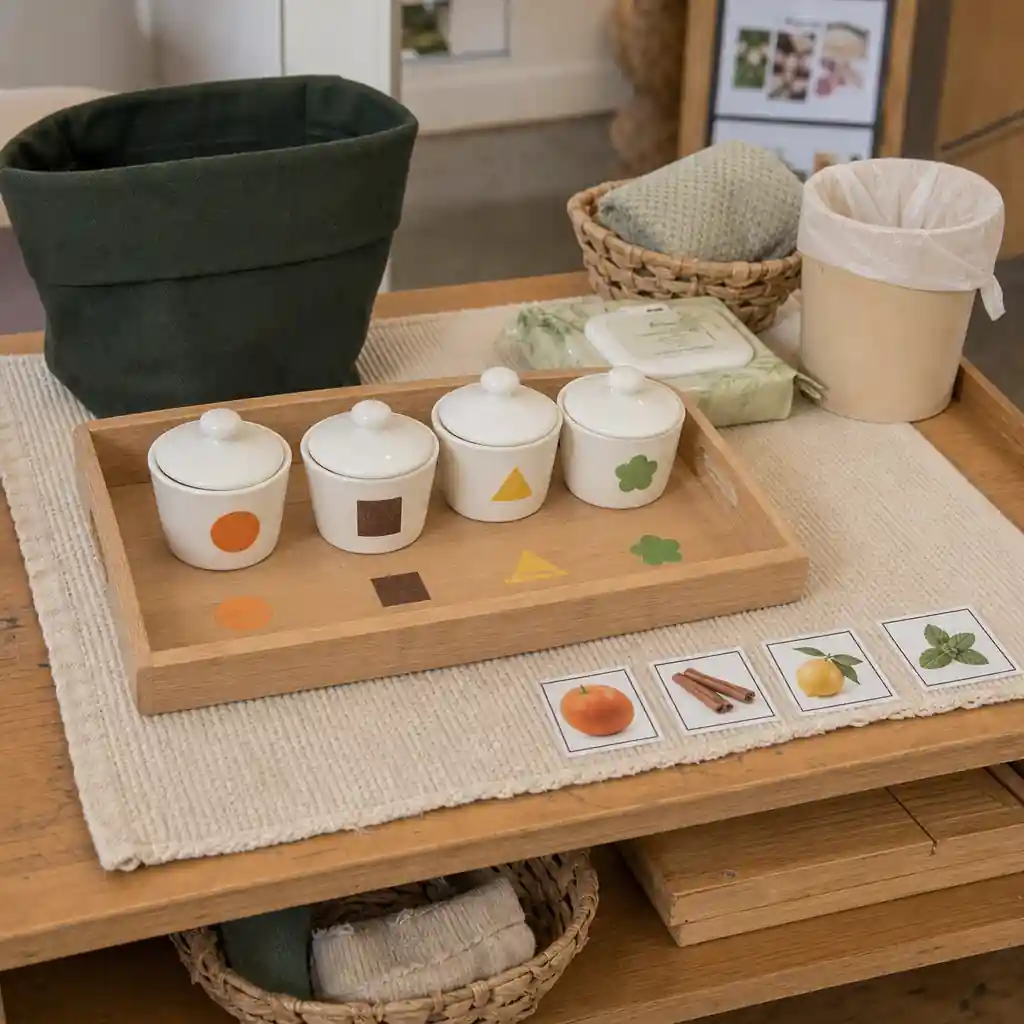
Reduce the selection to four familiar, distinct ingredients. Place each in a small lidded pot on a low tray arranged left to right, with a simple matching mark on pot and tray spot so children can return it independently. Keep the opaque box beside the tray holding any extra pots, but present only one tray at a time. Set a small hand mat, wipes, towel and mini bin within reach. If using picture cards, include only the four that match the tray and place them at the far-right spot for optional self-check.
Give one slow demonstration: wash hands, choose whether to close eyes, open the first pot, smell then touch with fingertips, say one describing word, close the lid, return it to its marked spot, and place any wipe in the bin; show the picture card check as optional. Then step back and keep language to brief safety and consent reminders. Watch for repetition, careful control with lids, signs of overwhelm or fatigue, descriptive words or gestures, left-to-right sequencing, and moments when a child links a scent to a family food.
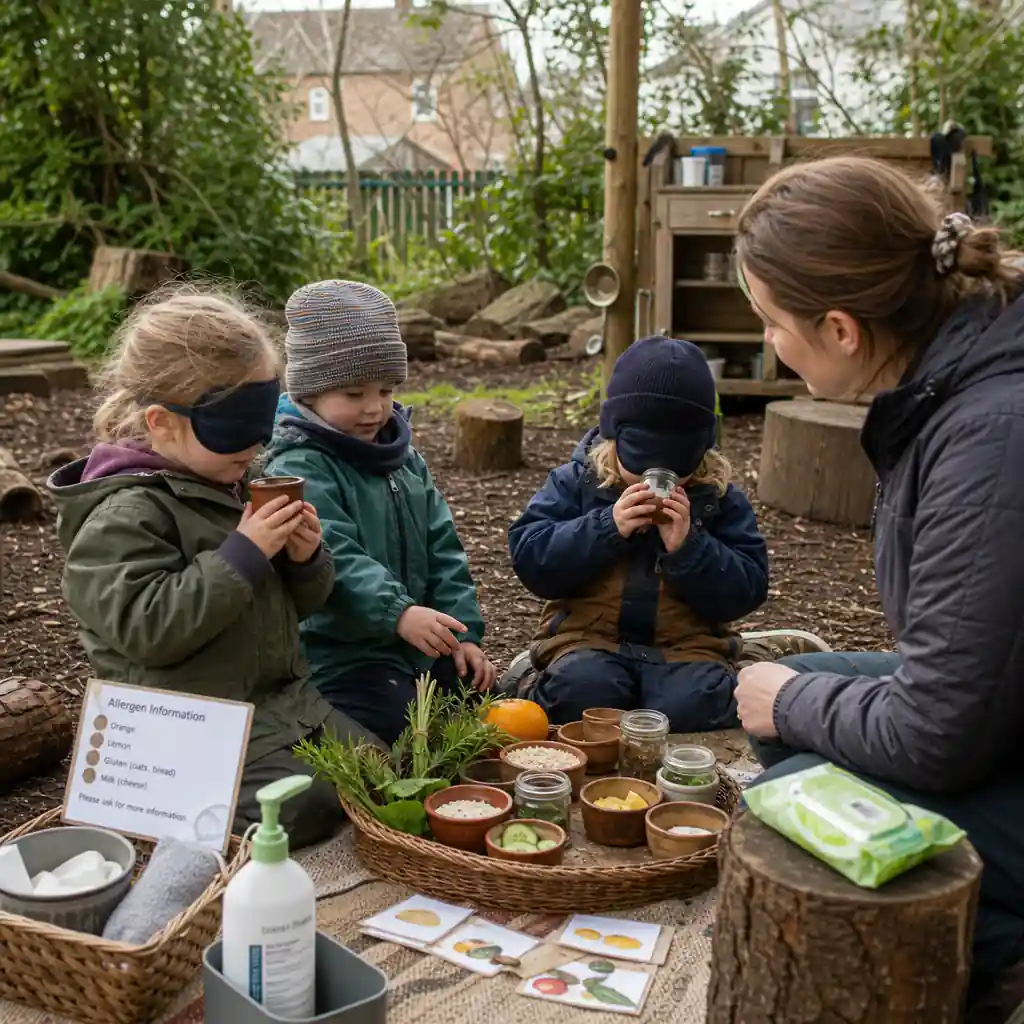
In an outdoor or nature-integrated space, move the mystery box to a sheltered garden spot or courtyard with a low log or blanket circle and varied surfaces nearby. Materials such as small wooden bowls, clay ramekins, fabric bags and natural containers hold the ingredients; include fresh peels, herbs or dried spices from the setting alongside the familiar food items already planned. Materials are arranged openly on a tray or mat so textures and scents can be explored without a fixed order, with handwashing supplies and allergen labels kept immediately to hand.
The adult observes from close enough to ensure safety and hygiene, responding with short prompts or single questions rather than step-by-step instruction and checking in if a child wants to opt out. Children choose whether to close their eyes or use a blindfold, take turns exploring by touch and smell, and may compare notes or match to picture cards afterwards; the adult models calm handling, names items briefly when asked, and steps back to let children lead the pace and choices.
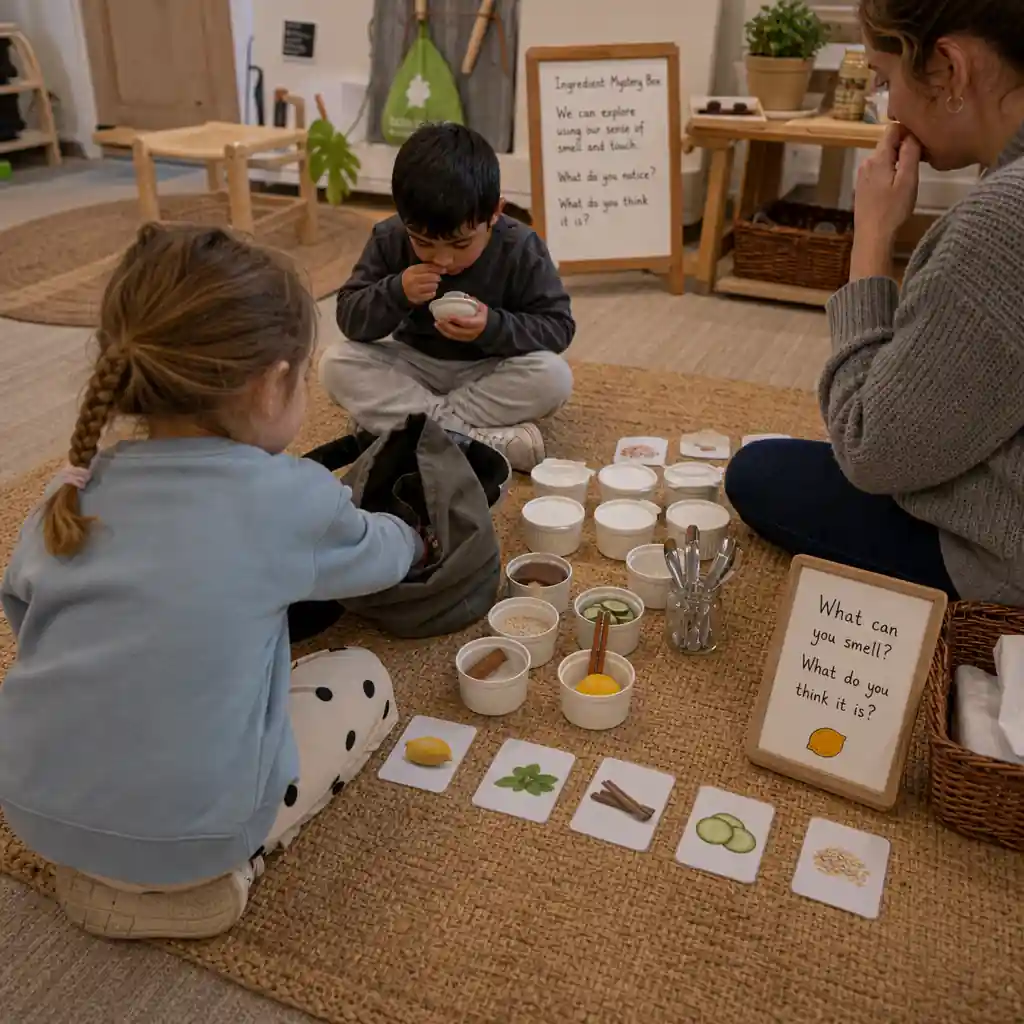
Arrange a low table or tray area as a choice-rich station where small lidded pots, bowls, fabric bags and natural containers are all visible and within reach; space several identical sets so children can work alone or side-by-side, and leave picture cards and ingredient packets nearby for later matching. Replace single-use kits with multiple small, varied ingredients and loose tools (spoons, scoops, tasting spoons sealed for hygiene) so the materials invite repeated, changing combinations and allow children to enter, pause or leave the exploration at will.
The adult steps back as observer and co-researcher, using soft, descriptive commentary such as “I can see you’re exploring the texture” or “What happens if you smell this next?” rather than instructions, following each child’s focus and offering words that extend noticing. The child may choose sequences, combine scents, or match cards; the adult notices patterns of hesitation, repeated actions, new vocabulary, and social negotiation, and positions notes or photos discreetly within the area so documentation is embedded in the flow.
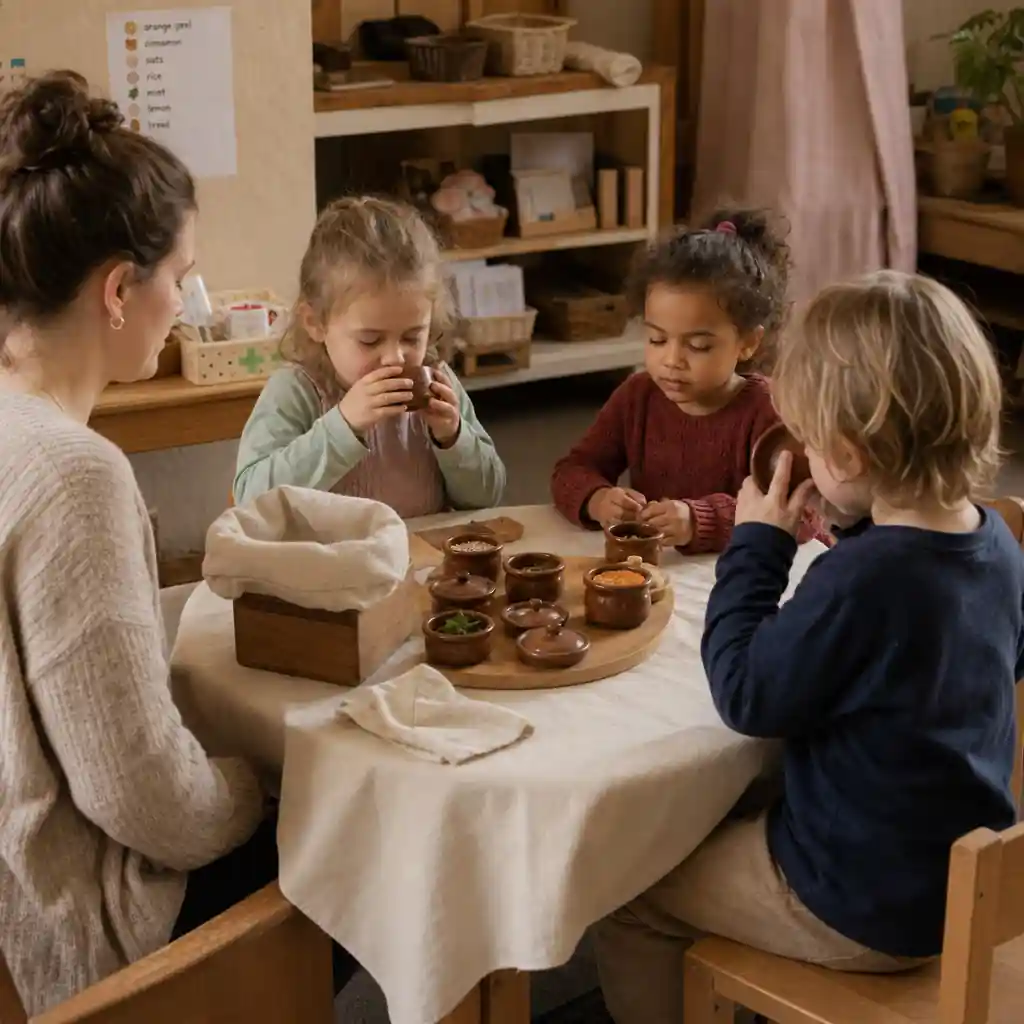
A quiet corner is prepared with a plain cotton cloth marking the space; a wooden box or thick cotton bag sits on a simple wooden tray. Only a small number of ceramic or wooden lidded pots are set out, each holding one familiar ingredient such as orange peel, a cinnamon stick, dry oats, rice, mint, or bread. A nearby sink or bowl for handwashing with a cotton towel is ready; allergen information and ingredient packets remain at the edge for adult reference. Optional soft cotton cloths for covering eyes are available only if requested; picture cards are kept aside.
The adult demonstrates by slowly opening one pot, closing their eyes to breathe in and touch briefly, then replacing the lid, using minimal words and stepping back. The child reaches in at their own pace, explores scent and texture with eyes closed if they choose, and may return to the same pot or compare two, placing lids back between turns. The adult observes gently, maintains a calm rhythm of open–explore–close–rest, supports handwashing and safety, and accepts opt-outs or brief pauses without comment.