Indoor baby obstacle course using cushions and low climbing points for early crawlers
Communication and Language
Children explore a low indoor obstacle course that invites crawling, pulling up, and early climbing in a safe, changeable space. Adults stay close to spot and notice how children choose routes, test surfaces, and signal for help. A small set of stable household items creates different movement challenges without requiring a fixed pathway. Practitioners can pay attention to persistence, balance recovery, and the language children use through gesture and sound.
This indoor obstacle course offers babies who are ready to crawl and begin climbing a safe way to use their whole body to move through a changing space. Babies may explore different routes, pause to assess a barrier, and try again with growing confidence. The experience can support early problem solving through movement, with adults noticing effort, persistence, and how babies ask for help.
Step-by-Step Guidance
1) Prepare the space: Clear a wide floor area away from sharp corners, heaters, cords, and unstable furniture. Place a large mat as the main base and check the floor for slip risks.
2) Adult safety check: Press down on each cushion/block and the low step to confirm they do not slide or tip. Remove anything that wobbles.
3) Build a simple route: Arrange 2–3 elements with generous gaps so babies can choose to go around as well as over. Keep heights low and surfaces wide.
4) Add an optional crawl-through: Place a large box on its side with both ends open, or create a low “tunnel” space between cushions if it stays stable.
5) Create a clear start area: Leave an open patch of mat where babies can settle, turn, and begin moving without being placed onto an obstacle.
6) Offer a reason to move: Place one or two familiar, large toys at different points so babies can decide where to head. Avoid using food as a lure.
7) Invite exploration: Bring babies to the start area and allow them to initiate movement. Keep the route flexible so babies can approach from any angle.
8) Support climbing attempts: Stay close enough to spot, with hands ready at the torso/hips. Allow time for babies to test with hands and knees before stepping in.
9) Scaffold only when needed: If a baby gets stuck, offer a stable handhold (your forearm or a firm surface) or slightly adjust spacing/angle rather than lifting them over.
10) Notice and name: Use simple language for actions and effort (e.g., up, over, steady, slow) and pause to let babies process.
11) Refresh the challenge: If babies repeat the same section easily, make one small change (distance, orientation, or removing an element) and observe how they respond.
12) Close calmly: End when babies show fatigue cues (slower movement, fussing, rubbing eyes). Return the space to open floor and offer a quiet reset on the mat.
Learning Objectives
In Physical Development, babies can practise crawling, pulling up, cruising, and controlled lowering as they move across and around low obstacles. In Communication and Language, babies may use sounds, gestures, eye contact, and early words to request support, share attention, or show preferences. The activity can also support early self-regulation as babies manage small frustrations and recover after slips or pauses.
Adult Role
Stay emotionally attuned by watching for signs of uncertainty, frustration, or tiredness, and respond with a calm presence and predictable support. Model simple, relevant language linked to movement and safety, using short phrases and consistent words for actions (up, down, stop, wait, steady). Scaffold by adjusting the environment first (spacing, stability, removing one element) and only use hands-on help when a baby is stuck or at risk; step back when the baby is actively problem solving and making safe attempts. Observe in action by tracking how each baby approaches risk, how they recover from slips, and what kinds of surfaces or heights they seek out. Hold responsibility for safety by spotting closely, keeping the course low and stable, and stopping the activity if the space becomes crowded or equipment shifts.
Observation Cues
Chooses a route and changes direction when a barrier feels difficult
Pauses to look, touch, or test a surface before moving onto it
Uses hands differently (open palm, fingertips, gripping) to steady or pull up
Shows persistence by repeating an attempt with small adjustments
Signals for help using eye contact, reaching, vocalising, or moving closer to an adult
Recovers balance after a wobble and decides whether to continue or rest
Time & Space
10–25 minutes, depending on babies’ stamina and how often the layout is adjusted.
A clear indoor floor area large enough for a low route with safe gaps (approximately 2m x 3m or larger), away from hard edges and breakables.
Materials
Safety
Age adaptations
Budding Adventurers
Offer a short circuit with a defined start and finish area, keeping heights low but adding a wider step and a longer crawl-through. Provide a “pause spot” (a marked mat square) where children can stop and decide their next move, supporting early self-regulation. Encourage children to describe their plan using simple choices (over/around/through) and adjust one element at a time to keep the challenge manageable.
Curious Investigators
Add a balancing section using a wide, low line of cushions or a taped path on the mat alongside the climb elements, so children can compare different movement challenges. Invite children to suggest safe changes (move the box closer, make a bigger gap) and test them with adult checks for stability. Use language that supports reflection (What felt wobbly? Where did you slow down?) without turning it into a performance.
Confident Discoverers
Offer a more complex layout with multiple decision points and a simple rule such as choosing two different ways to travel (crawl and step, or step and balance). Involve children in a safety check routine (press-test cushions, check clear landing space) and in redesigning the course with agreed limits on height and spacing. Observe how children negotiate turns and waiting, and support cooperative problem solving when the space is shared.
EYFS Links
Physical Development: Babies can practise large muscle movements such as crawling, pulling up, cruising, stepping, and controlled lowering, building coordination and body awareness through repeated attempts. Communication and Language: Babies may communicate needs and preferences through gestures, vocalisations, and shared attention, with adults modelling simple movement words in context. Personal, Social and Emotional Development: The course can support confidence to try, pause, and try again, with adults helping babies manage frustration and feel safe during challenge.
Ethos adaptations
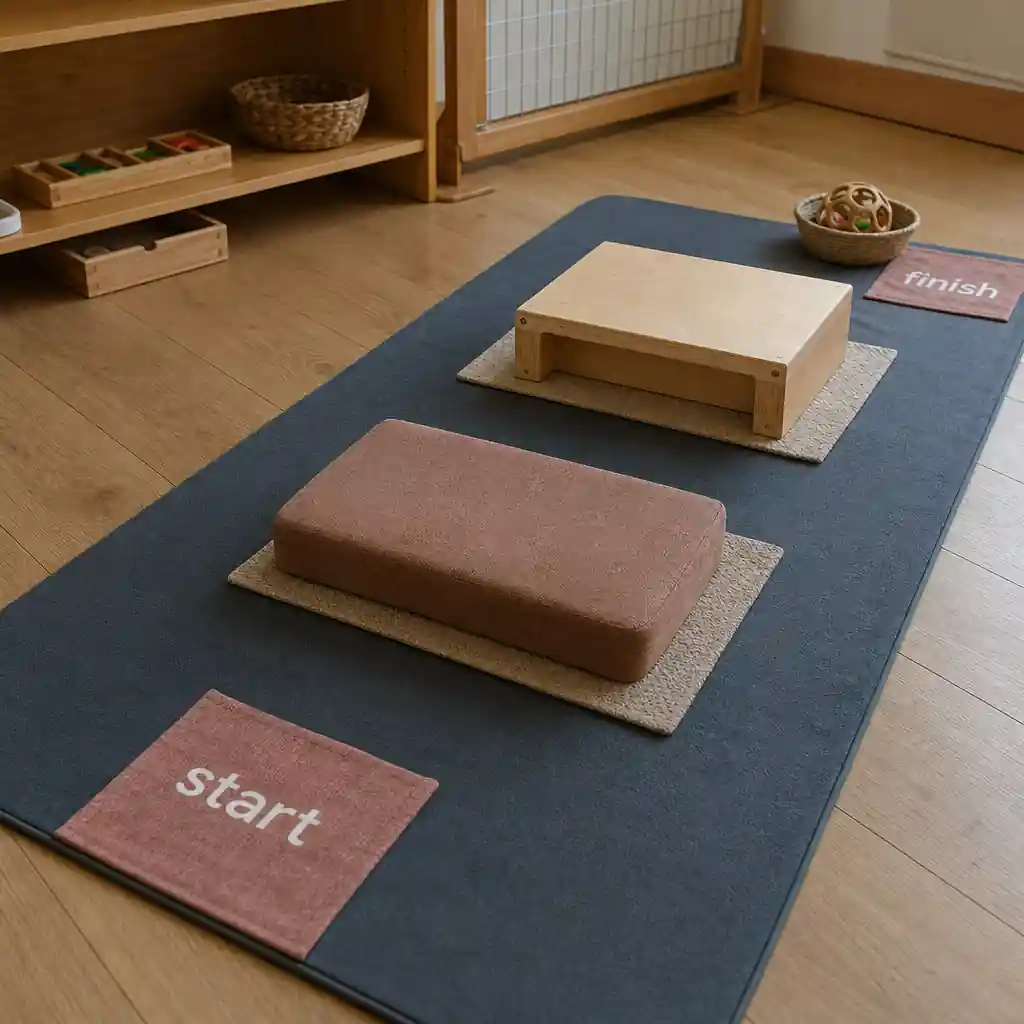
Place a single firm mat as a defined course and reduce obstacles to two ordered items (one low cushion then one stable step or box) with non-slip under each; remove extra cushions and toys so the path is clear and the dominant skill is crawling-to-pull-up. Mark a clear start and finish with simple fabric markers and keep one familiar toy at the end as an obvious goal. Keep materials reachable so a child can approach and return items independently and the sequence (move → pull → step down) is visually obvious.
Give one slow controlled demonstration of the route—move along the mat, pause, show a single pull-up and lowering—then step back and limit language to brief labels or safety words only. Avoid prompts or questions, intervene only for safety, and let the child repeat. Watch for repetition, steady control in pulling and lowering, strategies the baby uses to negotiate the obstacle, requests for help (vocal or gestural), and signs of sustained concentration rather than correcting movement.

In an outdoor or nature-integrated space, set the course on a picnic blanket or firm play mat on grass, or a sheltered section of hardstanding with natural cover. Materials such as short, low tree stumps or wide flat stones, upturned sturdy crates with a soft mat on top, a low turf or soil ridge, and a cardboard tunnel are provided in an open-ended way rather than pre-arranged; all pieces are tested for stability and placed with non-slip backing where needed. Familiar toys can be tucked into safe gaps to invite movement.
The adult observes from close proximity, checking stability and offering hands-on support only when needed, using minimal, responsive language or a single gesture to scaffold. Materials are arranged for choice and repeated exploration; children choose routes, pause, turn back or try new approaches and may use vocalisations, eye contact or touch to request help. The adult intervenes briefly to manage risk, models calm handling, and then steps back to allow self-led practice of crawling, pulling up and cruising.
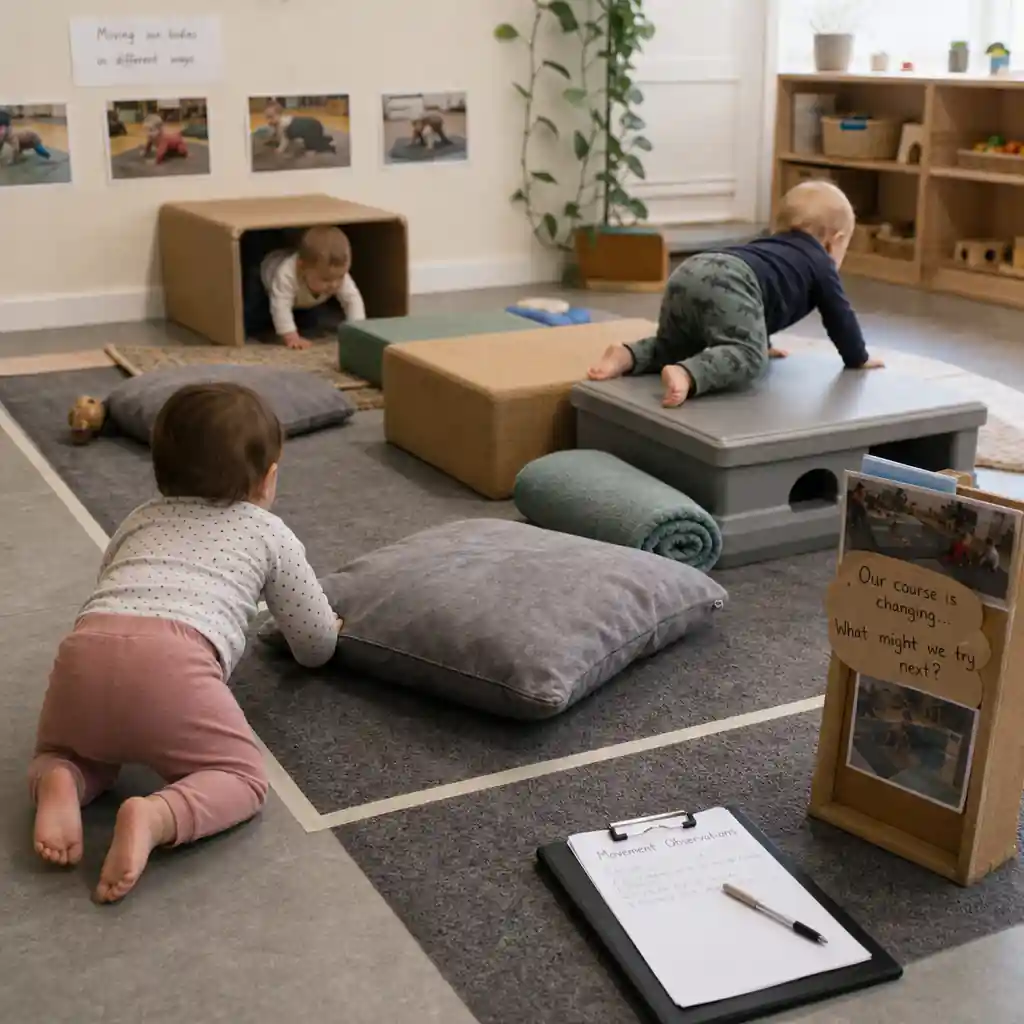
Treat the room as a movement studio by defining the course area with a clear boundary (tape line or mat edge) and adding a simple visual prompt such as photos of crawling, stepping, and balancing at baby eye level. Offer a small selection of high-quality, open-ended elements (foam blocks, box, low platform) arranged to invite multiple routes rather than one fixed path. Include a nearby documentation spot with a clipboard for adults to note observations and a safe place to display a couple of photos of the course evolving.
Interact as a co-researcher by naming what you notice and leaving space for babies’ responses through gesture and movement. Adjust the environment in response to repeated interests (e.g., more time at the pull-up point, a wider landing area) rather than directing babies to complete a set route. Observe strategies, persistence, and how babies communicate for support, and use those observations to make small, visible changes that invite new questions about how to move through space.
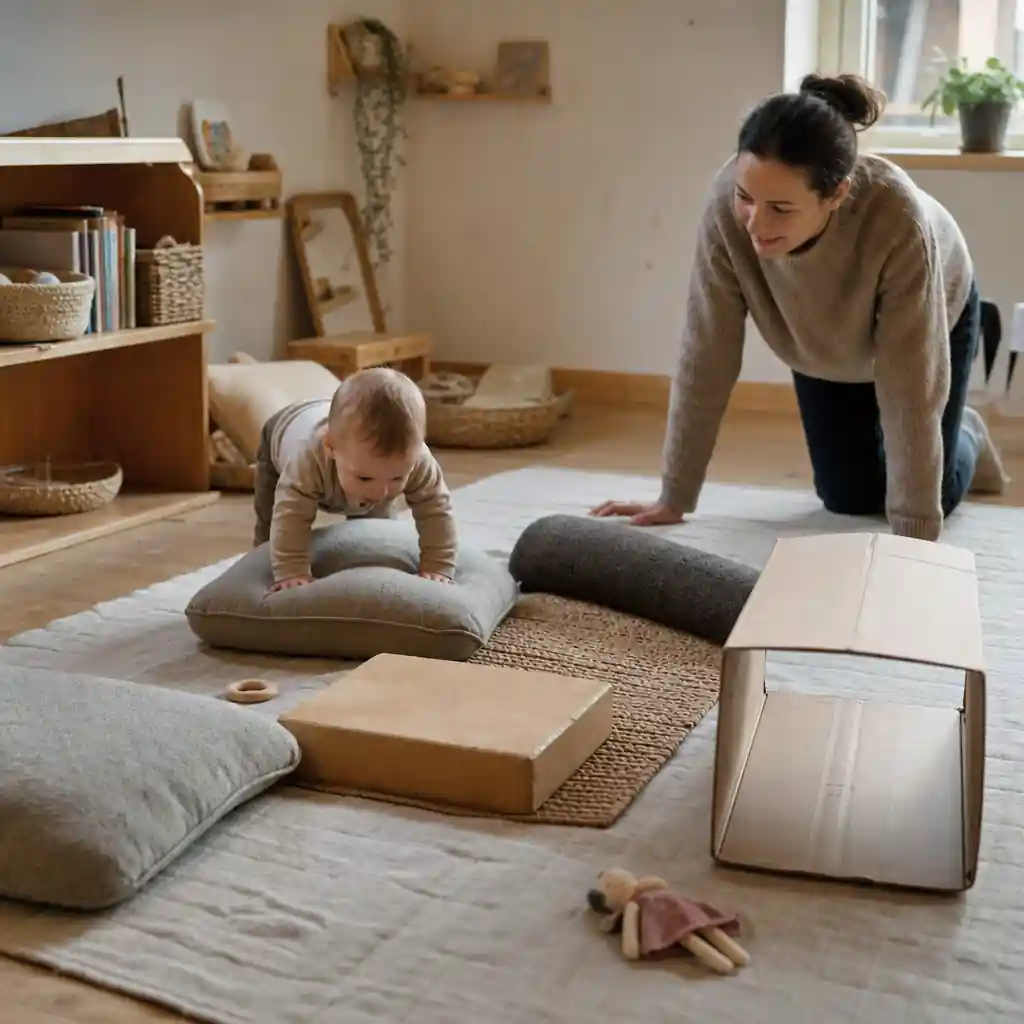
A calm, uncluttered strip of floor is defined with a neutral cotton quilt or wool felt mat. Only a small number of natural obstacles are set: two firm wool-stuffed cushions, a low solid wooden step or wide cork block (adult-tested for stability), a large cardboard box tunnel with open ends, and a rolled wool blanket to form a gentle ridge. A jute rug is placed where extra grip is needed. One or two familiar natural toys, such as a wooden ring or cloth doll, are set as quiet points of interest.
The adult demonstrates a slow crawl and a controlled lowering over one obstacle, then steps back, remaining close, quiet, and observant with hands ready near head or hips for safety without lifting unless necessary. The child chooses routes, repeats preferred sections, pauses to assess, and signals for help through looks, sounds, or reaching; the adult offers brief, steady support and releases. The course remains consistent for repeated passes, with an unhurried flow of explore, rest, and gentle tidy.