Face-to-face talking time with playful facial expressions for babies and toddlers
Communication and Language
On the mat, the adult and toddler sit facing a low mirror panel. The toddler presses their palms to their cheeks and watches their face change shape. The adult sits slightly to the side and says, “I can see your cheeks squish,” then waits. The toddler turns to the adult and makes a tight-lipped face; the adult copies it once and stays still. The toddler reaches into a small basket, picks up a chunky pencil, and makes a quick circle on paper before looking back up at their reflection.
This is a short, face-to-face interaction where an adult and baby spend uninterrupted time looking at each other, taking turns with sounds, words, and facial expressions. Babies often watch closely, track small movements, and respond to familiar voices and expressions in their own way. The focus is on connection, noticing cues, and giving the child time to respond without rushing.
Step-by-Step Guidance
1. Choose a calm moment and reduce background noise where possible. Position yourself so your face is close enough for the child to see clearly, without leaning over them.
2. Settle the baby comfortably on your lap or on a mat, with their head supported and their body aligned. Pause until their breathing and body look settled.
3. Begin with a neutral, warm face and say the baby’s name in a steady voice. Wait for a look, a stilling response, or any sign they are ready.
4. Offer one simple facial expression at a time (wide smile, raised eyebrows, open mouth), holding it for a few seconds. Keep your head movements slow so the baby can track.
5. Add short, clear language that matches your face, such as “hello”, “wow”, “uh-oh”, or a gentle sing-song phrase. Leave a pause after each expression or phrase for the baby to respond.
6. Follow the baby’s lead. If they look at your mouth, repeat a mouth-focused expression; if they look away, soften your face and wait quietly for them to return.
7. Build in turn-taking. Copy the baby’s sound or expression once, then pause. If they repeat, mirror again and keep the rhythm slow.
8. If attention drops, use one small change only (slightly closer, a quieter voice, or a brief mirror moment). Return to face-to-face once the baby re-engages.
9. End when the baby shows tiredness or “enough” cues. Use a calm closing phrase and a gentle cuddle or repositioning before moving on.
Learning Objectives
In Communication and Language, children have repeated chances to listen to a familiar voice, notice changes in tone, and respond with sounds, gaze, or movement. In Personal, Social and Emotional Development, the interaction can support secure connection through warm, predictable turn-taking. In Physical Development, babies may practise eye tracking, head turning, and small body movements as they follow facial expressions.
Adult Role
Stay emotionally attuned by watching for cues of interest, stress, and fatigue, and by matching your pace to the baby’s state. Model simple, clear language and expressive but not overwhelming facial movements, leaving generous pauses so the child can take a turn in their own way. Scaffold lightly by repeating what the baby attends to and reducing stimulation when they look away; step back by waiting rather than filling every silence. Observe in the moment for patterns (what expressions hold attention, how long the baby needs to respond) and adjust your distance, volume, and speed. Hold responsibility for safe positioning, head support, and keeping any optional items (mirror, cloth) under close supervision and used briefly.
Observation Cues
Baby holds gaze on the adult’s face, then looks away to pause and returns again.
Baby tracks the adult’s mouth or eyes when the adult changes expression.
Baby responds to a familiar voice with stilling, widening eyes, smiling, cooing, or kicking.
Baby copies a simple expression (open mouth, tongue out) or a sound after a short pause.
Baby shows “enough” signals (turning head away, arching, fussing) and settles when the adult slows down.
Toddler attempts to label expressions or asks for “again” through gesture or words.
Time & Space
2–10 minutes, depending on the child’s cues; can be repeated in short bursts.
A quiet corner with enough space for an adult to sit comfortably at the child’s level (floor mat, sofa, or chair) with minimal visual distractions.
Materials
Safety
Age adaptations
Budding Adventurers
Invite the child to lead a “face game” where they choose the expression and the adult copies, then swap roles. Add short, everyday links: “That’s your surprised face like when the doorbell rings.” Keep language concrete and brief, and accept partial attempts at words. If the child enjoys humour, use predictable patterns (same two or three expressions) so they can anticipate and join in.
Curious Investigators
Use a small mirror so the child can compare their face with the adult’s, taking turns to make and name expressions. Add simple questions that do not demand a right answer, such as “What do you notice about my eyebrows?” and wait. Extend into short role play for feelings using only faces and voices (no props needed), then return to calm face-to-face to close.
Confident Discoverers
Invite the child to create a short “expression sequence” (for example: neutral, surprised, happy) and teach it to the adult, then swap. Add richer vocabulary if it fits the child (“confused”, “proud”, “worried”) and link to real experiences they mention. Keep the focus on listening and turn-taking rather than performance, and end with the child choosing a calm face to finish.
EYFS Links
Communication and Language: the adult’s voice, pauses, and turn-taking give children chances to listen, attend, and respond with sounds, gestures, or words. Personal, Social and Emotional Development: warm, predictable face-to-face interaction can help children feel understood as the adult notices and responds to cues, including “enough” signals. Physical Development: tracking facial movements and turning towards a voice can involve eye movements, head control, and coordinated attention.
Ethos adaptations
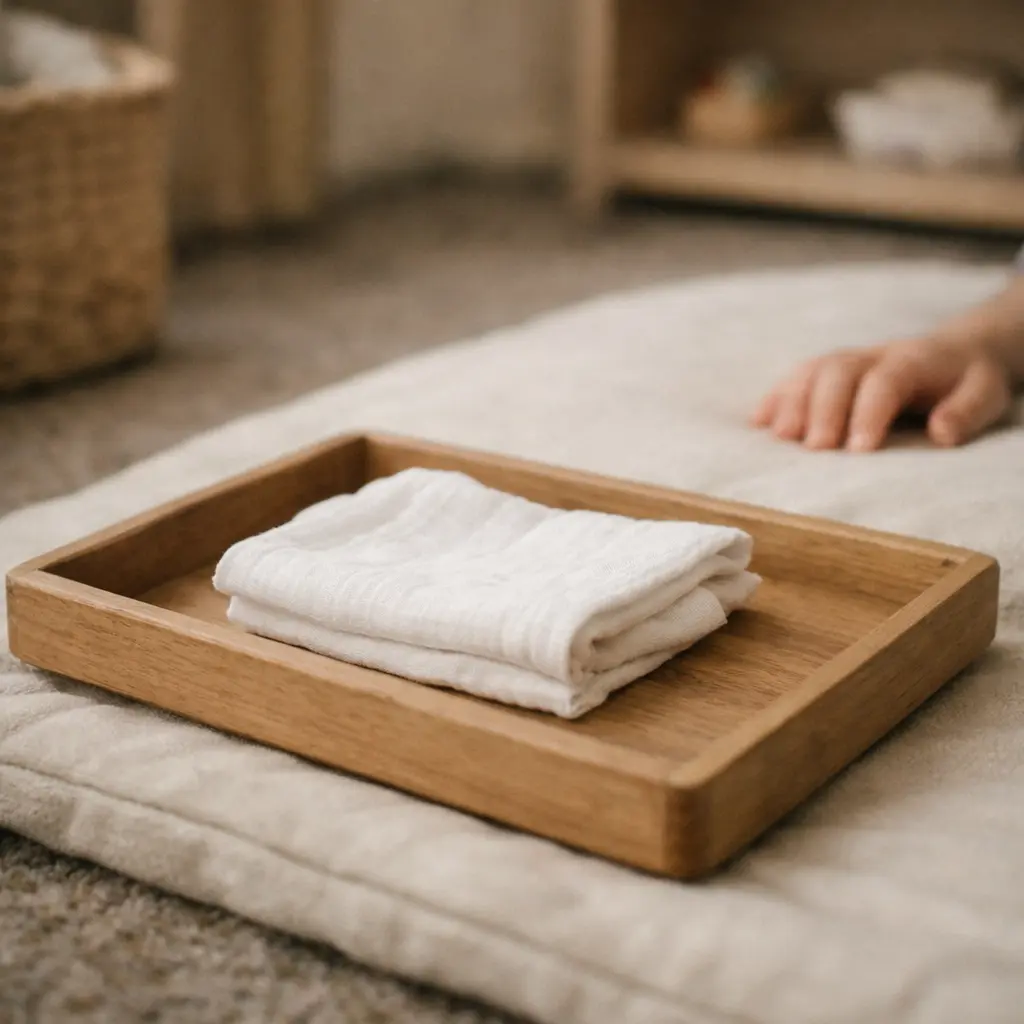
Use the same low-distraction spot each time, with one mat and the adult and child at the same level. Place a small tray beside you with one purposeful item only (either a small hand mirror or a folded muslin), and keep everything else out of view so the child can focus on faces. The adult decides the order of materials before starting (mat first, then tray placed to the same side each time) and keeps the tray within the child’s reach so the child can choose to touch or ignore the item.
The adult gives one slow demonstration of a single expression, adds one precise label, and then chooses to wait in silence rather than prompt. The adult chooses to repeat the same label and expression exactly, avoiding questions and extra sounds, and steps back by keeping hands still unless the child reaches for support. The adult watches for concentration, repetition, and visible self-correction (the child adjusts lips, tongue, or eyebrows after looking), and decides whether to repeat, return to a neutral face, or end when the child turns away or shows fatigue cues.

Choose a sheltered outdoor spot where the child can see the adult’s face clearly, such as near a hedge, under a canopy, or by a wall that blocks wind. Use the natural environment as the prompt: pause to listen for birds, then return to face-to-face to copy “listening faces” and “surprised faces” when a sound changes. Keep materials minimal; if needed, use a small piece of bark or a leaf as a simple focus point the adult holds near their face, then removes.
The adult stays close for warmth and safety, using a calm voice that competes less with outdoor noise. The adult comments on what the child notices (“You looked up when the crow called”) and waits for the child to look back before changing expression again. The adult observes how weather and light affect attention and adjusts by moving position, shortening the interaction, or offering a brief cuddle break before rejoining.
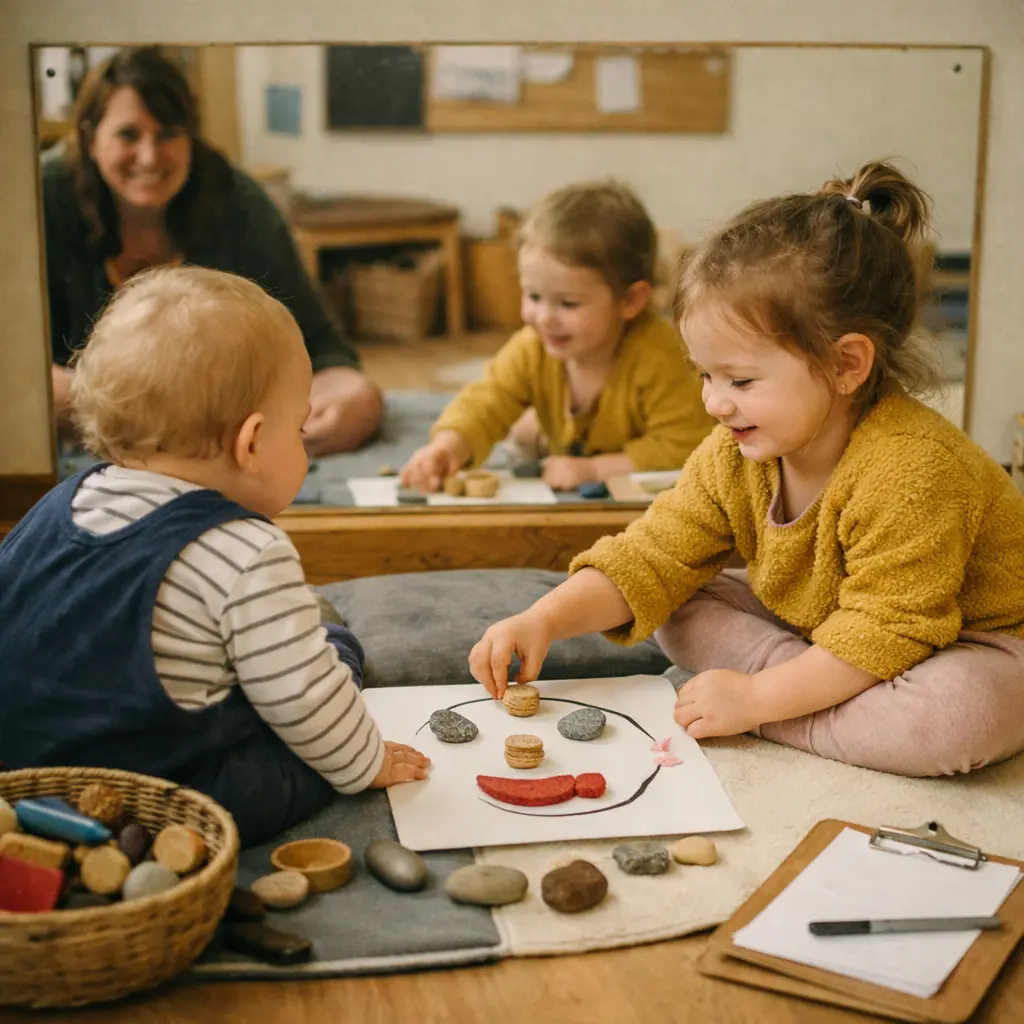
Create a clearly defined “face and voice” corner with a large, stable mirror panel at child height, a soft mat in front, and a second mat slightly to the side so two children can sit together without crowding. Place a small basket nearby with open-ended materials children can choose from, such as plain paper, chunky pencils, and a few loose parts for making faces (fabric scraps, corks, smooth stones), and keep a clipboard and pen for the adult within reach. Leave the space open so children can enter, leave, and return without being called back.
The adult stays alongside as a listener and co-researcher, choosing commentary over instruction: “I can see you’re watching your cheeks in the mirror,” or “You and Sam are making the same mouth.” The adult decides when to introduce a new expression by waiting for a child’s cue (a look, a sound, a gesture), and avoids correcting children’s ideas about what a face “means.” The adult observes which materials children return to (mirror, drawing, loose-part faces), records short notes or quick sketches of children’s words, and uses those observations to offer a related prompt later (“You noticed ‘tiny mouth’—shall I try a tiny mouth too?”) while keeping the direction with the children.

Create a calm, uncluttered space with a soft cloth on the floor and warm, natural light where possible. Use only the adult’s face and voice, with optional natural materials kept minimal, such as a small silk scarf used briefly for a gentle reveal-and-hide moment. Keep colours muted and avoid noisy additions so the child can focus on the human expression.
The adult models slowly and quietly, letting the child learn through watching rather than being told what to do. The adult repeats a small, predictable rhythm (greeting, one expression, pause, cuddle) and allows the child to return to the same expression many times. The adult observes changes in breathing, gaze, and body softness, responding by slowing further, lowering the voice, or ending with a steady, familiar closing phrase.