Exploring textures and temperatures with a simple treasure basket for babies
Sensory Play
An adult sits on the floor beside a baby on a mat and places a low basket within reach. The baby leans forward, grips a wooden spoon, then drops it and reaches for a metal spoon, pausing as it feels cool against their fingers. The adult quietly says, “cold spoon,” and waits while the baby taps it on the basket rim and looks up for a moment before returning to mouthing the spoon. The adult steadies the basket with one hand and slides a soft muslin closer when the baby’s arm brushes it.
This is a calm, baby-led exploration using a small basket of everyday objects that feel different to hold. Babies can mouth, bang, rub, drop and revisit items, noticing contrasts such as cool metal, warm wood, smooth fabric and bumpy surfaces. The experience often supports sustained attention and gives adults clear moments to tune into what a baby prefers or avoids.
Step-by-Step Guidance
1) Prepare a quiet floor space with a mat, and place the basket within easy reach of where the baby can sit or lie comfortably.
2) Select 6–10 objects that are large enough not to be a choking hazard, have no sharp edges, and can be cleaned; include a mix that feels cool, warm, smooth, rough, soft and firm.
3) Arrange the objects loosely in the basket so the baby can see and reach them without the adult handing items one-by-one.
4) Sit close at the baby’s level, steady the basket if it tips, and allow the baby to choose what to touch first.
5) Use short, descriptive language linked to what the baby is doing (for example, “cold spoon”, “soft cloth”, “you’re tapping”), then pause to let the baby continue.
6) If the baby mouths an item, watch closely and swap it for a safer alternative if needed, keeping the flow calm and uninterrupted.
7) When interest drops, reduce the number of items in view or rotate one or two objects, keeping most of the basket familiar.
8) End when the baby shows signs of tiredness or overload (turning away, fussing, pushing away), then remove the basket and clean items before storing.
Learning Objectives
Within Physical Development, babies can practise grasping, transferring objects between hands, and bringing items to the mouth safely. Within Communication and Language, babies may show preferences through gaze, reaching, vocalising and gestures, with adults naming what is happening in simple, responsive language. Within Personal, Social and Emotional Development, babies may build trust as an adult stays close, calm and predictable while the baby leads the exploration.
Adult Role
Stay physically close and emotionally steady so the baby can explore without being rushed. Model simple, responsive language that matches the baby’s actions, using a few consistent words for sensations (cold, smooth, bumpy, heavy) and waiting for the baby’s response. Step back when the baby is focused, and scaffold only when the baby is stuck (an item wedged, basket tipping) or when safety requires it. Observe patterns of preference, repetition and avoidance, and adjust the selection over time rather than directing the baby to “try” specific items. Hold responsibility for safety by checking items before use, supervising mouthing, and removing anything that becomes damaged, wet, or too small.
Observation Cues
Baby repeatedly returns to one object and explores it in the same way (rubbing, tapping, mouthing). Baby pauses when touching a cooler or heavier item, then adjusts grip or switches hands. Baby uses gaze, vocal sounds, or body movement to request an item or to signal “no more”. Baby compares by moving between two objects (e.g., fabric then metal) and changes pressure or speed. Baby drops items and watches where they land, then reaches again. Baby seeks the adult’s face after a new sensation, then continues when the adult stays calm.
Time & Space
5–20 minutes, depending on the baby’s cues and tolerance for new sensations.
A clear floor area indoors with a mat or blanket, or a quiet corner where the baby can sit/lie safely with an adult within arm’s reach.
Materials
Safety
Age adaptations
Budding Adventurers
Provide two baskets labelled with a simple picture cue (for example, a hand for “touch” and a bowl for “collect”) and include items that invite purposeful actions (brush, small rolling pin, large shell, fabric pouch). Allow the child to choose where to explore (floor, low table) and to create their own groupings, with the adult commenting on what they notice rather than setting a sorting task. Introduce a short tidy rhythm at the end, returning items together and naming where they go.
Curious Investigators
Offer a “mystery bag” alongside the basket so the child can reach in and describe what they feel before looking, using words like smooth, scratchy, hard, squishy, cold. Add a simple recording option such as placing favourite items on a small cloth “display space” to revisit and talk about. The adult follows the child’s theories (“This one feels colder”) and supports turn-taking if children explore together.
Confident Discoverers
Include a small set of paired items to compare (metal spoon and wooden spoon; smooth stone and rough pumice; cotton and wool fabric squares) and invite the child to arrange them in any order that makes sense to them. Offer a timer or sand timer only if the child chooses it, to notice how long they stay with one object. The adult supports richer language and reasoning (“What makes it feel colder?”) without pushing for correct answers.
EYFS Links
Physical Development: babies handle, grasp, transfer and mouth objects, building control and coordination through repeated, self-chosen actions. Communication and Language: adults tune into non-verbal communication and model simple sensory words linked to what the baby is doing, supporting attention and early back-and-forth interaction. Personal, Social and Emotional Development: a calm, predictable adult presence supports the baby to explore at their own pace, with the adult noticing and responding to comfort, curiosity and signs of overload.
Ethos adaptations

Place a small, stable tray on a low mat with only 4–6 real objects, each chosen to isolate one clear contrast (one metal, one wood, one fabric, one textured natural item). Arrange them left-to-right with a clear space on the tray for “in use” items, and keep all other objects out of sight so the baby can see the options and return each item to the same place. Choose items where the difference is obvious to the baby (weight, temperature, texture) so the baby can notice when something feels different without the adult correcting.
The adult gives one slow, silent demonstration of taking one item, feeling it briefly, and placing it back in its spot, then sits back and keeps hands in lap unless safety requires support. The adult limits language to a single word or short phrase only when the baby looks up (for example, “cold”, “rough”), and avoids questions or prompting to switch items. The adult watches for repetition, careful grip changes, and long pauses that suggest concentration, and responds by removing only what becomes unsafe (wet, frayed, damaged) or by steadying the tray if it shifts.

Set up on a groundsheet outdoors or in a sheltered garden area, choosing a spot with mixed surfaces (grass, paving edge, a log nearby) so children can move and reposition themselves safely. Offer a shallow basket with a small selection of robust natural objects that vary in texture and temperature, such as smooth stones, bark pieces, a pine cone, a feather, a large shell, and a wooden spoon, plus an empty metal bowl for collecting. Keep a warm blanket and hand-wipes at the edge of the space, and decide in advance which boundary keeps children within sight while still allowing them to roam a little.
The adult does a quick safety scan and checks each object for sharp points, crumbling bark, or anything small enough to mouth, then stays close enough to intervene without directing choices. The adult uses brief commentary linked to what the child picks up (“damp leaf”, “cold stone”) and pauses rather than leading a sequence. The adult watches for children testing risk (lifting heavier stones, stepping onto uneven ground, carrying items), and responds by adjusting the environment (moving the basket to flatter ground, offering a two-handed carry, or swapping an item) while keeping the play child-led.
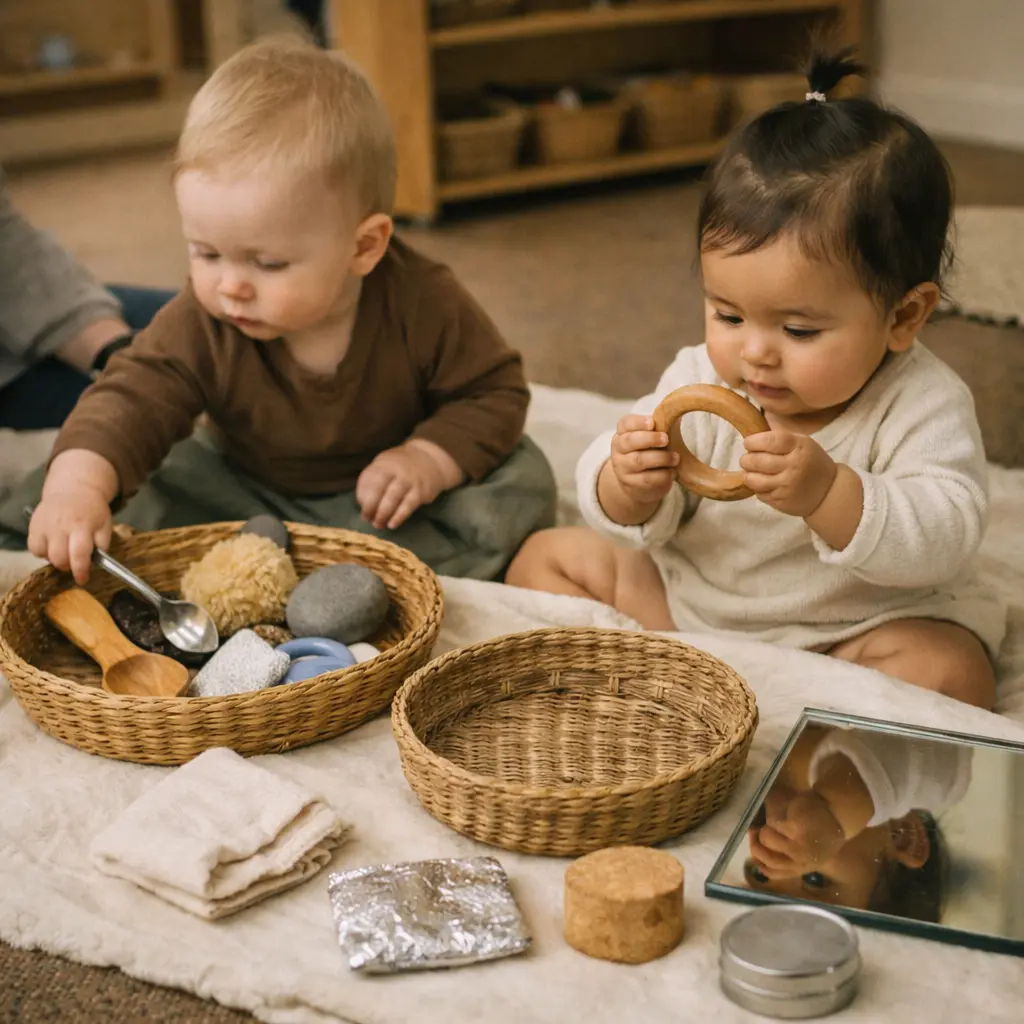
Create a low “sensory invitation” area with two shallow baskets on a neutral cloth: one basket holds a small range of contrasting objects, and the other is empty for children to place chosen items. Add a small mirror tile or reflective tray beside the baskets so children can see objects from different angles, and leave space for children to spread items out rather than keeping everything contained.
The adult listens and comments as a co-researcher, following the child’s focus and allowing them to change the activity (lining up, pairing, hiding, swapping). The adult uses language that extends the child’s noticing (“You chose the cold one again”) and pauses for the child’s response rather than questioning for an answer. The adult documents briefly with a note or photo of what the child returns to, then adjusts the next offering based on those observed preferences.
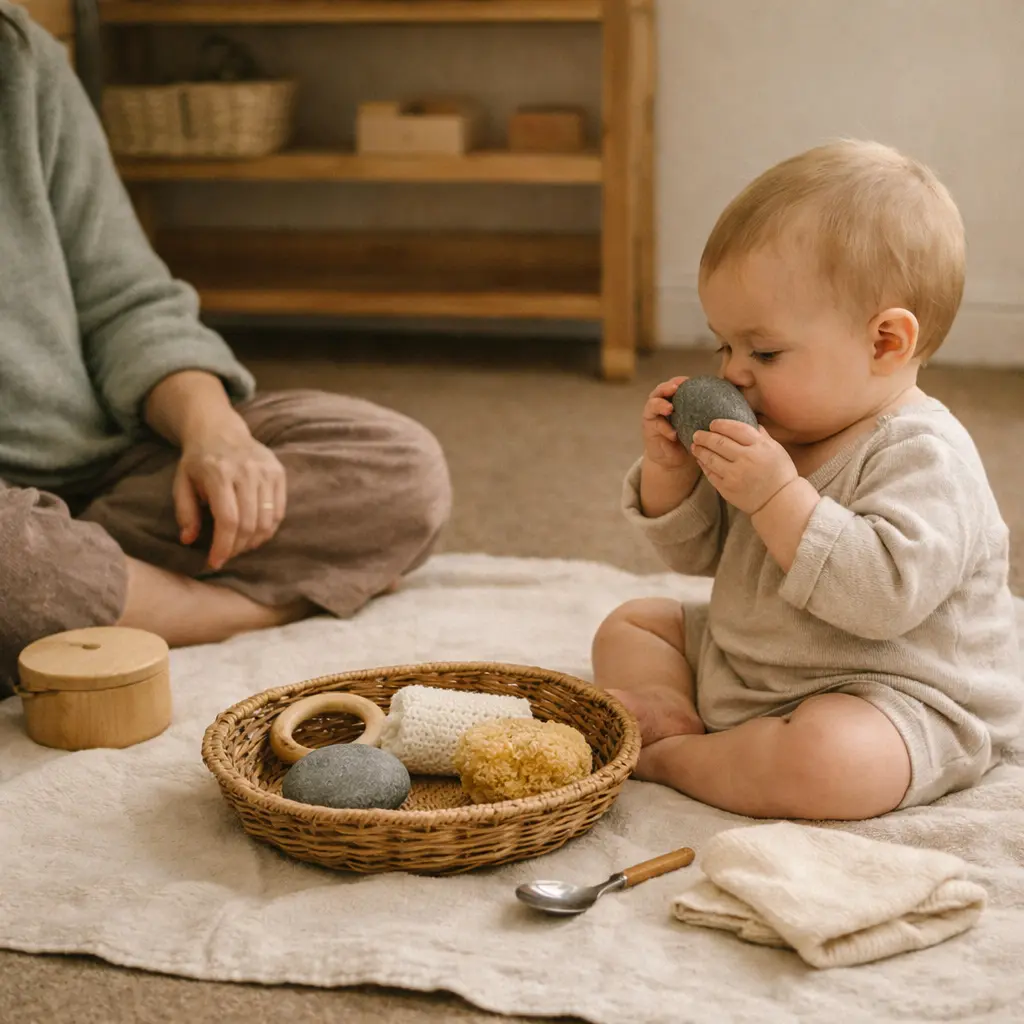
Lay a soft, plain cloth on the floor and place a small wicker basket with only a few natural items: a smooth wooden ring, a wool square, a large smooth stone, and a natural sponge. Keep the space uncluttered and quiet, with warm light and no additional toys in reach so the sensations stay clear and unhurried.
The adult sits nearby and models gentle handling with minimal words, letting the baby imitate the slow movements and return to the same object repeatedly. The adult watches for signs of comfort or overload and responds by reducing the number of items or offering a pause on the cloth. The adult intervenes only for safety, keeping the tone calm and predictable from start to tidy away.