Exploring summer light and shadow with a mirror and hanging white sheet spaces (0–4 years)
Sensory Play
Two toddlers step in and out of the sheet’s shade, watching their feet disappear into the darker patch on the ground. An adult kneels nearby with an unbreakable mirror held low and steady, and a bright spot slides across the white fabric as the breeze lifts the edge. One child points and says, “There,” then crouches to see the light on their hand in the mirror. The adult replies, “Bright on your fingers,” and waits while the child shifts position to find it again.
Children explore bright and shaded areas and notice how light changes across a space. A mirror offers a simple way to bring light into view and invite looking, reaching, and tracking. Hanging white sheets can create breezy, high-contrast places where children may pause, move through, or return to watch shifting shadows.
Step-by-Step Guidance
1. Choose a bright area where you can also create shade, and check the ground is clear for children to move and lie down.
2. Hang one or more white sheets to make a shady, breezy space with clear contrast between bright and shaded areas. Keep clips, lines, and any knots out of children’s reach.
3. Place a mat or blanket at the edge of the sheet space so children can choose to be in shade or brightness.
4. Offer the unbreakable mirror during tummy time or floor play. Position it so the child can see their face and the changing light nearby without the mirror tipping.
5. Stay close and let children lead the pace. Some will watch quietly; others will reach, roll, crawl, or move in and out of the sheet space.
6. Use simple language that matches what the child is doing: name bright, dark, shadow, and the movement of the sheet or reflected light.
7. If children lose interest, adjust only one thing at a time (mirror angle, where the mat sits, or which part of the sheet space is open) and then pause to observe.
8. End by returning the mirror to a safe place and taking down or securing sheets so the space is clear for the next play choice.
Learning Objectives
In Communication and Language, children may build attention and listening as adults name what is happening with light, shade, and movement. In Physical Development, children may practise tracking with their eyes, reaching, rolling, crawling, or moving between bright and shaded areas. In Understanding the World, children may begin to notice cause and effect as shadows change when bodies, sheets, or the mirror move.
Adult Role
Stay emotionally attuned by noticing when a child is absorbed, startled by a sudden change in light, or seeking closeness, and respond with calm presence and predictable voice. Model language in short, concrete phrases that match the moment, such as “bright on the sheet” or “shadow moved”, and allow silence when the child is watching. Scaffold lightly by adjusting the mirror or opening/closing part of the sheet space, then step back so the child can explore without repeated adult direction. Observe how each child uses their body to get information (watching, reaching, moving between shade and sun) and use that to decide whether to simplify the space or offer more room. Hold responsibility for safety by keeping hanging points out of reach, preventing sheets from covering faces, and supervising mirror use closely.
Observation Cues
Child turns head or shifts body to keep a bright patch or shadow in view. Child reaches toward a reflected light spot or watches it move across the sheet. Child pauses in shade, then moves back into brightness, repeating the change. Child vocalises or gestures when the sheet moves and the light pattern changes. Child uses early words or signs such as light, dark, bright, shadow, more, again.
Time & Space
10–25 minutes, with flexible entry and exit for children.
A bright area with room to hang white sheets and create a shaded space, plus a clear floor/ground area for tummy time and movement between shade and sun.
Materials
Safety
Age adaptations
Budding Adventurers
Hang two sheets to make a simple pathway or corner where light changes as the fabric moves. Place the mirror where children can choose to look, then move their body to see how the reflected light shifts on the sheet. The adult supports turn-taking if children gather, and uses short comparisons like “brighter here” and “darker there” while letting children decide where to stand or sit.
Curious Investigators
Offer a larger sheet area with more than one shaded zone so children can choose different places to test light and shadow. Place the mirror so children can angle it slightly under close supervision to see how the light spot changes position. The adult listens to children’s ideas about why shadows move, reflects their words back, and adds precise vocabulary only when it fits what they are already noticing.
Confident Discoverers
Create a sheet space with a clear boundary between bright and shaded areas and enough room for children to coordinate together. Provide the mirror as a shared resource so children can negotiate where it goes and what they want to try, with the adult staying close for safety. The adult supports children to describe patterns they notice over time (when the sheet flutters, when the sun shifts) and to agree simple rules for safe mirror handling.
EYFS Links
Communication and Language: adults model simple, accurate words for what children can see and feel (bright, dark, shadow, moving), supporting attention and shared focus. Physical Development: children use eye tracking, head turning, reaching, rolling, crawling, and walking as they follow light and move between shaded and bright areas. Understanding the World: children notice changes in the environment as the sheet moves and shadows shift, building early cause-and-effect thinking through repeated observation.
Ethos adaptations

Prepare one defined workspace with a low mat and a tray holding only the unbreakable mirror and one small folded white cloth, with the hanging sheet already in place to create a clear shaded edge nearby. The adult decides the mirror’s “home” position on the mat (for example, top left) and keeps it consistent so the child can return it independently. The adult limits the area to one clear access point and removes extra items so the child’s choices stay focused on looking, placing, and returning.
The adult gives one slow, silent presentation, then sits slightly back with hands in lap. The adult chooses minimal language and avoids questions, using only brief safety phrases if needed. The adult watches for repetition, careful carrying, and control of movement, and responds by pausing rather than stepping in; if the mirror is moved into an unsafe angle or too close to another child, the adult calmly resets it to the marked home position and then withdraws again.

Run the experience outdoors where the sun and breeze naturally change the sheet space, using a line between two fixed points or a simple frame to hang the white sheets as a shelter edge. Place the mirror on a ground mat near natural features that cast shadows (a fence line, shrubs, or a tree edge) so children can move between different kinds of shade.
The adult stays nearby to manage risk from wind, uneven ground, and glare, stepping in to secure the sheet or reposition the mirror only when needed. Children choose where to sit, lie, or move, and may return repeatedly as the light shifts. The adult uses brief observations like “the shadow got longer” and responds to children’s choices rather than setting a single route through the space.

Arrange the space as an invitation with two distinct zones: a bright open area and a shaded sheet area that children can enter from more than one side. Place the mirror on a low platform or stable board so it becomes part of the environment, and add a second white sheet at a different angle to create overlapping shadow shapes and more than one place to investigate.
The adult takes a co-researcher stance, staying close and using reflective commentary such as “You moved into the shade and your shadow changed” or “You’re trying to catch the light on the sheet.” The adult follows children’s theories, allowing them to reposition themselves and negotiate shared use of the mirror, and records brief notes or a quick photo of where children choose to stand and what they say. The adult responds by adjusting the environment (opening a side of the sheet space, changing the mirror’s stable base) rather than directing a sequence.
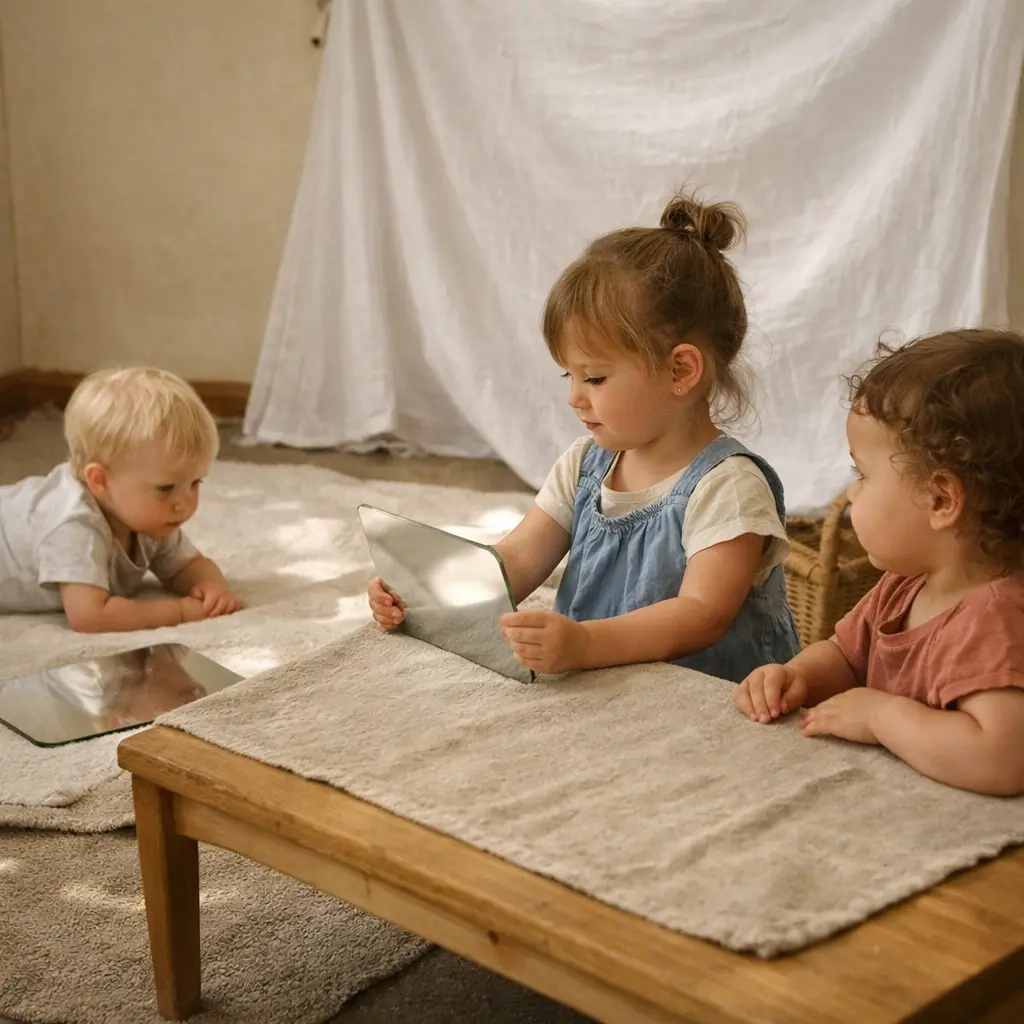
Create a calm, uncluttered corner with one white sheet hung to make a soft shaded space and one natural-fibre blanket on the ground, with only the unbreakable mirror placed beside it. Keep colours muted and limit the area to these few items so the light and shadow changes stay noticeable. The adult chooses a steady start and finish point (blanket laid, mirror placed, then both put away) so the flow stays predictable.
The adult demonstrates quietly by sitting, looking, and slowly turning the mirror once, then returns the mirror to the same resting place and becomes still. The adult keeps speech minimal, using a few repeated words only when the child looks for connection, and avoids questions that pull the child out of watching. The adult observes the child’s pace and signs of overwhelm or absorption, and responds by slowing their own movement, steadying the mirror, or adjusting the sheet only to prevent it brushing faces or blocking breathing.